
Puerto Escondido made its name on that Zicatela shorebreak — the one that snaps boards and occasionally egos. But walk ten minutes inland and the town goes quiet in a way most visitors never notice. Between the market stalls and the surf shops there is a small, stubborn art scene: a Tadao Ando-designed foundation behind a gate, a scruffy cultural center running dance classes, and a couple of design hotels that feel like private clubs if you know how to ask.
This guide is for the traveler who wants a plan for a flat-surf afternoon, a break from the sun, or something to talk about besides the waves. It is also honest about which doors need a reservation weeks in advance and which ones you should not bother knocking on.
Prices below use roughly 18 pesos to the dollar. Bring cash, because half of these places do not take cards.
Unlimited High-Speed International Travel eSIM
Connect in seconds across 180+ destinations. Instant QR code activation with zero roaming surcharges.

- Best time to visit: November to April for dry weather. Avoid Semana Santa and the December 26 to January 3 crush, when prices double and bookings vanish.
- Typical daily budget: $800–1,600 MXN (~$45–90 USD) for a backpacker day; $2,500–4,000 MXN (~$140–225 USD) if you are doing design hotels and taxis.
- Getting around: Colectivo vans along the Carretera 200 ($12–15 MXN), taxis inside town ($60–100 MXN), rented scooters ($350–500 MXN per day).
- Overall vibe: Barefoot surf town with a serious art streak. Dress code is sandals. Reservations are not optional.
1. Casa Wabi: The Art Foundation You Have to Ask to Enter
Roughly 35 minutes north of town, down a dirt road off the Mazunte highway, sits a concrete complex designed by Pritzker winner Tadao Ando and founded in 2014 by Mexican artist Bosco Sodi. It runs artist residencies, a clay workshop, a tree nursery and a small exhibition hall that changes with whoever is living on site. The architecture alone justifies the trip: thick walls, brick, palm, and long shadows that make the whole place feel like a very expensive monastery.
You cannot simply walk in. Visits are by guided tour only, and the schedule shifts with the residency calendar, so the tour you read about online may not exist the week you arrive. Email or WhatsApp ahead, confirm the day, and treat the response as the plan.
- Area: Carretera 200 toward Mazunte, around kilometer 25
- Cost: suggested donation about $500 MXN (~$28 USD) for the guided visit
- Best time: morning tours, before the heat and the mosquitoes
- Getting there: private driver or taxi ($700–900 MXN round trip with waiting), or a colectivo toward Mazunte and a 10-minute walk from the highway turnoff
Insider tip: Book two to three weeks out in high season and bring photo ID. Parts of the site are active studios, so keep your camera pointed at the architecture, not the artists at work.
2. Casa de Cultura: The Free Backdoor Into Local Life
Every Mexican town of any size has a Casa de Cultura, and Puerto Escondido's is a few blocks from the main plaza in Centro. It is not polished. There are folding chairs, a bulletin board held together with tape, and teenagers rehearsing dance routines in a room with one fan. That is exactly why it is worth an hour of your time.
Exhibitions rotate through a small gallery space, usually student work and regional painters, and there are workshops in painting, music and folk dance that anyone can join for a monthly fee. Weekday evenings are when the place comes alive, with parents waiting on the steps and the sound of a badly tuned guitar drifting out of a classroom.
- Area: Centro, a short walk from the pedestrian street
- Cost: free for exhibitions; workshops around $400–700 MXN per month (~$22–39 USD)
- Best time: weekday evenings, 5pm to 8pm
- Getting there: walkable from anywhere in Centro; taxis drop at the corner
Insider tip: Show openings get announced on paper flyers taped to the door, not on Instagram. Ask the person at the front desk what is coming up this week — a little Spanish goes a long way here.
3. Hotel Terrestre: Design-Hotel Bar With a Clubby Door Policy
This solar-powered, brick-tower hotel off the Carretera 200 near Playa Bacocho opened in 2022 and instantly became the most photographed building on the coast. No air conditioning, no glass walls, just cross-ventilation, deep shadows and a pool that looks like it was poured yesterday. It is not a gallery, but it functions like one — and like a private club, access depends on whether you planned ahead.
Non-guests can usually get a table at the bar or arrange a pool day with a minimum spend, but capacity is genuinely tiny and guests come first. Email before you go, get a confirmation in writing, and do not show up hopeful at 2pm on a Saturday.
- Area: Bacocho side of the Carretera 200, near the Playa Arena turnoff
- Cost: bar minimum spend roughly $600–900 MXN (~$33–50 USD); rooms start around $6,000 MXN per night
- Best time: 5pm to 7pm for sunset and a quieter terrace
- Getting there: 15-minute taxi from Centro, about $120–150 MXN
Insider tip: The pool is effectively off-limits during peak afternoon hours even with a spend. Ask for the bar terrace instead — the view is better and nobody will ask you to move.
4. Casa Losodeli: The Co-Working House With a Rotating Art Wall
Losodeli is a co-living and co-working house in Centro, popular with designers and remote workers who need wifi and a desk for a few days. The reason it belongs in an art guide is the ground floor: a rotating wall of work by local and visiting artists, plus a noticeboard that functions as the town's real cultural calendar.
Day passes are cheap, the coffee is decent, and nobody minds if you sit for three hours. It is also the fastest way to find out about a pop-up show in La Punta before it appears anywhere public.
- Area: Centro, walking distance from the market
- Cost: day pass around $250–350 MXN (~$14–19 USD)
- Best time: weekday mornings, when the desks are free and staff have time to talk
- Getting there: walk from Centro; a taxi from Zicatela runs about $80 MXN
Insider tip: Message them the day before. Schedules shift with the season, and in the slow September weeks the space keeps shorter hours than the website suggests.
5. Mercado Benito Juárez and the Workshop Crawl
The municipal market in Centro is where you go for two things: a tlayuda the size of a steering wheel, and textiles you will actually still own in ten years. Stalls sell hand-embroidered blouses from the Isthmus, woven pieces from the Mixteca, and the odd bit of black clay from the Ocotlán valley. It is not curated. It is better than curated.
Go early. By 7am the food aisle is running at full steam, vendors are eating standing up, and the produce section smells like wet earth and lime. The craft stalls open a little later and reward slow browsing over hard bargaining — haggling is not really the custom here, though buying two pieces sometimes softens the price.
- Area: Centro, near the main plaza
- Cost: free to wander; an embroidered blouse runs $350–900 MXN (~$19–50 USD)
- Best time: 7am to 11am, before the heat and the crowds
- Getting there: five-minute walk from the pedestrian street
Insider tip: The best food stalls are at the back, past the produce, where the vendors themselves eat. If there is no printed menu, you are in the right place.
6. La Punta: Gallery-Cafés, Murals and a Very Good Morning
La Punta is the small point between Zicatela and the open ocean — a knot of dirt lanes, surf shops and cafés that open and close with the seasons. Several of those cafés hang work by local painters and photographers, often with a small price tag and the artist's phone number written on the back. It is not a gallery district, but it works like one if you slow down and look at the walls.
Go before 10am. The lanes are empty, the light is good, and the murals behind the surf shops are visible instead of blocked by parked scooters. Pair it with breakfast and you have a proper morning out.
- Area: La Punta, at the north end of Zicatela
- Cost: free to walk; prints and small paintings typically $400–1,500 MXN (~$22–83 USD)
- Best time: 8am to 10am, or 5pm for the sunset crowd
- Getting there: 10-minute walk from Zicatela's north end, or a mototaxi for $40–50 MXN
Insider tip: Café prices in La Punta run 30 to 40 percent higher than Centro for the same coffee. Also: the point is a reef-and-rock surf break, not a swimming spot.
Where to Eat and Drink Nearby
Mercado Benito Juárez food aisle (Centro)
Order a tlayuda with quesillo and tasajo for $70–90 MXN (~$4–5 USD), plus a memela and an agua de jamaica. Open roughly 7am to 4pm, cash only, and the busiest stalls are the ones with a queue of locals on their lunch break.
The pedestrian street, Calle Pérez Gasga (Centro)
This is the town's evening living room, closed to most traffic and lined with casual restaurants. Expect pozole, enchiladas and grilled fish at $150–280 MXN per person (~$8–16 USD). Sit outside, order a michelada, and watch the town walk past.
Beachfront palapas on Playa Zicatela
Whole grilled fish — pescado a la talla — runs $220–350 MXN (~$12–19 USD) and easily feeds two with rice and tortillas. Skip the places with laminated photo menus and a host waving you in; walk one block back from the sand and prices drop by a third.
Practical Logistics and Budget Tips
Colectivo vans are the real transit system here. They run along the Carretera 200 between Centro and Zicatela for $12–15 MXN and keep going until roughly 10pm. After that, you are on taxis, and taxis have no meters — agree the fare before you get in the door.
Ride-hailing apps barely work in Puerto Escondido, so do not build your evening around one. Walking is fine inside Centro and inside La Punta, but the stretch between Centro and Zicatela is a shoulder-less highway with fast traffic. Take the van.
- Cash: withdraw at bank ATMs in Centro during daylight and keep a $3,000 MXN cushion. Machines run dry on holiday weekends.
- Cards: hotels take them; galleries, market stalls and small cafés usually do not.
- Bookings: Casa Wabi and Hotel Terrestre need one to two weeks notice in high season. Everything else is walk-in.
- Scooters: $350–500 MXN per day. Wear a helmet, avoid the highway after dark, and photograph existing damage before you ride off.
What to skip: Zicatela beach clubs charging a $500 MXN minimum spend for tired loungers and slow service. Also skip any tour that lets you handle sea turtles — the responsible releases are observation-only, and turtle shell souvenirs are illegal anyway.
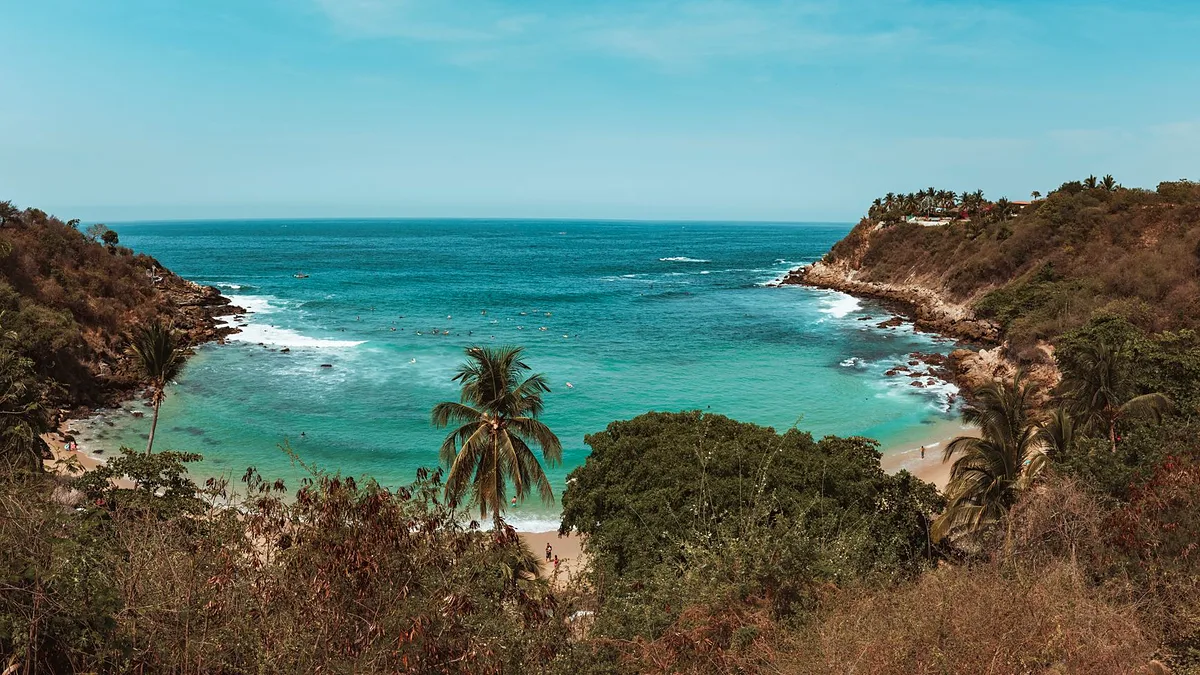
Honest heads-up: Zicatela's shorebreak causes serious spinal injuries every year. Swim at Carrizalillo or Angelito instead, and save Zicatela for watching.
Frequently Asked Questions
Do you need reservations for galleries in Puerto Escondido?
Casa Wabi is guided-tour only and needs booking one to three weeks ahead by email or WhatsApp. The Casa de Cultura, the market and the La Punta café walls are all walk-in and free.
Is there a real art scene in Puerto Escondido?
Yes, though it is small and seasonal. Most of it runs through Casa Wabi's residency program, the Casa de Cultura's classes, and short pop-up shows announced on paper flyers and co-working noticeboards rather than online.
How do you get to Casa Wabi from Puerto Escondido?
A private driver or taxi takes 35 to 40 minutes and costs roughly $700–900 MXN round trip with waiting. Cheaper option: take a colectivo toward Mazunte and ask to be dropped at the highway turnoff, then walk in.
How much does a day of galleries and cafés cost?
Plan on $600–900 MXN (~$33–50 USD) per person, including a donation entry, a co-working day pass, two coffees and a proper lunch. Add $500 MXN if you book a taxi to Casa Wabi solo.