
The Quick Verdict
Bruges is the closest thing Europe has to a London do-over for travelers who love brick, spires and river light but not £7 pints. Both cities grew rich on trade, both built their best buildings between the 13th and 19th centuries, and both reward aimless walking. The difference is scale and money: Bruges squeezes a comparable architectural punch into a town you can cross on foot in 25 minutes, for roughly 40–50% less per day.
What you give up is range. London layers a thousand years of style on top of itself — Wren churches beside Brutalist estates beside Victorian terracotta warehouses. Bruges plays one gorgeous note, and plays it well for about 48 hours. Come for the medieval streetscape and the beer; go to London when you need museums, midnight food and a city that doesn't shut at 23:00.
Side-by-Side Comparison Scorecard
| Feature | London | Bruges |
|---|---|---|
| Average Daily Cost (Stay + Meals) | £180–260 (~$230–330 USD) for a mid-range double and three meals | €130–185 (~$140–200 USD) for the same standard |
| Atmosphere & Aesthetic | Layered, soot-dark brick, Portland stone, glass towers, constant motion | Brick Gothic, canals, cobbles, a low skyline broken by bell towers |
| Crowd Density & Seasonality | Busy all year; worst July–August and the Christmas fortnight | Rough 10:00–17:00 crush April–October, then near-empty evenings and winter |
| Flight & Transit Accessibility | Five airports; Heathrow Express £25; Tube £2.80–£5.60 per ride | Fly to Brussels, train 75 minutes (€17–22), then walk everywhere |
| Best For | Museums, theatre, food variety, nightlife, first-timers | Romantic weekends, architecture, beer, slow travel on a budget |
Scenery & Atmosphere: How Similar Are They Really?
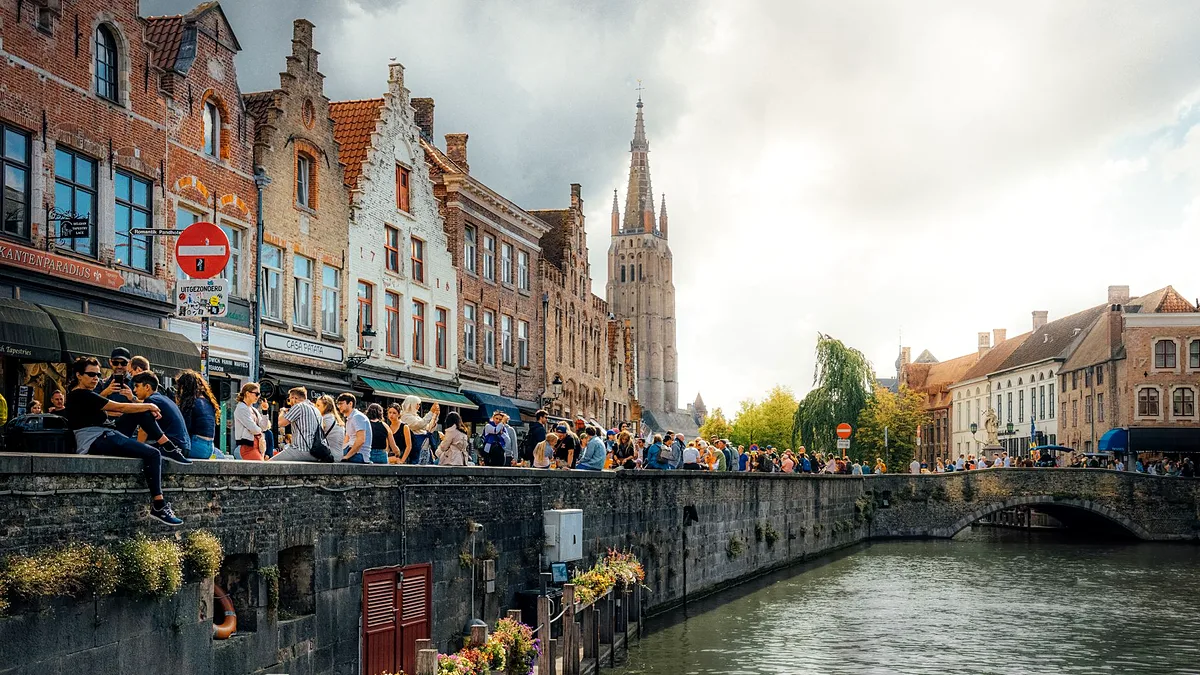
More similar than most guidebooks admit. Stand on the Rozenhoedkaai at 08:00 and you're looking at the same recipe London used along the Thames: merchant wealth poured into brick, water as transport, church towers as advertising. Swap the canal for the Strand and the grammar still holds.
Unlimited High-Speed International Travel eSIM
Connect in seconds across 180+ destinations. Instant QR code activation with zero roaming surcharges.

The Brick Gothic Connection
Bruges built in brick because the region had clay and no good stone. The result is the Church of Our Lady, whose 115.5-metre tower is the tallest brick structure in the world, plus a Belfry that has watched the Markt since the 13th century. London's equivalent thrill is the Inns of Court and the Temple, where soot-stained brick, quiet courtyards and gas lamps give you the same medieval hush — except in London you have to hunt for it.
Where the Resemblance Breaks Down
London is a working capital of nine million people; Bruges is a town of roughly 118,000 inside a UNESCO ring. Bruges has almost no 20th-century intrusion — no towers, no ring road slicing through the center, no commuter surge. That purity is the selling point, and also the trap: it can read as a stage set by your third canal view.
If what you love about London is Georgian and Victorian London — the terracotta warehouses of Shoreditch, the stucco terraces of Pimlico — Bruges won't scratch that itch. It's a medieval town, full stop.
The Wallet Test: Real Cost Breakdown
Prices below are what I found booking two to six weeks out for spring and autumn, the two best-value windows in both cities.
| Item | London | Bruges |
|---|---|---|
| Mid-range double, per night | £150–220 (~$190–280) | €110–150 (~$120–160) |
| Hostel dorm bed | £40–60 (~$50–75) | €30–45 (~$33–49) |
| Flat white | £3.80–4.50 | €3.00–3.50 |
| Local beer, 0.5L | £6.50–7.50 | €4.00–5.50 |
| Sit-down lunch | £15–22 | €14–18 |
| Dinner for two with wine | £70–110 | €60–85 |
| Marquee attraction | Tower of London £34.80 (~$44) | Belfry climb €15 (~$16) |
| Water trip | Thames Clipper ~£10 | Canal boat €14 |
| Transport | Contactless daily cap £8.90 (Zones 1–2) | €0 — the center is fully walkable |
Two lines stand out. Accommodation is where Bruges wins hardest — a well-reviewed double in the Sint-Anna quarter costs about what a Zone 3 budget chain charges in London. Booze is the second gap: a 0.5L Rodenbach or a De Garre tripel runs €4–5.50, while a London pint now sits at £6.50–7.50.
What a Three-Night Trip Actually Costs
Two people, three nights, mid-range hotel, one paid attraction per day, a proper dinner each evening: roughly €780–950 (~$850–1,030) in Bruges. The same trip in London lands at £1,250–1,600 (~$1,600–2,050) before you've added theatre tickets. That's a saving big enough to fund a second weekend away.
The honest caveat: Bruges restaurants ringing the Markt charge London prices for worse food. Walk ten minutes to Langestraat or Katelijnestraat and the numbers drop by a third.
Crowds, Authenticity, and Tourist Footprint
Bruges receives around 8 million visitors a year against 118,000 residents — a ratio that makes Venice look relaxed. Most of them arrive by coach between 10:00 and 16:00 and leave before dinner. The city you get at 08:30, or after 19:00, is a different and much calmer place.
The tourist tax is visible: chocolate shops outnumber residents' bakeries on some streets, and the Markt is a wall of photo menus. Step two blocks off the Rozenhoedkaai, though, and you find butchers, schoolkids and locals drinking at 't Brugs Beertje on Kemelstraat.
London's crowding is a different animal — year-round, spread across zones, driven by daily life rather than coach schedules. Neither city is undiscovered. Bruges just hands you a bigger, easier escape hatch each evening.
How to Experience the Best of Bruges
Where to Stay
- Sint-Anna (St. Anna) quarter: the quiet side of town, 10 minutes' walk from the Markt, with the best value on mid-range doubles.
- Langestraat and Katelijnestraat: local bars, bakeries and fewer tour groups; rooms run €20–30 less per night than canal-front addresses.
- Around 't Zand: the transport hub and the least pretty square in the city, but handy if you arrive by train with luggage.
- Skip: the Markt itself unless you're paying for the view and can sleep through the 23:30 street sweep.
What to Do Instead of London's Big Hits
- Climb the Belfry (366 steps, €15 / ~$16) instead of the Monument — the reward is a tiled-roof panorama rather than a glass skyline.
- Groeningemuseum (€15) for Jan van Eyck and Hans Memling — a smaller, sharper version of a National Gallery afternoon.
- Church of Our Lady to see Michelangelo's Madonna and Child, the only sculpture to leave Italy in his lifetime.
- De Halve Maan brewery tour (€15, about 45 minutes) — the beer travels to the bottling plant through a 3.2km underground pipeline.
- Walk the Kruisvest windmills at sunset; free, flat and almost empty compared with the center.
What to Order
- Carbonade flamande (Flemish beef stew braised in beer) — €18–22, the best-value plate in town.
- Garnaalkroketten — shrimp croquettes, €12–16, best with a sharp, dry beer.
- Moules-frites — €22–26; order them in months with an "r" if you want them sweet.
- A Liège waffle from a street counter (€4–6), not the €9 sit-down version buried in cream and fruit.
Who Should Still Choose London?
Bruges is a better deal, not a better city. London wins whenever variety matters more than charm.
- You want world-class museums. The British Museum, V&A, Tate Modern and National Gallery are free. Bruges has excellent small collections; London has cathedrals of art.
- You need a city after dark. Bruges goes quiet around midnight; London has theatre, live music and 24-hour food.
- You're traveling with teenagers or a mixed-age group. London's sheer range of things to do is hard to beat.
- Your architecture interest is Victorian, Georgian or Modernist. Bruges is medieval, and stays medieval.
- It's your first trip to Europe. London is easier to navigate blind, with English everywhere and a huge choice of flights.
Frequently Asked Questions
Is Bruges actually cheaper than London?
Yes — roughly 40–50% cheaper for the same standard of trip. Hotels run €110–150 a night against £150–220, beer is about a third less, and the historic center needs no transport budget at all.
Does Bruges feel like London architecturally?
In the medieval pockets, yes. Brick, guild halls, church towers and riverside merchants' houses create a similar atmosphere. What's missing is London's 300 years of Georgian, Victorian and modern layering.
How many days do you need in Bruges?
Two full days covers the highlights comfortably; three lets you add a bike ride to Damme or a brewery afternoon without rushing. Past four days, most people start craving a bigger city.
Can you visit Bruges as a day trip instead?
You can, but you'll get the worst version — arriving with the coaches at 11:00 and leaving before the evening empties out. One overnight transforms the experience if your budget allows it.