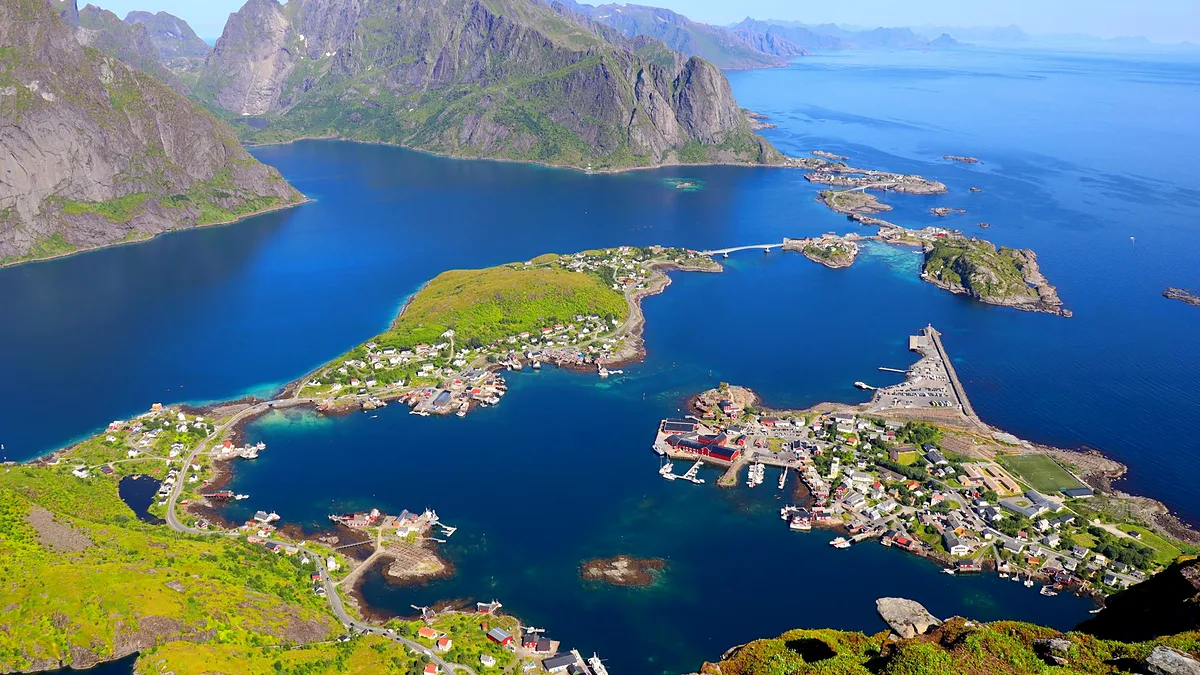

Lofoten usually gets sold as a photograph: red cabins, black water, a mountain shaped like a shark fin. Fair enough. But these islands had a working life long before cameras arrived — cod, wool, iron, glass — and that work is still happening in small buildings you can walk straight into.
This guide is about that side of Lofoten. Beach glass furnaces, a wool farm on Gimsøy, a rebuilt Viking chieftain's hall, and the fishing museums that explain why any of it exists in the first place. You'll get real prices, transport that actually connects, and a few things I'd honestly skip.
At a Glance
- Best time to visit: mid-June to late August for full opening hours and live demonstrations. February to April is quieter, cheaper, and the cod season is in full swing.
- Typical daily budget: 1,100–2,000 NOK (~$105–190) per person, excluding car rental.
- Getting around: the E10 is the spine of the islands. Buses exist but are thin — a rental car is close to essential if you want more than one stop a day.
- Vibe: hands-on, weather-dependent, unhurried. Bring a windproof layer and don't schedule anything tightly.
1. Glasshytta på Vikten: Glassblowing on the Beach
Vikten sits on the north coast of Flakstadøy, and the glass workshop there is about 30 metres from the shoreline. You walk in, and there's a furnace, a bench, and someone turning a glowing blob into a bowl while the weather does its thing outside the window.
Unlimited High-Speed International Travel eSIM
Connect in seconds across 180+ destinations. Instant QR code activation with zero roaming surcharges.

This is a small operation, not a factory tour. Pieces are made with local sand and seaweed ash, which gives the glass a faint green-grey tint you won't find in a souvenir shop. Watching a short blowing demo takes maybe 20 minutes; browsing the shelves takes longer.
- Where: Vikten, Flakstadøy (signposted off the E10 between Napp and Ramberg).
- Cost: free to browse; small pieces from about 300 NOK (~$29), larger bowls 1,500–2,500 NOK (~$143–238).
- Best time of day: late morning to early afternoon in summer, when the furnace is hot and the light is good.
- Getting there: the Leknes–Reine local bus stops near the Vikten turnoff; from there it's a 10–15 minute walk down to the beach.
Insider tip: ask which pieces are kiln-annealed rather than flame-cooled. If you're flying home with glass, buy a small piece and ask them to wrap it heavily — the airline isn't going to be gentle.
2. Lofoten Wool at Hov Gård, Gimsøy
Hov is an old farm on the flat, wind-scoured island of Gimsøy, and the wool studio here works almost entirely with Spælsau fleece from sheep you can see out the window. The colours come from lichen, madder, birch leaves and onion skins, not from a dye catalogue.
You can buy yarn and finished pieces, but the real reason to come is a dyeing or felting session. These run in small groups and last a few hours, so you leave with something you made and a working idea of how much labour sits behind a hand-knitted sweater.
- Where: Hov gård, Gimsøy, about 35 minutes north of Svolvær.
- Cost: farm shop free; workshops roughly 800–1,200 NOK (~$76–114).
- Best time of day: mid-morning to mid-afternoon; hours are seasonal and limited, so check before you drive out.
- Getting there: cross the Gimsøy bridge on the E10 and follow signs for Hov. No useful bus service — this one needs a car.
Insider tip: Hov also runs beach rides from its horse stable. Pair a morning dyeing session with an afternoon on Gimsøy's white sand, and you've covered the island in one day.
3. Lofotr Viking Museum, Borg
The longhouse at Borg is a full-scale reconstruction of the largest Viking hall ever excavated in Norway — 83 metres of timber, turf roof and fire pit. It's a museum, yes, but the smell of smoke and wet wool does most of the work.
In summer there are live roles: a blacksmith at the forge, a boat house with a replica vessel, animals on the pasture, and staff who will hand you a shield without asking you to read a plaque first. Off-season you get the building and the exhibits, roughly 60% of the experience.
- Where: Borg, Vestvågøy, about 15 minutes north of Leknes on the E10.
- Cost: around 260 NOK (~$25) for adults in high season, less in winter. Family tickets available.
- Best time of day: arrive at opening. The hall gets loud and busy by early afternoon in July.
- Getting there: local buses from Leknes run past the junction; parking is free and plentiful.
Insider tip: the blacksmith tends to work mid-morning. Go straight to the forge before the main hall — most tour groups do it the other way round.
4. Norsk Fiskeværsmuseum, Å
Å sits at the very end of the E10, and the preserved village here is the most honest heritage site on the islands. It's a complete 19th-century fishing village: rorbuer on stilts, a cod liver oil factory, a warehouse packed with dried stockfish, and a shop that looks like it closed for a week in 1935 and never reopened.
The stockfish museum in the same complex explains the industry that paid for everything else in Lofoten. It sounds dry and isn't — the smell alone tells you what the trade was worth.
- Where: Å, Moskenesøy, at the road's end.
- Cost: around 130 NOK (~$12) for adults, covers the village museum and stockfish museum.
- Best time of day: first thing in the morning, before the day-trip traffic arrives from Reine.
- Getting there: 55 minutes by car from Leknes; the Lofotekspressen bus also terminates here.
Insider tip: 90 minutes is plenty for the museums. Use the rest of your time on the short walk out toward the harbour breakwater — most people never leave the buildings.
5. KaviarFactory, Henningsvær
An old caviar factory on the harbour at Henningsvær, converted into a contemporary art space with sea-facing picture windows. The building is a big part of the appeal: concrete frames, industrial bones, water on three sides.
The art programme leans toward international names and sound and video installations. If the exhibition isn't your thing, admission also buys you the roof terrace, which is one of the better views in a village that is not short of them.
- Where: Henningsvær harbour, 20-minute detour off the E10.
- Cost: roughly 120–150 NOK (~$11–14) depending on the exhibition.
- Best time of day: check opening days first — the gallery runs seasonal hours and closes between exhibitions.
- Getting there: buses run from Svolvær; by car, park at the edge of the village and walk in, since the harbour roads are narrow.
Insider tip: call ahead on a changeover week. It's a genuinely disappointing drive if you arrive to find the doors shut for installation.
6. Nusfjord: The Village That Was Almost a Museum
Nusfjord is a preserved fishing village on Flakstadøy, tucked into a narrow inlet between cliff walls, and it's been maintained rather than restored. The result is rorbuer, a cod liver oil factory and a harbour that still smells faintly of fish — because people still work there.
It's a small place. Two hours covers the factory tour, the old shop and the harbour loop. What makes it worth the detour is the light on the inlet in the late afternoon, when the parking area empties out and the village goes quiet again.
- Where: Nusfjord, Flakstadøy, off the E10 near Ramberg.
- Cost: a small visitor fee in high season, roughly 50–75 NOK (~$5–7) per adult.
- Best time of day: after 5pm in summer, when the coach groups have gone.
- Getting there: short signposted turnoff from the E10; the access road drops steeply into the fjord.
Insider tip: if you're staying on the islands, the village is at its best in winter, when the rorbuer light up and the aurora often fires over the inlet. Summer day visitors miss this entirely.
Where to Eat & Drink Nearby
Børsen Spiseri, Svinøya (Svolvær)
Dinner in a restored 1820s fish-oil warehouse, which fits the theme better than any themed restaurant could. Order the bacalao — they take it seriously here — and expect mains around 280–380 NOK (~$27–36).
Klatrekafeen, Henningsvær
A climber-run cafe with big sandwiches, proper cinnamon buns and coffee at roughly 55 NOK (~$5). Lunch for two with coffee lands around 400 NOK (~$38). It's a functional, friendly spot rather than a destination, which is exactly why it works.
Trevarefabrikken, Henningsvær
A former woodworking factory turned cafe, bar and guesthouse, with the original machinery still overhead. Pizza and sharing plates run 200–300 NOK (~$19–29). It's busy in summer, so book or go late.
Practical Logistics & Budget Tips
Fly Widerøe into Leknes or Svolvær, or into Evenes and drive the 2.5–3 hours north. The Bodø to Moskenes ferry takes about three hours and drops you near the Å end of the islands, which is handy if you're working west to east.
Download the Reis app for Nordland county buses. The Lofotekspressen links Svolvær, Leknes and Å, but frequency drops fast in the evening and many rural stops are a walk from the actual site. Rental cars run 700–1,200 NOK (~$67–114) per day in summer — book months ahead, and fill up in Leknes or Svolvær because stations get very sparse.
- Combined tickets: Museum Nord sells passes covering several sites. Do the maths first — anything under four sites and single tickets usually win.
- Card everywhere: Norway is effectively cashless. Even small craft stalls take cards.
- Rainy-day swap: Espolin Gallery in Kabelvåg and the Lofoten Museum at Storvågan are close together, indoors, and rarely crowded. Good backup when the coast fog rolls in.
What I'd skip: the troll-and-viking souvenir shops in Svolvær sell imported trinkets at three times what the workshops charge. Skip the troll statue queue at Reine, too — it's a photo stop, not a craft stop.
Honest heads-up: many of these workshops are one- or two-person businesses. They close without warning in shoulder season, and winter hours often shrink to weekends only. Call ahead the day before you go. Nothing is more frustrating than a two-hour drive to a locked door.
Frequently Asked Questions
Do I need to book Lofoten artisan workshops in advance?
For hands-on sessions like dyeing, felting or glassblowing, yes — small groups fill in summer and some only run once or twice a week. Galleries, farm shops and museums are walk-in and don't need a booking.
When are Lofoten's heritage sites fully open?
Mid-June to late August is when everything runs full hours with live demonstrations, especially at the Viking Museum and the Å fishing village. If you want the cod season atmosphere, come in February to April instead and accept shorter museum days.
Can I visit these places without a car?
Yes, if you pick one base per night — Svolvær for Henningsvær, Leknes for Borg and Vikten, Å for the fishing village. The buses are reliable but infrequent, so plan around the morning departure and the early evening return.
How much do museum tickets cost in Lofoten?
Expect 120–260 NOK (~$11–25) for the major sites, with the Viking Museum at the top of that range. Small galleries, glass studios and wool shops are usually free to enter, which makes a craft-focused day much cheaper than a hiking-and-tours day.