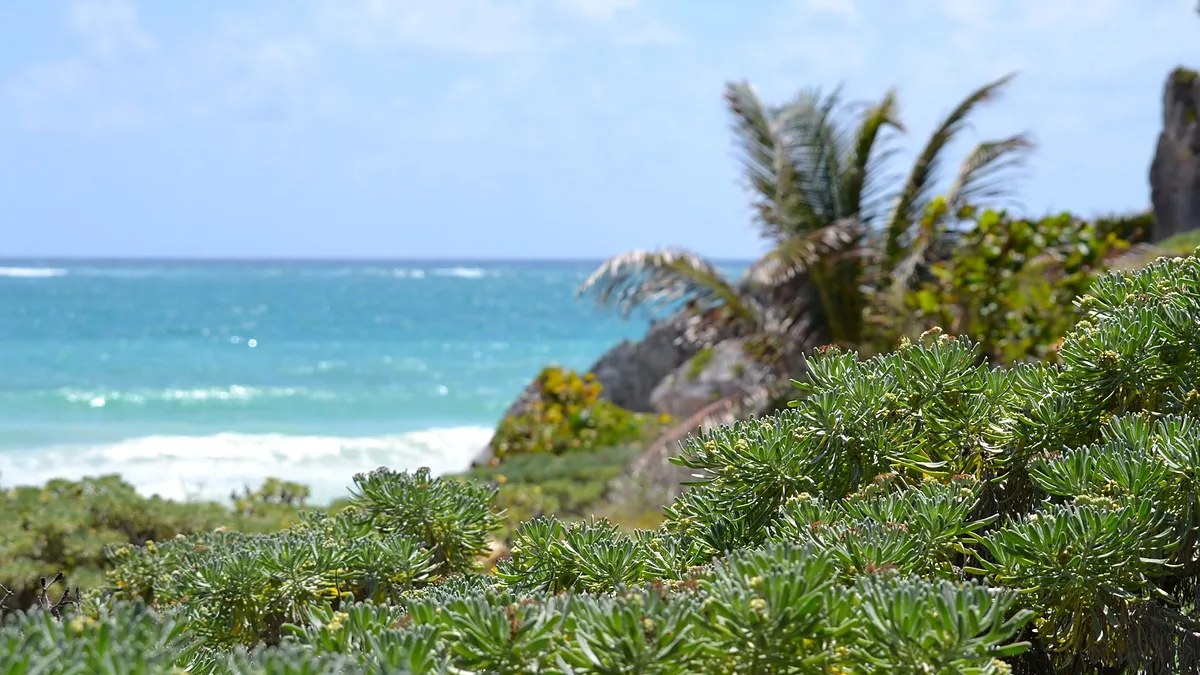

Tulum has a reputation problem. The photos show overwater swings, $18 smoothies and hotels charging $700 a night for a room with no windows. That version of Tulum exists. It's just not the only one.
The Tulum that long-stay travelers and locals actually use runs on pesos, bicycles and good timing. Show up at the ruins at 8 a.m. and the cliffs are yours. Sleep four blocks inland instead of on the beach road and your room drops by 70%. Eat where the taxi drivers eat.
This guide is that second version — same turquoise water, same jungle light, roughly a third of the price.
Unlimited High-Speed International Travel eSIM
Connect in seconds across 180+ destinations. Instant QR code activation with zero roaming surcharges.

At a Glance
- Best time to visit: November to mid-April. Dry, breezy, no sargassum. May through October is 30–50% cheaper but seaweed peaks June to August.
- Daily budget (budget-luxury): $95–170 USD (roughly $1,700–3,000 MXN) per person, including a boutique room, one paid activity and good food.
- Getting around: Bicycle ($200–300 MXN/day) or colectivo van ($30 MXN flat). Taxis are the single biggest budget leak.
- Cash: Carry pesos. Cenotes, taquerías and colectivos are cash-only.
- Vibe: Barefoot boho with a wellness markup. Relaxed in town, curated and pricey on the beach road.
The Tulum Ruins Before the Buses Roll In
The archaeological zone opens at 8 a.m. By 10:30, the tour buses from Cancún have arrived and the narrow paths between the temples turn into a slow-moving queue. In that early window you get the cliff-top Castillo, the iguanas and the whole Caribbean below you with maybe forty other people.
The ruins themselves take about 45 minutes. Budget another 20 for the walk down to the swimming cove below, where locals fish off the rocks in the morning light.
- Neighborhood: Tulum Ruins zone, at the north end of the beach road (Carretera Tulum–Boca Paila, km 0).
- Cost: About $160 MXN (~$9 USD) total — an INAH fee plus a separate state park fee, paid at two different windows.
- Best time: 8:00–9:30 a.m. on a weekday. Sundays are busiest because Mexican nationals enter free.
- Getting there: A 20-minute bike ride from the pueblo, or a $40 MXN colectivo drop at the access road.
Insider tip: Pay both windows before you walk in — the two-fee system catches out almost every first-timer, and there is no refund once you're past the gate. Skip the touts in the parking lot offering to "handle the line" for $200 MXN; there is no line to handle.
Cenote Calavera and the Cheap Cenote Circuit
Calavera means skull, and the name comes from three holes punched through a limestone roof — one big enough to jump through, two small enough to lower yourself into. It's 1.5 km from town on the Coba road, which makes it the easiest cenote to reach without a tour.
From there, the circuit is cheap and close. Cenote Zacil-Ha sits further west on the same road with a pool and palapa bar. On the beach-road side, Cenote Cristal and Cenote Escondido are two swims for the price of two small entries, connected by jungle paths.
- Neighborhood: Calavera and Zacil-Ha on the Carretera Tulum–Coba; Cristal and Escondido on the beach road, about 3 km south of town.
- Cost: Calavera $300 MXN (~$17 USD); Zacil-Ha $250 MXN (~$14 USD); Cristal and Escondido $200 MXN each (~$11 USD). Life jackets $50 MXN.
- Best time: 9–11 a.m., before the snorkel vans arrive. Calavera stays quietest on weekday mornings.
- Getting there: Bike to Calavera in 15 minutes, or take a colectivo toward Coba and ask the driver to drop you at the entrance.
Insider tip: Bring a rash guard instead of sunscreen. Most cenotes make you shower off before entering and several ban chemical sunscreen outright — and a rented snorkel mask costs nearly as much as the entry fee.
Playa Paraíso and the Public Beach Hack
Every beach in Tulum is public below the high-tide line, including the sand in front of the $900-a-night hotels. Playa Paraíso, south of the ruins, is the widest, calmest stretch and the easiest to reach without a beach club booking.
Walk in from the beach road, lay a towel down between the clubs and swim. Shade and loungers cost money; sand and water don't.
- Neighborhood: Playa Paraíso, Carretera Tulum–Boca Paila at km 5.5 (public access road).
- Cost: Free for the sand and water. A palapa and lounger run $200–300 MXN (~$11–17 USD) if you want shade.
- Best time: 8–10 a.m. or after 4 p.m. The middle of the day is brutally hot and crowded.
- Getting there: Bike it in 25–30 minutes from town, or take a colectivo to the Playa Paraíso stop and walk five minutes down the access road.
Insider tip: Bring small bills for parking and showers — the access road charges cyclists and drivers, and nobody has change for a $500 note. There is a freshwater shower near the north end of the beach, which saves you the $100 MXN beach-club shower fee.
One Beach Club Splurge, Done Cheaply
Pick one afternoon and one club. Papaya Playa Project at km 4.5 is the big, photogenic one with timber decks and a long bar; Ziggy's at km 5.5 is older, sandier and slightly less scene-y. Both charge a minimum spend rather than an entry fee.
Treat that minimum as your lunch and drinks budget for the day and the maths works. You're paying $55–85 USD for shade, service, a table and a lounger — not unreasonable if it replaces a restaurant meal you'd have bought anyway.
- Neighborhood: Papaya Playa Project at Carretera Tulum–Boca Paila km 4.5; Ziggy's at km 5.5.
- Cost: Minimum spend typically $1,000–1,500 MXN (~$55–85 USD) per person, applied to food and drink.
- Best time: Weekday afternoons, 1–5 p.m. Sunset at the bar is free to watch if you skip the daybed entirely.
- Getting there: Bike parking out front, or a colectivo to the club's kilometre marker.
Insider tip: The minimum is almost always per person, not per bed — so a couple sharing one daybed still owes two minimums. Confirm the number with your waiter before anyone opens a tab.
Bike the Beach Road and Sleep Inland
This is the accommodation hack that makes the whole trip work. Beach-road hotels charge $400–900 USD a night. La Veleta and Aldea Zama, ten to fifteen minutes inland, have boutique hotels and apartment rentals with pools, AC and rooftop terraces for $60–140 USD.
Then you rent a bike and ride to the beach. It's flat, and the Coba road has a proper bike path. The catch is honest and worth repeating: the beach road itself has no bike lane and no streetlights for long stretches.
- Neighborhood: La Veleta (south of Avenida Kukulcán) and Aldea Zama (north of the Coba road).
- Cost: Boutique room $60–140 USD per night; bike rental $200–300 MXN/day (~$11–17 USD).
- Best time: Ride between 7 and 9 a.m., before the heat and the delivery trucks.
- Getting there: A 15–20 minute walk from the ADO bus station, or an $80–100 MXN taxi with luggage.
Insider tip: Many La Veleta guesthouses include free bikes — ask before you rent. And take a taxi home after dark rather than riding the beach road at night; the potholes are real and the shoulder disappears.
Muyil and the Sian Ka'an Floating River
If you're going to spend real money on one thing, spend it here. Muyil village is 20 km south of Tulum, and its small ruins are usually empty. From there, a boat takes you through the Sian Ka'an canals — a channel the Maya dug through the mangroves centuries ago — and you float back down with the current in a life jacket.
It is genuinely unlike anything else on the Riviera Maya, and it costs a fraction of a Cancún yacht day.
- Neighborhood: Muyil village, on Highway 307 about 20 km south of Tulum.
- Cost: Guided tour $1,400–1,800 MXN (~$80–100 USD) including boat, guide, float and transport. DIY entry to the Muyil ruins is about $100 MXN (~$6 USD).
- Best time: Morning departures, 8–10 a.m., when the light through the mangroves is best.
- Getting there: Colectivo or ADO bus toward Felipe Carrillo Puerto, or a tour with hotel pickup.
Insider tip: Book directly with a Muyil-based cooperative instead of a beach-road agent — the markup is often 40%. Bring a dry bag, because you will be in the water with your phone in your hand at some point.
Where to Eat and Drink Nearby
Antojitos La Chiapaneca
A Tulum institution on Avenida Tulum in the town centre, open from around 6 p.m. until midnight. Plastic chairs, blazing grill, tacos al pastor carved straight off the trompo.
- Signature dish: Al pastor tacos at about $22 MXN (~$1.20 USD) each.
- Realistic bill: Five tacos and a horchata lands around $150 MXN (~$8.50 USD). Cash only.
El Camello Jr.
A no-frills seafood spot on Avenida Tulum, a short walk south of the ADO station, open roughly 11 a.m. to 8 p.m. Locals come for ceviche and whole fried fish; tourists mostly miss it.
- Signature dish: Ceviche tostada at $130 MXN (~$7 USD); a seafood platter to share around $400 MXN (~$22 USD).
- Heads-up: It closes early by Mexican standards. Don't plan a late dinner here.
Palma Central
A food-truck courtyard on Avenida Kukulcán on the La Veleta side, open from late afternoon into the night. It's the best-value dinner in town when you want variety, outdoor tables and no reservation.
- Signature dish: Wood-fired pizza or Yucatecan cochinita, depending on which truck is running.
- Realistic bill: $300–450 MXN (~$17–25 USD) for two, with drinks.
Practical Logistics and Budget Tips
Taxis are where budgets die. A ride from the pueblo to the beach road runs $200–350 MXN each way, and there's no Uber in Tulum. Build your day around bikes and colectivos instead.
Colectivos cost a flat $30 MXN and run constantly along Avenida Tulum — but they stop around 9 or 10 p.m., so plan your evening accordingly. From Cancún airport, the ADO bus to Tulum is about $350 MXN (~$20 USD) and takes roughly two hours; the private shuttles quoted at the terminal run $120 USD and up.
| Sample day, per person sharing a double | Cost (USD) |
|---|---|
| Boutique room in La Veleta, split two ways | $35–60 |
| Bike rental | $11–17 |
| Coffee and breakfast | $8–12 |
| One paid activity (cenote or ruins) | $10–30 |
| Lunch and dinner | $25–40 |
| Buffer (tips, water, one taxi) | $8–12 |
| Total | ~$95–170 |
Use bank ATMs in the pueblo — Santander and HSBC on Avenida Tulum are the most reliable — and always decline the machine's peso conversion offer. Bring a refillable bottle; Tulum has refill stations around town and single-use plastic is banned at the ruins.
What to skip: the $250 MXN beach-road smoothie bars, the queue for the Tulum sign photo, tours booked through hotel concierges, and any cenote package that bundles four stops into one afternoon. You'll spend more time in a van than in the water.
Frequently Asked Questions
Is Tulum expensive to visit?
Tulum gets its pricey reputation from the beach road, where rooms and restaurants are genuinely expensive. Sleep in La Veleta or the pueblo, eat where locals eat and use bikes and colectivos, and a comfortable trip runs about $95–170 USD a day.
How many days do you need in Tulum?
Three full days covers the ruins, two cenotes, a beach day and one bigger outing like Muyil. Give it four or five if you want slow mornings and a second beach day without rushing.
Do you need a car in Tulum?
No. Parking on the beach road is a nightly ordeal and rental cars sit in traffic on the single access road. A bicycle plus the occasional colectivo handles nearly everything.
When is the cheapest time to visit Tulum?
Late September through early October, plus May, when room rates fall 30–50% below the December–April peak. Just go in knowing that seaweed risk climbs from May onward and some beach days will be a write-off.