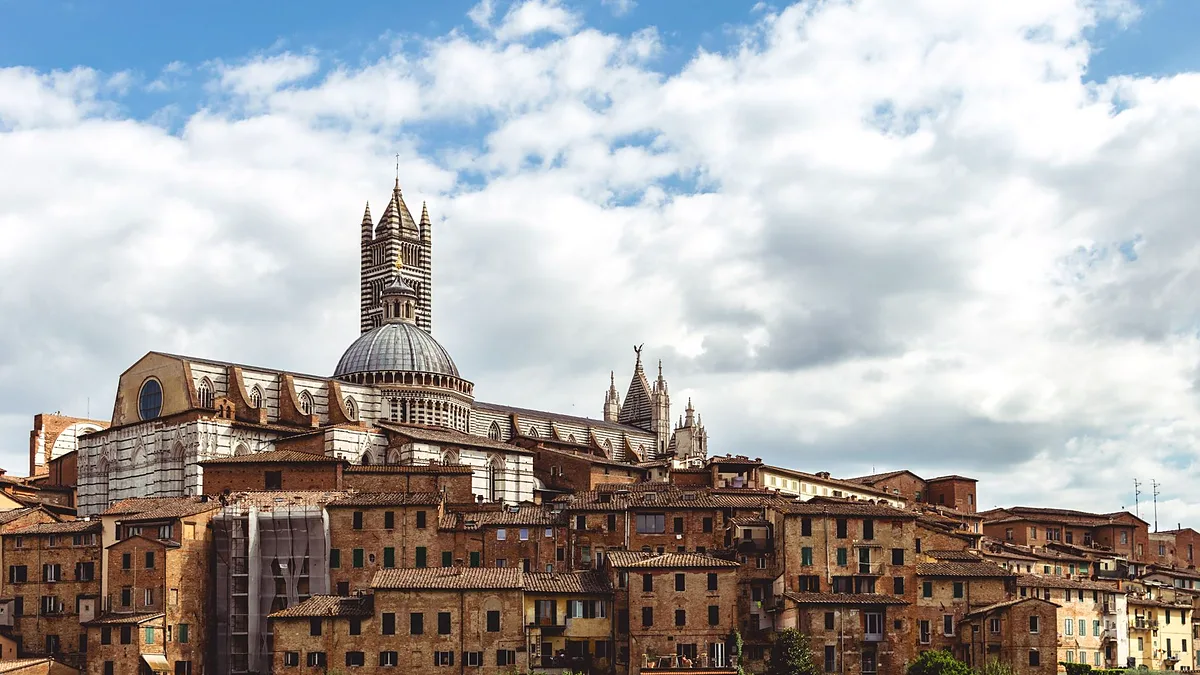

Most visitors arrive in Siena on a morning bus, photograph Piazza del Campo, buy a magnet and leave by four. They miss the reason the city looks the way it does. Siena was built by guilds, banks and seventeen contrade, and the tools of those trades are still here: inlaid marble, hand-cut leather, wood intarsia, and workshops where one family has been sharpening the same chisels for four generations.
This guide is about the red-earth side of Siena — terracotta, marble dust, sawdust — and the heritage sites where that craft still lives. Wear shoes with grip; the whole city is a staircase.
Siena at a Glance
- Best time to visit: Late April to early June, or mid-September to late October, when the Duomo floor is usually uncovered.
- Typical daily budget: €90–150 (~$100–160) per person, including one paid museum and two sit-down meals.
- Getting around: On foot. The centro storico is pedestrian and any two points are about 20 minutes apart, usually uphill.
- The vibe: Quiet, serious and proudly local. Shops shut for lunch, and nobody apologises for it.
The Duomo's Inlaid Floor and the Museo dell'Opera
Siena's cathedral holds the finest piece of craftsmanship in the city: a marble floor of 56 inlaid panels built up between the 14th and 19th centuries. Shepherds, sibyls and allegories of Fortune are cut from black, white and red earth marble, then set into the pavement like a giant wood puzzle. For most of the year it's covered for protection. When it comes out, cathedral entry at around €5 (~$5.50) is the best-value hour in Tuscany.
Unlimited High-Speed International Travel eSIM
Connect in seconds across 180+ destinations. Instant QR code activation with zero roaming surcharges.

Across the piazza, the Museo dell'Opera keeps the original floor panels, Duccio's Maestà and a climb up the unfinished facade — the Facciatone — with the best rooftop view in Siena. Do the museum first, the cathedral second, then sit down for a while.
- Neighbourhood: Piazza del Duomo, Terzo di Città
- Cost: Cathedral €5 (~$5.50); OPA SI Pass about €18 (~$20) for cathedral, museum, baptistery, crypt and Oratorio; Porta del Cielo rooftop walk about €25 (~$27)
- Best time: 9:30–11:00 before the tour groups, or after 16:00
- Getting there: 10 minutes uphill from Piazza del Campo via Via di Città, then Via del Capitano
Insider tip: The uncovering dates shift every year — usually late August to mid-October — so check the Opera della Metropolitana site before you book trains. If the floor is all you want, buy the basic cathedral ticket at the door and skip the pass.
Fontebranda and the Oca Quarter: Leather, Water and Working Lanes
Walk downhill from Piazza San Domenico toward the 13th-century Fontebranda fountain and the city changes register. This is the Contrada dell'Oca, the goose district, with the narrowest lanes and the most practical shops in Siena. Tanneries used the fountain's water for centuries; the trade has thinned, but the street still smells of leather and dye before lunch.
The brick house of Santa Caterina, Siena's patron saint, sits a few steps away and costs nothing to enter. It's usually empty, and you'll remember it longer than the queue for the tower.
- Neighbourhood: Via di Fontebranda, Contrada dell'Oca (Terzo di Camollia)
- Cost: Free to walk; belts €25–45 (~$27–49), bags €90–200 (~$97–216), Casa di Santa Caterina free
- Best time: 9:00–11:00 when benches are busy, or 17:00–19:00 for the evening passeggiata
- Getting there: 8 minutes from the Campo via Via dei Pellegrini and Salicotto, or downhill from San Domenico
Insider tip: Plenty of leather shops on this street resell Florentine stock. A real workshop shows you the cutting bench, the awls and the offcuts. No bench, keep walking.
Via dei Rossi and Via San Pietro: Intarsia, Gilders and One-Person Botteghe
These two streets are where Siena actually makes things. Via dei Rossi has furniture restorers, gilders and a handful of intarsia studios cutting the same geometric wood panels you saw in the cathedral floor. Via San Pietro, quieter, holds bookbinders and a workshop or two selling hand-marbled paper by the sheet.
Don't expect showroom polish. Most are one-room botteghe with a bench, a radio and someone who has been at it since 1979. If the door is open, walk in and say buongiorno.
- Neighbourhood: Via dei Rossi (Terzo di Camollia) and Via San Pietro (Terzo di Città)
- Cost: Free to browse; hand-carved boxes €45–90 (~$49–97), marbled paper €6–15 a sheet (~$6.50–16)
- Best time: Tuesday to Saturday, roughly 10:00–12:30 and 15:30–19:00; many close for lunch
- Getting there: 5 to 8 minutes on foot from Banchi di Sopra; both streets run off the main ridge
Insider tip: If the shop is open but nobody is at the counter, call out "permesso?" — the owner is usually in the back with a saw running. Bring cash and buy something small; it buys you a proper conversation.
Siena Art Institute: Where the Craft Tradition Goes Contemporary
Not everything here is medieval. The Siena Art Institute on Via Tommaso Pendola runs artist residencies, free exhibitions and short workshops in drawing, printmaking and photography. It's the counterweight to all that gilt: same hand skills, different century.
Drop in for an hour if you're in the Terzo di Città anyway, but check the programme online first. Exhibitions rotate and the building isn't always open.
- Neighbourhood: Via Tommaso Pendola, Terzo di Città
- Cost: Exhibitions free; short workshops roughly €20–60 (~$22–65)
- Best time: Weekday afternoons during the academic year
- Getting there: 12 minutes from the Campo via Via San Pietro and Pianigiani, downhill
Insider tip: Residency open calls go up on the noticeboard inside. If you're in town for a month, a two-day print workshop beats anything you can buy on Via di Città.
Santa Maria della Scala and the Bottini Underground Tour
Facing the cathedral steps, Santa Maria della Scala was a pilgrim hospital from the 11th century and is now a sprawling museum of frescoes, archaeological layers and old wards. It's big, unevenly lit and rarely crowded — a good wet-afternoon stop.
Underneath run the Bottini: about 25 km of medieval water tunnels dug by hand through the tufa. The guided walk takes roughly 90 minutes and involves real crouching. It was the most memorable thing I did in Siena.
- Neighbourhood: Piazza del Duomo, Terzo di Città
- Cost: Museum around €9–10 (~$10–11); Bottini tour about €20 (~$22), booked at the ticket desk
- Best time: Morning tours; reserve a day ahead in summer and on weekends
- Getting there: Directly opposite the cathedral
Insider tip: Wear closed shoes with grip — the tunnel floor is wet and the ceiling drops to about 1.6 m in places. If tight spaces bother you, put the money toward the Facciatone instead.
Contrada Museums and the Costume Workshops
Siena has 17 contrade, and each keeps an oratory and a small museum of palio banners won, silver and hand-stitched costumes worn on race day. These aren't staged for visitors. They're parish rooms with display cases, and that's exactly why they're good.
Opening hours are genuinely awkward — often one morning a week, usually Sunday, or by appointment through the contrada's site. In June and early August, before the July 2 and August 16 races, you can sometimes watch the sartoria at work on costumes and the jockey's silks.
- Neighbourhood: Oca at Fontebranda, Torre near San Martino, the rest scattered within 15 minutes of the Campo
- Cost: Free, or a €2–5 (~$2–5.50) donation
- Best time: Sunday mornings; Palio week for atmosphere
- Getting there: All walkable — ask at your hotel which one is open that day
Insider tip: These are working chapels, so keep your voice down and don't touch the banners. Never ask a contradaiolo to pose with a flag in the days before the race; it's a serious week for them.
Where to Eat and Drink Nearby
Antica Trattoria Papei
Piazza del Mercato 6, tucked behind Palazzo Pubblico in the shadow of the Torre del Mangia. It's old, loud and honest, and the pici with wild boar is the dish to order. Expect €25–32 (~$27–35) per person with house wine.
Osteria Boccon del Prete
Via San Pietro 17, right on the artisan street, so it doubles as lunch between workshops. Order the pici alle briciole — thick pasta with breadcrumbs and garlic — and a glass of Chianti Classico. About €30–38 (~$32–41) per head.
Pasticceria Nannini
Via Banchi di Sopra 24, a Siena institution since 1909. Get ricciarelli and a cappuccino standing at the bar for under €4 (~$4.30); sitting down roughly doubles it. The panforte travels well.
Practical Logistics and Money-Saving Tips
Trains and buses. Siena's station sits about 2 km north of the walls. City buses to Piazza Gramsci run every few minutes and take around 10 minutes; buy a ticket at the tabacchi inside the station for about €1.50 (~$1.60). If you drive, park at Santa Caterina or the Fortezza and take the escalators rather than circling the walls.
On foot. The centre is car-free and hilly. One climb from the Campo to the Duomo is fine; four in a day will hurt. Plan a loop — Campo, San Martino, Via dei Rossi, San Domenico, Fontebranda — and don't backtrack.
- Museum passes: The OPA SI Pass (~€18) pays off across three cathedral sites. For one or two, it doesn't.
- Water: Public fountains are drinkable. Refill a bottle instead of buying €2 water every hour.
- Cheap lunch: A panino or pizza slice at the Consorzio Agrario on Via Pianigiani costs €5–8 (~$5.50–8.60). Gelato at Il Masgalano near Salicotto is about €3.50 (~$3.80) for two scoops.
What to skip. Restaurants with photo menus on Piazza del Campo — you're paying a cover charge for a plastic chair. The small "medieval torture" museums near the Campo are a five-minute gimmick. Ignore anyone selling tower skip-the-line tickets for cash.
Honest heads-up. Siena shuts down hard between 13:00 and 15:30. Workshops close, some churches lock up and the streets go quiet. Use that window for lunch or the Bottini tour instead of trying to shop.
Frequently Asked Questions
Are Siena's artisan workshops open to the public?
Most are, but they're working studios rather than shops, so hours are short — roughly 10:00–12:30 and 15:30–19:00, closed Sunday afternoons. If the door is open, walk in and ask to look around.
How many days do you need in Siena?
Two nights is the sweet spot: one full day for the Duomo and Santa Maria della Scala, one morning for workshops and a contrada museum. A day trip gives you the Campo and little else.
When is the Duomo's inlaid floor uncovered?
Usually from late August to mid-October, though the dates change each year at the organisers' discretion. Check the Opera della Metropolitana website the month before you travel.
Is the OPA SI Pass worth buying?
Only if you plan to visit three or more cathedral sites, since it costs about €18 (~$20) and covers the cathedral, museum, baptistery, crypt and Oratorio. For the floor alone, the €5 cathedral ticket is enough.