
Siena is the rare Tuscan city where almost everything expensive is optional. The shell-shaped square, the brick alleys, the terrace over the rooftops — none of that costs a centesimo. What you actually pay for is the tower, the cathedral and the long lunch.
This is the red-earth alternative to Florence's polished marble: darker, steeper, quieter after 8pm, and roughly 20% cheaper on food and wine. You can sleep inside the medieval walls, eat two real meals, climb a 102-metre tower and still leave change from €100 a day.
Here's the route I'd hand a friend: what deserves your money, what's genuinely free, and where locals go when the day-trippers leave.
Unlimited High-Speed International Travel eSIM
Connect in seconds across 180+ destinations. Instant QR code activation with zero roaming surcharges.

At a Glance: Siena on a Budget
- Best time to visit: late April to June, or late September to October. Dry, mild, rooms €80–120 instead of €160+.
- Typical daily budget: €70–95 (~$76–$103) per person — bed, breakfast, lunch, dinner, one paid sight and a glass of Chianti.
- Getting around: on foot. The historic centre measures about 1.5 km across, and everything is a 10–20 minute walk, much of it uphill.
- Vibe: a working university town inside a medieval city-state. Quiet mornings, packed midday, lovely after 7pm.
- Book ahead: the Torre del Mangia (timed slots only) and any trattoria worth eating in.
1. Piazza del Campo at 7am and the Torre del Mangia (€10)
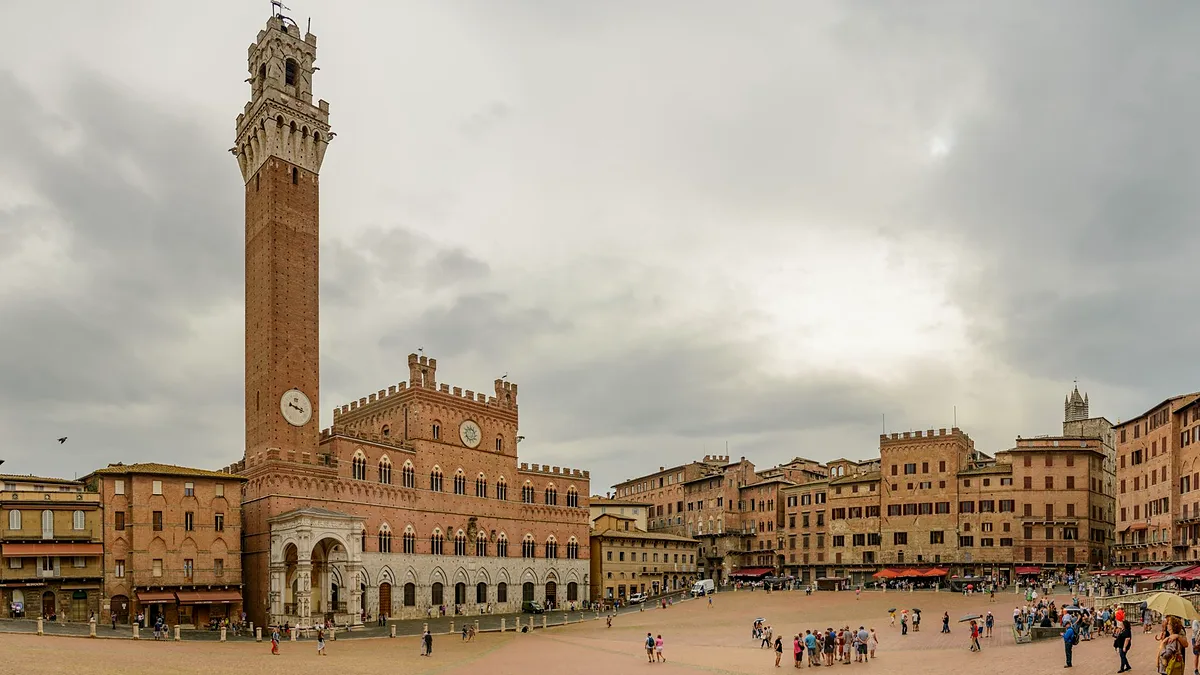
Piazza del Campo is free and open all night, and it belongs to dog walkers and shopkeepers before 8am. The brick fans out in nine segments from the Palazzo Pubblico — one for each member of the medieval council — so the whole city seems to tilt into one room.
Then put your money in one place: the Torre del Mangia, 400 steps and 102 metres straight up. The last stretch is a wooden staircase inside the shaft, and the reward is the entire clay-red city with the Crete hills rolling behind it. It's the best €10 in Tuscany.
- Neighbourhood: Piazza del Campo, Terzo di San Martino.
- Cost: square free; tower €10 (~$11) for a timed slot.
- Best time: 7:00–8:30am for the empty square; 10:00 or 17:30 for the climb.
- Getting there: 8-minute downhill walk from Piazza Gramsci bus hub via Via Banchi di Sopra and Via di Città.
Insider tip: Book the 10am slot online the day before and carry nothing bigger than a small shoulder bag — backpacks get turned away at the gate. The tower also shuts in rain or high wind, so check the forecast before you commit.
2. Duomo and the Piccolomini Library (€5)
Five euros gets you into one of Italy's strangest churches: black and white marble stripes, a nave that feels like a ribcage, and the Piccolomini Library off the left aisle. Pinturicchio's ceiling in that small room is so bright it looks wet, and it's included in the ticket.
If you plan to see more than the cathedral, the Opa Si Pass at about €15 (~$16) covers the crypt, baptistery and museum, and pays for itself after two stops.
- Neighbourhood: Piazza del Duomo, Terzo di Città.
- Cost: €5 (~$5.50) cathedral alone; Opa Si Pass ~€15 (~$16).
- Best time: 10:30–11:30, or after 16:00 when the coach groups have gone.
- Getting there: 5-minute walk from the Campo up Via di Città.
Insider tip: The famous inlaid marble floor is usually boarded over — it's uncovered mainly June to September, and that's also when queues peak. Go early or buy the pass online and walk straight in.
3. The Facciatone: Siena's Best View Is on a Museum Ticket
The Facciatone is the top of an unfinished 14th-century nave — a blind facade you climb along a narrow stone gallery, looking straight down the back of the Duomo and out over the whole valley. Almost nobody does it, because the entrance hides inside the Museo dell'Opera del Duomo.
You spiral up through the museum's sculpture halls, past Duccio's Maestà, and come out into open air. It's the best photograph in the city and it comes free with the pass you already bought.
- Neighbourhood: Piazza del Duomo, opposite the cathedral facade.
- Cost: included in the Opa Si Pass (~€15 / ~$16); around €9 (~$10) on a museum-only ticket.
- Best time: right at 10:00 opening, or 17:00 for warm sideways light.
- Getting there: entrance at the far end of Piazza del Duomo, past the cathedral steps.
Insider tip: Do the Torre del Mangia in the morning and the Facciatone late afternoon — two completely different cities for one ticket. The spiral staircase is tight and one-way; leave strollers and big bags at the desk.
4. Fontebranda and the Orti de' Pecci (Free)
Walk down Via della Costa from the Campo and the city falls away in steps until you reach Fontebranda, a vaulted 13th-century fountain house that still runs. Dante name-checked it, and the water is still cold and free — fill your bottle here.
Two minutes further is the Orti de' Pecci, a walled community garden in the valley with vegetable plots, benches and a straight-up view of the Torre del Mangia that makes the tower look absurd. Entry costs nothing and locals treat it as their own back garden.
- Neighbourhood: Terzo di San Martino, below the Campo.
- Cost: free; picnic supplies €8–12 (~$9–13) from a grocery on Via dei Rossi.
- Best time: 9:00–10:30 for shade, or sunset for the light on the tower.
- Getting there: down Via dei Pellegrini then Via della Costa; 6 minutes from the Campo, steep on the way back.
Insider tip: The little kitchen inside the garden is only reliably open at lunch, so don't build your day around it. Bring bread, pecorino and tomatoes instead, and wear shoes with grip — those brick steps are slick after rain.
5. Fortezza Medicea and the Enoteca Italiana (Free Entry)
The Medici built this squat brick fortress in 1563 to keep Siena quiet, and locals now use it for jogging, football and kissing. Entry is free, the grass is soft, and the western rampart looks over rooftops to the Duomo with nothing between you and the sunset.
Inside the old barracks is the Enoteca Italiana, a national wine cellar with glasses from about €4–6 and short tastings. It's where Sienese buy bottles, not where tour groups stop.
- Neighbourhood: Terzo di Camollia, near Porta Camollia.
- Cost: fortress free; wine €4–6 (~$4.50–6.50) a glass.
- Best time: 19:00–20:30 in summer for the sunset side.
- Getting there: 8-minute walk from Piazza Gramsci, or take the free escalators up from the Fortezza car park.
Insider tip: Buy a bottle at the enoteca and drink it on the grass like everyone else — it's cheaper than a bar table and the view is better. There are no staff policing the ramparts.
6. San Domenico and the Santa Caterina Quarter (Free)
San Domenico is a huge brick barn of a church on the Camollia hill, free to enter, holding the relics of Catherine of Siena in a gilded chapel. Stand on the terrace outside and the Duomo lines up perfectly across the valley — the classic Siena postcard, no ticket needed.
Then walk ten minutes downhill to the Santuario di Santa Caterina, a small church built around her family's home and wool workshop. It's free, silent, and closes for lunch, like everything else here.
- Neighbourhood: San Domenico / Fontebranda, Terzo di Camollia.
- Cost: free; donations welcome.
- Best time: 9:30–11:30, before the church tours arrive.
- Getting there: 10 minutes uphill from the Campo via Via di Fontebranda, or 5 minutes from Piazza Matteotti.
Insider tip: Cover shoulders and knees or you'll be handed a paper shawl at the door. The convent shop sells hard almond biscuits made by the nuns — a better souvenir than anything on Via di Città, and about €5 (~$5.50).
7. Cheap Culture After Dark: Chigiana, Jazz and Free Museum Sundays
From July to August the Accademia Chigiana runs concerts in the church of Sant'Agostino and sometimes the Campo, with tickets often €10–20 and free student recitals at Palazzo Chigi Saracini. Late July brings Siena Jazz, which puts free outdoor sets in and around the Fortezza.
Year-round, the Pinacoteca Nazionale costs €8 (~$9), closes Mondays, and is free on the first Sunday of the month thanks to the national museum scheme. That's Duccio, Simone Martini and the Lorenzetti brothers for nothing.
- Neighbourhood: Sant'Agostino / Via San Pietro, plus the Fortezza.
- Cost: €0–20 (~$0–22) depending on the night.
- Best time: July and August for the festival calendar; first Sunday of any month for the gallery.
- Getting there: all within 12 minutes' walk of the Campo.
Insider tip: Pick up the printed festival programme at the tourist office by the Duomo — unsold Chigiana seats are often released an hour before the downbeat, and nobody thinks to ask.
Where to Eat and Drink Nearby
Antica Trattoria Papei
Piazza del Mercato 6, tucked under the back of the Palazzo Pubblico with tables in the fish market square. Ribollita is €8, pici all'aglione €10, sausage and beans €12, house Chianti €4 a glass — about €25–30 per person for two courses. Open daily for lunch and dinner; reserve or turn up at 12:15.
Osteria Boccon del Prete
Via San Pietro 17, a tiny room where the menu is short and the pici with sausage is the reason people book. Expect €30–35 each with wine, cash preferred, closed Sunday. If they're full, walk five minutes to Via dei Rossi and try your luck.
Il Carroccio
Via dei Rossi 40, an old-school Sienese canteen with paper tablecloths and antipasti from €6. Mains run €9–14 and the house wine is cheaper than water; it's where locals eat on a Tuesday. Closed Sunday.
Quick hits: Nannini on Via Banchi di Sopra for ricciarelli at about €2 each and panforte by weight; Kopakabana on Via dei Rossi for gelato around €3; Enoteca I Terzi on Via dei Termini for a €5–7 glass and a cheese board.
Practical Logistics and Money-Saving Moves
Getting there and around
From Florence the bus beats the train: the 131R leaves the bus station, costs about €10 (~$11), runs 1h15 direct and drops you at Piazza Gramsci inside the walls. Trains require a change at Empoli and take closer to 1h40.
From Siena's station, take any city bus up to Piazza Gramsci for €1.50 (~$1.65) instead of a €15 taxi. There's also a free escalator network — locals call it the tagliatelle — connecting the outer car parks to the centre, which spares your legs and your wallet.
City bus tickets cost €1.50 from a tabacchi and a day pass is about €4.50, but you'll rarely need them. The centre is 1.5 km across with vertical streets, so grippy shoes matter more than transit.
What things actually cost
| Item | Euro | USD |
|---|---|---|
| Coffee at the bar | €1.30 | ~$1.40 |
| Coffee seated on the Campo | €5–6 | ~$5.50–6.50 |
| Trattoria lunch | €15–20 | ~$16–22 |
| Dinner with house wine | €25–35 | ~$27–38 |
| Gelato | €2.50–3.50 | ~$2.70–3.80 |
| Double room, 3-star inside the walls | €90–130 | ~$98–141 |
| Torre del Mangia | €10 | ~$11 |
| Opa Si Pass | €15 | ~$16 |
| Florence bus, one way | €10 | ~$11 |
What to skip
- Any restaurant on Piazza del Campo with a photo menu — triple the price, half the quality, and a €6 seated coffee.
- Multi-language food tours and Palio dinner shows at €45+; eat where the menu is only in Italian.
- The little tourist train around the centre. You can walk the whole loop in 40 minutes.
- Panforte from the first shop below the Duomo; Nannini or a supermarket sells the same thing for 30% less.
- Palio weeks (2 July and 16 August) unless that's the whole point — rooms triple and often demand three-night minimums. Come the day before instead and watch a free trial run.
Frequently Asked Questions
Is Siena expensive to visit?
No — most of the city's best experiences are free, and a comfortable day lands around €70–95 per person. Your only real costs are the tower, the cathedral pass and dinner.
How much do the Duomo and Torre del Mangia cost?
The cathedral alone is €5, the Opa Si Pass covering four sites is about €15, and the tower is €10 with a timed slot. Buy both online to skip the ticket queues.
Can you visit Siena as a day trip from Florence on a budget?
Yes — the 131R bus takes 1h15 and costs about €10 each way, far easier than the train. Arrive by 9:30am, and stay until 7pm when the groups leave and the Campo empties out.
When is the cheapest time to visit Siena?
Late March to May and late September to November, when rooms drop to €80–120 and restaurants have space. Avoid Palio weeks and the August national holiday, when prices roughly double.