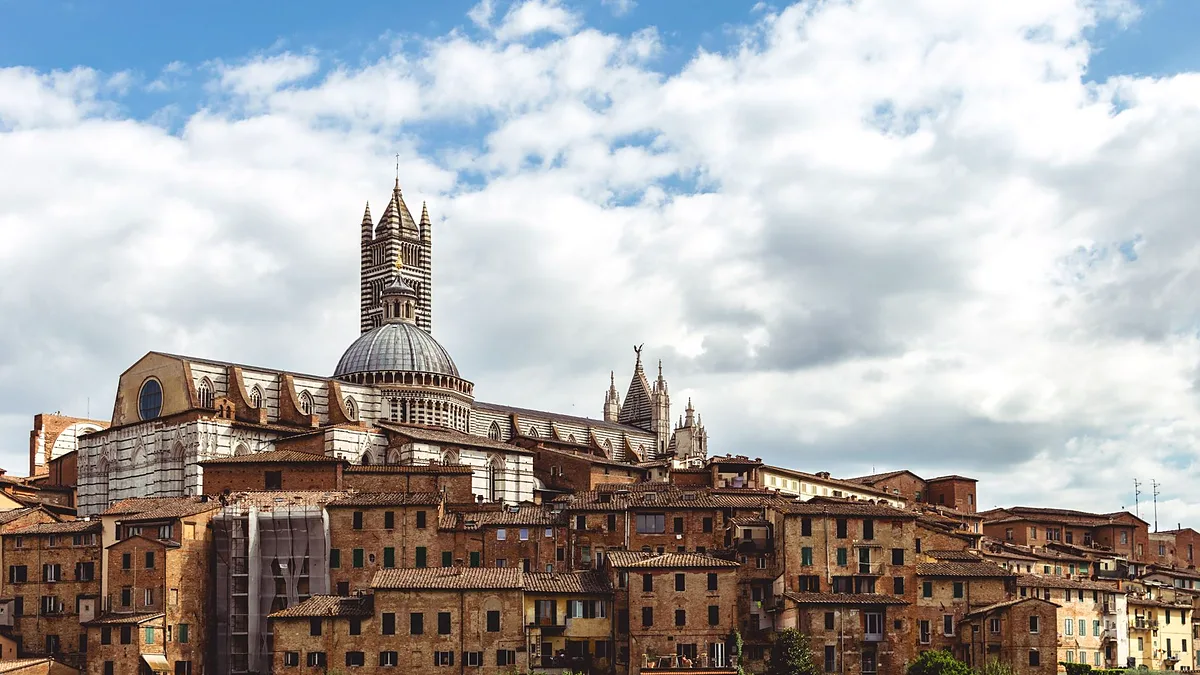

Siena looks like one square and one very tall tower. It isn't. The city's real collection sits behind unmarked doors: contrada oratories that unlock for three afternoons a week, a brick aqueduct running under your feet, private academies that have been meeting since the 1500s.
This guide is for the traveler who'd rather pay €5 to stand alone in front of a Sodoma fresco than €30 to follow a raised umbrella. Everything below is genuinely open to the public — just on narrow, slightly awkward schedules. Plan around those hours and you'll see a Siena most visitors walk straight past.
At a Glance
- Best time to go: Late April to June, or September to mid-October. July and August are hot, crowded, and expensive, and the Palio days (2 July and 16 August) book out the entire city.
- Daily budget: Roughly €70–130 (~$75–140) per person, covering two museum entries, coffee, lunch, a proper dinner and local buses.
- Getting around: On foot, entirely. The center is pedestrianized but steep — expect real hills and staircases between districts.
- Vibe: Quiet, brick-colored, deeply local. Siena rewards slow walkers and punishes people in a hurry.
1. Santa Maria della Scala — Skip the Courtyard
This enormous former hospital faces the Duomo and has been sheltering pilgrims, orphans and the sick for roughly a thousand years. Most people wander the entrance courtyard, take two photos, and leave. That's a mistake, because the building keeps unfolding for another hour in every direction.
Unlimited High-Speed International Travel eSIM
Connect in seconds across 180+ destinations. Instant QR code activation with zero roaming surcharges.

Head first for the Sagrestia Vecchia, a small painted room by Vecchietta from the 1440s that is often completely empty. Then go down into the brick corridors below, where the old cisterns and storerooms still smell of damp stone, and finish in the archaeological rooms with Etruscan and Roman finds from the surrounding hills.
- Neighborhood: Terzo di Città, Piazza del Duomo 1, directly opposite the cathedral steps.
- Cost: €10 (~$11) adult; combined tickets with the Museo Civico run about €20 (~$22).
- Best time of day: Right at opening, or after 15:00 when school groups have gone.
- Getting there: Three minutes uphill from Piazza del Campo — a steep, stepped climb.
Insider tip: Go to the Sagrestia Vecchia first. Guided groups always start at the big frescoed pilgrim ward, so you'll have the small rooms to yourself for a good 20 minutes.
2. The Bottini — Siena's Underground Aqueduct
Medieval Siena built a 25-kilometer network of brick tunnels to carry water into the city's fountains, and long stretches still work. Guided walks descend into them through narrow openings and follow the channel for around a kilometer, torchlit and cool, with the original plaster and graffiti still on the walls.
This is the single strangest thing you can do in Siena, and hardly anyone does it. Groups are capped at around 15 people, so book ahead rather than turning up.
- Neighborhood: Access points vary — usually near Fontebranda or Porta San Marco, in the Terzo di San Martino.
- Cost: About €15 (~$16) per person; longer routes can hit €20 (~$22).
- Best time of day: Afternoon slots, generally weekends only, roughly March to November.
- Getting there: Meeting point confirmed at booking; all are within a 10-minute walk of the center.
Insider tip: The tunnels run at about 14°C year-round and some sections are low — bring a light layer, wear flat closed shoes, and skip it if you dislike tight spaces. Ask about the language of the tour when you book; several are Italian-only.
3. Oratorio di San Bernardino — Free Frescoes, No Crowd
Tucked beside the Basilica di San Francesco, this small oratory holds a cycle of frescoes by Sodoma painted in the 1530s, plus a lower chapel that's easy to miss. The colors are still strong, the lighting is poor in a way that feels honest, and there is usually nobody else inside.
Entry is free or by small donation, which makes it the best value art stop in the city by a wide margin. Hours are volunteer-run, so treat any timetable as a hint rather than a promise.
- Neighborhood: Terzo di San Martino, Piazza San Francesco.
- Cost: Free; a €2–3 (~$2–3) donation is the polite move.
- Best time of day: Late morning, roughly 10:00–12:30, or mid-afternoon. Closed over lunch.
- Getting there: Six-minute walk downhill from Piazza del Campo via Via San Martino.
Insider tip: Combine it with the basilica next door, which is also free and has a beautiful bare interior. Then walk five minutes to the terrace on Piazza San Francesco for a quiet view over the rooftops.
4. Contrada Museums and Oratories — Siena's Real Private Clubs
Siena is split into 17 contrade, semi-private neighborhood clubs that run the Palio and most of the city's social life. Each one keeps a museum and oratory packed with racing silks, painted banners, trophies and photographs going back generations. A handful open to visitors for a few hours a week.
The Contrada della Torre on Via Salicotto and the Contrada dell'Oca near Santa Caterina are two of the friendliest, and the volunteer on duty is usually delighted to explain what you're looking at. This is the closest most travelers get to the private side of Siena without an invitation.
- Neighborhood: Scattered across all three terzi — Torre in Salicotto, Oca around Via Santa Caterina, Nicchio near Via dei Pispini.
- Cost: €3–5 (~$3–6) per museum, cash appreciated.
- Best time of day: June to September, typically two or three afternoons a week from about 16:30 to 19:00.
- Getting there: All within a 10-minute walk of Piazza del Campo; look for a small sign or an open green door.
Insider tip: Sign the guestbook, then ask the person on duty which contrada won their first Palio. You will get a 20-minute story and possibly a phone number for the next dinner.
5. Palazzo Chigi Saracini and the Chigiana
This palace on Via di Città houses the Accademia Musicale Chigiana, one of Europe's most respected summer music schools, and a private art collection that includes works by Beccafumi, Sodoma and Guercino. Visits run by appointment in small groups, so it feels less like a museum and more like being let into someone's very grand house.
The concert hall is the highlight — a painted, gilded room that hosts the Micat in Vertice series in July and August. Tickets for those evenings are reasonable and the sound is excellent.
- Neighborhood: Terzo di Città, Via di Città 89.
- Cost: Guided visits around €10–12 (~$11–13); concerts roughly €15–35 (~$16–38).
- Best time of day: Weekday mornings for visits; evening for concerts.
- Getting there: Two minutes from Piazza del Campo, but the entrance is discreet — look for the numbered door, not a banner.
Insider tip: Email or phone a few days ahead instead of showing up. Visiting hours change with the academic calendar, and the door is often locked outside them.
6. Teatro dei Rozzi and the Accademia dei Rozzi
The Accademia dei Rozzi was founded in 1531 as a club for artisans and writers, and it still occupies a neoclassical theatre on Piazza Indipendenza. The academy is private; the theatre opens for performances, lectures and occasional open days, and the painted auditorium is worth the price of a cheap ticket on its own.
Check the playbill posted by the entrance rather than the website — the schedule is genuinely printed and posted first. Even if nothing's on, the little square outside is one of the calmest places to sit in the city.
- Neighborhood: Terzo di Camollia, Piazza Indipendenza.
- Cost: Events typically €10–25 (~$11–27); open days are free.
- Best time of day: Evening, roughly 20:30–21:00 curtain.
- Getting there: Five-minute walk north from Piazza del Campo via Via di Città and Via dei Rossi.
Insider tip: Seats in the upper tiers are cheaper and have a better view of the ceiling fresco than the stalls. Nobody checks whether you linger in the foyer afterwards.
7. Pinacoteca Nazionale — the Quietest Great Gallery in Tuscany
This is where Siena keeps its gold-ground paintings: Duccio, Simone Martini, the Lorenzetti brothers, all on two floors of a former palazzo on Via San Pietro. In Florence you'd queue for these names. Here you'll often share a room with two other people.
The upper floor holds the strongest works and the best light, and it's almost always empty. Give it 90 minutes minimum; it's the single best €8 you'll spend in the city.
- Neighborhood: Terzo di San Martino, Via San Pietro 29.
- Cost: About €8 (~$9) adult.
- Best time of day: Opening time, roughly 09:00; the light through the upper windows is best before noon.
- Getting there: Eight minutes' walk from Piazza del Campo, uphill along Via San Pietro. Closed Mondays.
Insider tip: Many rooms have printed captions in Italian only. Photograph the English information sheets near the entrance before you start and read them as you go.
Where to Eat and Drink Nearby
Osteria Nonna Gina (Via Pianigiani 2, near San Domenico) is a plain, noisy, honest trattoria with paper placemats and a handwritten menu. Expect pici all'aglione, ribollita and a house red for around €25–32 (~$27–35) per person. Book, or arrive at 19:30 sharp.
Osteria Boccon del Prete (Via San Pietro 17) sits two minutes from the Pinacoteca and is where locals go after work. Portions are generous, the pici with Chianina ragù is the thing to order, and dinner runs about €30–40 (~$33–44) with wine.
Enoteca I Terzi (Via dei Termini 7) is a wine bar rather than a restaurant, and the right move after an afternoon of frescoes. A glass of Montalcino and a cheese board will set you back €20–28 (~$22–31). For sweets, skip the souvenir shops and get ricciarelli at Nannini on Via Banchi di Sopra — about €1.50 (~$1.60) each.
Practical Logistics and Budget Tips
Do not drive into the center. The ZTL cameras will catch you and the fine starts around €80 (~$88). Park at the Il Campo or Stadio lots on the edge and use the escalators up into town — free, covered, and a genuine leg-saver.
City buses are cheap and useful for the station run: a single ticket is about €1.50 (~$1.60), and buses 3, 8, 9 and 17 connect the train station with Piazza Gramsci in around 15 minutes. The little orange Pollicino minibuses loop through the historic center when your feet give out. A day pass is roughly €5 (~$5.50).
Free drinking fountains are everywhere, so carry a bottle instead of buying water. Sit-down restaurants add a coperto of €2–3 (~$2–3) per person, and most small museums close between roughly 12:30 and 15:00 and shut entirely on Mondays.
What to skip: the cafés ringing Piazza del Campo, where a spritz can cost €12 (~$13); the "Palio history" film screenings sold from kiosks near the square; and souvenir-shop panforte, which is dry and overpriced. Also think twice about climbing the Torre del Mangia at midday in summer — 400 steps in full sun, €10 (~$11). Go at opening or an hour before closing instead.
Frequently Asked Questions
Are Siena's contrada museums open to the public?
Yes, most open a few afternoons a week from roughly June to September, run by volunteers for a €3–5 entry fee. Look for a small sign or an open door at the oratory, and don't expect fixed hours outside summer.
How do I book a tour of Siena's underground aqueduct?
Book through the authorized local guides who run the Bottini walks, ideally one to two weeks ahead in spring and autumn. Tours cost about €15–20 (~$16–22), run mostly at weekends, and cap numbers at around 15 people.
Is Siena walkable, or do I need a bus?
The historic center is car-free and easy to walk end to end in 20 minutes, but it is extremely hilly with constant steps. Use the escalators from the edge-of-town car parks and the Pollicino minibuses if you're carrying luggage or traveling with kids.
What's the best free art in Siena?
The Oratorio di San Bernardino holds Sodoma frescoes with free or donation entry, and the Basilica di San Domenico is free and has a striking, bare interior. For paid art, the €8 Pinacoteca Nazionale is far quieter than anything comparable in Florence.