
Most visitors come to Siargao for one wave and leave with two hundred photos of palm trees. Fair enough. But the island's real character lives in the boatyards, weavers' stalls and market lanes that keep running long after the surf report goes flat.
Siargao is not a heritage-tourism island like Vigan or Ilocos. There are no grand colonial mansions to queue for. What it has instead is a working culture — coconut farming, fishing, boat building, surf craft — and the small workshops attached to it. You will need to ask permission and slow down, and that's the whole point.
This guide is for travelers who'd rather spend a morning watching a banca take shape than line up for a lagoon photo. Everything below is walkable, scooter-friendly, or a short habal-habal hop from General Luna.
Unlimited High-Speed International Travel eSIM
Connect in seconds across 180+ destinations. Instant QR code activation with zero roaming surcharges.

At-a-Glance Snapshot
- Best time to visit: March to June for dry weather and calm crossings. September to November is peak surf season, so workshops and markets are busiest but accommodation costs climb 40–60%.
- Typical daily budget: ₱1,800–3,500 (~$32–62 USD) covering scooter hire, meals, entrance fees and one paid workshop or guide.
- Local transport: No Grab, no Uber. You'll use habal-habal (motorbike taxis), tricycles, and a rented scooter at ₱350–500 (~$6–9 USD) per day.
- General vibe: Informal, slow, tide-dependent. Nothing starts before 7am and most workshops shut by 4pm.
1. Cloud 9 Boardwalk and the Old Judging Tower
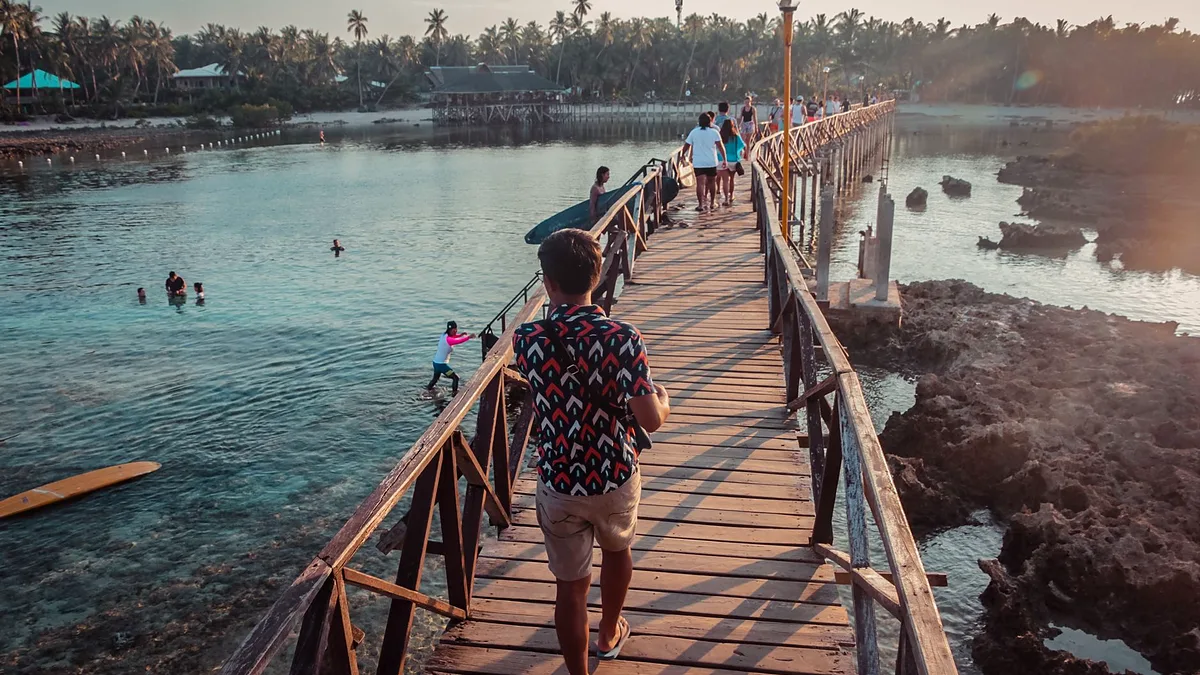
The wooden boardwalk at Cloud 9 is the closest thing Siargao has to a national monument, and locals treat it that way. It was built for the surfing cup that put this island on the map in the 1990s, and the timber judging tower at the end still creaks underfoot.
Walk it slowly. On the seaward side you can watch locals paddle out over the reef shelf, and on the landward side there are small shapers' sheds and a couple of stalls selling coconut-shell buttons and hand-cut wooden fins. It's a 20-minute visit unless you stop for photos, which you will.
- Neighborhood: Barangay Catangnan, General Luna, at the end of the road past Tourism Road.
- Cost: Free to walk. Some events charge a ₱50 (~$1 USD) environmental fee at the gate; parking is ₱20 (~$0.35 USD).
- Best time of day: 6:00–7:30am for empty boards and soft light, or 4:30–5:45pm for sunset from the tower.
- Getting there: 10 minutes by habal-habal from General Luna town center, ₱50–80 (~$1–1.50 USD).
Insider tip: Walk south past the tower toward the fishing village rather than north toward the resorts. The southern stretch is where the old coral-stone steps and the original wooden stairway survive, and you'll have them almost entirely to yourself.
2. Dapa Public Market and the Market Lanes
Dapa is the island's real town — the port, the provincial offices, the hospital — and its market is where Siargao actually shops. This is not a tourist market. It's a working hall of dried fish, coconut oil, hardware, and woven goods piled on tarpaulins.
Head to the stalls behind the fish section for pandan and buri weaving: sleeping mats (banig) from ₱250 to ₱900, market totes (bayong) from ₱150 to ₱400, and small coin purses for under ₱50. Upstairs and to the rear you'll find secondhand clothing, farming tools and occasionally a woman selling freshly distilled coconut oil by the recycled bottle.
- Neighborhood: Dapa town center, roughly 20–25 minutes north of General Luna.
- Cost: Free entry. Expect ₱200–400 (~$3.50–7 USD) for a decent mat, ₱60–80 (~$1–1.40 USD) for a liter of tuba.
- Best time of day: 5:30–8:00am. Saturday draws vendors from the outer barangays and is the biggest day; by 2pm the weaving stalls are packing up.
- Getting there: Habal-habal or tricycle from General Luna, ₱100–150 (~$1.80–2.70 USD). Motorbikes from Dapa port run constantly.
Insider tip: Bring small bills and exact change. Vendors rarely have change for a ₱1,000 note before 9am, and there's no ATM inside the market — the nearest ones in Dapa town run dry on weekends.
3. Del Carmen Mangrove Boardwalk and Craft Stalls
Del Carmen's mangrove forest is protected by the local government and a community association, and the 1.3-kilometer boardwalk through it is the most peaceful hour you'll spend on the island. Herons, mudskippers, and the occasional monitor lizard; almost no noise.
The small visitor center at the entrance sells nipa shingles, woven pandan fans and mangrove honey from households in the surrounding barangays. It's not a formal workshop, but the staff will happily explain how the nipa panels are cut and dried if you ask — most visitors don't.
- Neighborhood: Del Carmen municipality, about 10 minutes from Sayak Airport.
- Cost: ₱30–50 (~$0.55–0.90 USD) entrance. Paddle boat tours run ₱200–500 (~$3.50–9 USD) depending on group size.
- Best time of day: 7:00–10:00am, timed to high tide so the water actually sits under the walkway.
- Getting there: 45–50 minutes by scooter from General Luna via the circumferential road, or a ₱150–200 habal-habal from Del Carmen town proper.
Insider tip: Check the tide chart before you commit. At low tide you're staring at mud, which is interesting for about four minutes. Ask your guesthouse to confirm the high tide window the night before.
4. The Banca Boatyards of Pilar and Dapa
Traditional outrigger boats are still built by hand on this island, and in the shoreline yards around Pilar and the boat sheds near Dapa port you can watch it happen. Adze work, hand-drilled planks, bamboo outriggers lashed with nylon — no factory, no conveyor belt.
These are working yards, not attractions. Nobody will hand you a ticket or a brochure. Stand at a respectful distance, catch someone's eye, and ask if you can watch for a while. In my experience the answer is almost always yes, followed by an offer of coffee.
- Neighborhood: Pilar town shoreline and the boat sheds south of Dapa port.
- Cost: Free, but budget ₱200–300 (~$3.50–5.50 USD) to buy the crew snacks or hire a local fixer to introduce you.
- Best time of day: 7:00–10:00am, before the heat makes the work miserable. Avoid Sundays.
- Getting there: Pilar is 25 minutes south of General Luna by scooter; the Dapa sheds are a 5-minute walk from the port terminal.
Insider tip: Never photograph a boatbuilder's face without asking first, and don't stand between the workers and the hull. The most common tourist mistake here is walking straight into the work zone for a video.
5. Tuba Stalls and Coconut Sap Heritage
Coconut toddy — tuba — is the island's oldest drink, and you'll see the collection points all along the circumferential road. A climber shimmies up a coconut trunk twice a day to slice the flower stalk and hang a bamboo tube beneath it.
The roadside stalls, especially around Santa Monica, San Isidro and Pilar, sell it by the recycled bottle. Fresh morning tuba is sweet and lightly fizzy; by late afternoon it has fermented into bahal, which is sour, stronger, and an acquired taste.
- Neighborhood: Scattered along the Siargao Circumferential Road; the densest cluster sits around Santa Monica and Pilar.
- Cost: ₱60–100 (~$1–1.80 USD) per 1.5-liter bottle. Aged bahal ₱100–150 (~$1.80–2.70 USD).
- Best time of day: 8:00–11:00am for fresh, sweet tuba. After 3pm you're buying bahal whether you meant to or not.
- Getting there: Scooter is the only practical option. Flag down any stall with hanging bamboo tubes.
Insider tip: Ask for "bag-ong tuba" (fresh tuba) if you want the sweet version, and bring your own empty bottle — most stalls charge a small deposit or refuse to part with their containers.
6. Ding-Repair and Board-Shaping Sheds Behind Cloud 9
This is the closest thing to a hands-on craft workshop on the island. The small sheds behind Cloud 9 and along the Catangnan road repair surfboards for locals and travelers — sanding, fiberglassing, resin work, all done by hand in 35-degree heat.
A few shapers will let you sit in for a ding-repair session, and it's genuinely satisfying work. Bring a board with a ding and you'll learn more in two hours than in a week of YouTube tutorials. Custom board orders take three to six weeks.
- Neighborhood: Barangay Catangnan, behind the Cloud 9 boardwalk and along the road to General Luna.
- Cost: Ding repair ₱500–1,500 (~$9–27 USD) depending on size. A full custom board runs ₱18,000–30,000 (~$320–535 USD).
- Best time of day: 8:00–10:00am, before the resin gets tacky in the afternoon heat.
- Getting there: Walkable from the Cloud 9 boardwalk or a ₱50 habal-habal from General Luna.
Insider tip: Message the shaper the day before rather than turning up. Most of them split their time between repairs and surf lessons, and a walk-in at 1pm will usually get you a polite "come back tomorrow."
Where to Eat and Drink Nearby
Mama's Grill — Tourism Road, General Luna. Charcoal-grilled squid, pork belly and fish, served on banana leaf with rice and a calamansi dip. Mains ₱180–350 (~$3.20–6.20 USD). Open daily 11am–10pm. Go before 6:30pm or you'll wait 30 minutes for a table.
Dapa Market Carinderias — inside and around the public market, Dapa. Breakfast from 5:30am: sayongsong (sticky rice steamed inside a banana-leaf cone, ₱20–30), longganisa, and endless rice. A full plate runs ₱80–150 (~$1.40–2.70 USD). Cash only, and the best trays are gone by 8am.
Corregidor Bar — Cloud 9 boardwalk, General Luna. The sunset seat on the island. Rum and coke ₱150 (~$2.70 USD), grilled bar chow ₱200–350. Opens around 4pm; the deck fills by 5:15pm in high season.
If you want one sit-down splurge, Kermit in General Luna does wood-fired pizza and pasta at ₱350–550 a plate — decent, though not cheap by island standards.
Practical Logistics and Budget Tips
Getting around
Sayak Airport (IAO) sits in Del Carmen, 45 minutes from General Luna. Shared vans run ₱300 (~$5.35 USD) per seat. Once you're on the island, rent a scooter for ₱350–500 per day and budget ₱85 per liter of fuel — a full tank lasts most people three days.
Money
Cash is king. ATMs in General Luna are few, frequently empty, and cap withdrawals at ₱10,000. Bring pesos from Cebu, Manila or Surigao City. Most workshops and market vendors don't take cards, and the few that do add a 3–5% surcharge.
What to skip
Package tours that bundle three islands and a lagoon into one day are exhausting and overpriced at ₱1,800–2,500 per person. Sugba Lagoon on a group tour is crowded by 10am; go independently at opening or not at all. And the much-photographed coconut-lined road is a 90-second photo stop, not a destination — don't build a morning around it.
Honest heads-up
Midday heat between 11am and 3pm is brutal, and almost every workshop, market and boatyard goes quiet during it. Plan your craft stops for early morning, and keep afternoons for the beach. Also note that prices for habal-habal rides roughly double after dark.
Frequently Asked Questions
Are there real craft workshops in Siargao?
Yes, but they're informal rather than commercial. The most reliable are the ding-repair and board-shaping sheds around Catangnan and the weaving stalls at Dapa market, where you can watch and often join in for a small fee.
What's the best day to visit Dapa public market?
Saturday is the biggest market day, when vendors from the outer barangays bring their goods in. Arrive between 5:30am and 8am for the best selection and the freshest food.
How much does a craft and heritage day cost in Siargao?
Roughly ₱1,200–1,800 (~$21–32 USD) per person if you hire a scooter, pay entrance fees, buy a mat or two and eat at local carinderias. Hiring a guide for the boatyards adds ₱200–300.
Do I need a guide to visit the boatyards?
Not strictly, but it helps enormously. A local introduction makes the difference between being tolerated and being welcomed, and most guesthouses can arrange one for a few hundred pesos.