
Most people come to Siargao for one wave — Cloud 9 — and leave without meeting the people who actually make things here. That is a waste, because the island's real texture lives in its workshops and working sites: surfboard bays that smell of resin, pandan mats drying on fences in Dapa, and fish traps older than any resort on the coast.
This guide covers where to watch, learn, and buy, with realistic prices, sensible timing, and honest notes on what is worth your morning and what you can skip.
At-a-Glance Snapshot
- Best time to visit: March to June for calm seas and easy boat trips. August to November if you want big surf to watch while you are here.
- Typical daily budget: ₱1,800–3,000 (~$31–52) for a scooter, a simple room, and market meals. ₱5,000+ (~$86) for resort comfort.
- Local transport style: rented scooter (₱350–500/day) or habal-habal motorbike taxis. Vans and multicabs link General Luna and Dapa.
- General vibe: laid-back, dusty roads, cash-only, slow mornings, patchy wifi.
1. Watch a Surfboard Take Shape in General Luna
In a shed off the Tourism Road in General Luna, shapers turn foam blanks into boards that get ridden at Cloud 9 the same week. You can stand in the doorway and watch a planer run down a stringer for as long as you like. Nobody minds.
Unlimited High-Speed International Travel eSIM
Connect in seconds across 180+ destinations. Instant QR code activation with zero roaming surcharges.

This is not a polished factory tour. It is dusty, loud, and smells like resin and coconut oil. But if you have ever wondered why a custom board costs what it does, an hour here explains the whole thing.
- Neighborhood: General Luna, along Tourism Road near the Cloud 9 turn-off
- Cost: free to watch. Custom boards ₱18,000–30,000 (~$310–520), ding repair ₱500–1,500 (~$9–26)
- Best time of day: weekday mornings, before the repair queue builds
- Getting there: 5-minute tricycle ride from Cloud 9, ₱50–100 (~$1–2)
Insider tip: Ask what is already on the racks before you order anything custom. Off-the-rack boards made for visiting surfers sell at a discount when their owners fly home, and a good secondhand board costs half of new.
2. Weave a Banig with the Women of Dapa
Dapa is the island's market town and the quieter, older side of Siargao. Women here still weave pandan and karagumoy into banig — sleeping mats — plus baskets, placemats, and fans that sell for a fraction of what resort gift shops charge.
There is no ticketing counter for this. Ask at the public market or the municipal tourism office and someone will usually walk you to a nearby weaving household that is happy to show you the loom and sell direct.
- Neighborhood: Dapa Poblacion, around the public market and side streets
- Cost: free to visit. Mats ₱300–1,500 (~$5–26) depending on size and tightness of weave
- Best time of day: weekday mornings. Market day is liveliest but the weavers are busiest
- Getting there: van or multicab from General Luna, 25–30 minutes, ₱50–80 (~$1–2)
Insider tip: Buy from the weaver, not the boutique. The markup is often triple, and the money never reaches the person who spent two weeks on the mat. Ask to try two rows of weaving — it is harder than it looks, and that is half the fun.
3. Walk the Mangrove Boardwalk at Del Carmen
The Siargao Mangrove Protected Area in Del Carmen is one of the largest remaining mangrove forests on the island: hundreds of hectares of bakawan, replanted and guarded by the community that lives behind it. A wooden boardwalk loops through the trees and a small paddle boat takes you deeper into the channels.
This is a heritage site in the practical sense. The forest is what stops storm surge from flattening the villages inland. Guides explain which species were used for dye, medicine, and charcoal, and how the seedling nursery keeps the whole thing going.
- Neighborhood: Del Carmen, off the road to Sayak Airport
- Cost: ₱100–150 (~$2–3) entrance, paddle boat extra
- Best time of day: 7–9 a.m., before the heat and the tour vans
- Getting there: about 45 minutes from General Luna by scooter, or 10 minutes from Sayak Airport
Insider tip: Wear closed shoes — the boardwalk gets slick after rain — and bring mosquito repellent. This is a working forest, not a landscaped park, and the sandflies know it.
4. Time the Tide at Magpupungko and the Baklad Traps
Magpupungko's rock pools in Pilar only appear at low tide, which is why half the island shows up at the wrong hour and sees nothing but open ocean. Go when the tide table says low and you get turquoise pools set in black rock, plus a clear view across the reef flat.
Out past the break, look for the baklad — traditional bamboo-and-net fish traps staked offshore, some tended by the same families for generations. Ask a local guide about how they work and you will get a better story than any museum panel could give you.
- Neighborhood: Pilar, east coast, roughly 45 minutes from General Luna
- Cost: ₱50–100 (~$1–2) entrance, parking ₱20–50
- Best time of day: within 1–2 hours either side of low tide, no exceptions
- Getting there: scooter or habal-habal. Roads are paved but rough in patches after rain
Insider tip: Check a tide app the night before, not at breakfast. Pair the trip with Tayangban Cave Pool nearby (₱100–150 / ~$2–3), where you float through a dark limestone tunnel on a lifeline — genuinely fun, and almost nobody does both in one go.
5. Trace the Surf Story at the Cloud 9 Boardwalk
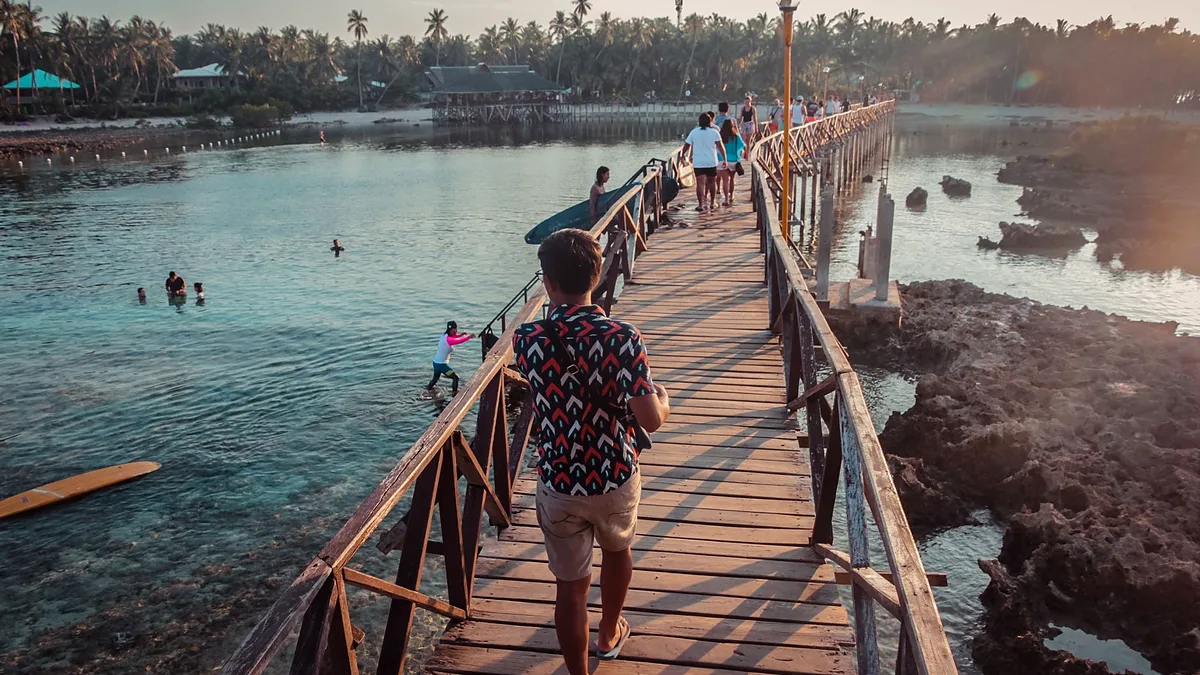
The wooden boardwalk above Cloud 9 is the closest thing Siargao has to a monument. It was built so surfers could cross the reef without tearing it apart, and it now frames the break that put the island on the map in the late 1980s.
Walk it at sunrise and you will have the tower mostly to yourself. The Siargao International Surfing Cup has run here for decades, and the wall of old contest photos near the entrance is a free, genuinely interesting slice of local sports history.
- Neighborhood: Cloud 9, General Luna
- Cost: free to walk the boardwalk, small parking fee ₱20–50
- Best time of day: 5:30–7 a.m. for empty planks and good light
- Getting there: 10 minutes by tricycle from General Luna town center, ₱50–100 (~$1–2)
Insider tip: Never walk the reef flat barefoot. Coral cuts get infected fast in this climate. Wear booties or sandals, and do not stand on living coral while you frame a photo — the boardwalk exists precisely so you do not have to.
6. Learn Kubo Building and Tuba Tapping in the North
Head north past Burgos and Santa Monica and the resorts thin out into coconut land, where carpenters still build kubo — nipa-and-bamboo huts — with joinery that needs almost no nails. Several family homestays will let you help for a morning if you ask a day ahead.
The other craft up here is tuba: coconut sap tapped from the flower stalk at dawn, drunk fresh or left to ferment into vinegar. Watching a tapper climb a 15-meter palm with a bamboo harness is worth setting an early alarm for.
- Neighborhood: Burgos, Santa Monica, and Pacifico
- Cost: homestay ₱800–1,500 (~$14–26) a night. A building session is usually barter or a ₱500 (~$9) thank-you
- Best time of day: 5–7 a.m. for tuba collection, mid-morning for building
- Getting there: scooter, 45–60 minutes north of General Luna on paved road
Insider tip: Arrange it through your homestay owner, not a tour desk. And if you are offered tuba, drink it the same day — in this heat it turns to vinegar faster than you would believe.
Where to Eat & Drink Nearby
Kermit, General Luna
Wood-fired pizza and solid Filipino plates a short walk from the Cloud 9 road. Mains run ₱350–550 (~$6–10), and the kitchen stays open late enough to feed you after a sunset session. Book ahead on weekends.
Shaka, General Luna
Smoothie bowls, proper coffee, and shade. Budget ₱200–350 (~$3.50–6) for breakfast. It is busy from 8 a.m. because the wifi actually works, which tells you something about the rest of the island.
Carinderias at Dapa Public Market
Rice plus two viands for ₱100–150 (~$2–3). Point at what looks good, sit where the tricycle drivers sit, and you will eat better than most resort guests do. Go before 1 p.m. or the good trays are gone.
Practical Logistics & Budget Tips
Siargao runs on cash. ATMs exist in Dapa and General Luna but empty out on weekends, and withdrawal limits hover around ₱10,000. Pull money on a weekday morning and keep small bills for tricycles, parking, and entrance gates that never have change.
Rent a scooter (₱350–500/day) if you are comfortable on two wheels — it is the only realistic way to reach the mangrove forest and the northern towns on your own schedule. Otherwise, habal-habal rides between towns cost ₱100–300 and are easy to flag on the main road.
| Item | Typical cost (PHP) | Approx. USD |
|---|---|---|
| Scooter rental, per day | 350–500 | $6–9 |
| Fuel, per liter | 60–75 | $1–1.30 |
| Sayak Airport van to General Luna | 300–500 | $5–9 |
| Magpupungko entrance | 50–100 | $1–2 |
| Del Carmen mangrove entrance | 100–150 | $2–3 |
| Tayangban Cave Pool | 100–150 | $2–3 |
| Sugba Lagoon boat, up to 6 people | 1,600–2,000 | $28–35 |
| Banig mat, direct from weaver | 300–1,500 | $5–26 |
| Custom surfboard | 18,000–30,000 | $310–520 |
What to skip: the combined Sohoton-plus-Sugba day trip sold at hotel desks. It sounds efficient and is actually six hours in a van and a boat for two rushed stops. Pick one. Also skip Sugba Lagoon between 10 a.m. and 2 p.m. unless you enjoy sharing a dive platform with eighty people — go at opening or not at all.
Honest heads-up: brownouts happen, wifi is unreliable, and the roads flood in heavy rain. Build slack into any day where you have a flight to catch. On the plus side, that same slowness is why the crafts here still feel real rather than staged.
Frequently Asked Questions
Are there real craft workshops in Siargao, or is it mostly beaches?
Both, but the workshops are informal. Surfboard shaping in General Luna, banig weaving in Dapa, and kubo building up north are arranged by asking directly rather than booking online. Budget half a day and treat it as a visit, not a formal class.
Which heritage sites in Siargao are actually worth visiting?
The Del Carmen mangrove forest, the Cloud 9 boardwalk, and the baklad fish traps off Pilar are the three most genuine. None of them are museum-style attractions — they are working sites, which is exactly why they are worth your time.
How much should I budget per day in Siargao?
₱1,800–3,000 (~$31–52) covers a scooter, a basic room, three meals, and one entrance fee. Add ₱1,500–2,500 (~$26–43) on days you join a boat tour or hire a guide.
Do I need cash for workshops and entrance fees?
Yes, almost always. Weavers, shapers, and gate attendants rarely take cards, and the ATMs in Dapa and General Luna run dry on weekends. Withdraw on a weekday morning and carry small denominations.