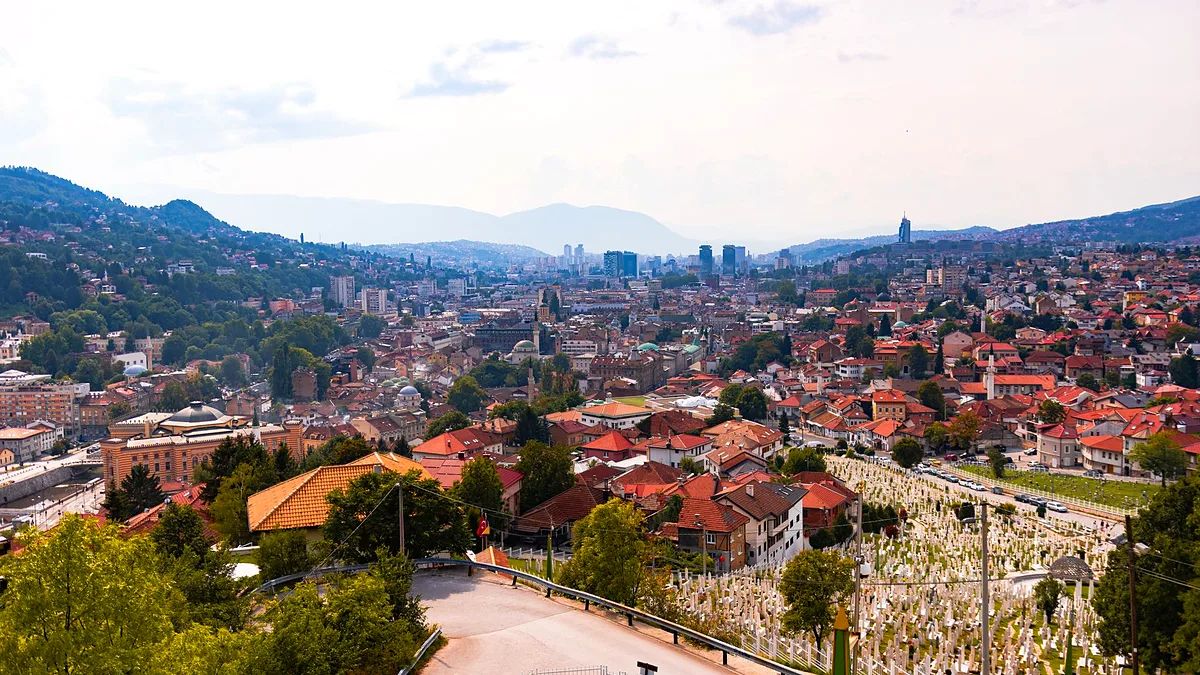

Sarajevo rewards the traveler who slows down. Most visitors sprint from the Sebilj to the Yellow Fortress and back, but the city's real cultural pulse beats in small rooms: a memorial gallery on Ferhadija, a concrete exhibition hall under Skenderija, a garden club in Kovačići where the band starts at ten and nobody checks a guest list.
This guide is for the traveler who would rather spend an hour alone with one photograph than queue for a viewpoint. Every spot below is real, walkable and cheap. Several are completely free.
Bring small cash and decent shoes. Sarajevo is built on hills, and the good stuff is never on the flat.
Unlimited High-Speed International Travel eSIM
Connect in seconds across 180+ destinations. Instant QR code activation with zero roaming surcharges.

Sarajevo at a Glance
- Best time to visit: late April to June, or September to early October. August is hot, crowded and booked solid during the Sarajevo Film Festival.
- Typical daily budget: 90 to 150 KM (~$50 to $85 USD) covering coffee, two meals, a museum or two and tram fares.
- Getting around: walk the old town, use trams 1, 2 and 3 for anything along the east-west valley, and take taxis only after dark or uphill.
- Vibe: unhurried, smoke-filled, deeply social. Nobody minds if you sit in a café for three hours on one coffee.
Galerija 11/07/95: The Room That Refuses to Look Away
Galerija 11/07/95 exists for one reason: to keep the Srebrenica genocide from becoming a paragraph in a textbook. It is a small, dimly lit space on Ferhadija holding photographs, video testimony and a room of personal belongings that once belonged to people killed in July 1995.
It is not entertainment, and it never pretends to be. Most people need 60 to 90 minutes here, and there is a reason the café downstairs is always full of people sitting quietly afterwards.
- Neighborhood: Ferhadija 13, right in the pedestrian center.
- Cost: 10 KM (~$6 USD) for adults, less for students.
- Best time: 9 am to 11 am, before tour groups arrive.
- Getting there: a five-minute flat walk from the Cathedral or the Baščaršija tram stop.
Insider tip: The video testimony room asks for silence and no photography. Respect it — staff notice, and the space depends on that quiet.
Collegium Artisticum: Contemporary Art Under Skenderija
Collegium Artisticum sits literally underneath the Skenderija complex, down a staircase most pedestrians walk straight past. It is the city's main independent contemporary space, showing student work, photography, installations and the occasional loud group opening with cheap wine and too many people in one room.
Check the schedule before you commit, because between exhibitions the hall can sit closed for a week. When a show is running, it is the best free hour of art in Sarajevo, and the person at the desk is often the curator.
- Neighborhood: Skenderija, Terezija side, under the main hall.
- Cost: free, though 2 to 5 KM (~$1 to $3 USD) donation is appreciated.
- Best time: Tuesday to Saturday, 12 pm to 8 pm.
- Getting there: tram 1, 2 or 3 to Skenderija, then two minutes on foot.
Insider tip: Openings usually land on Thursday evenings and are open to anyone. Walk in, take a plastic cup of wine, and you will be talking to a Sarajevan artist within ten minutes.
Galerija Preporod: Free, Local and Almost Always Empty
The Bosniak cultural society Preporod runs a first-floor gallery that plenty of Sarajevans have never set foot in. It is a plain white room with good light, showing local painters, calligraphers and archival photography — the sort of work that sells for €200 to €800 and never makes it into the big museums.
Entry is free, the guard will nod at you, and you will probably have the whole place to yourself. It is a five-minute walk from the Cathedral, which makes it an easy stop between coffee and lunch.
- Neighborhood: Branilaca Sarajeva, near the Cathedral end of the street.
- Cost: free.
- Best time: weekday mornings, roughly 10 am to 1 pm.
- Getting there: walk from Ferhadija; it is under ten minutes from the old town.
Insider tip: Ask at the desk whether any catalogues are for sale. They are cheap, thin and often the only printed record of a show that closed a decade ago.
The History Museum's Quiet Wing (and the Ars Aevi Question)
The History Museum of Bosnia and Herzegovina on Zmaja od Bosne is the best-value museum in the city and almost always empty. The siege section downstairs is devastating and carefully built; the art collection upstairs is the part most visitors skip entirely.
This is also where you will get a straight answer about Ars Aevi, Sarajevo's long-promised contemporary art museum. The Renzo Piano building was never constructed, so the collection — Beuys, Kiefer, Boltanski — keeps surfacing in temporary spaces around town. Ask at the desk, or check Ars Aevi's page before you travel.
- Neighborhood: Marijin Dvor, Zmaja od Bosne 5.
- Cost: 8 KM (~$4.50 USD).
- Best time: Tuesday to Sunday, mid-afternoon, when the school groups have gone.
- Getting there: tram 3 to the Muzeji stop, then a two-minute walk.
Insider tip: When an Ars Aevi show does open, it runs for weeks, not months. Go the week it opens — announcements appear on local culture portals and nowhere else.
Kino Bosna: Sarajevo's Open-Secret Garden Club
Kino Bosna is a former cinema in Kovačići whose garden became the city's most loved alternative club. Plastic chairs, string lights, a stage made of pallets and a crowd that mixes twenty-year-olds with fifty-year-old ex-punks who saw the same bands in 1987.
Live nights usually fall on Thursday and Saturday, music starts around 10 pm, and cover runs 5 to 10 KM (~$3 to $6 USD). It is not private in any legal sense, but it feels like it — there is no sign on the road, and nobody arrives by accident.
- Neighborhood: Kovačići, a short uphill walk from the Marijin Dvor tram stop.
- Cost: free on quiet nights, 5 to 10 KM on live nights; drinks 3 to 5 KM (~$2 to $3 USD).
- Best time: arrive by 9:30 pm to claim a table before the band starts.
- Getting there: tram to Marijin Dvor, then 10 minutes uphill on foot; a taxi back costs around 10 KM.
Insider tip: Cash only, and bring mosquito spray from June to September. Sit on the terrace side away from the speakers if you actually want to talk.
Zlatna Ribica: A Bar With No Real Sign
Zlatna Ribica — the goldfish — is a shoebox bar on Kaptol packed floor to ceiling with lamps, lace, framed photographs and stopped clocks. The only sign is a small model fish above the door, and the room holds maybe twenty people standing.
Drinks are strong and cheap: 3 to 6 KM (~$2 to $3.50 USD) for a beer or a local rakija, around 8 KM for a proper cocktail. It comes as close to a private club as Sarajevo gets, in the sense that everyone inside seems to know someone else.
- Neighborhood: Kaptol, in the old town below the Habsburg-era streets.
- Cost: cash only, roughly 6 to 12 KM (~$3.50 to $7 USD) for two drinks.
- Best time: before 8 pm if you want to sit; after 10 pm if you want atmosphere.
- Getting there: a three-minute walk from the Baščaršija tram terminus.
Insider tip: Do not walk past it looking for a neon sign — look for the fish and the little courtyard with two or three tables.
Dženita: The Old Kafana With a Gallery Upstairs
Dženita has been pouring Bosnian coffee in Baščaršija for generations. Low ceilings, wooden benches, copper pots and a small upstairs room that doubles as a gallery for local painters — where an opening means fifteen people and a great deal of coffee.
Skip the tourist terraces around the main square and take a table inside. Order a small pot of bosanska kafa with rahat lokum, and stay as long as you like. Nobody will bring you a bill you did not ask for.
- Neighborhood: Baščaršija, a side lane off Bravadžiluk, two minutes from the Sebilj.
- Cost: coffee 3 to 4 KM (~$2 USD); tea and pastries similar.
- Best time: 8 am to 10 am for the quiet hour, or mid-afternoon for the gallery.
- Getting there: walk from the Sebilj fountain; there is no need for transport.
Insider tip: Do not stir the sugar into Bosnian coffee. Dip the cube, take a bite, sip. That is how it is done here, and the waiter will notice if you dump it in.
Where to Eat and Drink Nearby
Aščinica Stari Grad (Saburina, behind the Gazi Husrev-beg Mosque) is a plain canteen serving bosanski lonac, stuffed peppers and veal stew for 9 to 12 KM (~$5 to $7 USD). Go at 12:30 pm when the trays are freshest and expect to share a table.
Buregdžinica Sač (Bravadžiluk) sells burek by the piece for 4 to 5 KM (~$2.50 USD) and cheese pita from the tray. It is a two-table operation with no menu — point at what came out of the oven and eat it standing if you have to.
Nanina Kuhinja (a lane off Baščaršija square) serves a fixed plate of small Bosnian dishes for 15 to 18 KM (~$9 to $10 USD). It is the easiest place to try six things at once without ordering six plates.
Practical Logistics and Budget Tips
Trams 1, 2 and 3 run the length of the valley and cost about 2 KM (~$1.10 USD) from a kiosk, slightly more if you pay the driver. Buy from a kiosk, validate the ticket on board, and expect a fine if you do not.
Walking is faster than transit inside the old town, but the hills toward Kovačići and the Yellow Fortress will cost you. Use a metered taxi or have your host call one; skip the unmarked cars waiting outside the airport, where the ride into the center should run 25 to 35 KM (~$15 to $20 USD).
Carry cash in convertible marks. Small galleries, Kino Bosna and Zlatna Ribica do not take cards, and ATMs in Baščaršija occasionally run dry on Sunday evenings.
Money-saving basics: coffee 2 to 3 KM, čevapi 8 to 10 KM, a museum ticket 8 to 10 KM, a tram ride 2 KM. A full day of galleries, two meals and three coffees lands around 80 to 100 KM (~$45 to $55 USD).
What to skip: the combined war-tour jeep packages that rush the Tunnel of Hope, Sniper Alley and the bobsled track in three hours. Do those individually and slowly. Also skip the copper plates on Kazandžiluk that claim to be handmade — most are machine-stamped imports.
Honest heads-up: many galleries close on Sundays and a few close on Mondays, so do not build a Monday-only plan around them. The Yellow Fortress at sunset in July is shoulder-to-shoulder, and the Sarajevo Film Festival in mid-August fills every bed and every café table in the center.
Frequently Asked Questions
Are there free art galleries in Sarajevo?
Yes. Galerija Preporod and Collegium Artisticum are free to enter, and the History Museum's upstairs art section is covered by the 8 KM ticket. Galerija 11/07/95 is the main paid exception at 10 KM.
Is Sarajevo's nightlife safe for solo travelers?
Yes, and the bar scene is small and friendly rather than rough. Take the usual precautions on trams at night and use a metered taxi for the ride home from Kovačići.
Do I need to book ahead for these galleries and clubs?
No. All the spaces in this guide are walk-in, and only Kino Bosna on a live night gets tight, when arriving before 9:30 pm is enough. Reservations are only worth it for restaurants on weekend evenings.
When is the best time to visit Sarajevo for gallery-hopping?
Late April through June and September through early October give you mild weather and a full exhibition calendar. Avoid mid-August unless you are coming specifically for the film festival, which takes over every venue in town.