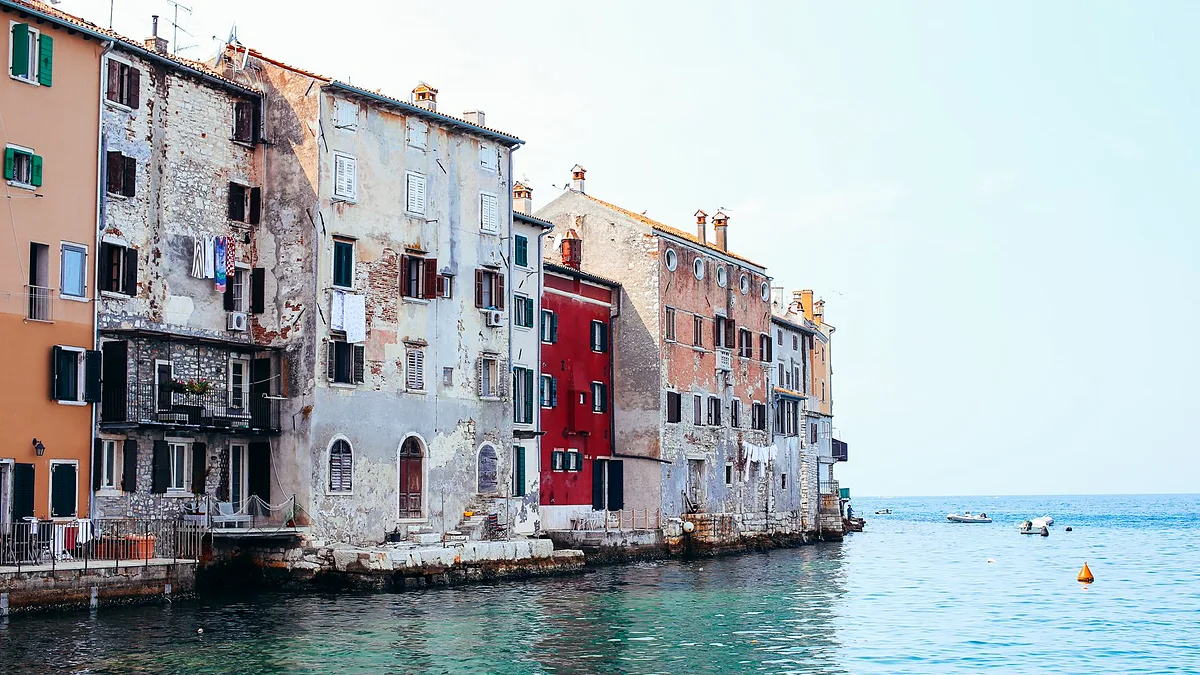

Rovinj squeezes a working fishing harbor, a Venetian-era hill town, and a genuine art colony onto one small limestone peninsula. What separates it from a dozen other pretty Adriatic towns is that the crafts are still practiced here. Boatwrights plank batana hulls by hand, painters rent the same tiny studios their teachers used, and the bell tower costs less to climb than a round of coffee back home.
You can walk the whole old town in an afternoon, but the artisan and heritage side rewards a slower pace. Two full days is the sweet spot. Below is what's actually worth your time, what it costs in euros, and where to eat when you're done.
- Best time to visit: Mid-May to mid-June, or mid-September to early October. Warm sea, thin crowds, everything open.
- Daily budget: Roughly €70–110 / ~$75–120 per person. Coffee €1.60, museum tickets €3–5, dinner with wine €30–45.
- Getting around: The old town is car-free and 15 minutes wide. Everything here is on foot; bring shoes with grip for the polished cobbles.
- Vibe: Fishing-port practical, quietly proud, zero rush. Locals still outnumber tourists at the morning market.
1. Grisia Street: Rovinj's Open-Air Artist Colony
Grisia is the steep cobbled lane that climbs from Balbi's Arch to the church, and it has been an artists' street since the 1960s. Small galleries open straight onto the stones, and on a good morning you'll find someone stretching a canvas or framing prints in the back room while a dog sleeps in the doorway.
Unlimited High-Speed International Travel eSIM
Connect in seconds across 180+ destinations. Instant QR code activation with zero roaming surcharges.

Once a year it goes fully feral. The Grisia open-air exhibition has run since 1967 on the second Sunday of August, when more than a hundred artists hang work directly on the walls and railings along the climb. It's crowded and sweaty and completely worth planning a trip around.
- Neighborhood: Old Town, starting at Balbijev luk (Balbi's Arch).
- Cost: Free to walk. Prints €20–60 (~$22–65), originals from €150 (~$162).
- Best time: 8–10am before the day-trippers, or after 6pm when the light goes gold.
- How to get there: Five minutes uphill from Trg maršala Tita, the main square. Signposted the whole way.
Insider tip: The bottom third of Grisia has several shops selling identical machine-printed canvases of the same sunset. Keep walking to the upper stretch, where the person behind the counter is usually the person who made the work.
2. House of Batana: The Boat That Built Rovinj
The batana is a flat-bottomed rowing boat unique to this port, and in 2014 the town's boatbuilding tradition was added to UNESCO's register of intangible heritage. The Kuća o batani museum occupies a restored spacio, the old stone workshop-storage buildings that once lined every Rovinj waterfront.
It's small, maybe 45 minutes, and it does one thing well: tools, half-finished hulls, and audio of bitinada singing, the a cappella style fishermen used to keep time on the water. You leave understanding why a town this size bothered to save a rowboat.
- Neighborhood: North waterfront, Obala Pino Budicin 2.
- Cost: About €3.50 / ~$3.80. Children reduced.
- Best time: Late morning, Tue–Sun. Closed Mondays outside high season.
- How to get there: Four-minute walk from Valdibora square, along the little boat harbor.
Insider tip: Ask the staff about the summer batana regatta and the rowing school. Watching a dozen hand-built boats race in the channel is a better afternoon than anything on the paid excursion boards.
3. Church of St. Euphemia and the Bell Tower Climb
The church crowns the peninsula, built over older foundations and finished in the Venetian baroque style you see across Istria. Inside, the relics of St. Euphemia sit behind the altar, and the copper saint on the spire has been a navigation marker for centuries. The current statue is a replacement; the original came down in a storm.
Climb the tower and you get the whole geography in one look: the red roofs, the fish-shaped peninsula, the green slab of Zlatni Rt, and the islands beyond. It is the single best-value thing to do in Rovinj.
- Neighborhood: Top of the old town hill, Trg sv. Eufemije.
- Cost: Church free; tower about €5 / ~$5.40.
- Best time: 9–10am. Open roughly 9am–6pm, longer in July and August.
- How to get there: Ten minutes of stairs from the harbor. No shortcut exists, whatever the map suggests.
Insider tip: The last section is a near-vertical wooden ladder inside a narrow stone shaft. If tight spaces bother you, the view from the church terrace outside is 80% as good for free.
4. Rovinj Heritage Museum in the Califfi Palace
The town museum sits in a 17th-century palace on the main square, and it's the place to sort out your timeline: Illyrian and Roman finds, the Venetian centuries, the Austro-Hungarian fishing boom, and the Italian exodus after 1945. It's honest about the difficult parts, which is not always the case in Istria.
The upper floor holds a decent modern art collection donated by local families. Give it an hour, not a morning, and you'll come out with a much sharper eye for the rest of the town.
- Neighborhood: Old Town, Trg maršala Tita 11.
- Cost: About €3–5 / ~$3.20–5.40.
- Best time: Early afternoon, when the sun outside gets serious. Seasonal hours vary — check the sign on the door.
- How to get there: Two minutes from Balbi's Arch, on the square side.
Insider tip: There's no city museum card in Rovinj, so don't waste time hunting for one online. Buy each ticket separately and you'll pay less than any bundle would cost.
5. Adris Gallery: Free Contemporary Art
It surprises people that a town of 14,000 has a serious contemporary gallery with free entry. Adris Gallery runs curated shows of Croatian and international artists in clean white rooms, the kind of space you'd expect in Zagreb or Ljubljana.
Exhibitions rotate a few times a year, so the visit is a gamble worth taking. Even a mediocre show here beats another hour of souvenir shops, and it costs nothing.
- Neighborhood: Vladimira Nazora 1, just off the old town's northern edge.
- Cost: Free.
- Best time: Roughly Tue–Sat, daytime only. Check the current exhibition page before you walk over.
- How to get there: Five minutes on foot from Valdibora square.
Insider tip: Opening days change between exhibitions and this is the one place in town that genuinely closes without warning. Screenshot the schedule before you go.
6. Zlatni Rt (Punta Corrente) Forest Park
This planted forest park was laid out in the late 19th century and is now a protected landscape. Paths run through pines and cypresses to rocky coves, and the little 18th-century Chapel of the Holy Trinity sits near the middle of the ridge, usually unlocked and always empty.
It's the counterweight to all the stone and stairs: free, quiet on weekdays, and fifteen minutes from the harbor. Bring water and shoes that can handle sharp rock, because the swimming spots are not sand.
- Neighborhood: Immediate south of the old town, along Obala Alda Rismonda.
- Cost: Free.
- Best time: Before 10am or after 5pm in summer. Midday in July is punishing, with little shade on the coves.
- How to get there: A flat 15-minute walk from the harbor, or five minutes by bike.
Insider tip: Ignore the paid tourist train that runs out here. It costs several euros to travel a distance you can walk in the time it takes to queue for a ticket.
7. Half-Day Heritage Run: Monkodonja and Dvigrad
Two of Istria's strangest sites are within half an hour of Rovinj and almost nobody does both in one morning. Monkodonja, near Bale, is a Bronze Age hillfort from around 1800–1200 BC with reconstructed dry-stone walls and a view over the whole coast.
Dvigrad is the opposite: a medieval town abandoned in the 17th century after plague and war, now a roofless shell of houses and the church of St. Sophia on a hill above the Kanfanar valley. Walking its lanes alone, with only the wind, is the most atmospheric hour you'll spend in the area.
- Neighborhood: Istrian interior — Bale is 15 km, Kanfanar about 25 km from Rovinj.
- Cost: Dvigrad free; Monkodonja a few euros. A rental car runs €35–50 per day (~$38–54).
- Best time: Early morning. Both sites are shadeless by noon.
- How to get there: Buses toward Bale and Kanfanar are thin, especially at weekends. Rent a car or take a taxi, roughly €35 each way.
Insider tip: Dvigrad's limestone gets slick after rain and the drops are unmarked. Stay on the worn path, and pair the trip with Bale's Soardo-Bembo castle, which charges a couple of euros and has a tiny, charming collection.
Where to Eat and Drink Nearby
Kantinon (Obala Aldo Rismondo 10) is the reliable harbor-side choice, all wooden benches and local families. Order the pljukanci with scampi or whatever whole fish is on the board; mains €15–22, dinner with house wine around €35–45 per person. Book for 8pm or expect to wait.
Konoba Veli Jože near the small harbor keeps prices sane and portions Istrian-sized. The maneštra soup and fuži with truffles are the safe bets, mains €12–20. It's not fine dining and doesn't pretend to be.
Monte (Montalbano 75) holds a Michelin star and is the splurge: a tasting menu runs roughly €95–120 (~$103–130) before wine. Reserve weeks ahead. For cheap eats, the morning market at Trg na mostu plus a bakery burek (€2) makes a €10 picnic that beats most restaurant lunches.
Practical Logistics and Budget Tips
- No trains: Rovinj has no station. The bus terminal at Trg na kolodvoru is 10 minutes' walk from the old town. Pula takes about 45 minutes and costs around €5 (~$5.40); Zagreb is roughly 5 hours and €20–25.
- Airport: Pula Airport is 40 km away. A taxi runs €40–50; the cheaper route is a bus into Pula then a connecting bus out.
- Parking: Leave the car at the Valdibora or Karolina lots, about €1.50–2 per hour in high season. Driving into the old town is permit-only and pointless.
- Ferry: Fast catamarans to Venice run roughly May to September, about 2h45m, from around €70 one way.
- Cash: Croatia uses the euro. Most places take cards, but small studios on Grisia and the market stalls often prefer cash.
- Save money: Free tap water, free church, free forest park, and a market picnic. Skip the €4 hotel coffee and drink it standing at a bar for €1.60.
What to skip: The restaurants fronting the harbor near Valdibora with photo menus and a host waving you in — high prices, tired seafood. The panorama boat trips that motor 200 metres out and back. And the shops selling "original" Rovinj paintings that are identical in four stores.
Honest heads-up: From 11am to 5pm in July and August, the old town is shoulder-to-shoulder, and the ferry day-trippers peak around midday. Either start at 8am, take a long lunch, and come back out at 5pm, or visit in May and September.
Frequently Asked Questions
Is Rovinj old town walkable?
Yes, entirely. The peninsula is car-free and about 15 minutes across, though the cobbles are polished and steep in places. Bring shoes with grip and leave the suitcase at the hotel until you've checked in.
How much does it cost to climb St. Euphemia's bell tower?
About €5 (~$5.40), paid in cash at the entrance, with the church itself free. Go at 9am to beat both the tour groups and the midday heat inside the stone shaft.
When is the Grisia art exhibition in Rovinj?
It's held on the second Sunday of August, an open-air show that has run every year since 1967. Artists hang work directly on the walls along Grisia street, and the whole lane is packed from mid-morning.
What is a batana boat, and where can I see one?
A batana is the flat-bottomed rowing boat traditional to Rovinj, and the craft was added to UNESCO's intangible heritage register in 2014. See original examples and tools at the House of Batana on Obala Pino Budicin, for around €3.50.