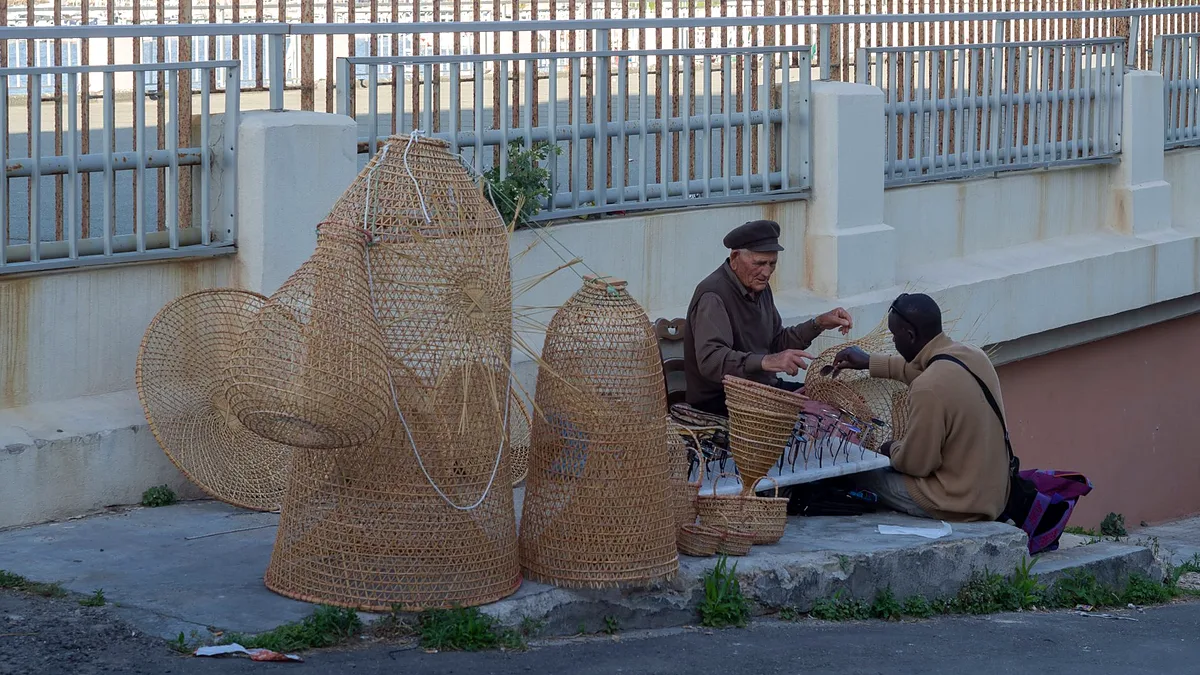

Puglia's crafts are not behind glass. In Grottaglie you can stand in a doorway while a man in his sixties throws a plate on a wheel, and in Lecce you can glue strips of paper onto a wire frame that will be carried through the streets on a saint's day.
The region's built heritage is just as hands-on: trulli stacked without mortar, olive mills carved ten metres underground, masserie that were fortresses long before they were hotels. This guide covers the workshops you can genuinely visit and the sites worth your time, plus the things you should skip.
At a Glance
- Best time to visit: late April to June and mid-September to October. Many workshops shut for two to three weeks around Ferragosto (15 August).
- Daily budget: €70–€120 (~$76–$130) per person, excluding car hire — enough for one workshop, one site ticket, lunch and dinner.
- Getting around: a small rental car. Trains reach Alberobello, Lecce and Otranto, but Grottaglie, Presicce and the masserie are far easier by road.
- Vibe: slow. Shops close 13:00–16:00, artisans talk before they sell, and nothing happens in a hurry.
1. Grottaglie: The Ceramics Quarter Where the Kilns Still Work
Grottaglie has been firing clay since the 7th century BC, and roughly thirty workshops still operate in the lanes below Castello Episcopio. This is where Puglia's capasoni — the waist-high terracotta jars once buried to the neck to store wine and oil — are still made by hand.
Unlimited High-Speed International Travel eSIM
Connect in seconds across 180+ destinations. Instant QR code activation with zero roaming surcharges.

You will also see pumi, the curling ceramic buds that sit on rooftops and gateposts for luck. Expect €18–€45 (~$20–$49) for a good-sized one and €12–€30 for plates. The Museo della Ceramica inside the castle covers the history in about twenty minutes, then you can walk downstairs and watch the real thing.
- Where: Quartiere delle Ceramiche, the old-town lanes below Castello Episcopio.
- Cost: museum €5 (~$5.50); workshops free to enter; a two-hour wheel lesson €40–€60 (~$44–$65) if booked ahead.
- Best time: weekday mornings, 9:00–12:30, when kilns are being loaded.
- Getting there: 30 minutes by car from Taranto, an hour from Bari. Park outside the old-town walls and walk — the lanes are too narrow for anything bigger than a scooter.
Insider tip: Ask to see the wood-fired furnace before you buy. A working workshop says yes immediately. Then check the back shelves for secondi — seconds, with small glaze flaws, at roughly half price.
2. Lecce: Papier-Mâché Workshops Behind Santa Croce
Lecce's cartapesta tradition goes back to the 1600s, when local artisans copied the expensive marble statues of Naples using glue, paper and wire. The results are still carried through the streets for the feast of Sant'Oronzo on 24–26 August, and used to build nativity scenes every December.
Start at the Museo della Cartapesta in the former Celestini convent beside Santa Croce. It is small — forty minutes — but it shows the wire armatures and the layered moulds, so you understand what you are looking at in the workshops afterwards.
- Where: the lanes between Basilica di Santa Croce and Porta Rudiae, including Via degli Ammirati.
- Cost: museum €5 (~$5.50); half-day workshop €45–€70 (~$49–$76); a small handmade figure €25–€60.
- Best time: weekday mornings, or after 17:00 when artisans return from lunch.
- Getting there: ten minutes on foot from Piazza Sant'Oronzo. The whole centro storico is pedestrianised.
Insider tip: Book a week ahead and specifically ask for a maestro who works on processional figures rather than souvenir pieces. Glue needs 24 hours to dry, so schedule your session early in the trip and collect later.
3. Alberobello and the Itria Valley: Dry-Stone Building Without Mortar
The trulli are not decoration. They are a clever tax dodge and a masterclass in dry-stone construction, stacked without mortar so they could be pulled down fast when the inspector rode in. The technique itself joined UNESCO's intangible heritage list in 2018.
Alberobello takes about two hours. Rione Monti is now almost entirely shops, so cross to Aia Piccola instead, where the trulli are still lived in and the lanes are genuinely quiet before 9:00.
- Where: Alberobello (Rione Monti and Aia Piccola), plus the countryside around Locorotondo and Martina Franca.
- Cost: walking the town is free; Trullo Sovrano €4 (~$4.40); Museo del Territorio €5 (~$5.50).
- Best time: before 9:00 or after 19:30. Between 10:00 and 17:00 in July it is shoulder to shoulder.
- Getting there: FSE train from Bari Centrale, about 1h35, €5.60 (~$6); by car, 50 minutes from Bari, parking at Largo Martellotta.
Insider tip: Watch for muretti a secco being repaired on the road between Locorotondo and Cisternino, especially in spring. Seeing a trullaro fit a stone without cement tells you more than any museum label.
4. Underground Olive Mills: The Frantoio Ipogeo
Before electricity, Salento pressed its olives in chambers cut eight to ten metres below the street, where the temperature stayed steady and donkeys walked in circles turning the millstone. Over thirty survive in and around Presicce-Acquarica alone, and Gallipoli has one directly under the old town.
They are cramped, cool and oddly moving — you can still see grooves worn into the floor by animals that died a century ago. Presicce's mills are the better visit. Gallipoli's is a fifteen-minute stop best paired with something else.
- Where: Gallipoli (below Palazzo Granafei, centro storico) and Presicce-Acquarica, inland from Santa Maria di Leuca.
- Cost: €4–€6 (~$4.40–$6.60) entry; tours in Italian, with English notes usually available.
- Best time: November to January, when nearby mills are actually pressing and the air smells of olive paste.
- Getting there: car required for Presicce; Gallipoli is reachable by FSE train from Lecce in about 1h20.
Insider tip: Buy oil from a mill, not a souvenir shop, and read the harvest date on the back label rather than the best-before. Anything over 18 months old has lost its peppery kick. Expect €12–€18 (~$13–$20) for a good litre.
5. Sleeping in a Masseria (And How to Spot a Fake One)
A masseria was a fortified working farm: whitewashed walls, a courtyard, a private chapel, a tower to watch for raiders, and rooms for seasonal labourers. Many are now hotels, and the good ones still grow almonds, keep bees and press their own oil.
Some are not. The word carries no legal protection, so plenty of new builds add a lime-washed facade and charge €250 a night. Older properties with a chapel, a defensive tower or a documented 17th-century core are the ones worth the money.
- Where: the countryside between Ostuni, Cisternino, Fasano and Martina Franca is the densest cluster.
- Cost: €140–€260 (~$152–$282) for a double with breakfast; dinner for non-guests €45–€65 (~$49–$71) per person, booked ahead.
- Best time: May, June and September. Ask about olio nuovo if you visit in November.
- Getting there: car essential — most sit two to five kilometres down unpaved or half-paved lanes off the provincial roads.
Insider tip: Email the property directly and ask two questions: does the farm still produce oil or almonds, and which part of the building is original? Vague answers mean it is a resort in a costume.
6. Castel del Monte: The Heritage Site Everyone Photographs and Nobody Explains
Frederick II's octagonal castle sits alone on the Murgia plateau outside Andria and is the strangest building in southern Italy. Eight towers, eight rooms per floor, no kitchen, no stable, no obvious purpose. UNESCO listed it in 1996.
Be honest with yourself about the interior: it is empty. No furniture, no fresco, no agreed theory. Go for the geometry, the light and the walk around the outside — the building rewards that far more than a guided tour of bare rooms.
- Where: Strada Statale 170, about 18 km from Andria.
- Cost: €10 (~$11) adult, free on the first Sunday of the month; timed entry, so book online in summer.
- Best time: at opening around 9:00, or the last 90 minutes before sunset. Midday in July is shadeless and brutal.
- Getting there: realistically car only, one hour from Bari. Park in the lower lot and walk up, about ten minutes.
Insider tip: Skip the castle café. Drive fifteen minutes to a Castel del Monte DOC winery for a Nero di Troia tasting instead — €15–€25 (~$16–$27) for four or five pours, and the vines are a better story than the audioguide.
Where to Eat and Drink Near the Workshops
Le Zie, Lecce — Via Colonnello Archimede Costadura 19. A bare-bones trattoria with paper tablecloths and the best ciceri e tria in the city. Around €30–€35 (~$33–$38) per person with wine; they prefer cash and the room is tiny, so book.
Osteria del Tempo Perso, Ostuni — Via Gaetano Tanzarella Vitale 47, tucked inside a former olive mill with the vaulted ceiling intact. Order the bombette and the fave e cicoria. Budget €35–€45 (~$38–$49).
Il Muretto, Polignano a Mare — Via Pompeo Sarnelli 9. Raw fish and a terrace over the water at €45–€60 (~$49–$65) per person. Honestly, you are paying for the view, so book two to three weeks out, then walk to Il Super Mago del Gelo for a caffè speciale at a third of the price.
Practical Logistics and Budget Tips
Fly into Bari (BRI) for the north and centre, or Brindisi (BDS) for Salento. A small rental car costs €25–€45 a day outside August and €65-plus in peak season, with fuel around €1.80 a litre.
Trains cover the headline towns well: Trenitalia Bari to Lecce takes 1h30 for €10–€15, and the FSE line from Bari reaches Alberobello and Martina Franca. There is no regional pass worth buying — point-to-point tickets are cheap and simpler.
- Book workshops directly: email the artisan, not an aggregator. Prices drop 20–30% and you get the maker, not a middleman.
- Carry cash: many small workshops and trattorias will not take a card under €30. Keep €50–€80 on you.
- Coperto: €2–€3 per person is normal. Tipping is not expected.
- ZTL warning: Lecce, Ostuni and Martina Franca have camera-enforced restricted zones. One wrong turn can cost €80 or more, billed months later. Park outside the walls.
What to Skip
- The tourist train in Ostuni — the old town is fifteen minutes across on foot.
- Olive-oil tastings at roadside sheds along the SS16. Go to a mill and ask for the harvest date.
- Ceramics at airport gift shops, at twice the Grottaglie price.
- Alberobello between 10:00 and 17:00 in high season. Go early or go late.
- Anything labelled menu turistico. Walk one block off the main piazza and pay less for better food.
Frequently Asked Questions
Are Puglia's craft workshops open in August?
Many are not. A large number of ceramics, cartapesta and olive-oil workshops close for two to three weeks around Ferragosto on 15 August. Confirm directly by email before you build a trip around one specific artisan.
Do I need a car to visit Puglia's craft villages and heritage sites?
For Grottaglie, Castel del Monte, Presicce and the masserie, yes — public transport is slow or nonexistent. You can manage Lecce, Alberobello and Otranto by train, but a car unlocks everything in between.
How much does a ceramics workshop in Grottaglie cost?
A two-hour session on the wheel with a working ceramist runs about €40–€60 (~$44–$65) per person, materials included. Browsing the workshops is free, and most artisans are happy to demonstrate if you simply ask.
Which Puglia heritage sites are UNESCO-listed?
Castel del Monte near Andria, the trulli of Alberobello, the Sanctuary of Monte Sant'Angelo on the Gargano, and the dry-stone walling technique found across the Itria Valley. All four are worth planning a route around.