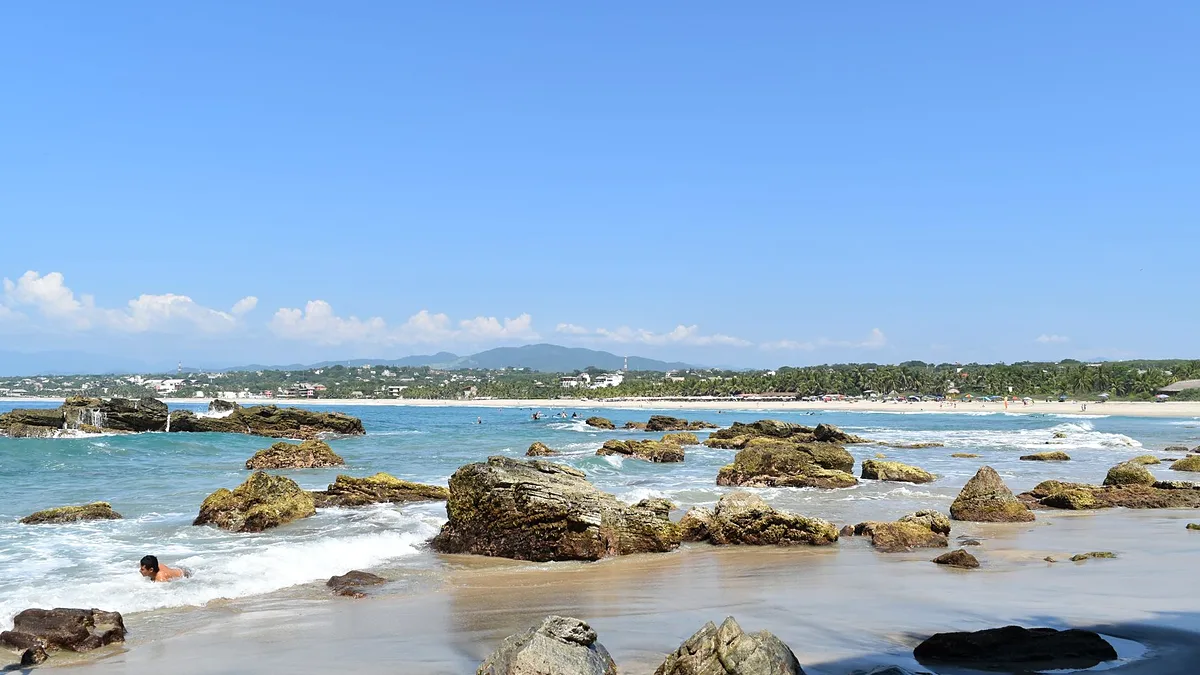

Puerto Escondido sells itself as a wave. Zicatela's beach break, the pipeline at sunrise, the sunset crowd at La Punta. Fair enough — but this town also has a small, stubborn art scene that most visitors never touch, mostly because nobody bothers to market it.
This guide is about that layer: a Tadao Ando art foundation 35 minutes out of town, a free civic gallery with rotating shows, a handful of artist-run spaces in La Punta, plus design hotels that feel like private clubs but will absolutely let you in if you call ahead.
Expect small. Expect a few doors that are locked when the sign says open. That is the trade-off for seeing the real version of this coast instead of the postcard.
Unlimited High-Speed International Travel eSIM
Connect in seconds across 180+ destinations. Instant QR code activation with zero roaming surcharges.

Puerto Escondido at a Glance
- Best time to visit: November to May for dry weather; December and February are peak. September and October, many small galleries and studios shut for the rains.
- Daily budget: $900–2,500 MXN (~$50–140 USD) per person, once you have a room. Art stops themselves are cheap or free.
- Getting around: Colectivos and taxis in town, moto-taxis in La Punta, no Uber worth relying on. Rent a car or hire a driver for Casa Wabi.
- Vibe: Barefoot, low-rise, no dress code anywhere. The only places that ask you to book are the ones with a gate.
Fundación Casa Wabi: The Concrete Art Compound You Must Book
Thirty-five minutes east of town, past the palm nurseries and a lot of dust, a 312-meter concrete wall runs parallel to the Pacific. Behind it sits Casa Wabi, the foundation Bosco Sodi started in 2014 and handed to Tadao Ando to design. It is the single best art experience on this stretch of coast, and half the people on Zicatela have never heard of it.
Inside you get artist residencies, a clay studio where local potters work alongside visiting artists, a small library, and exhibitions in rooms that open straight onto the sand. It is quiet in a way that makes you lower your voice. Ask before you start photographing — some spaces are restricted.
- Neighborhood: Santa María Tonameca, off the coastal highway, about 30–40 minutes by car.
- Cost: Free entry; a $100 MXN (~$6 USD) donation is the polite move. Workshops cost extra.
- Best time: Late morning, Tuesday to Saturday, before the heat and the day-trippers.
- Getting there: No public transit stops at the gate. Hire a taxi or driver for the round trip ($800–1,200 MXN / ~$45–65 USD) and ask them to wait.
Insider tip: Book online at least three days out and reconfirm the day before by WhatsApp. The gate staff work off a list, not your confirmation email, and showing up without a slot usually means turning around.
Centro Mexicano de la Tortuga: Small Museum, Serious Work
A ten-minute walk up from Playa Principal, this rescue and research center keeps sea turtles in open tanks and explains the species found along the Oaxacan coast. It is not an aquarium and does not pretend to be — some tanks are plain concrete and the signage is Spanish-first.
That is exactly why it works as a culture stop. A couple of dollars buys you 45 minutes of genuine local science, plus hatchlings if you catch the season right. Families with kids get the most out of it; adults who want a polished experience will not.
- Neighborhood: Centro, a short walk inland from Playa Principal and Playa Marinero.
- Cost: Around $40 MXN (~$2 USD); small children free.
- Best time: 9–11am, before the building heats up.
- Getting there: Walkable from the Andador; a taxi from Zicatela runs about $70 MXN (~$4 USD).
Insider tip: It closes on Mondays and often shuts early on rainy afternoons. Call the same morning rather than trusting the hours posted online.
Casa de la Cultura: Free Shows in a Scruffy Civic Building
Every Oaxacan town of any size has a Casa de la Cultura, and Puerto Escondido's is the real deal: a plain municipal building with a hallway gallery, a courtyard, and a schedule of dance, music, and painting classes that runs on local time.
Shows rotate every few weeks and lean toward Oaxacan painters, printmakers, and coastal photography. Entry is free, the rooms are airy, and you will usually be the only visitor — which means you can actually look at the work instead of queuing for it.
- Neighborhood: Centro, a few blocks inland from Av. Pérez Gasga.
- Cost: Free; workshops run $200–500 MXN (~$11–28 USD) if you want to join one.
- Best time: Weekday mornings, roughly 9am to 1pm.
- Getting there: Walkable from Playa Principal, or any Centro-bound taxi.
Insider tip: Ask at the front desk what is opening that week. Most exhibitions get a low-key opening night with mezcal and no announcement anywhere online — that is where you meet the actual artists.
La Punta: Artist Studios, Murals, and Pop-Up Shows
La Punta is Zicatela's southern tip, and it is where the surfers, tattooers, and painters actually live. The lanes behind the main strip hold a rotating set of small studios, screen-print shops, and mural walls that change with every season.
Nothing here is formal. You will see a hand-painted sign on a gate, a rack of prints on a porch, paintings for sale above a bar till. Go on foot, late afternoon, and talk to people. That is the entire method.
- Neighborhood: La Punta, Zicatela.
- Cost: Free to browse; prints $350–1,200 MXN (~$20–67 USD).
- Best time: 5–7pm, when studios open and the light softens.
- Getting there: Colectivo or moto-taxi from Centro ($12–50 MXN / under $3 USD); a 15-minute walk from Zicatela's main drag.
Insider tip: Skip the mass-produced alebrijes sold along the beach — many are resold from Oaxaca City at triple the price. Buy a print from the person who pulled it.
Hotel Terrestre: A Design Compound With a Members' Club Feel
Alberto Kalach's solar-powered hotel sits inland, all brick, palm, and cross-ventilation — no air conditioning, no glass walls, no lobby scene. It reads as private because it mostly is: a handful of villas, each with its own plunge pool.
What most people miss is that non-guests can often book the restaurant or bar with a reservation, and the hotel releases day passes in low season. Message them on WhatsApp a day ahead and ask directly. Being specific about timing gets you further than the website does.
- Neighborhood: Inland from Playa Bacocho, about 10 minutes by car from Centro.
- Cost: Day passes, when available, $1,200–1,800 MXN (~$67–100 USD), usually credited toward food and drink.
- Best time: Sunset, for the light on the brick and the still water.
- Getting there: Taxi only, around $120 MXN (~$7 USD) from Centro.
Insider tip: This is a quiet property — no music, no crowd. If you are after a party, they will politely tell you at the gate, so save the trip for a slow evening.
The Andador on Playa Principal: Prints, Textiles, and Small Shops
Av. Pérez Gasga runs along Playa Principal and becomes the town's living room after six. Mixed in with the seafood places are a dozen small shops selling Oaxacan textiles, hand-pulled prints, and ceramics — some genuinely good, some resold from the market two blocks away.
Treat it as a scouting walk rather than a shopping stop. Note what you like and what it costs, then check the Mercado Benito Juárez the next morning before you commit.
- Neighborhood: Centro / Playa Principal.
- Cost: Free to walk; textiles $250–1,500 MXN (~$14–83 USD).
- Best time: 6–9pm, when the heat breaks and everything is open.
- Getting there: Any Centro taxi, or a 10-minute downhill walk from the ADO bus station.
Insider tip: Carry cash. Several shops cannot process cards after 8pm, and the ATM queues on this street get long on weekends.
Where to Eat and Drink Nearby
El Cafecito (Av. Pérez Gasga, Playa Principal) opens around 7am and is where you go before a gallery morning. Order the chilaquiles verdes with a café de olla, roughly $120 MXN (~$7 USD). Tables by the sand fill first.
The comedores inside Mercado Benito Juárez are the cheapest real meal in town. A tlayuda with quesillo runs $70–90 MXN (~$4–5 USD), tamales are half that, and lunch service winds down by 2pm. Go early, bring small bills, and sit wherever there is a stool.
La Punta's evening carts take over the side streets after 7pm — three tacos for about $60 MXN (~$3.50 USD), grilled fish or birria depending on the night. Cash only, no seating worth mentioning, and it beats most restaurants on the strip.
Practical Logistics and Budget Tips
- No Uber. Use taxis and agree the price before you get in. A Centro-to-Zicatela hop is $70–90 MXN (~$4–5 USD); moto-taxis in La Punta are $40–50 MXN.
- Colectivos along the main road cost $12–15 MXN (~$1 USD) and are the cheapest way to move between Centro and Zicatela. They stop when flagged.
- Rent a car for one day if you are doing Casa Wabi. About $900–1,300 MXN (~$50–72 USD) plus insurance, cheaper than four separate taxi runs.
- Cash rules. Small galleries, print studios, and market stalls do not take cards. Withdraw from Banorte or HSBC in Centro during the day.
- What to skip: hostel-sold art tours that charge $600 MXN for what is a free walk, and beachfront souvenir shops pricing the same ceramics three times over.
- Honest heads-up: the scene is thin. Two or three studio visits plus Casa Wabi is a full art day here. If you want gallery density, that is Oaxaca City, not the coast.
Frequently Asked Questions
Does Casa Wabi require a reservation?
Yes. Entry is free, but visits run on fixed slots Tuesday through Saturday and you must book online in advance. Reconfirm the day before by WhatsApp, because the gate list is what actually gets you through.
Are there real art galleries in Puerto Escondido?
There is a small, informal scene rather than a gallery district: free rotating shows at the Casa de la Cultura, artist-run studios in La Punta, and Casa Wabi about 35 minutes east. Set expectations at a half day, not a weekend.
Can you visit Hotel Terrestre without staying there?
Often, yes. Non-guests can usually book the restaurant or bar with a reservation, and day passes appear in low season. Message the hotel directly a day ahead rather than relying on the booking website.
When is the best time of year for art and culture here?
November through May, when everything stays open and the roads to Casa Wabi are dry. September and October are the riskiest months, since small studios and restaurants close for the rains without updating their hours.