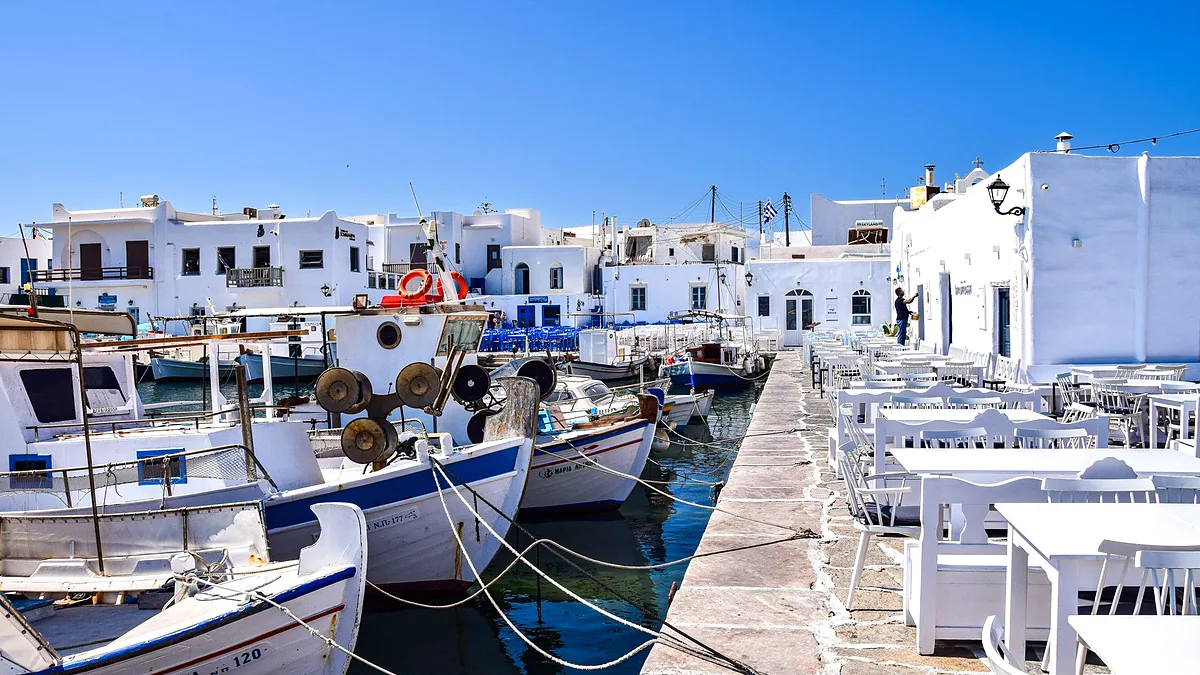

Paros gets sold as the quiet alternative to Mykonos, which is only half true. In August, Naoussa's harbour is packed shoulder to shoulder until midnight. But walk two lanes back and you find something else entirely: a working island with a real, year-round art scene.
That is the side of Paros this guide covers. Sculptors still carving the stone that made the Venus de Milo. A 1960s art school that opens its studios to visitors. An open-air cinema on a headland, and wine bars with eight seats where the owner pours and tells you which hillside the grapes came from.
Low-key does not mean boring, and it does not mean you have to spend big. You can have a better evening for €25 than the people paying €18 a cocktail on the waterfront.
Unlimited High-Speed International Travel eSIM
Connect in seconds across 180+ destinations. Instant QR code activation with zero roaming surcharges.

At a Glance: Paros for Quiet Evenings
- Best time to visit: 20 May–20 June or 10–30 September. Warm sea, open galleries, roughly half the crowds.
- Daily budget: €70–120 (~$75–130) mid-range, covering a scooter, one paid entry, dinner and two drinks. Frugal travellers manage on €45–60 (~$49–65).
- Getting around: KTEL buses run Parikia–Naoussa every 30 minutes in summer (€2.20 / ~$2.40). Scooters cost €22–30 a day. Taxis are scarce, so book ahead.
- Vibe: Whitewashed lanes, working artists, no velvet rope. The dress code is 'I walked here'.
1. The Aegean Center for the Fine Arts, Parikia Old Town
Founded in 1966, the Aegean Center is a working art school folded into the lanes of Parikia's old town, a few minutes uphill from the Frankish castle. Painting, photography, printmaking and creative writing students spend full semesters here, so the walls change constantly.
In summer the center opens its doors for student and faculty exhibitions, plus the occasional small concert — usually a string quartet or a poetry reading, forty people maximum. It feels like being let into someone's house, because it is one: thick Cycladic walls, a marble staircase, and a courtyard that stays cool at 8pm.
- Neighbourhood: Parikia old town, in the lanes behind the port near the Kastro.
- Cost: Free; exhibitions sometimes suggest a €3–5 (~$3–5) donation.
- Best time of day: 7–9pm, when the courtyard light turns gold.
- Getting there: An 8-minute walk from the Parikia ferry dock. No bus needed.
Insider tip: Opening nights get announced on handwritten posters around the old town and on the center's Instagram, rarely in island event listings. Check the noticeboard by the entrance in the morning and build your evening around it.
2. The Marble Quarries at Marathi and the Sculptors' Village
Parian marble was the ancient world's premium stone: translucent, fine-grained, and used for the Venus de Milo and much of the sculpture at Delos. The quarries at Marathi, about 5 km inland from Parikia, still cut into the hillside, and you can walk into the old galleries where the blocks were worked.
Go late. Marble holds heat, so the quarry floor is a furnace at 4pm; by 6pm it becomes a strange, quiet moonscape with fig trees pushing up through the spoil heaps. Sculptors still keep studios in Marathi village and on the edge of Parikia — look for open doors with stone dust on the step and ask politely if you can look in.
- Neighbourhood: Marathi village, inland from Parikia.
- Cost: Free to walk the quarry area. A small sculpture or bowl from a studio runs €40–90 (~$43–98).
- Best time of day: 6–8pm. Bring water and closed shoes.
- Getting there: No useful bus service. A taxi from Parikia is €12–15 (~$13–16) each way, or 15 minutes on a scooter.
Insider tip: The quarry tunnels are unlit and unmarked — take a phone torch and do not go deep. And do not pocket a piece of marble: removing stone from an archaeological site carries a heavy fine.
3. Open-Air Cinema at Paros Park, Monastiri
The Ai Yannis Detis peninsula, 4 km north of Naoussa, is an 80-hectare park with an old monastery, marked walking trails and a small swimming cove. It is also where Paros watches films in summer: a screen set up in a natural stone amphitheatre, the sea somewhere behind you, cicadas competing with the dialogue.
Screenings run a few nights a week from mid-June to early September, usually mixing new releases with Greek subtitles and older classics. Turn up 40 minutes early, bring a jumper for the wind, and carry your own wine — the canteen queue at the interval moves slowly.
- Neighbourhood: Monastiri and Ai Yannis Detis, north of Naoussa.
- Cost: Park entry free; cinema ticket around €8 (~$8.70).
- Best time of day: Gates near 8:30pm, film at 9pm. Sunset first on the monastery terrace.
- Getting there: 10 minutes by car from Naoussa; parking fills by 8:15. Check the KTEL Paros board in Naoussa for seasonal shuttle times.
Insider tip: Sit on the left-hand side of the amphitheatre if you can. The right side catches the meltemi wind and you will spend the second half holding your jumper over your knees.
4. Naoussa After 10pm: Wine Rooms and Back-Lane Bars
Moraitis is the island's best-known winery, a family operation that has been bottling on Paros for generations, and its stone tasting room sits on the edge of Naoussa. A seated flight of five wines costs roughly €12–18 (~$13–20), with the Monastiri red and the Malagouzia white the usual favourites.
Book a day ahead in July and August; in June and September you can often walk in. Afterwards, walk back into the village and skip the harbour front entirely. The lanes behind Agios Nikolaos church and up towards the Venetian castle ruins hold the small bars — six tables, a record player, and a proper Negroni for €10 instead of the €18 charged on the water.
- Neighbourhood: Naoussa, north coast; winery on the village outskirts, bars in the old centre.
- Cost: Tasting €12–18 (~$13–20); cocktails €9–12 (~$10–13).
- Best time of day: Tasting at 7pm, bars from 10pm when the dinner crowd clears.
- Getting there: Buses from Parikia every 30 minutes until late; last return is around 1am in high season.
Insider tip: The castle sunset is a scrum — two hundred people on a rock the size of a tennis court. Watch the sun go down from the small pier on the north side of the harbour instead, then walk into the lanes at 10pm when the first seating empties out.
5. Aliki: The Cycladic Folklore Museum and a Quiet Waterfront
Benetos Skiadas spent decades building exact-scale models of Cycladic boats, windmills and workshops, and the museum in Aliki holds hundreds of them. It is a one-man obsession in the best sense: miniature rigging, hand-carved oars, labels written by the maker himself.
Aliki stays calm even in mid-August. The waterfront has tavernas, a couple of small galleries selling ceramics and jewellery, and the shallow beach at Agios Nikolaos is still swimmable at 8pm. It is the easiest place on the island to combine a museum, a swim and dinner without touching a single queue.
- Neighbourhood: Aliki, south coast, roughly 13 km from Parikia.
- Cost: Entry around €3–4 (~$3–4). Most small galleries are free to browse.
- Best time of day: 6:30–8pm, then swim, then eat at 9pm.
- Getting there: Bus from Parikia takes 20 minutes and costs about €2.20 (~$2.40).
Insider tip: Museum hours are short and seasonal, often late morning and again in the evening. If the door is shut, ask at the kafeneio two doors down — someone usually knows who has the key.
6. Lefkes: Marble Streets and the Byzantine Path
Lefkes was Paros's capital in the 1800s and sits high enough to catch a breeze when the coast is sweltering. The whole village is built from marble: doorsteps, thresholds, entire streets polished smooth by 150 years of footsteps.
The old Byzantine path to Prodromos starts near the top of the village — 3.5 km of marble-paved track through olive terraces, about an hour at an easy pace. Start at 5:30pm with the light behind you, eat in Prodromos, then catch the last bus back down.
- Neighbourhood: Lefkes, central highlands.
- Cost: Free. Bus from Parikia is around €2.50 (~$2.70), 25 minutes.
- Best time of day: 5:30–8pm; the marble is brutal at midday.
- Getting there: KTEL bus from Parikia, or 25 minutes by car with parking at the village entrance.
Insider tip: Order a Greek coffee and a spoon sweet at the kafeneio under the big plane tree on the platia — about €3 total — and ignore the restaurant on the main lane with photo menus and a tout at the door.
Where to Eat and Drink Nearby
Levantis, Parikia. A garden courtyard a few lanes back from the port, serving modern Greek cooking with real technique. Expect €30–45 (~$33–49) per person before wine. The slow-braised lamb and the wild greens with lemon are the dishes to order. Book two days ahead in summer.
Taverna Glafkos, Naoussa. Right on the water at the small port, slightly away from the harbour circus. Grilled octopus, fried kalamari, and a tomato salad that tastes like it was picked an hour ago. Budget €25–35 (~$27–38) per person with a carafe of house white. Arrive at 7pm or wait until 10.
The kafeneia on Lefkes platia. Not a restaurant in any formal sense — just tables under a plane tree, village wine, and simple plates of cheese, olives and tomatoes for €10–14 (~$11–15). Cash only, no card machine, no menu in English, and the best value meal on the island.
Practical Logistics and Budget Tips
- Buses: There is no tourist travel pass on Paros. You buy single tickets on board or at the Parikia kiosk, €1.80–2.50 (~$2–2.70) depending on the route. Keep small notes handy.
- Scooters and cars: A 50cc scooter is €22–30 (~$24–33) a day; a small car is €40–60 (~$43–65), more in August. Fuel runs about €1.90 a litre. A standard car licence usually covers 50cc; anything bigger needs a motorbike licence.
- Cash: Many small bars, studios and kafeneia are cash-only. Withdraw in Parikia or Naoussa, not in the villages.
- Skip: The waterfront restaurants in Naoussa with photo menus and €22 moussaka. The €50-plus sunbed pairs at the Santa Maria beach clubs. And the sunset queue at the Venetian castle, which is genuinely not worth 30 minutes of standing.
- Save: Supermarket water at €0.50 instead of €2 at a bar. Gallery openings, which are free and usually include a glass of wine. The park and quarry walks, which cost nothing at all.
- Honest heads-up: Some galleries keep erratic hours outside July and August. If a show is the reason for your trip, message the space on Instagram before you book flights.
Frequently Asked Questions
Is Paros good for nightlife if I do not want big clubs?
Yes — that is exactly Paros's strength. Naoussa has small bars and wine rooms rather than superclubs, and most close by 2am, so evenings stay conversational.
Do I need to book gallery visits or wine tastings in advance?
Galleries are generally free to walk into during posted hours, though a quick message helps in shoulder season. Wine tastings at Moraitis and similar wineries should be booked a day ahead in July and August.
How do I get around Paros at night without a car?
KTEL buses run between Parikia and Naoussa until roughly 1am in high season, and taxis exist but are few. For quarry or park evenings, book a return taxi in advance or rent a scooter for the day.
When is the best time to visit Paros for quiet evenings?
Late May to mid-June and mid to late September give you open galleries, warm water and tables you can walk into. August is lively but crowded, and many art spaces are at their busiest.