
Milos has been quarried, tunnelled and fired in kilns for more than 11,000 years. That isn't a tourism slogan — obsidian hacked out of Nychia beach turned up in caves on the Greek mainland long before anyone built a temple, and the island has been digging, grinding and shipping minerals ever since.
Most visitors come for Sarakiniko and never see any of it. That's fair; the beaches really are that good. But the island's second layer — the mines, the catacombs, the boat garages, the small studios where people still throw pots — is what makes a windy afternoon or a shoulder-season day worth having.
- Best time to visit: Late May–June and September–early October. Same light, half the people, cheaper rooms.
- Typical daily budget: €80–130 (~$87–141 USD) for a mid-range couple, including a rental car and one taverna meal.
- Getting around: KTEL buses from Adamas port cover Plaka, Trypiti, Klima and Pollonia. A small car or scooter is better if Paliorema is on your list.
- Vibe: Slow, geological, a bit industrial in the best way. Bring closed shoes and a jacket.
Start at the Milos Mining Museum in Adamas
Before you drive anywhere, spend an hour in this small two-floor museum on the Adamas waterfront, a two-minute walk from where the ferries dock. Black-and-white photographs of miners, hand tools, and shelves of bentonite, perlite, kaolin and sulfur explain exactly why this island looks the way it does.
Unlimited High-Speed International Travel eSIM
Connect in seconds across 180+ destinations. Instant QR code activation with zero roaming surcharges.

It is not a slick operation. Some displays are dusty, labelling is inconsistent, and the upstairs video is genuinely dated. That's part of the charm — it tells you what Milos exports and who did the work.
- Where: Adamas, on the coast road toward the north end of the bay.
- Cost: About €3–5 (~$3–5 USD). Cash is easiest.
- Hours: Roughly Tuesday–Sunday, 09:00–14:00. Closed Mondays; seasonal variations are real.
- Getting there: Walk from the port or any Adamas hotel. Five minutes, flat.
Insider tip: Photograph the large island map showing the mineral zones before you leave. Paliorema has zero signage on site, and this board is the clearest explanation you'll get all week.
Nychia: The Obsidian Quarry That Started It All
On the north edge of Adamas bay, a low slope above a rough beach is littered with black glass shards. This is the Neolithic quarry that made Milos rich — Melian obsidian was traded across the Aegean before pottery existed, and the hillside is still covered in debitage and broken blades.
There's no fence, no ticket booth, no interpretive panel. You simply walk up and stand in a stone-age workshop, which is either thrilling or underwhelming depending on your expectations. Go in the morning before the slope heats up.
- Where: Nychia, about 2.5 km north of Adamas port.
- Cost: Free.
- Best time: 08:00–10:30, before the sun hits the west-facing slope.
- Getting there: 30–35 minutes on foot along the coast road, or 5 minutes by car or scooter.
Insider tip: Wear real shoes, not flip-flops — the shards are razor-sharp — and do not pocket any obsidian. Customs and port staff do check, and the fine is steep.
Paliorema: Milos's Abandoned Sulfur Mine
On the east coast, above a beach stained red and yellow, sits a rusting sulfur works: loading machinery, crumbling miners' huts, and ochre ground that looks like another planet. Mining stopped in the 1950s and nothing has been tidied since.
Getting there is the filter that keeps it quiet. You either join a boat trip that loops the east coast or drive a rough dirt track from the Zefyria side in a proper 4x4. A standard rental hatchback will not enjoy it.
- Where: Paliorema (Thioricheia), east coast, below Kalogeromilos.
- Cost: Free. Boat day trips run roughly €60–90 (~$65–98 USD) including lunch.
- Best time: Morning light; most boats arrive between 11:00 and 13:00.
- Getting there: 4x4 via dirt road from Zefyria, or a full-day sail from Adamas.
Insider tip: Email or ask your skipper directly whether Paliorema is actually on the route. Plenty of "around the island" tours quietly drop it to add swimming time at Kleftiko.
The Catacombs and Ancient Theatre of Trypiti
The early-Christian catacombs at Trypiti are among the largest in Greece, cut into soft volcanic rock between the 2nd and 4th centuries. Dozens of grave niches line three main chambers, and the temperature drops the moment you step inside.
Five minutes downhill, the Roman theatre holds around 7,000 people on marble seats, with the sea framed behind the stage. The Venus de Milo was found in a field nearby in 1820 — the exact spot is fenced and essentially unmarked.
- Where: Trypiti, between Plaka and Klima.
- Cost: Catacombs about €4 (~$4 USD), reduced €2. Theatre is free and always open.
- Hours: Catacombs roughly Tuesday–Sunday, 08:30–15:00. Closed Mondays.
- Getting there: Bus from Adamas to Trypiti (about €2 / $2 USD), then walk.
Insider tip: Skip Sarakiniko at sunset once and watch it from the theatre instead. Same west-facing light, a dozen people instead of three hundred, and marble to sit on.
Plaka: The Kastro, the Museums and the Potters
Plaka is the island capital, a knot of whitewashed lanes below a Venetian-era Kastro where the old town once stood. Panagia Korfiatissa has a courtyard view that justifies the walk up on its own, and the two tiny museums are worth twenty minutes each.
The Folk Museum holds weaving looms, farm tools and household gear. The Ecclesiastical Museum is packed with icons. Both are volunteer-run, so treat the sign on the door as the only reliable schedule. Behind the main street, small studios still throw and sell pottery — you'll spot wheels and drying racks in courtyards.
- Where: Plaka, central village and the Kastro above it.
- Cost: Museums about €2 (~$2 USD) each. Kastro and lanes are free.
- Best time: 19:30–21:00, when day-trippers have gone back to the port.
- Getting there: Bus from Adamas, about €2 (~$2 USD); last return around 23:00 in high season.
Insider tip: Knock and ask before photographing a potter at work. Most will happily stop and show you the kiln — but a camera in the doorway without a word reads badly.
Klima's Syrmata and the Tripiti Windmills
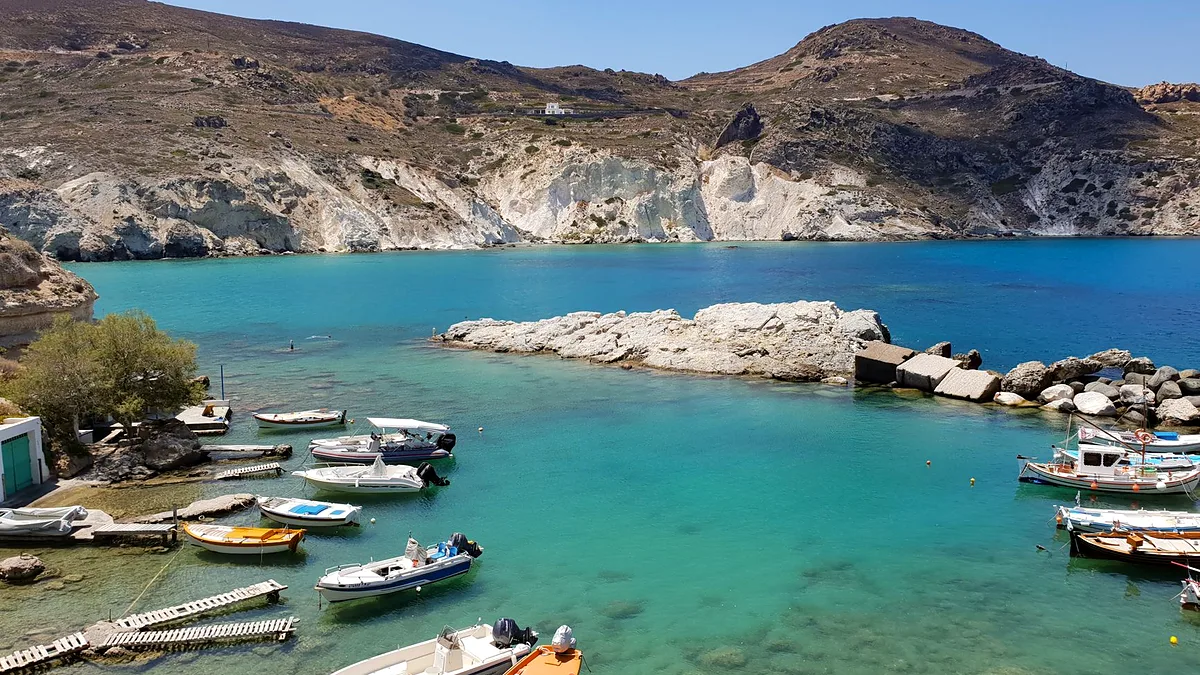
Klima is a row of two-storey boat garages painted in faded blues and yellows, doors opening straight onto the water. These are working syrmata — winter storage for fishermen's boats, not boutique rentals, despite what the listings suggest.
Above the village, four windmills sit on the ridge line between Trypiti and Klima. One has been restored and occasionally opens as a small bar. The rest are shells, which is honestly the better photo.
- Where: Klima, 3 km below Trypiti.
- Cost: Free to walk.
- Best time: 18:30–20:00 for the light on the painted doors.
- Getting there: Park at the top of the hill and walk down; the lane is narrow and parking is minimal.
Insider tip: The climb back from Klima to Trypiti takes 25 minutes and has no lighting. Either arrange a pickup or bring a torch on your phone.
Where to Eat & Drink Nearby
O! Hamos, Adamas
A big, noisy, family-run taverna a street back from the port, with portions that defeat most tables. Expect roughly €22–28 (~$24–30 USD) per person with wine. Order the lamb in parchment and the fava, and share everything.
Medusa, Mandrakia
Perched on the rocks above a tiny fishing harbour, 4 km north of Adamas. No reservations — put your name down and wait. Grilled octopus is about €14 (~$15 USD), fried kalamari similar. Cash helps.
Mourgia, Plaka
A courtyard taverna in the capital that feels like someone's grandmother is still in charge, because she effectively is. Goat with lemon and local cheese pies; around €20–25 (~$22–27 USD) per person. Book the night before in July and August.
Practical Logistics & Budget Tips
KTEL buses leave from the Adamas port and cover Plaka, Trypiti, Klima, Sarakiniko and Pollonia for €2–2.20 (~$2 USD) a ride. Schedules thin out hard in the shoulder season, so photograph the timetable on day one.
A small rental car runs €40–55 (~$44–60 USD) per day outside August and €70–95 in peak season. Scooters are €20–25 and ATVs €25–35. Book at least a month ahead for July and August, and fill the tank before heading east — stations are limited to Adamas, the Plaka road and Pollonia.
- Realistic daily spend: €80–130 (~$87–141 USD) per couple, mid-range, self-catering breakfasts.
- Ferries: Piraeus to Adamas takes 3.5–5 hours conventional or about 2h45 on a fast cat; flights from Athens run 35–45 minutes.
- Money saver: Buy picnic supplies in Adamas and eat one taverna meal a day instead of two.
What to skip: The "Venus de Milo discovery site" as a destination — the statue is in the Louvre and you'll see a plaster cast. Sarakiniko at sunset in August, unless you enjoy queueing for a photo. And don't plan the catacombs or the Mining Museum for a Monday; both close.
Frequently Asked Questions
Is the Milos Mining Museum worth visiting?
Yes, if you plan to see Paliorema or Nychia — it gives you the context those bare sites don't. Skip it if you only have two days and want beaches, since it's a 45-minute stop at most.
Can you reach the Paliorema sulfur mine without a boat?
Yes, but only with a proper 4x4 on a rough dirt track from the Zefyria side, and you'll want to ask your rental company first. Most people find a day sail from Adamas far easier.
Do you need a car to see Milos's heritage sites?
No — buses cover Plaka, Trypiti, Klima and the port, which is where the main sites sit. A car or scooter does make Nychia and Paliorema much simpler.
How long do the Catacombs of Milos take?
Thirty to forty minutes, including the short walk from Trypiti village. Pair it with the theatre and Klima for a comfortable half-day loop.