
Milos gets sold on its beaches, and fair enough — Sarakiniko genuinely looks like a moon landing. But the island has a second story that almost nobody plans a day around: it's one of the longest-worked places in the Aegean, and the crafts that shaped it are still running.
Obsidian from Milos was traded 13,000 years ago. The Venus de Milo came out of a farmer's field near Trypiti in 1820. Sulfur and marble paid wages here well into the 20th century. You can trace that whole arc in two unhurried days, and you can still watch potters, winemakers and stone carvers at work between museum visits.
At a Glance
- Best time to visit: Late May–June and September — sites are open, roads are quiet, and prices drop 25–35% from August.
- Daily budget: €70–140 (~$75–150) per person, excluding ferries. Museums and ruins cost under €10 each.
- Local transport: KTEL buses from Adamas plus a small rental car or ATV. No ride-hailing apps on the island.
- Vibe: Slow, dusty, unpretentious. Heritage sites are rarely crowded, even in high season.
1. Milos Mining Museum, Adamas
Start here and the rest of the island makes sense. Two floors of tools, mineral samples, maps and photographs explain how obsidian, baryte, bentonite and sulfur built Milos — and how the mines emptied out in the 1970s and 80s. It's a small museum with real substance, not a room of dusty rocks.

The obsidian display alone is worth the entry. Milos obsidian has been found in caves on the Greek mainland dating back roughly 13,000 years, which makes this island one of Europe's oldest export economies.
- Where: Adamas, a 200 m walk from the ferry ramp
- Cost: €6 (~$6.50); under-18s free
- Best time: 10:00–11:30, before the beach heat. Usually closed Mondays
- Getting there: Four minutes on foot from the ferry; the bus terminal is three minutes away
Insider tip: Ask about the combined museum ticket at the desk before you pay — bought separately, the island's four main sites add up to around €18.
2. Phylakopi Bronze Age Settlement, near Pollonia
Phylakopi was a major Bronze Age town with trade links to Crete and the Cyclades, occupied for roughly two thousand years. What you see today is low stone walls, a few paved lanes and a headland above the sea — subtle, quiet, and usually completely empty.
It rewards people who like ruins without labels and crowds. Bring a hat and water; there's no shade and no facilities, and the site is fenced with irregular opening hours.
- Where: North coast, about 2 km east of Pollonia
- Cost: Free
- Best time: Early morning, roughly 08:00–10:00
- Getting there: Bus or drive to Pollonia, then a 20–25 minute walk on a dirt track
Insider tip: The gate is sometimes padlocked outside summer months. Treat the walk as the point of the trip, and pair it with a swim at Pollonia afterwards.
3. The Catacombs and Roman Theatre, Trypiti
The early Christian catacombs of Milos are cut into soft volcanic rock and run for about 185 metres in a maze of tunnels and burial chambers. You enter in small groups, and the low ceilings and oil-lamp niches make it feel far more atmospheric than the usual fenced-off ruin.
Five minutes uphill, the Roman theatre is carved straight into the hillside with seating for thousands. A stone marker nearby points out where the Venus de Milo was found, which is a strange and slightly anticlimactic thrill — it's just a field with a view of the sea.
- Where: Trypiti, 2 km above Klima
- Cost: Catacombs €6 (~$6.50); theatre free
- Best time: 08:30 opening or after 17:00
- Getting there: Bus from Adamas to Plaka/Trypiti (~€2.30 / ~$2.50), then a short uphill walk; 15 minutes by car
Insider tip: The catacombs close for a midday break on some days, and the schedule shifts with the season. Check the board in Plaka or the day before, not on the morning you plan to go.
4. Kostantakis Winery, Pollonia
This is the closest thing on Milos to a working workshop visit. The Kostantakis family grows vines in the volcanic soil around Pollonia and runs small tastings in the cellar — usually four or five pours, including a dry white and a sweet sun-dried wine, with the winemaker talking you through the harvest.
Tastings are short, informal and genuinely informative. It's not a slick corporate cellar tour, and it's better for it.
- Where: Pollonia, on the edge of the village
- Cost: Roughly €15–20 (~$16–22) per person
- Best time: The 18:30–19:00 slot, then dinner by the water
- Getting there: Bus from Adamas to Pollonia (~€2.50), or 20 minutes by car
Insider tip: Book a day ahead in July and August and ask which wines are actually open that week — production is tiny, so the list changes.
5. Plaka: the Archaeological Museum and the studios around it
Plaka's neoclassical Archaeological Museum holds a copy of the Venus de Milo (the original is in the Louvre), plus obsidian tools and finds from Phylakopi. It takes 40 minutes and sets you up for the best part: the lanes around it, where ceramicists and marble carvers still keep small studios.
Milos marble was quarried for centuries and shipped across the Mediterranean. The trade has shrunk to a handful of workshops, but you can still walk in and watch a wheel spin or a chisel work — the honest, unhurried kind of workshop tourism rather than a staged demonstration.
- Where: Plaka village, the lanes below Panagia Korfiatissa
- Cost: Museum €6 (~$6.50) or covered by the combined ticket; studios free to browse
- Best time: 10:00–13:00, then again after 18:00
- Getting there: Bus from Adamas (~€2.30) or 15 minutes driving, parking below the village
Insider tip: Studios shut hard between about 14:00 and 18:00. Don't plan a shopping stop in the afternoon heat — you'll find locked doors and sleeping cats.
6. Thiorichia (Paliorema) Sulfur Mine
Abandoned in the 1960s, this sulfur mine on the southeast coast is the strangest heritage site on the island: rusted ore carts, yellow-stained concrete buildings, and a red-black pebble beach below. It looks like a film set that everyone walked away from.
Getting there is the adventure. The dirt road from Zefyria is rough and needs high clearance, or you can arrive by boat on a day trip from Adamas and swim ashore.
- Where: Southeast coast, near Paliorema
- Cost: Free; boat trips €35–45 (~$38–49)
- Best time: Morning, before the wind picks up
- Getting there: 4x4 or ATV from Zefyria (about 40 minutes of rough track), or by boat
Insider tip: Don't attempt the track in a small city car, and don't count on phone signal. Carry water — there's nothing there, and nobody selling it.
7. Sarakiniko: the Lunar Coast
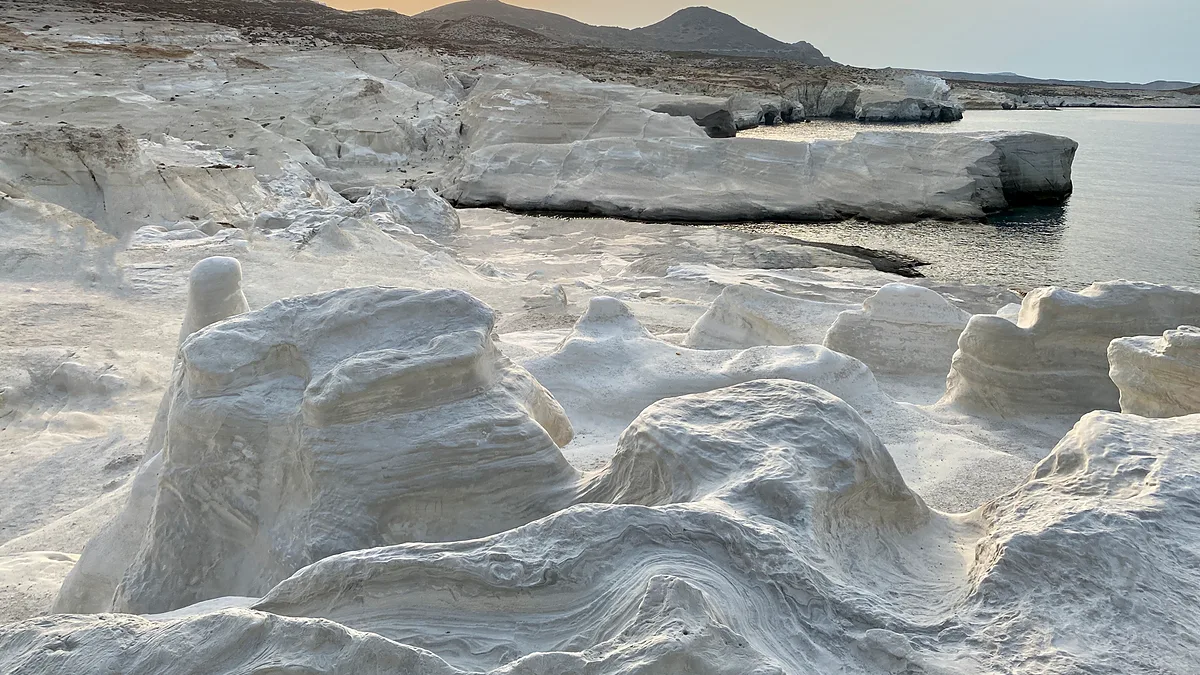
Sarakiniko is white, wind-carved rock with no sand and a few deep blue swimming channels. It's free, it's genuinely spectacular, and it's the reason half the island's Instagram photos exist. It's also the one place where the crowds can ruin the experience.
Go early or go late. At 08:00 you can hear the water moving between the rocks; at 13:00 in August you'll be queuing for a photo of a rock.
- Where: North coast, 4 km from Adamas
- Cost: Free; summer bus about €2 (~$2.20)
- Best time: 07:30–09:30 or after 18:00
- Getting there: Seasonal KTEL bus from Adamas, or 10 minutes by car with a small car park
Insider tip: Wear shoes with grip. The white rock is polished and slippery, and the cave pool is dangerous when there's swell running.
Where to Eat and Drink Nearby
Medusa, Mandrakia. Tables on the rocks above a tiny fishing harbour, no reservations, and a queue that's worth it. Grilled octopus and whatever fish came in that morning; expect €30–40 (~$33–43) per person with wine. Arrive at 13:00 or after 15:30.
Astakas, Klima. Right on the water beside the painted boat houses, so sunset here is the whole point. Seafood pasta and grilled prawns, roughly €25–35 (~$27–38) per person. Book a table for 19:30 and walk up to the theatre beforehand.
Kivotos ton Gefseon, Plaka. A courtyard full of flowers, honest mezedes and local wine, around €20–25 (~$22–27) per person. The reliable stop before or after the Plaka museums, and it doesn't push the tourist menu.
Practical Logistics and Budget Tips
Fly from Athens in about 45 minutes (€60–120 one way in summer) or take the ferry from Piraeus: roughly 2h40m on the fast catamaran (€60–75 / ~$65–80) or five hours-plus on a conventional boat for less. Ferries book out weeks ahead in August.
KTEL buses run from Adamas to Plaka, Trypiti, Sarakiniko, Pollonia and Provatas, mostly timed around ferries and beaches. In shoulder season the schedules thin out fast, so check the day before. A rental car is €40–70 per day in high season, an ATV €25–40; both sell out, so reserve before you arrive.
| Site | Entry | Time needed |
|---|---|---|
| Mining Museum | €6 | 45–60 min |
| Catacombs, Trypiti | €6 | 30 min |
| Roman Theatre | Free | 15 min |
| Archaeological Museum, Plaka | €6 | 40 min |
| Phylakopi, Thiorichia, Sarakiniko | Free | 1–3 hrs each |
What to skip: the lunchtime Sarakiniko trip in August, the €60 sunset cruises that never actually leave the bay, and any "lunar jeep tour" charging €70 to take you to a free site you can reach yourself. Also skip Plaka restaurants with photo menus right at the bus stop.
Heads-up: Carry cash for small sites and mountain tavernas. Several heritage spots keep erratic hours, and a locked gate in October is normal, not a scam.
Frequently Asked Questions
Is the Milos Mining Museum worth visiting?
Yes, especially if you're visiting the old mine sites. It's small, costs €6 and explains the island's obsidian, sulfur and marble history in under an hour.
Are the Catacombs of Milos open every day?
No. They generally open Tuesday to Sunday with a midday break, and hours shift by season. Check the board in Plaka the day before you go.
Can you drive to the Thiorichia sulfur mine?
You can, but only in a high-clearance vehicle — the dirt track from Zefyria is rough. A boat trip from Adamas is the easier option at roughly €35–45.
Where can I buy local ceramics or marble on Milos?
The lanes of Plaka below Panagia Korfiatissa hold the most studios, open roughly 10:00–14:00 and again after 18:00. Prices for a hand-thrown bowl start around €25.