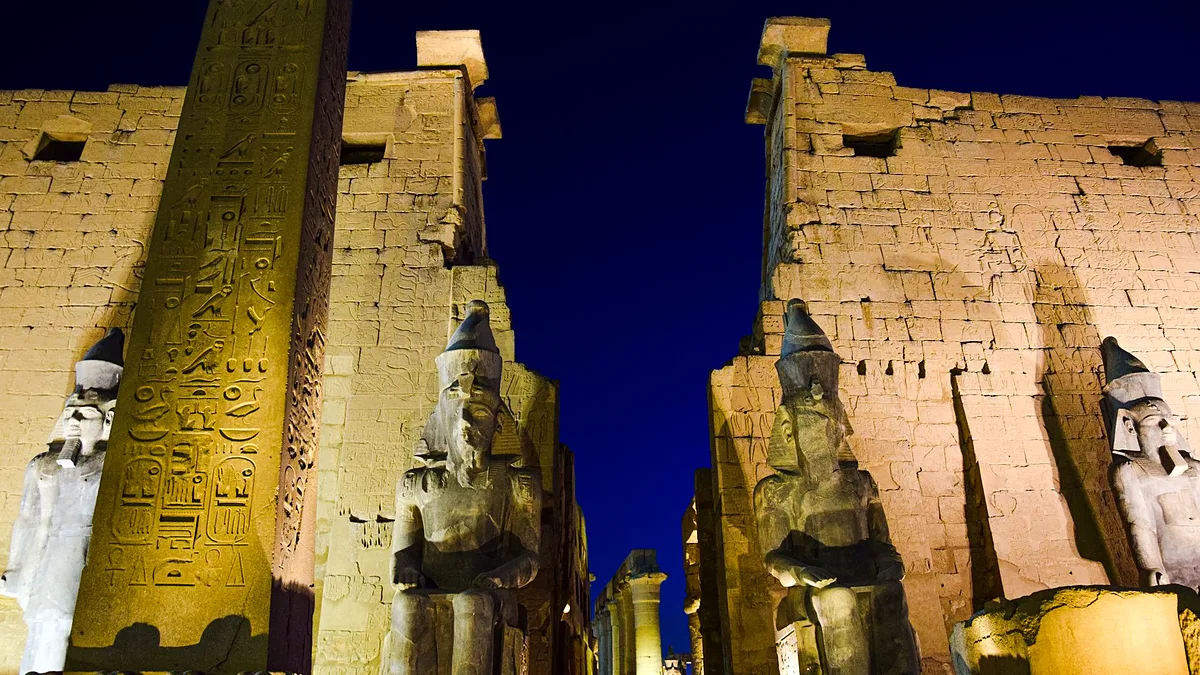

Luxor is usually sold as a checklist: temple, tomb, photo, minibus. That is a shame, because this is one of the few places on earth where you can stand in the actual workshop of the people who made the art. Not a reconstruction, not a diorama — the narrow mud-brick rooms where the painters and stone cutters of the Theban necropolis ate lunch and complained about their foremen.
This guide connects the two halves of Luxor: the heritage sites where the techniques were invented, and the working workshops where you can still watch carving, painting, weaving and mud-brick building happen today. You need two days, a bit of haggling nerve, and a willingness to cross the Nile by boat instead of taxi.
Luxor at a Glance
- Best time to visit: October to March. Start at 6:30–7am; almost every site opens early and the light is best before 10am.
- Typical daily budget: 2,200–4,500 EGP (~$45–90 USD) per person, covering tickets, food, transport and one decent purchase.
- Local transport: Public ferry across the Nile, tuk-tuks and microbuses on the West Bank, Careem or taxis on the East Bank.
- Vibe: Slow mornings, dry heat, hard selling at the big-name sites, genuine quiet at the small ones.
Deir el-Medina: The Original Craft Workshop
Deir el-Medina is the village where the tomb builders lived — a walled settlement of about 70 houses, packed between the hills on the West Bank. You can walk the same narrow lanes the draughtsmen used, then look at their own tombs a few minutes uphill, where the paint is still fresh enough to read brush strokes.
Unlimited High-Speed International Travel eSIM
Connect in seconds across 180+ destinations. Instant QR code activation with zero roaming surcharges.

This is the single best stop for understanding Luxor as a craft town rather than a monument park. The workmen left sketches on pottery shards and limestone flakes — practice pieces, jokes, complaints about wages — and the site museum displays them. It is small, shaded, and rarely crowded before 9am.
- Neighborhood: West Bank, above the village of Qurna, off the main tourist road.
- Cost: ~220 EGP (~$4.50 USD) for the village, tombs and museum. The Valley of the Kings next door is ~750 EGP (~$15 USD) on top.
- Best time: 7–9am. There is almost no shade after 11am.
- Getting there: Public ferry from the Luxor Temple corniche (~10 EGP / $0.20), then a 15-minute tuk-tuk (~70–100 EGP return, agree first).
Insider tip: The Tomb of Sennedjem (TT1) is the star of the artisan tombs, but the guards' 'closed today' line usually dissolves if you are polite and patient. Bring a small torch — some tomb interiors are lit poorly.
Karnak's Open Air Museum: How the Carving Was Done
Most people blast through Karnak in 90 minutes and leave with a headache. Instead, buy the extra ticket for the Open Air Museum in the north-west corner, a walled garden of reconstructed barque chapels from the Middle Kingdom onward. It is almost always empty, and it shows you precisely how blocks were cut, stacked, carved and then re-carved by later kings.
Pair it with the main hypostyle hall, where you can still see unfinished reliefs — outlines sketched in red ochre, then corrected in black, then cut. Once you have noticed that, every temple wall in Luxor becomes a construction site you can read.
- Neighborhood: Karnak, about 2.5 km north-east of Luxor Temple, East Bank.
- Cost: ~450 EGP (~$9 USD) for Karnak plus ~100 EGP (~$2 USD) for the Open Air Museum.
- Best time: Right at 6am opening, or 2–4pm when the tour buses have gone for lunch.
- Getting there: Cab or Careem (~80–120 EGP), or walk the 2.5 km down Sharia Karnak if it is not yet hot.
Insider tip: Do not hire the 'official' guide standing at the gate who offers a shortcut through the bazaar. The best route to the Open Air Museum is left past the sacred lake, then north — the signs are smaller than they should be.
New Gourna: Hassan Fathy's Village of Makers
In the 1940s the architect Hassan Fathy built New Gourna to rehouse villagers whose homes sat on top of the antiquities. It is a strange, beautiful, partly abandoned place: mud-brick domes, vaults and courtyards built entirely without concrete, plus a theatre and a market square designed around craft workshops.
Come for the architecture, not a polished visitor experience. Several buildings are crumbling, some are locked, and locals will occasionally offer to show you inside for a small tip. It is still the most honest lesson in Luxor's building craft you can get, and it costs nothing but the tuk-tuk.
- Neighborhood: West Bank, just behind the Qurna hills, roughly 3 km north of the ferry landing.
- Cost: Free. Budget 50–100 EGP (~$1–2 USD) tip if someone opens a building for you.
- Best time: 8–10am or an hour before sunset, when the domes throw shadows and it is cool enough to walk.
- Getting there: Tuk-tuk from the West Bank ferry; ask for 'Gourna Gedida, Hassan Fathy'. Drivers know it.
Insider tip: Skip this stop if you are short on time and want reliable, well-signposted sights. It rewards people who like buildings more than plaques.
Alabaster Workshops in Qurna and Ramla
Egyptian alabaster is really a soft calcite stone, and the West Bank villages of Qurna and Ramla are full of workshops turning it into lamps, vases and goblets on hand-turned lathes. Watch for the moment a craftsman shapes a rim with a stick and water — that is the genuine article, and it takes years of practice.
The catch: many places called 'factories' are showrooms with a demo for show and hard, commission-driven selling. Look for a workshop where the floor is gritty and the tools are in use, and where nobody pressures you to enter a carpet room.
- Neighborhood: Ramla, along the road towards the Colossi of Memnon; also around Qurna village centre.
- Cost: Free entry. Small vases 150–400 EGP (~$3–8 USD); large pieces 1,500–4,000 EGP (~$30–80 USD).
- Best time: Mid-morning on a weekday, when workshops are actually working rather than doing showroom demos.
- Getting there: Tuk-tuk on the West Bank circuit; combine it with Medinet Habu or the Colossi in one 150 EGP (~$3 USD) loop.
Insider tip: Ask 'how much if I buy two?' before you touch anything. Prices quoted to tourists are usually double what a Cairo shop would charge, and a calm 30% counter-offer is normal, not rude.
Medinet Habu: Chisel Marks and Reused Homes
Medinet Habu is the mortuary temple of Ramesses III, and its reliefs are so deeply cut you can see the tool marks. It is also the site of a Coptic town that grew inside the walls, leaving houses, a church ruin and a strange sense of layered habitation that most Luxor temples have lost.
Photographers love it for the hieroglyph depth and the pinkish stone in early light; historians love it because the graffiti and Coptic additions are left in place rather than cleaned away. It is rarely crowded and the ticket office is relaxed.
- Neighborhood: West Bank, southern edge, about 4 km from the ferry.
- Cost: ~220 EGP (~$4.50 USD).
- Best time: 7–9am for light and cool air; it stays fairly empty all day.
- Getting there: Tuk-tuk or bicycle from the ferry landing; the road is flat and quiet.
Insider tip: The nearby Chicago House is where archaeologists record every relief drawing by hand. Ask politely at the gate if a visit is possible — sometimes they will let you watch the artists inking plates.
Luxor Art Gallery and the Painters of Karnak Street
Luxor has a living art scene, and the best entry point is Luxor Art Gallery on Sharia Karnak, founded by painter Mohamed Abou El-Naga. The canvases inside pull their colours and body shapes straight from Theban tomb painting, but they are contemporary works made by working artists, not antique pastiche.
It is small, free to browse, and the staff will happily explain the difference between a print and an original. Pair it with a stop at the nearby Luxor Museum, where the sculpture is displayed so cleanly you can study how stone was carved before you decide what to buy.
- Neighborhood: Sharia Karnak, East Bank, a 15-minute walk south of Karnak's main gate.
- Cost: Free. Originals typically 2,000–15,000 EGP (~$40–300 USD); prints far less.
- Best time: Late afternoon, after 4pm, when there is still light on the walls.
- Getting there: Walk from Luxor Temple along Sharia Karnak, or a short taxi from the corniche.
Insider tip: If a gallery opens with 'you buy, you buy' before you have looked, walk out. The serious studios let you browse quietly and will roll and tube a canvas for free.
Where to Eat & Drink Nearby
Sofra on Mohamed Farid Street, East Bank, is a comfortable Egyptian restaurant in a converted house — good for molokhia, stuffed pigeon and a proper mezze spread. Mains run 180–320 EGP (~$4–6.50 USD). Book a table upstairs for dinner; the downstairs fills with tour groups.
Africa Restaurant on the West Bank at Gezira serves grilled chicken, tagines and cold beer on a rooftop looking at the Nile. Expect 150–300 EGP (~$3–6 USD) per person and a slow, unhurried pace that suits post-temple exhaustion perfectly.
Any koshary shop on Sharia El-Talafizyon (Television Street) will feed you for 60–90 EGP (~$1.20–1.80 USD). Order the small and add extra fried onions; the locals eat standing up at 2pm and so should you.
Practical Logistics & Budget Tips
- Buy the Luxor Pass if you are doing five or more sites. The standard pass costs around $100 USD and includes the Valley of the Kings and most major temples; do the maths before committing, because smaller sites are cheap anyway.
- Carry small cash. Ticket windows and drivers rarely have change for a 200 EGP note, and card machines fail often enough to be a real risk.
- The public Nile ferry from the Luxor Temple corniche costs a few pounds, not a negotiation. Private motorboats will quote 100–200 EGP — fine if you want a sunset, silly for a daily crossing.
- Microbuses on the West Bank cost 5–10 EGP (~$0.20) and will drop you near the Colossi road; a tuk-tuk for a full half-day circuit is 250–350 EGP (~$5–7 USD) and worth it in summer.
- Tipping: 10% in restaurants, 20–50 EGP for bathroom attendants and guards who actually help.
What to skip: papyrus 'institutes' and perfume 'palaces' are sales pitches dressed as cultural attractions, usually on commission through your driver. The banana-island boat trips are overpriced and dull. Calèche (horse carriage) rides around Luxor are an animal-welfare problem and a hard sell. And unless you are a dedicated Egyptologist, the Valley of the Queens is thin value except for Nefertari's tomb, which costs around 2,000 EGP (~$40 USD) on its own.
One more honest note: if a driver insists on taking you to a 'government shop' or says a site is closed and offers an alternative, decline politely. It is a commission system, not a public service.
Frequently Asked Questions
Are there real craft workshops in Luxor I can visit?
Yes — the alabaster lathes in Qurna and Ramla are genuine working workshops, and the painters' studios around Sharia Karnak are legitimate galleries. Just avoid any place that opens with a guided sales talk before showing you the tools.
How much do Luxor's temples and tombs cost in total?
Budget around 1,500–2,000 EGP (~$30–40 USD) for four or five major sites bought individually, or roughly $100 USD for the standard Luxor Pass. Prices rise most years, so check at the ticket office rather than trusting old blog posts.
Can I visit the West Bank heritage sites without a guide?
Absolutely. Deir el-Medina, Medinet Habu and New Gourna are all easy to reach by tuk-tuk from the ferry landing. A guide adds real value at Deir el-Medina, where the tomb paintings need explanation, but you will be fine elsewhere with a good map.
Is it safe to buy crafts in Luxor and how much should I pay?
Buying is safe and stone pieces travel well if you wrap them in clothes. Expect to counter-offer around 30% below the first price, pay in cash, and refuse politely if the seller will not budge — there are twenty more workshops on the same road.