
Luxor has a reputation problem. Everyone knows it holds a huge share of Egypt's ancient monuments, so people assume a visit costs the earth — private guides, polished hotels, balloon rides priced like small cars. It doesn't work that way. Egypt's pound has weakened sharply against the dollar and euro, and the same ticket that stings in Rome or Athens costs about the price of a sandwich here.
I spent five days in Luxor doing everything I actually wanted and nothing I regretted, and the total for tickets, food, boats and transport came in under $40 a day. The trick isn't skipping the good stuff. It's knowing which tickets are worth it, when to show up, and which extras are a waste of both money and morning.
This guide is built for travelers who want the good version of Luxor — quiet temples at sunrise, a felucca at golden hour, a proper dinner on a rooftop — without paying resort prices for any of it.
Unlimited High-Speed International Travel eSIM
Connect in seconds across 180+ destinations. Instant QR code activation with zero roaming surcharges.

Luxor at a Glance
- Best time to visit: October to March. Sites open around 6am and the light is glorious; by 11am you'll be hunting shade.
- Daily budget: 1,200–2,000 EGP (~$24–$40) per person for tickets, food and transport, hotel on top. Add roughly 3,500 EGP if you're doing the balloon.
- Getting around: public ferry to the West Bank (10–25 EGP), Careem rides (60–120 EGP), microbuses, or a rented bike. The East Bank corniche is best on foot.
- Currency: Egyptian pound (EGP), roughly 50 EGP to $1 at the time of writing. Carry cash — many ticket windows and small restaurants don't take cards.
- Vibe: an open-air museum with a slightly sleepy Nile town attached. Hot, dusty, occasionally exhausting, and completely worth it.
1. Karnak Temple at First Light
Karnak is the biggest temple complex ever built and the single most impressive thing in Egypt. Arrive at opening and you get something money usually can't buy: the Hypostyle Hall with nobody in it, 134 columns throwing long shadows and not a selfie stick in sight. By 9am the coaches roll in and the same space becomes a slow-moving queue.
Give it two hours. Walk in, head straight for the Hall, then work backwards through the second pylon, Hatshepsut's obelisks and the Sacred Lake.
- Neighborhood: Karnak, East Bank — about 2.5 km north of Luxor Temple along the corniche
- Cost: 300 EGP (~$6) per adult
- Best time: 6–8am; gates open at 6am in winter
- Getting there: Careem or taxi from the corniche, 60–100 EGP each way, or a 30-minute walk along the Nile
Insider tip: The ticket office is not at the temple gate. It sits back on the main road about 200 m before the entrance, and every morning you'll watch people walk to the gate first and then double back.
2. Valley of the Kings Without Wasting a Pound
This is where the budget conversation actually matters. Your standard ticket covers three tombs from the open list, and the tombs rotate for conservation, so ask at the window which ones are included that day. Ramesses IV, Ramesses IX and Merenptah are consistently strong picks — deep, painted and cool inside.
What most people miss is the add-on pricing. Tutankhamun's tomb costs extra and takes four minutes to walk through. Seti I and Nefertari are genuinely spectacular, but they're priced like luxury goods.
- Neighborhood: West Bank, about 7 km from the ferry landing
- Cost: 750 EGP (~$15) for three tombs; Tutankhamun +500 EGP (~$10); Seti I or Nefertari around 1,400–1,800 EGP (~$28–$36)
- Best time: the 6am opening; by 10am the valley floor is an oven
- Getting there: ferry plus taxi (150–200 EGP each way), or hire a West Bank driver for the full day at 500–700 EGP
Insider tip: Skip Tutankhamun unless you're a completionist and put that money toward one of the big painted tombs instead. Bring your own water — the car park vendors charge triple.
3. Medinet Habu and Deir el-Medina
Two West Bank sites that almost nobody puts on a short itinerary, and both cost less than a coffee in London. Medinet Habu is a walled temple with the sharpest, deepest reliefs in Luxor — you can still pick out original paint in the shaded corners of the first court. Deir el-Medina is the village where the tomb workers actually lived, with their own small tombs and ancient graffiti still on the walls.
You'll often have both almost to yourself, which is the real luxury here. The Colossi of Memnon are on the road between them and cost nothing.
- Neighborhood: West Bank, near the Qurna villages and the road to the Valley of the Queens
- Cost: Medinet Habu 150 EGP (~$3); Deir el-Medina 140 EGP (~$3)
- Best time: 7–9am, before the heat and the day tours
- Getting there: included on most West Bank day-hire taxi routes; a bike works well if you're staying in Gezira
Insider tip: At Medinet Habu, walk past the first pylon to the small Roman-era gate on the right — its carvings are wild and almost no one stops there.
4. Luxor Museum: The Midday Escape
Between 11am and 3pm the temples stop being fun. That's the moment to spend 200 EGP on air conditioning and some of the best museum displays in Egypt. The Luxor Museum is small, calm and beautifully lit — the royal mummy cache and the Amarna gallery are the highlights — and you can see the whole thing in 90 minutes.
Pair it with the Mummification Museum next door on the corniche. It's tiny, a little strange and worth the 100 EGP if you've ever wondered how the process actually worked.
- Neighborhood: East Bank corniche, between Luxor Temple and Karnak
- Cost: Luxor Museum 200 EGP (~$4); Mummification Museum 100 EGP (~$2)
- Best time: 11am–2pm, or after 6pm when the light outside is best
- Getting there: a 10-minute walk north of Luxor Temple, or 50 EGP in a Careem
Insider tip: The Luxor Museum keeps evening hours until around 9pm, which makes it a smart pre-dinner stop on days when you've been on the West Bank since dawn.
5. Sunrise Hot Air Balloon Flight
A balloon over the West Bank at dawn is the one splurge I'd defend in a budget guide. You lift off over the Theban hills while the Valley of the Kings is still in shadow, drift across the fields and the Colossi, and land in a sugarcane field 45 minutes later. The same flight in Cappadocia or Napa Valley costs three times as much.
- Neighborhood: launch sites near the West Bank villages; hotel pickup around 4:30–5am
- Cost: roughly $70–$110 per person, depending on operator and basket size
- Best time: dawn, year-round; winter flights are cancelled more often for wind
- Getting there: transfers are included in nearly every package
Insider tip: Book a licensed operator through your hotel rather than a tout on the corniche, and confirm the refund policy before paying — flights get grounded roughly one morning in five.
6. Sunset Felucca and Banana Island
Sunset on the Nile is Luxor's cheapest luxury. A felucca is a wooden sailing boat and you hire the whole thing rather than a seat, which means a private hour on the water costs less than two cocktails in most cities. Sail south toward Banana Island, a small garden island where you can wander among date palms and drink tea for pocket change.
- Neighborhood: feluccas leave from the East Bank corniche near Luxor Temple and from the West Bank ferry dock
- Cost: 300–600 EGP (~$6–$12) per hour for the boat; Banana Island entry 50–100 EGP (~$1–$2)
- Best time: 4–6pm so you're on the water for the good light
- Getting there: walk the corniche and negotiate directly with a captain
Insider tip: Fix the price, the duration and the return leg before you step aboard, and politely decline the "extra loop" — that's how a 300 EGP sail turns into 900.
7. Souk el-Sagha and Tea at the Old Winter Palace
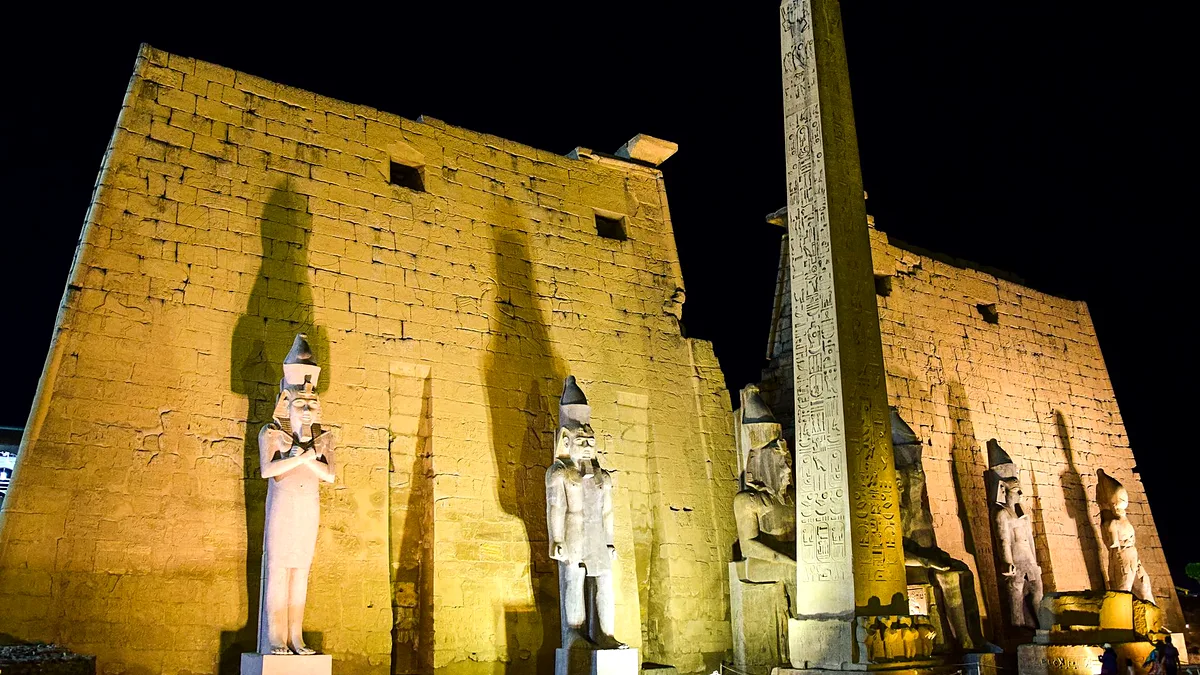
Luxor's market street runs behind Luxor Temple and comes alive after dark, when spice stalls, galabeya shops and alabaster sellers all switch on. It's touristy right by the temple and much better two blocks in, where locals buy lentils, hibiscus and household plastic. Then walk five minutes to the Old Winter Palace, the 1902 hotel on the corniche, and take tea on the terrace for a fraction of what a room costs.
- Neighborhood: Souk el-Sagha off Sharia el-Karnak, East Bank; Winter Palace on the corniche
- Cost: tea and pastries at the Winter Palace around 350–500 EGP (~$7–$10); souvenirs from 50 EGP
- Best time: 6–9pm for the souk, then tea around 8pm
- Getting there: both are a five-minute walk from Luxor Temple
Insider tip: Open bargaining at about half the first asking price and be ready to walk away — it's expected, and it works. Alabaster, scarves and spices are good buys; anything sold as "papyrus" is usually banana leaf.
Where to Eat and Drink in Luxor
Food is where your budget stretches furthest. A full dinner with mezze, grilled meat and mint tea costs less than one main course in a mid-range European restaurant.
Sofra Restaurant & Café — East Bank
A converted townhouse on Mohamed Farid Street with low lights, wood floors and a menu of proper Egyptian home cooking. Order the stuffed pigeon, the vine leaves and the spiced lentil soup. Expect 150–280 EGP (~$3–$6) per main, about 700 EGP (~$14) for two with drinks.
El-Kababgy — opposite Luxor Temple
The grill house locals send visitors to when they want them to eat well without being fleeced. Kofta, kebab and fresh bread straight off the fire; roughly 200–350 EGP (~$4–$7) per person. Sit outside upstairs for the temple view at sunset.
Marsam Hotel — West Bank
An old mudbrick hotel in Gezira with a garden, a resident archaeologist or two, and the best pigeon in Luxor. Mains run 150–250 EGP (~$3–$5). It's a 10-minute walk from the ferry dock, which makes it the ideal last stop after a West Bank day.
For street food, koshary costs 50–70 EGP (~$1–$1.50), a ta'meya sandwich is 10 EGP, and a glass of fresh sugarcane juice is 15 EGP. Buy water in 1.5-litre bottles from corner shops for 10–15 EGP, never from your hotel minibar.
Practical Logistics and Budget Tips
Use the public ferry between the East and West Banks rather than a private motorboat — it's 10–25 EGP and runs constantly until well after dark. A private boat is 100–200 EGP for the whole crossing and only worth it if you're a group or running late.
If you're hitting four or more sites, price up the Luxor Pass (around 1,200 EGP / ~$24 for the standard version, with a premium tier that adds Nefertari's tomb). It's valid for multiple days, so it usually pays off on a two-day temple binge. Do the arithmetic against your actual list before buying, because it's poor value if you're only in town for one full day.
Keep a stack of 5, 10 and 20 EGP notes for baksheesh — bathrooms, car parks, helpful guards. Budget 100–200 EGP for a half-day guide if you want one, and agree the fee up front.
- Skip the caleche (horse carriage): the quoted price is rarely the final price, and the horses are often in poor condition.
- Skip "free" West Bank guides: anyone who attaches themselves to you at the ferry and starts explaining things will ask for 300 EGP at the end.
- Skip the alabaster "factory" stop: it's a commission shop dressed up as a cultural visit.
- Skip the Sound and Light Show at Karnak unless you love narration — it's around $30 and most people find it slow.
- Be honest about Hatshepsut's Temple: it's stunning from a distance and mobbed by 9am. Go at opening or fold it into a West Bank day rather than making a special trip.
The single best money-saving decision in Luxor isn't a pass or a discount — it's setting your alarm for 5:15am. Every site is cheaper in value, not price, when you have it to yourself.
Frequently Asked Questions
How much does a day in Luxor cost?
Plan on 1,200–2,000 EGP (~$24–$40) per person per day for tickets, food and local transport, not counting your hotel. That covers two major sites, a ferry crossing, a sit-down dinner and a felucca if you time it well.
Is the Luxor Pass worth buying?
It's worth it if you're visiting four or more of the big sites over two or more days, since one Valley of the Kings ticket plus Karnak alone gets close to the price. For a single-day visit, buy individual tickets instead.
Do I need a guide in the Valley of the Kings?
No, but signage inside the tombs is minimal and a licensed guide adds real context for 400–700 EGP (~$8–$14) for a half day. If you go without one, read up on three or four tombs beforehand and you'll get most of the value.
What should I wear and carry in Luxor?
Light, loose clothing that covers shoulders and knees, plus a hat, sunglasses and a refillable water bottle. Bring small cash notes for tips and expect a scanner and bag check at every major site.