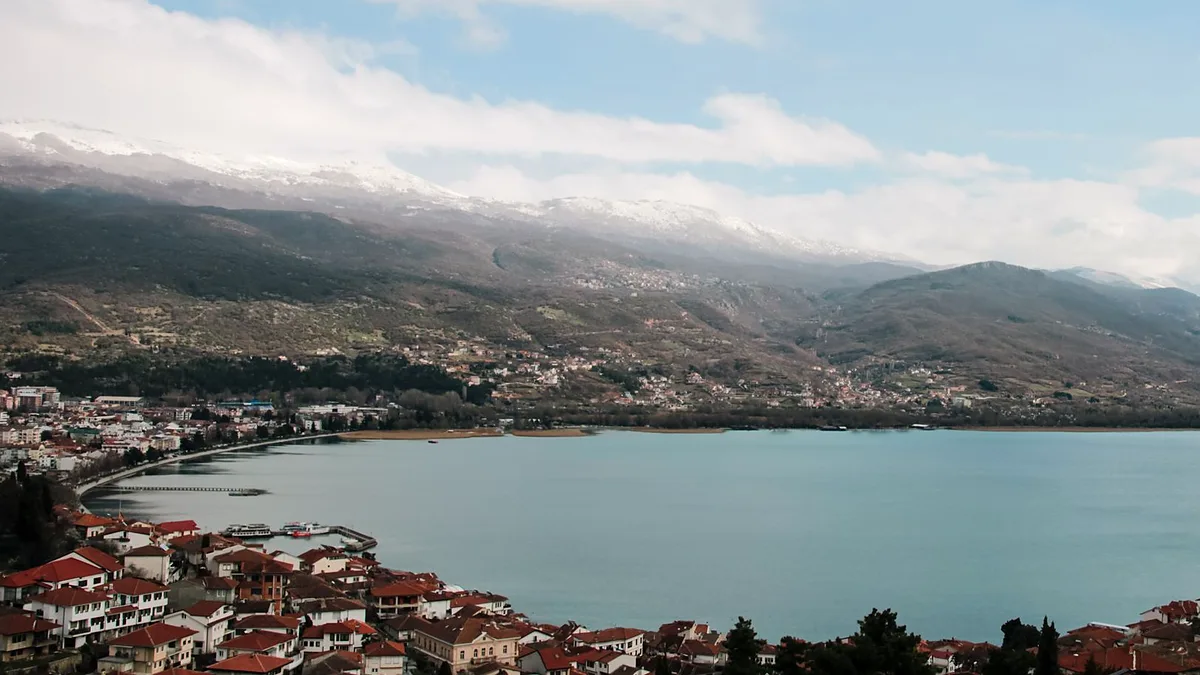

Ohrid has been a craft town for longer than most of Europe's capitals have been cities. The lake below it is one of the oldest in the world, the town above it was a Byzantine bishopric, and the workshops inside the old walls are still run by families who set up shop in the 1920s — or, in the case of the coppersmiths, a few centuries before that.
What makes this place worth a week rather than an afternoon is the density. Within a fifteen-minute walk you can watch a pearl maker coat a fish scale by hand, study frescoes painted in the 1200s, climb the fortress Tsar Samuel held against the Byzantines, and eat grilled trout that was swimming that morning. Everything is small, everything is walkable, and almost nothing costs more than a coffee back home.
Below are the specific workshops and heritage sites worth your time, with real prices in denars and dollars, honest gripes, and the traps to walk past.
Unlimited High-Speed International Travel eSIM
Connect in seconds across 180+ destinations. Instant QR code activation with zero roaming surcharges.

At a Glance: Ohrid in Four Lines
- Best time to go: Late May to June, or September to early October. July and August hit 33°C and the Old Town clogs up by 11:00. Many ateliers close from mid-November to March.
- Daily budget: 3,000–5,000 MKD (€49–81 / ~$53–88) for a comfortable day — room, two proper meals, one museum ticket. Backpackers can squeeze it to 1,800 MKD.
- Getting around: On foot, entirely. The Old Town is car-free and steep with polished cobbles. A taxi across the whole town runs 150–250 MKD (€2.50–4 / ~$2.60–4.40).
- The vibe: Quiet. Church bells, hammers on copper, old men arguing over backgammon. Busiest between 10:00 and 13:00, when the day-trippers arrive from Skopje.
Ohrid Pearl Workshops: The Talev and Filev Families
The Ohrid pearl has nothing to do with oysters. It is made from the scales of the plasnica, a small fish native to the lake, which are shaped, layered and sealed with a pearlescent lacquer until they look like something pulled from the sea. The Talev family has been doing this since 1924, and the Filev family just down the lane nearly as long.
You can walk in, watch a scale get trimmed and set, and be out in ten minutes — or stay half an hour while someone explains why no two are identical. It is a genuine workshop, not a demonstration for tourists, which is exactly why it is worth the stop.
- Neighborhood: Old Town, on and around Kliment Ohridski Street, uphill from the main square.
- Cost: Free to browse. Earrings 1,500–3,500 MKD (€24–57 / ~$26–61); a full necklace 6,000 MKD (€98 / ~$105) and up.
- Best time: Weekday mornings, 10:00–13:00, before the tour groups.
- How to get there: A 10-minute uphill walk from the town square; no bus needed.
Insider tip: Real Ohrid pearls come with a handwritten certificate and a maker's mark. The shiny strands sold on the waterfront promenade for 300 MKD are plastic beads from a wholesaler — if the seller cannot tell you which family made it, keep walking.
Icon Gallery: Thirty Icons, Nine Centuries
Ohrid was a centre of Orthodox painting for hundreds of years, and this small gallery holds around thirty icons dating from the 11th to the 19th century, many salvaged from churches around the lake. The gold leaf is still bright. The faces are unsentimental and human in a way that icons in bigger museums often are not.
It takes about forty minutes if you read everything, and it is the single best primer for the frescoes you will see later at St. Sophia and Plaošnik. Go here first and the rest of the town makes more sense.
- Neighborhood: Old Town, Kliment Ohridski Street, just uphill from the Church of St. Sophia.
- Cost: 100 MKD (~$1.75). Cash is easiest.
- Best time: 10:00–17:00, Tuesday to Sunday. Closed Mondays outside July and August.
- How to get there: Walk; it is 400 m from the square, all uphill.
Insider tip: The Church of St. Sophia next door charges separately for its 11th-century frescoes. Buy both, but do the gallery first — the icon labels explain the saints whose lives are painted on the church walls.
Robevi House: The Merchant's Mansion
The Robevi were a family of traders who built this house in 1863, and it is one of the finest Ottoman-era townhouses left in the Balkans — carved wooden ceilings, a cool central courtyard, deep overhanging upper floors designed to catch the lake breeze. It has been a museum since 1952.
The ground floor holds the archaeological collection, including the gold funeral masks from Trebeništa, dug up about 20 km away and dated to the 6th century BC. They are small, thin and startlingly modern-looking. The upper rooms show how the family actually lived, which most visitors skip and shouldn't.
- Neighborhood: Old Town, just below Samuel's Fortress on the main climb.
- Cost: 150 MKD (€2.40 / ~$2.60).
- Best time: Late afternoon, 16:00–18:00, when the tour buses have gone.
- How to get there: On the walking route from the square up to the fortress; you cannot miss the ochre facade.
Insider tip: The balcony on the top floor has the best free view in Ohrid over the lake and the tiled roofs. Most people photograph the courtyard and never go up.
Plaošnik: Where the Script Was Taught
This hill above the town is where St. Clement of Ohrid set up his school in 893, and it may be the most historically loaded patch of ground in North Macedonia. Excavations have exposed an early Christian basilica with a baptistery, fourth- and fifth-century floor mosaics of peacocks and vines, and the foundations of the scriptorium where a generation of Slavic scribes learned their letters.
The mosaics are the reason to come. They are roofed over but open to the air, and you walk right across them on a raised path. It is quiet, under-visited, and genuinely moving if you care about how writing spread across Europe.
- Neighborhood: Plaošnik Hill, on the eastern ridge above the Old Town.
- Cost: 100 MKD (~$1.75). Guided tours cost roughly 1,000 MKD (€16 / ~$18) for a small group.
- Best time: 09:00, when the light comes across the lake and the site is empty.
- How to get there: A 15-minute walk uphill from the Old Town; steep stone steps most of the way.
Insider tip: The steps near the baptistery are polished smooth and get slick after rain. Wear something with grip — people slip here every summer.
The Old Bazaar Craft Lanes
The Stara Čaršija, the bazaar quarter behind the main square, is where Ohrid's working craftsmen still sit. This is not a reconstructed heritage street: you will find coppersmiths hammering coffee pots, silversmiths doing filigree, woodcarvers cutting iconostases, and a couple of ateliers making hand-bound paper and leather.
Half an hour of slow wandering gets you past most of it. Talk to anyone whose hands are busy. The older craftsmen speak a few words of German or Italian, and if you show real interest in a piece you will usually be taken into the back room to see the workshop.
- Neighborhood: Stara Čaršija, between the square and the Old Town gates.
- Cost: Free. A hand-hammered copper coffee pot runs 800–2,000 MKD (€13–33 / ~$14–35); silver filigree earrings 1,000–2,500 MKD; a carved wooden box 1,500–4,000 MKD.
- Best time: Mornings, 09:00–12:00. Lots of workshops shut for lunch from about 13:00 to 17:00.
- How to get there: Two minutes' walk from the main town square, behind the fountain.
Insider tip: Bring cash. Almost no craft workshop takes a card, and the nearest ATM is down by the waterfront. Prices are fixed but a small cash purchase often gets you a hand-written note about the maker, which is the actual souvenir.
Samuel's Fortress and the Ancient Theatre
The walls at the top of the town date mainly to the reign of Tsar Samuel, who ruled from Ohrid around the year 1000 and used the city to hold off the Byzantine Empire for decades. What stands now is a mix of original masonry and careful reconstruction, and the walk around the battlements takes about twenty minutes with drops of 40 metres in places.
The view is the point: the whole lake, the town's red roofs, and the Albanian mountains on the far shore. On the way down you pass the Ancient Theatre, a Hellenistic arena from around 200 BC, still used for concerts during the Ohrid Summer Festival.
- Neighborhood: Ohrid Old Town, upper gate.
- Cost: Fortress 150 MKD (€2.40 / ~$2.60). The theatre is free unless a performance is rehearsing.
- Best time: 17:00–19:00 in summer for the low light; the climb is brutal at midday in July.
- How to get there: Walk up through the Old Town past the Robevi House; around 20 minutes from the square.
Insider tip: Between early July and mid-August the theatre is fenced off for festival rigging and you will not get in. Check the concert schedule online before planning your day around it.
Where to Eat and Drink Nearby
Letna Bavča Kaneo
A seasonal summer terrace above the Church of St. John at Kaneo, with a view that explains why people put up with the walk. The grilled Ohrid trout is the thing to order, sometimes baked in paper with lemon and oil. Mains 600–900 MKD (€10–15 / ~$11–16).
Restoran Antiko
Set in an old stone house on the lane up to the fortress, with low ceilings and a menu of grilled meats, tavče gravče (beans baked in a clay pot) and shopska salad. Portions are huge and the house wine is decent and cheap. Mains 500–800 MKD (€8–13 / ~$9–14).
The Burek Bakeries Near Goce Delčev
For breakfast, skip the hotel spread and find a bakery on the flat streets outside the Old Town. A fat piece of burek — layered pastry with cheese or minced meat — costs 60–80 MKD (~$1–1.40), and locals eat it standing up with a carton of yogurt. Nothing else in Ohrid is that cheap or that good at 8am.
Practical Logistics and Budget Tips
Getting In and Around
Ohrid has no train station. Buses from Skopje take about three hours and cost 500–700 MKD (€8–11 / ~$9–13); from Tirana it is roughly three and a half hours. Once you are here, everything in the Old Town is on foot, and the cobbles are genuinely slippery — pack shoes with tread. Local buses are sparse and not worth learning; a taxi is cheap enough that you will not bother.
Money
The currency is the Macedonian denar, pegged at roughly 61.5 to the euro. Many small workshops and museums are cash-only, so draw out 5,000 MKD at a time. Cards work at hotels, supermarkets and larger restaurants. Museum tickets are cheap enough that there is no combined pass worth buying — just pay as you go.
What to Skip
Skip the 40-minute "panoramic boat tours" leaving from the main pier. They motor past a few churches, charge 500 MKD (€8 / ~$9), and give you nothing you cannot see from the shore. Do take the boat to St. Naum Monastery instead — around €25 return, less by bus — but go on the 08:00 departure before the crowds. And be sceptical of restaurants with photo menus along the waterfront; the food is fine and the price is double.
Frequently Asked Questions
Are Ohrid pearls real or fake?
Real Ohrid pearls are made from the scales of the plasnica fish, layered and coated by hand, and sold with a maker's certificate. Buy from the Talev or Filev family workshops in the Old Town, not from souvenir stands on the promenade.
How much do the heritage sites in Ohrid cost?
Entry is cheap across the board: 150 MKD each for Samuel's Fortress and the Robevi House, and 100 MKD for the Icon Gallery and Plaošnik — roughly $1.75 to $2.60 per site. Budget about 600 MKD in total and you will cover all of them.
Are the artisan workshops open in winter?
Most ateliers in the Old Bazaar keep limited hours or close entirely from mid-November to March, when tourist numbers drop sharply. The pearl workshops often open by appointment — call or email a day ahead.
How many days do you need in Ohrid?
Two full days covers the Old Town, the museums, the fortress and one day trip to St. Naum. Give it three if you want time to actually talk to the craftsmen and sit through an afternoon without rushing.