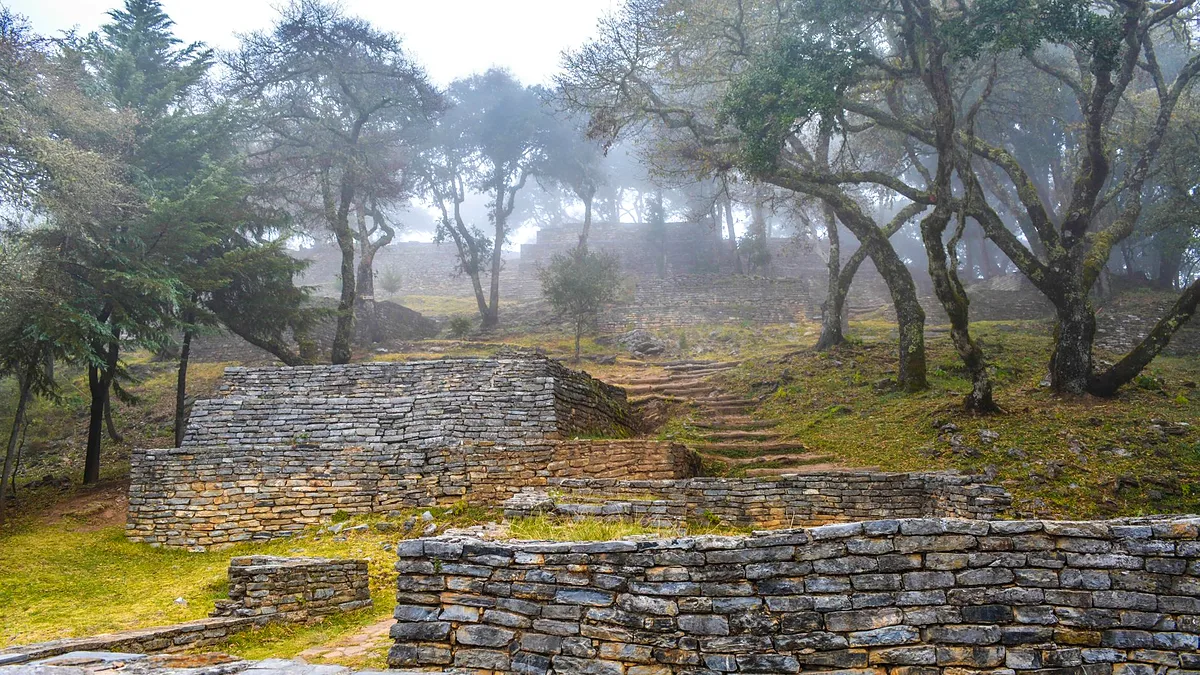

Kuelap sits on a limestone ridge above the Utcubamba Valley at roughly 3,000 meters (9,800 feet). It is a walled city of more than 400 round stone houses built by the Chachapoya people, and the first wall you meet is 20 meters tall in places. People stand in front of it looking mildly annoyed that nobody warned them.
Most tours give the site ninety minutes. That is the mistake. The best of Kuelap is under the platforms and behind the main loop — narrow stone galleries where the air is cold and bone-dry, with carvings that half the crowd walks straight past. Add the cliff tombs, the small museums, and the reservation-only rooms nearby, and you have three or four days of genuinely quiet travel.
One honest note about the theme before we start: Amazonas does not have members-only clubs in the London or Buenos Aires sense. What it has is a set of rooms you have to book, ask about, or be invited into — a tasting table, a museum archive, a lodge lounge. Knowing which ones exist is the whole trick.
Unlimited High-Speed International Travel eSIM
Connect in seconds across 180+ destinations. Instant QR code activation with zero roaming surcharges.

At a Glance
- Best time to visit: April to November (drier); arrive at opening any month to beat the buses
- Typical daily budget: S/ 130–220 (~$35–60 USD); add S/ 100 on day-trip days
- Local transport style: shared combis from Chachapoyas, the Kuelap cable car from Nuevo Tingo, and your own two feet
- Vibe: cold, misty mornings, small groups, wet stone underfoot
The Templo Mayor Galleries: Kuelap's Dark Rooms
The Templo Mayor sits at the highest point of the complex, and its outer wall carries a frieze of zigzag patterns plus a carved serpent most people pass on the way to the viewpoint. Look for the low doorway on the south side. Step through and the temperature drops immediately — a stone gallery running into the hill, ceiling low enough to make you duck, and a stillness that makes the tour groups outside sound like they're in a different country.
Be realistic about access. Only one or two galleries are open at a time; the rest are locked for conservation. You will not be exploring a tunnel network, and anyone selling you a “secret passages” tour is inventing things. What you do get is a handful of dark, dry rooms with carvings still sharp after a thousand years, and that is worth the trip on its own.
“Everyone photographs the wall,” a local guide told me at the gate. “The wall is the outside. The galleries are the building.”
- Location: upper sector of the Kuelap complex, Amazonas region
- Cost: site entry about S/ 20 (~$5.50 USD); cable car round trip about S/ 20 (~$5.50)
- Best time: 8:00–9:30 a.m., before the Chachapoyas coaches land around 10:30
- Getting there: combi from Chachapoyas to Nuevo Tingo (about 1h15, S/ 8–10 / ~$2–3), cable car up, then a 20-minute uphill walk
Insider tip: Bring a small torch, not your phone. A low-beam torch held at an angle makes the frieze patterns pop; phone flashlights flatten the stone into a white blur.
Pueblo Alto at Eight in the Morning
Pueblo Alto is the residential sector: a slope of round houses with doorways shaped like old keyholes. In the first hour the cloud sits inside the ruins, and you can walk between houses without seeing another human. By eleven it is a queue for the same three viewpoints.
Nothing here is dramatically roped off, which means you can stand in a doorway and look at the same slice of valley a Chachapoya family looked at. The stone underfoot is polished and slippery, and it is almost always damp. Grippy soles are not optional.
- Location: upper residential sector, a 10-minute walk from the entrance gate
- Cost: included in site entry
- Best time: first hour after opening; cloud usually lifts by 10 a.m.
- Getting there: follow the signed loop clockwise from the ticket gate
Insider tip: Skip the wide path the groups use. The narrow side stair between houses three and five in the second row gets you above the crowd for the only wide-angle shot of the whole site.
Revash: The Galleries You Have to Climb To
Revash is the closest thing to a private viewing in the region. A row of cliff mausoleums painted in red and cream sits in a natural hollow high above the Utcubamba, shaped like tiny houses with peaked roofs and painted figures. There is no cable car, no ticket booth crowd, and often no one else there at all.
The climb is the filter. You walk uphill for roughly an hour and a half from the village of San Bartolo, and the last stretch is a narrow ledge. People with a fear of heights should look at the photos before committing.
- Nearest village: San Bartolo, Luya province (about 2.5 hours from Chachapoyas)
- Cost: entry around S/ 10 (~$2.70 USD); combi S/ 10–12 (~$3)
- Best time: 9–11 a.m., before afternoon cloud swallows the cliff
- Getting there: combi from Chachapoyas toward Leymebamba, get off at San Bartolo, then walk
Insider tip: Hire a local guide in San Bartolo for S/ 40–50. The turnoff to the ledge is unmarked, and everyone misses it the first time.
Museo Leymebamba: The Dim Room of 219 Mummies
Three hours from Chachapoyas, this small museum holds 219 mummified Chachapoya from the Laguna de los Cóndores, recovered after looters found the site in the late 1990s. The main room is deliberately dark and cool, and the effect is closer to a chapel than an exhibition hall. It is the quietest gallery in Amazonas.
Ask at the desk about the archive and study collection in the back building. Access is by request, not by ticket, and it is granted more often than you would think — especially on weekday mornings when the curators are in.
- Location: Leymebamba, on the edge of town, about 3 hours from Chachapoyas
- Cost: entry around S/ 15 (~$4 USD); combi S/ 20–25 (~$6–7)
- Best time: late morning; hours shift seasonally, so confirm the day before
- Getting there: combi or shared taxi from Chachapoyas, or an overnight in Leymebamba
Insider tip: Pair it with a coffee stop in town and stay the night. Doing Leymebamba as a day trip from Chachapoyas means six hours in a van for two hours of looking.
A Reservation-Only Coffee Cupping in Chachapoyas
Amazonas grows serious coffee in Rodríguez de Mendoza province, and a handful of small roasters in Chachapoyas will set up a private cupping for two or three people if you ask nicely and give them a day's notice. You sit at a table with six cups, a spittoon, and someone who actually grows the stuff, and you taste the difference between a washed and a honey process in about twenty minutes.
Start by asking at a specialty café near the Plaza de Armas — the staff usually know which roaster is taking visitors that week. Expect to pay for the coffee, not for a “experience.”
- Location: Chachapoyas, within a few blocks of the Plaza de Armas
- Cost: S/ 40–70 (~$11–19 USD) per person, usually waived if you buy beans
- Best time: weekday mornings, when the roastery is working
- Getting there: central Chachapoyas is flat and walkable; everything is under 10 minutes on foot
Insider tip: Buy a 250g bag on the way out. The same beans cost three times as much in Lima, and the cash goes straight to the family that picked them.
Karajía Sarcophagi at First Light
Seven clay sarcophagi stand on a ledge in a cliff face above the Utcubamba, each with a carved wooden head and a skull motif, facing out across the valley. They are two meters tall, roughly 600 years old, and they look like they were installed last month.
The walk down from the village of Cruzpata takes about 40 minutes; coming back up takes an hour and will remind you that you are above 2,500 meters. Go early. By midday the sun hits the ledge full-on and the figures flatten into silhouettes.
- Nearest village: Cruzpata, near Lámud (about 2.5 hours from Chachapoyas)
- Cost: entry around S/ 5 (~$1.40 USD); combi to Lámud S/ 8, mototaxi to Cruzpata S/ 15–20
- Best time: 7–9 a.m.
- Getting there: combi Chachapoyas–Lámud, then mototaxi, then walk
Insider tip: There is a second, smaller set at Pueblo de los Muertos about an hour further on, and it gets roughly one visitor a day.
Where to Eat and Drink Nearby
Nuevo Tingo: trout by the cable car
The restaurants clustered at the teleférico base all serve the same thing: trucha frita, fresh from the valley, with rice and a wedge of lime. A full plate runs S/ 20–25 (~$5–7). Skip the S/ 45 buffet places with photo menus; they are aimed at coach groups and the food shows it.
Chachapoyas: set lunches and highland cooking
Away from the Plaza, the set-menu spots popular with office workers serve soup, a main, and a drink for S/ 12–18 (~$3–5). At the other end, places known for cuy chactado charge S/ 40–50 (~$11–13) and need an hour's warning — order when you arrive, not when you sit down hungry.
Cafés around the Plaza de Armas
For breakfast, local cafés pour Amazonas coffee and serve tamales wrapped in banana leaf for S/ 15–20 (~$4–5). The Mercado Central nearby sells fresh juices for S/ 4 (~$1) and is where you should buy fruit for the bus.
Practical Logistics and Budget Tips
- Cable car reality check: the teleférico is the only practical way up, and it closes for maintenance and high winds. Check the day before, and never book a “guaranteed” tour that cannot tell you its contingency plan.
- Ticket hack: buy the combined cable car plus site entry at the Nuevo Tingo station. Queuing twice at the top wastes 20 minutes you could spend in a gallery.
- Altitude: 3,000 meters is not Cusco, but it is enough to make you breathless on the stairs. Walk slower than feels natural for the first hour.
- Cash: Chachapoyas has ATMs; Nuevo Tingo, San Bartolo, and Cruzpata mostly do not. Carry small bills.
- Weather: this is cloud forest. A packable rain shell and grippy shoes matter more than any camera lens.
| Item | Cost (PEN) | Approx USD |
|---|---|---|
| Kuelap site entry | S/ 20 | ~$5.50 |
| Cable car round trip | S/ 20 | ~$5.50 |
| Combi Chachapoyas–Nuevo Tingo | S/ 8–10 | ~$2–3 |
| Museo Leymebamba | S/ 15 | ~$4 |
| Revash entry | S/ 10 | ~$2.70 |
| Karajía entry | S/ 5 | ~$1.40 |
What to Skip, Honestly
Skip the horseback “Kuelap approach” tours that ride you to a viewpoint above the site and call it a visit — you never enter the ruins. Skip the souvenir stalls at the cable car base, where the same textiles cost double what they do in the Chachapoyas market. And skip trying to do Kuelap plus Karajía plus Revash in one day; the roads are slow and you will spend the whole day in a van.
One more: the galleries are not a light show. If you are hoping for torchlit tunnels and dramatic reveals, this is the wrong site. Kuelap rewards patience and quiet, and it punishes rushing.
Frequently Asked Questions
Can you go inside the galleries at Kuelap?
A few, mainly the gallery beside the Templo Mayor, and you may have to duck. Most are gated for conservation, so plan for two or three rooms rather than a tunnel system.
How long do you actually need at Kuelap?
Three hours covers the loop and one gallery; half a day lets you sit with it. Arriving at opening is the single biggest quality-of-visit upgrade you can make.
Are there private clubs or members-only venues in Kuelap?
Not in the formal sense. What exists are reservation-only experiences — private coffee cuppings, museum archive access, small lodge lounges — that you arrange by asking a day ahead.
Is Kuelap worth visiting compared to Machu Picchu?
It is a different experience: round architecture, cloud forest, and a fraction of the visitors. If you want fewer people and stranger history, Kuelap wins.