
Kanazawa gets called "little Kyoto" so often that people assume it comes with Kyoto prices. It doesn't. The city's two biggest draws — Kenroku-en garden and the Higashi Chaya geisha district — cost ¥320 and absolutely nothing.
What you get for that is a former castle town that spent the Edo period getting rich on rice and gold leaf instead of fighting wars. The craft studios, tea houses and samurai lanes survived the war intact, and they're packed into a flat, walkable grid between two rivers.
The trick is timing and geography. Go early, sleep near Korinbo instead of the station, and you'll spend real money on maybe two things while everything else costs less than a coffee in Tokyo.

At-a-Glance Snapshot
- Best time to visit: Late October to November for autumn colour; January to February for snow, empty streets and crab season
- Typical daily budget: ¥8,000–12,000 (~$55–85) per person, excluding your hotel
- Local transport style: Flat-fare city buses at ¥200 a ride, a ¥600 day pass, and a lot of walking on flat ground
- General vibe: Working craft town, not a tourist stage set — shops shut around 5–6pm and the streets go quiet
1. Kenroku-en Before the Ticket Booth Opens
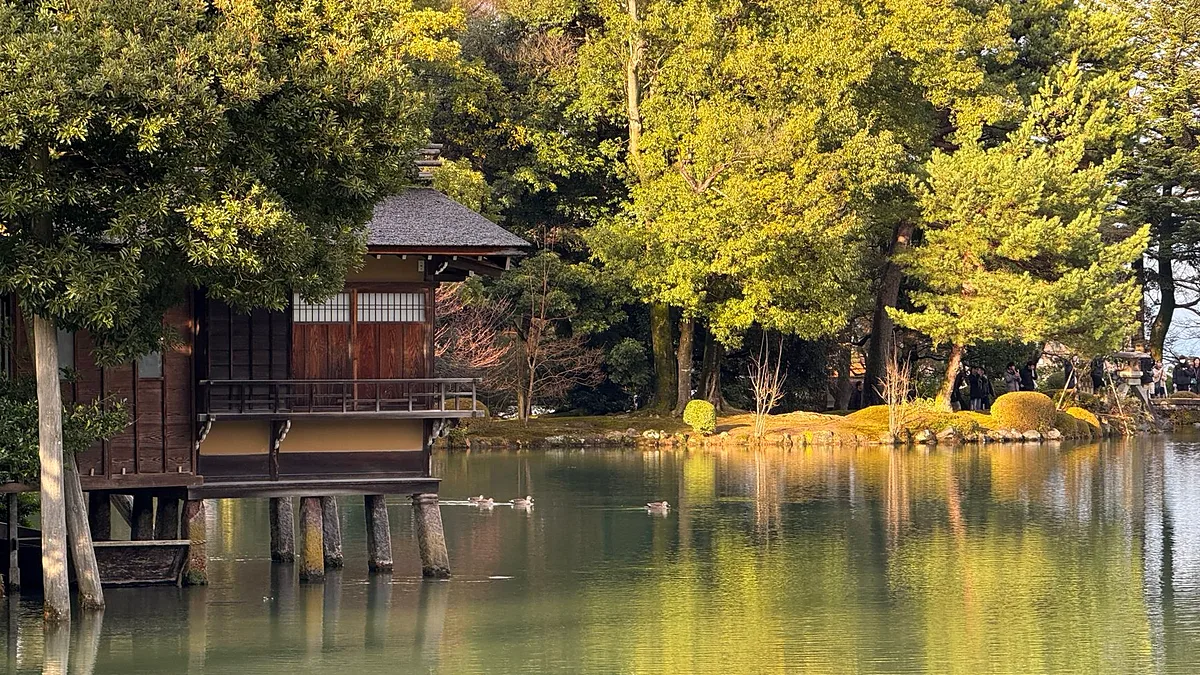
This one move is what makes the whole trip feel expensive when it isn't. Kenroku-en is one of Japan's three great gardens, and if you walk in before staff start selling tickets — roughly before 7am from March to October, before 8am in winter — you pay nothing at all.
You also get the garden at its best. Mist sits on the ponds, gardeners rake gravel in silence, and the Kotoji lantern photo spot is yours. By 9am the coach groups arrive and the main paths turn into a slow-moving queue.
- Neighborhood: Kenroku-en, 15 minutes on foot from Korinbo, 25 from Kanazawa Station
- Cost: ¥320 (~$2.20); combined ticket with the castle's Gyokusen'inmaru Garden around ¥560 (~$3.90)
- Best time of day: 6:30–8:00am, or late afternoon in winter when the yukitsuri snow ropes go up (from 1 November)
- How to get there: Hokutetsu bus to Kenroku-en-shita (¥200), or walk the flat approach through Ōtemachi
Insider tip: Don't sprint to the famous lantern first. Enter at the Katsurazaka gate, loop clockwise past Kasumigaike pond, and you'll hit it before the buses unload. The castle park next door is free to wander — only the small Gyokusen'inmaru garden charges.
2. Higashi Chaya: The Geisha District That Costs Nothing to Walk
Dark wooden teahouses, lattice fronts, a stone lane that hasn't changed much since the 1820s. Walking Higashi Chaya is free, and the two teahouses that open their doors charge less than a sandwich in London.
Kaikaro (¥750 with matcha) is the working teahouse with gold-leaf tatami and a steep, polished staircase. Shima (¥500) is the smaller, museum-quiet one that shows how geisha actually lived and worked. Pick one — doing both is overkill.
- Neighborhood: Higashi Chaya, north bank of the Asano River
- Cost: Free to walk; Kaikaro ¥750 (~$5.20) including matcha; Shima ¥500 (~$3.40)
- Best time of day: 8:00–9:30am, or after 4:30pm when the day-trippers have gone
- How to get there: Bus to Hashiba-chō (¥200), then five minutes on foot
Insider tip: Almost everyone stays on the single main lane, Higashi Chaya Ōdōri. Turn down any side alley toward the river and you'll find workshops, a tiny shrine and nobody else.
3. Nagamachi: Samurai Walls, Carp Canals and a ¥100 House
Nagamachi is where the Kaga samurai kept their walled compounds, and the earthen walls and irrigation channels still run beside the pavement. You can walk the whole district free; the two houses worth paying for are the ones with gardens.
Nomura-ke (¥550) is the polished showpiece, a samurai villa with a pond garden you view from tatami. Two doors down, the Shinise Kinenkan (¥100) is a former herbal medicine shop with a courtyard that's nearly as lovely for a fifth of the price.
- Neighborhood: Nagamachi, 15 minutes on foot from Korinbo
- Cost: Free to walk; Nomura-ke ¥550 (~$3.80); Shinise Kinenkan ¥100 (~$0.70)
- Best time of day: 9–11am, when the lanes are still empty and the light hits the walls
- How to get there: Walk from Kenroku-en's Katsurazaka exit, or take the bus to Nagamachi and walk in
Insider tip: If you want Myōryū-ji, the so-called ninja temple, book by phone at least a day ahead. It runs on timed slots with no walk-ins, and turning up unannounced is the most common tourist mistake in this district.
4. 21st Century Museum of Contemporary Art
A glass drum in a lawn, with free-standing artworks you can walk around without buying anything. The paid galleries cost ¥450, which is remarkable value for a museum of this calibre.
Inside, the Leandro Erlich swimming pool and the darkened colour rooms are the pieces people photograph. Outside, the free zone is a genuinely pleasant place to sit, and the lawn is where local families spend Sunday afternoons.
- Neighborhood: Hirosaka, directly beside Kenroku-en
- Cost: ¥450 (~$3.10) for the permanent collection; the outdoor and public areas are free
- Best time of day: 10am at opening, or after 3pm when the school groups leave
- How to get there: Loop bus to Hirosaka, or a five-minute walk from the garden
Insider tip: Closed Mondays. Buy from the ticket machine inside rather than queueing at the desk, and peek down into the swimming pool from the free zone first — you may decide you only need the ¥450 ticket for the rest.
5. A Gold Leaf Workshop at Sakuda or Hakuza
Kanazawa produces around 99% of Japan's gold leaf, and the craft is still done in small workshops. For roughly the price of two coffees, you can sit down and apply leaf to a small plate or box yourself.
Sakuda and Hakuza both run short sessions in Higashi Chaya, usually 30 to 45 minutes with an English-speaking instructor. It's the rare souvenir that's actually made by you, not bought off a shelf.
- Neighborhood: Higashi Chaya, with a second branch inside Kanazawa Station
- Cost: ¥1,000–1,500 (~$7–10) for the application experience; shop entry is free
- Best time of day: Weekday mornings; afternoons fill up in autumn
- How to get there: Bus to Hashiba-chō, then walk five minutes
Insider tip: Choose the flat plate over the boxed set. Same technique, cheaper, and it survives the flight home in hand luggage. Skip the gold leaf soft serve (¥600–900) if you're counting yen — it's pretty, but it's just vanilla underneath.
6. Nishi Chaya and Kazue-machi: The Quiet Geisha Districts
Two smaller geisha districts get a fraction of the foot traffic, and both are free to walk. Nishi Chaya sits west of the station side with a free little museum, the Nishi Chaya Shiryōkan, that explains the geisha system in plain Japanese and English.
Kazue-machi runs along the Asano River, all dark timber and lantern light with mountains behind it. At dusk it's the most atmospheric ten minutes of walking in the city, and it costs nothing.
- Neighborhood: Nishi Chaya and Kazue-machi, either side of the Asano River
- Cost: Free, including the Nishi Chaya Shiryōkan
- Best time of day: Dusk, roughly 5–7pm, when the lanterns come on
- How to get there: 15 minutes on foot from Higashi Chaya over the river bridge
Insider tip: Pair Kazue-machi with the D.T. Suzuki Museum (¥300), a concrete meditation building about 15 minutes southwest that stays quiet even during foliage season.
Where to Eat & Drink Nearby
Omicho Market — Mori Mori Sushi
This 300-year-old market is where the city actually shops, and Mori Mori is the reliable middle ground between tourist queues and ¥10,000 crab lunches. A bowl piled with snow crab, sweet shrimp and tuna belly runs ¥2,500–3,800 (~$17–26).
Go Go Curry, Kanazawa Station branch
Kanazawa invented this chain, and the flagship plate — thick curry, pork cutlet, shredded cabbage — costs ¥900–1,200 (~$6–8). It's the best cheap meal in the city and locals eat here without irony.
Tsubajin, Katamachi
A tiny husband-and-wife oden counter where you point at what's simmering. Budget ¥2,500–4,000 (~$17–28) per person with a drink, and reserve a day ahead — there are only about eight seats.
Practical Logistics & Budget Tips
Getting around
Hokutetsu city buses charge a flat ¥200 within the central zone, and the ¥600 day pass pays off after three rides. The Machi-nori bike share costs about ¥1,000 (~$7) a day and is faster than the bus between Korinbo and the geisha districts.
To get here, the Hokuriku Shinkansen from Tokyo takes about 2.5 hours (roughly ¥14,000 / ~$95). Highway buses from Tokyo or Osaka run ¥5,000–7,000 overnight if you can sleep sitting up.
What a day actually costs
Two paid sights, a market lunch, a bus pass and a coffee lands at ¥4,000–6,000 (~$28–42). Add a gold leaf workshop and a proper dinner and you're at ¥9,000–12,000 (~$62–85) — which is luxury money in Kanazawa.
Stay in Korinbo or Katamachi rather than by the station. Business hotels run ¥7,000–11,000, and you'll save the bus fare and 20 minutes a day.
What to skip
Skip the ¥8,000–12,000 crab set lunches in Omicho and buy crab from a stall instead, especially outside winter. Skip the rickshaw tours in Higashi Chaya (¥3,000+ for 30 minutes) — the district is four streets long.
Also be honest with yourself about Kenroku-en: it's smaller than the photos suggest, and on a November weekend you'll be shuffling shoulder to shoulder. Go early or go in February snow.
Frequently Asked Questions
Is Kanazawa expensive to visit?
No — it's one of the better-value cities in Japan. Most of the famous sights are free to walk through, and a comfortable day with two paid attractions costs ¥8,000–12,000 (~$55–85) before your hotel.
Can you walk between Kanazawa's main sights?
Yes. Kenroku-en, the 21st Century Museum, Nagamachi and Higashi Chaya sit within about 25 minutes of each other on flat ground. Use the ¥200 buses only for the station run or bad weather.
When is the cheapest time to visit Kanazawa?
January and February, when hotel rates drop and the garden is at its quietest under snow ropes. Avoid cherry blossom season and Golden Week, when prices double and the lanes jam.
Is the Kanazawa bus day pass worth it?
Only if you'll ride three or more times in one day. The centre is compact enough that most visitors walk, so buy the ¥600 pass on days you're heading out to Nishi Chaya, the station or Yuwaku Onsen.