
Kanazawa spent the Edo period as Japan's second-richest city after Kyoto. The Kaga clan had rice money and nowhere to put it except into lacquerware, gold leaf, Noh stages and a garden that took two centuries to get right. Four hundred years later, you can still walk through all of it.
Here's the part nobody tells you: almost none of it is priced like a luxury destination. Kanazawa's headline sights cost ¥320, ¥500, ¥550. That's pocket change in a country where a train ticket between cities runs ¥14,000.
This guide is built around that gap — paying properly for the few things that genuinely move you, and walking straight past everything that's just expensive.
Unlimited High-Speed International Travel eSIM
Connect in seconds across 180+ destinations. Instant QR code activation with zero roaming surcharges.

Kanazawa at a Glance
- Best time to visit: Late April for cherry blossom, or mid-November for the yukitsuri rope cones going up in Kenrokuen. Avoid Golden Week and the first week of August.
- Daily budget: ¥10,000–14,000 (~$67–93) per person including a business hotel, all entry fees and three meals. Tight travellers can do ¥7,500 (~$50) by staying in a hostel and eating at markets.
- Getting around: Hokutetsu city buses cost a flat ¥200 (~$1.30) in the centre. Most of the historic districts are a 15–20 minute walk from each other, so your feet do 70% of the work.
- The vibe: Quiet, low-rise, slightly formal. Shops shut at 17:00. Nobody rushes you.
1. Kenrokuen Garden — ¥320 for One of Japan's Three Great Gardens
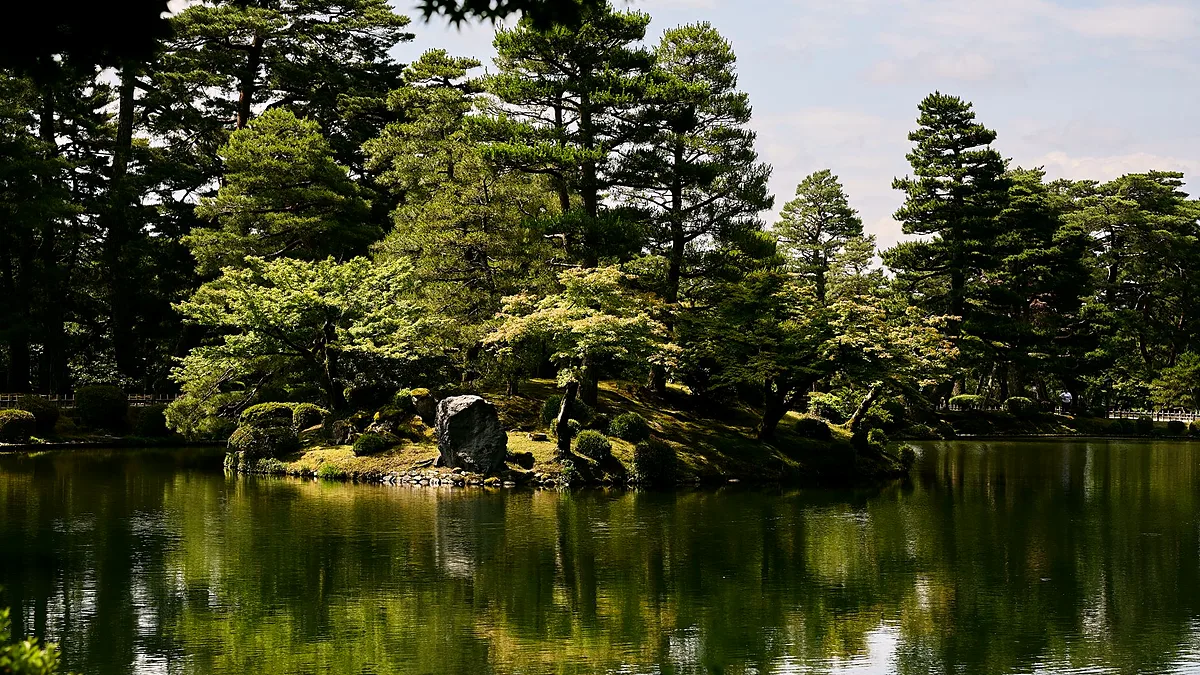
Kenrokuen is the reason most people come, and it costs less than a sandwich. The ¥320 entry fee has barely moved in a decade. Inside you get 11 hectares of ponds, tea houses, stone lanterns and that famous two-legged Kotoji lantern, all built around the idea that a garden should combine six qualities at once.
The trick is timing. Gates open at 07:00 from March to mid-October, and the first hour is when the light comes through the pines and the tour groups are still at breakfast. In winter, the yukitsuri — those conical rope umbrellas protecting the branches — go up around 1 November and stay until March.
- Neighborhood: Kenrokuen, directly west of Kanazawa Castle Park
- Entry: ¥320 (~$2) adult, ¥100 child. Combined ticket with Kanazawa Castle buildings ¥570 (~$4)
- Best time: 07:00–08:30, or after 16:00 in summer
- Getting there: Loop Bus to Kenrokuen-shita (¥200), or a 25-minute walk from Kanazawa Station through the Ote-machi shopping street
Insider tip: Most people enter at the main Katsurazaka gate and walk clockwise, which means they bunch up at the Kasumigaike pond. Enter at the Renchimon gate on the north side and go counter-clockwise — you'll have the Kaburaki-tei teahouse area almost to yourself for the first 20 minutes.
2. Higashi Chaya — the Geisha Lanes That Cost Nothing to Walk
Higashi Chaya is the postcard district: wooden lattice fronts, dark timber, paper lanterns, no overhead wires. It's free to wander and there is no gate, no ticket booth, no queue. Two teahouses still operate as actual geisha houses, and one of them, Kaikaro, opens its downstairs rooms to visitors for ¥750 (~$5) including matcha.
The better-value stop is Shima, a preserved Edo-period teahouse that's been left almost exactly as it was, tatami and all, for ¥500 (~$3). Twenty minutes there teaches you more about geisha life than any museum exhibit.
- Neighborhood: Higashi Chaya-gai, north-east of the station across the Asano river
- Entry: Free to walk. Shima ¥500 (~$3), Kaikaro ¥750 (~$5) with tea
- Best time: 09:30 before the crowds, or 19:00 when the lanterns come on and the streets empty out
- Getting there: 15-minute walk from Omicho Market, or Loop Bus to Hashiba-cho
Insider tip: Walk five minutes south to Kazuemachi, the smallest of the three geisha districts. It's a single street on the riverbank with a couple of restaurants and almost no tourists — same architecture, none of the crowd. Do Higashi Chaya for the photos, Kazuemachi for the feeling.
3. Nagamachi Samurai District & the Nomura-ke Garden
Nagamachi is where the Kaga samurai lived, and it still has the earthen walls, the craft canals and the lattice gates. Walking the lanes is free. The one thing worth paying for is the Nomura-ke, a former retainer's house with a tiny, perfect garden that designers still argue about.
Entry is ¥550 (~$4) and includes the garden and the rooms. It's small enough to see in 30 minutes, but the garden is dense — a waterfall, a pond, stepping stones and a view composed to look twice as deep as it actually is. Pair it with the Kanazawa Castle Park grounds next door, which cost nothing.
- Neighborhood: Nagamachi, 15 minutes south-west of Kenrokuen
- Entry: Streets free. Nomura-ke ¥550 (~$4). Castle park and Gyokusen'inmaru Garden free
- Best time: 10:00–15:00. The district is residential — keep your voice down and don't photograph inside gates
- Getting there: Loop Bus to Korinbo, then a 7-minute walk
Insider tip: The Nomura-ke ticket office sells a small matcha set for around ¥700 (~$5) served on the upper floor looking down into the garden. It's the cheapest "luxury" moment in Kanazawa and almost nobody takes it up.
4. 21st Century Museum of Contemporary Art — the Free Zone
Kanazawa's contemporary art museum is a glass circle in the middle of a park, and the building itself — plus the permanent free area and the outdoor pieces — costs nothing. That includes Leandro Erlich's famous swimming pool, which you can photograph from above without buying anything.
If you want the ticketed galleries, the permanent collection is ¥450 (~$3). Special exhibitions run ¥1,200 and up, which is the one place your budget can quietly evaporate. Check what's actually on before you commit.
- Neighborhood: Hirosaka, immediately east of Kenrokuen
- Entry: Free common zone. Collection ¥450 (~$3). Closed Mondays
- Best time: Opening time at 09:00, or after 16:00 on weekdays
- Getting there: Loop Bus to Hirosho-ji or a 3-minute walk from Kenrokuen's south gate
Insider tip: Skip the café inside — it's ¥900 for a coffee. Walk eight minutes to the D.T. Suzuki Museum instead (¥310, ~$2), a concrete-and-water building so quiet it recalibrates your whole afternoon.
5. Gold Leaf Workshop in Higashi Chaya
Kanazawa produces something like 99% of Japan's gold leaf, and most people's contact with it is a ¥900 ice cream cone with a flake of leaf on top. Skip that. Instead, book a bench session at one of the small workshops and apply leaf yourself.
At Sakuda and similar craft shops, a 30–45 minute session runs roughly ¥1,000–2,000 (~$7–13) and you leave with a small box or plate you decorated. The leaf is thinner than a hair — you breathe too hard and it's gone. It's genuinely fiddly and genuinely memorable, and it's a fraction of what a Kyoto craft experience would cost.
- Neighborhood: Higashi Chaya-gai and around Kanazawa Station
- Cost: ¥1,000–2,000 (~$7–13) for a drop-in session; walk-in slots most weekday afternoons
- Best time: Weekday afternoons — weekends book out
- Getting there: Walking distance from Higashi Chaya, or the Kanazawa Yasue Gold Leaf Museum (¥310) on the eastern edge of town
Insider tip: Hakuza's gold leaf shop has free entry to its "Hikari no Kura" storage room, a two-storey space completely covered in leaf. It's a five-minute stop, costs nothing, and photographs beautifully.
6. Yuwaku Onsen — a Hot Spring Bath for ¥600
This is the move that makes a budget trip feel indulgent. Yuwaku is a small mountain onsen town about 40 minutes from Kanazawa Station, with a handful of family-run ryokan that open their baths to day visitors for ¥500–800 (~$3–5). No reservation, no ceremony — you pay at the front desk and get a towel.
Go in the late afternoon, soak, then take the last bus down before dinner. The mountain road up is worth the ride on its own in autumn.
- Neighborhood: Yuwaku Onsen, in the hills south-east of the city
- Cost: ¥500–800 (~$3–5) day bath; Hokutetsu bus from the station ¥730 (~$5) each way
- Best time: 15:00–17:00 on a weekday
- Getting there: Hokutetsu bus from Kanazawa Station east exit, roughly 40 minutes
Insider tip: If you're short on time, skip the trip and use a city sento in Katamachi instead — entry is around ¥450 (~$3) and it's a far more local experience than any hotel spa.
Where to Eat & Drink Nearby
Iki-iki Tei, Omicho Market
A tiny counter inside the covered market serving kaisendon bowls that stack sweet shrimp, crab, salmon roe and whatever came off the boat that morning. Bowls run ¥1,800–3,500 (~$12–23), the queue moves fast, and it opens at 07:00 — go at 08:00 and eat breakfast like royalty.
Miyoshino
A Kanazawa institution for anpan-style gyoza and bowls of miso oden. Nothing on the menu breaks ¥900 (~$6), branches are near Korinbo and the station, and it's where locals actually eat on a Tuesday night. Order the gyoza and the oden set.
Curio Espresso & Vintage Design
Proper flat whites and homemade cake in a quiet corner near Omicho, around ¥500–700 (~$3–5). It's a small room with mismatched furniture and no rush to leave — the right stop between Kenrokuen and the castle park.
Practical Logistics & Budget Tips
- Bus passes: The Loop Bus day pass is ¥600 (~$4) and pays for itself after three rides. But the ordinary Hokutetsu city bus is a flat ¥200 and often faster — the Loop Bus gets packed and crawls.
- Walk the centre: Kanazawa Station to Omicho is 15 minutes. Omicho to Higashi Chaya is 15 minutes. Kenrokuen to the 21st Century Museum is 3 minutes. You barely need transport.
- Get there cheaply: The Hokuriku Shinkansen from Tokyo is 2h30 and about ¥14,000 (~$93). A 7-day JR Pass now costs ¥50,000, so it only makes sense if you're doing a lot more than one round trip.
- Hotels: Business hotels near the station run ¥7,000–10,000 (~$47–67). Hostels in Katamachi are around ¥3,500 (~$23).
- Cash still matters: Many small teahouses, workshops and market stalls are cash-only.
What to Skip
The gold leaf ice cream cones in Higashi Chaya are ¥900 for something you'll photograph and forget. Omicho Market is also pricier than it looks — the seafood is excellent, but you're paying a tourist premium after 11:00, so go early.
And plan around opening hours. Almost everything closes at 17:00, and a lot of it closes on Mondays. Build your day around mornings and early afternoons, then treat the evening as a food-and-walking exercise — the geisha districts are at their best after dark anyway.
Frequently Asked Questions
Is Kanazawa expensive to visit?
No — it's one of the better-value cities in Japan. Entry to Kenrokuen is ¥320 (~$2) and most major sights sit under ¥600, so a comfortable day including a hotel lands around ¥10,000–14,000 (~$67–93).
How many days do you need in Kanazawa?
Two full days covers Kenrokuen, the three geisha districts, Nagamachi, the 21st Century Museum and Omicho Market without rushing. Add a third if you want a gold leaf workshop and a trip to Yuwaku Onsen.
Is the Kanazawa Loop Bus worth buying a pass for?
Only if you're riding three or more times a day. The pass is ¥600 (~$4) and single rides are ¥200, but central Kanazawa is compact enough that most visitors walk between districts faster than the bus moves.
What's the cheapest way to see Kenrokuen and the geisha districts?
Walk it. Start at Kenrokuen at 07:00 for the ¥320 entry, cross the castle park for free, then follow the river east to Kazuemachi and Higashi Chaya, which cost nothing to wander. You'll spend under ¥1,000 (~$7) on a full day of the city's best sights.