
Kanazawa hides its best rooms behind wooden doors and blank concrete walls. The city is famous for gold leaf and Kenrokuen garden, yet the real reason to come is what happens inside the small, cold-lit spaces that tour groups walk straight past.
This guide is for the traveller who would rather sit in a silent contemplation room than queue for a photo. Expect real prices, closing days that actually matter, and a few honest warnings about what is not worth your yen.
- Best time to visit: Late April to May and October to mid-November. Skip the first week of April (cherry blossom crush) and mid-June to mid-July (rainy season).
- Typical daily budget: ¥9,000–16,000 (~$60–107 USD) per person for entry fees, buses, coffee and two solid meals. Add ¥5,000 (~$33 USD) for a bar night.
- Local transport style: Flat-fare city buses at ¥210 (~$1.40 USD) per ride, plus a lot of walking. Central Kanazawa is genuinely flat and easy on foot.
- Vibe: Low-rise, craft-obsessed and socially reserved. Streets go quiet by 8pm outside the Katamachi bar zone.
D.T. Suzuki Museum: The Coldest, Calmest Room in the City
The D.T. Suzuki Museum is the closest thing Kanazawa has to a sensory reset. Built in 2011 to honour the Zen scholar who introduced Japanese Buddhism to the West, it is a concrete and glass complex in the Hondamachi residential grid. You follow a set route: entrance gallery, a shallow water-mirror courtyard, then a small room with one bench and one open window.
Unlimited High-Speed International Travel eSIM
Connect in seconds across 180+ destinations. Instant QR code activation with zero roaming surcharges.

Nothing is displayed. No labels, no audio guide, no gift shop worth browsing. Light bounces off the pool onto white walls, and the effect sits somewhere between a museum and a spa. Twenty minutes here does more for your head than an hour in a crowded temple.
- Neighborhood: Hondamachi 3-4-20, an 8-minute walk from Kenrokuen's Sakura-mon gate.
- Cost: ¥310 (~$2 USD) adult entry. Skip the ¥100 audio guide.
- Best time: 9:30am opening, or the last hour before 5pm on a weekday.
- Getting there: Kenrokuen-shita bus stop, or a flat 25-minute walk from Kanazawa Station.
Insider tip: Go on a rainy Tuesday. The water mirror doubles in size, the crowds vanish, and the staff will let you sit in the contemplation room without hovering. Photography is banned inside that room — leave the phone in your bag.
Kanazawa Noh Museum: Masks Under Fluorescent Light
Kanazawa keeps more than 30 working Noh stages, and the Noh Museum in Hirosaka explains why. The entrance sits below street level, which is exactly why most visitors miss it. Downstairs you get a half-scale cypress stage, a rack of brocade costumes and a wall of carved masks.
The lighting is unglamorous — plain fluorescent, no theatre tricks — and that is the appeal. You can stand a hand's width from a 200-year-old demon mask and see the knife marks. It takes 40 minutes and teaches you more about Japanese performance than a full-price show.
- Neighborhood: Hirosaka 1-2-25, beside the 21st Century Museum block.
- Cost: ¥300 (~$2 USD).
- Best time: Weekday afternoons, 10:00am–6:00pm, closed Mondays.
- Getting there: Hirosaka bus stop, or 5 minutes on foot from Kenrokuen.
Insider tip: Ask at the desk about amateur Noh performances at the Ishikawa Prefectural Noh Theatre nearby. Tickets often run ¥2,000–3,000 (~$13–20 USD) and you can watch locals rehearse for free during daytime practice.
Shima Teahouse: Walking Into a Private Club
Higashi Chaya is the postcard district, but Shima is the one building where you can step inside the private world. Built in 1820, it operated as an ochaya — a geisha house where guests were entertained behind closed doors. The six-mat tatami room, the kitchen hearth and the steep hidden staircase are all original.
The upper floor is where money changed hands and performances happened. Rooms are dim, walls are thin, gold leaf is faded to a dull ochre. You can hear traffic outside, which somehow makes the whole thing more convincing rather than less.
- Neighborhood: Higashi Chaya 1-13-21, in the northern lane of the district.
- Cost: ¥500 (~$3.30 USD).
- Best time: Right at 9:00am before the tour groups arrive, or after 4:00pm.
- Getting there: Hashiba-cho bus stop, then a 3-minute walk. Flat and easy from the station by bus.
Insider tip: Across the lane, Kaikaro teahouse charges ¥750 (~$5 USD) and includes matcha in a room with red-and-gold walls; it also arranges evening ozashiki for groups from roughly ¥15,000 (~$100 USD) per person. Book that two weeks ahead — and understand it is a performance, not a party.
Ohi Museum and Kiln: 350 Years of Tea Bowls
The Ohi family has made tea-ceremony pottery in Kanazawa since the 1660s, and their museum sits next to the working kiln in Hashiba. The collection is small and deliberate: maybe 80 pieces, including amber-glazed bowls, water jars and incense boxes, with handwritten labels.
What makes the detour worthwhile is the scale. You can often glimpse the kiln's sliding door, and the shop lets you handle a bowl that costs more than your flight home. Nobody rushes you, nobody upsells you, and the whole visit takes half an hour.
- Neighborhood: Hashiba 1-chome, about 15 minutes on foot north of Ohi Bridge.
- Cost: ¥700 (~$4.70 USD); the adjoining shop is free to browse.
- Best time: 9:00am–5:00pm, closed Mondays and over New Year.
- Getting there: Walk from Higashi Chaya (20 minutes) or take a bus to Hashiba-cho.
Insider tip: If you want to buy, ask for the chawan (tea bowl) seconds — pieces with a tiny glaze flaw sell for ¥3,000–6,000 (~$20–40 USD) instead of ¥30,000. They are kept in a separate box and staff will not offer unless you ask.
KAMU Kanazawa: A Privately Run Art Room in Katamachi
KAMU Kanazawa is the contemporary counterweight to the city's craft reputation. This privately run space in Katamachi, a few minutes from the Korinbo crossing, occupies a converted building and shows one or two artists at a time — video, installation, photography.
It is small enough to finish in 45 minutes and serious enough to justify the ticket. The rooms are cool, white and almost always near-empty on weekday mornings. Check the current exhibition before you go; between shows it closes entirely.
- Neighborhood: Katamachi, three minutes from Korinbo crossing.
- Cost: Typically ¥1,000–1,500 (~$7–10 USD), depending on the show.
- Best time: Late morning on a weekday; weekends bring a young local crowd.
- Getting there: Korinbo bus hub, or 20 minutes on foot from the station's east exit.
Insider tip: Combine it with the small commercial galleries along the Katamachi backstreets, many of which are free and open only from 11am to 6pm. Look for the vertical signs with a single character — those are dealers, not shops, and browsing is welcome.
Katamachi After Dark: The Third-Floor Rooms
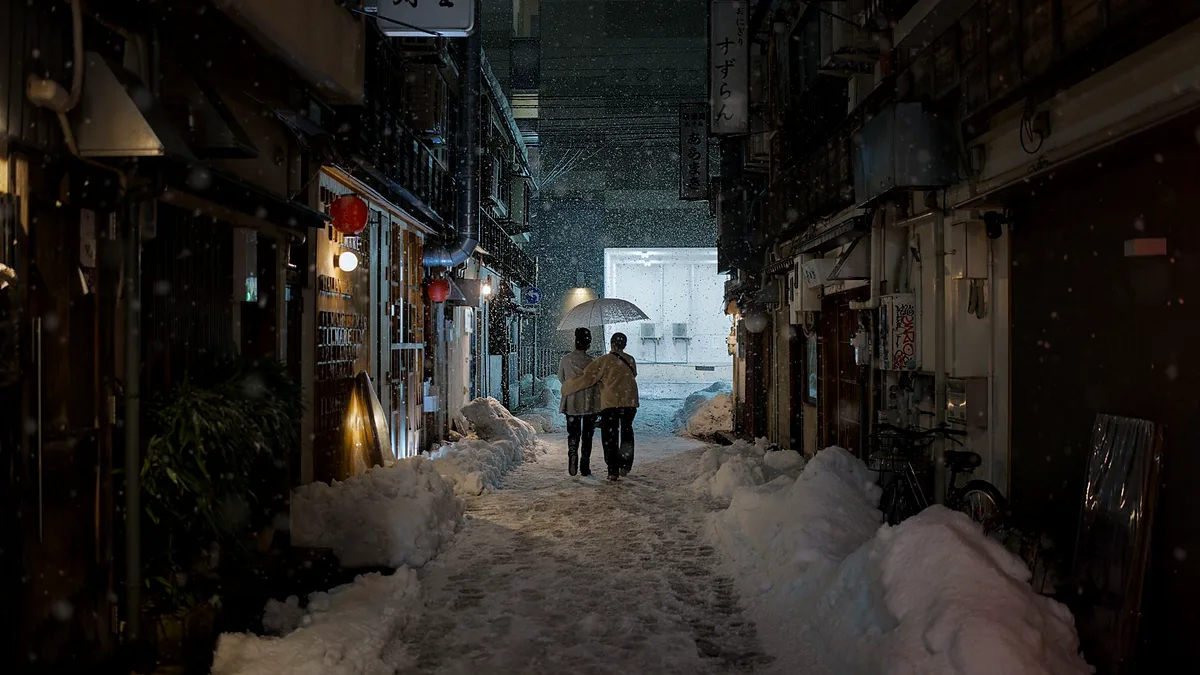
After 9pm, Kanazawa's private clubs open in the narrow buildings above Katamachi and the lanes behind Oyama Shrine. These are snack bars: a counter, eight seats, a hostess who pours and talks, and a bottle of whisky with a regular's name on it. Many are regulars-only, and some quietly turn away first-timers who do not speak Japanese.
The workaround is simple. Start somewhere public — Oriental Brewing's Katamachi taproom is friendly, English-speaking and pours local craft beer at ¥900 (~$6 USD) a glass — then ask the bartender where a visitor can go. A recommendation carries real weight here.
- Neighborhood: Katamachi 1-chome and 2-chome, particularly the side lanes off the main drag.
- Cost: Set charge ¥3,000–6,000 (~$20–40 USD) for two hours plus drinks. Bottle keep is extra.
- Best time: 9pm–1am. Most places close by 2am and Sunday is quiet.
- Getting there: 10 minutes on foot from Korinbo, or a short ¥800–1,200 (~$5–8 USD) taxi.
Insider tip: Confirm the price before you sit down — ask "setto wa ikura desu ka". Carry cash, since many bars do not take cards, and never assume a quoted price includes the table charge.
Where to Eat and Drink Nearby
Curio Espresso and Vintage Design (Yasue-machi, near Ohi Bridge) is a tiny corner café with proper flat whites at ¥550 (~$3.70 USD) and a toasted sandwich for ¥800. It opens at 8am, which matters in a city where breakfast is thin on the ground.
Sushi Ippei in Katamachi is where locals go for a weekday lunch: a chirashi or nigiri set at ¥1,100–1,600 (~$7–11 USD), plates from ¥150. Arrive before noon or expect a 20-minute wait at the door.
Tsubajin, also near Katamachi, serves jibuni — duck simmered with wheat gluten — as a lunch set for around ¥2,000 (~$13 USD). It is the dish Kanazawa is proudest of and the one most visitors never try.
Practical Logistics and Budget Tips
- Bus passes: The Kanazawa Loop Bus day pass costs ¥600 (~$4 USD) and only pays off if you ride four or more times. Most trips are short — a flat ¥210 single fare on regular Hokutetsu buses is usually cheaper.
- Walk the middle: Kanazawa Station to Kenrokuen is 30 flat minutes. The stretch between Korinbo, Hirosaka and Higashi Chaya is best done entirely on foot.
- Bikes: Machi-nori share bikes are docked near the station and Kenrokuen. A day pass runs roughly ¥1,100 (~$7 USD) and beats waiting for buses on weekends.
- Cash: Small galleries, teahouses and bars are cash-only. Withdraw at 7-Eleven ATMs, which accept foreign cards.
- Skip: The 21st Century Museum's "Swimming Pool" queue (20 minutes for a 30-second look), Omicho Market kaisendon at noon (¥3,500 for what costs ¥1,800 at 8am), and the gold-leaf soft cream sold on every Higashi Chaya corner at ¥900.
- Honest heads-up: Most ochaya are private homes and businesses, not attractions. Standing in doorways photographing geisha walking to work is frowned upon and increasingly policed.
Frequently Asked Questions
Are there free galleries in Kanazawa?
Yes — several small commercial galleries around Katamachi and along the Tatemachi shopping street are free to enter and rotate shows monthly. The Nishi Chaya museum is also free, and it is the quietest of the three teahouse districts.
Can tourists visit a Kanazawa teahouse?
You can visit preserved teahouses like Shima and Kaikaro during the day, and Kaikaro arranges evening ozashiki performances for groups. Working ochaya remain private and require an introduction, so book through a hotel concierge rather than knocking on doors.
Is Kanazawa worth visiting for contemporary art?
Yes, though the scene is small and spread out rather than concentrated in one district. KAMU Kanazawa, the 21st Century Museum and the Katamachi dealer galleries together make a solid half-day, especially on a rainy weekday.
How much does a night out in Katamachi cost?
Expect ¥6,000–10,000 (~$40–67 USD) for a bar or snack bar visit with a set charge and three drinks. Craft beer bars and izakaya run closer to ¥4,000, and taxis back to the station add ¥1,200–1,800.