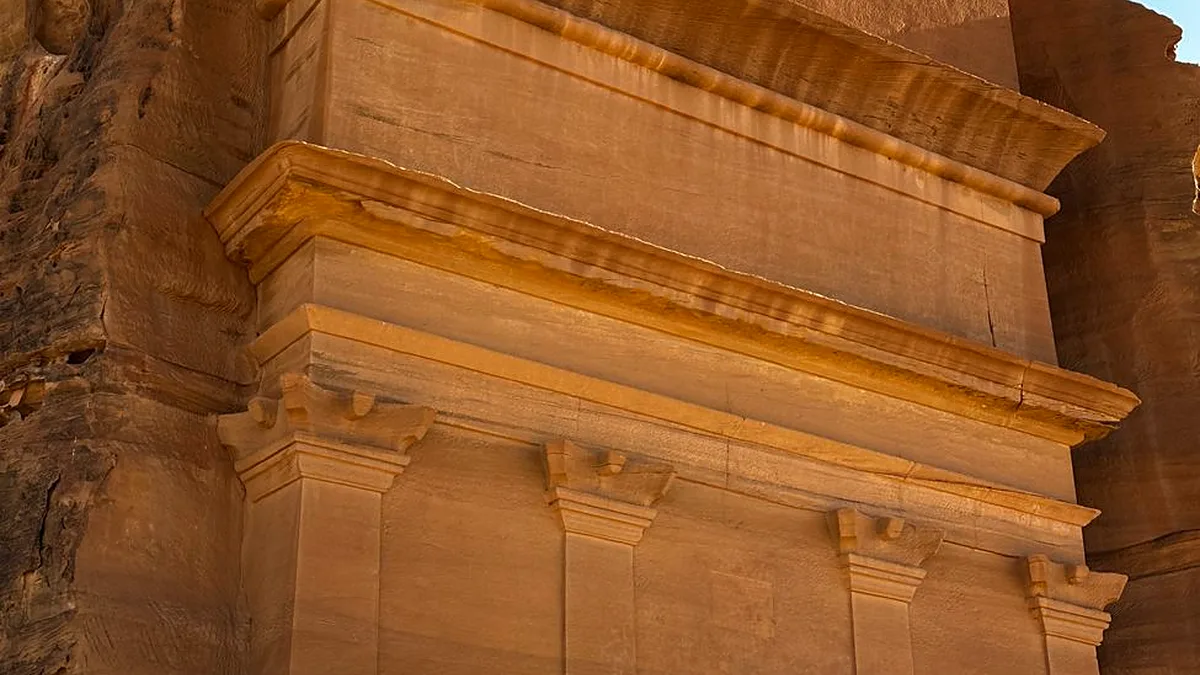

Hegra — locals still call it Al-Hijr, and the old name Mada'in Salih hangs around too — is the reason most people fly into AlUla. It's Saudi Arabia's first UNESCO World Heritage site, and it holds 111 monumental Nabataean tombs carved into sandstone outcrops between the 1st century BC and the 1st century AD. The same civilization that built Petra worked here, and the stone is arguably better preserved.
What surprises people is how much of the trip happens off the rock face. AlUla has quietly built a small craft economy around the ruins: palm-weaving studios, ceramics benches, jewellery workshops, and a converted girls' school where local artisans now teach. Pair the archaeology with those rooms and Hegra stops being a photo stop and starts being a place you actually understand.
One honest caveat before you book anything: Hegra is only visitable by guided tour, at fixed times, and roughly 85% of the site hasn't been excavated. You are seeing a fraction. Plan around that and you'll be fine.

At-a-Glance Snapshot
- Best time to visit: October to April. January and February are coolest (18–24°C) and coincide with the Winter at Tantora festival. Avoid June to September, when daytime highs hit 40°C+ and tours get shortened.
- Typical daily budget: SAR 250–400 (~$67–107) for budget travelers, SAR 500–900 (~$133–240) mid-range including a rental car, guided tours and one proper dinner. Luxury resorts push far past that.
- Local transport style: You need wheels. There's no public bus to Hegra, ride-hailing is patchy outside central AlUla, and the site sits about 20 km north of town. Rental car or a booked tour transfer is the realistic answer.
- General vibe: Quiet, low-rise, and still figuring itself out. Expect long empty roads, friendly guides, and long stretches where you're the only person in the frame.
1. Hegra South: The Tomb of Lihyan, Son of Kuza
This is the one on every poster. Qasr al-Farid — "the lone castle" — is a 72-foot tomb cut free on four sides, standing alone on the plain like a sculpture someone abandoned mid-thought. Your Rawi guide, a trained local storyteller, will point out the eagle carved above the doorway and the Nabataean inscription that names the man buried inside.
The tour moves through a cluster of tomb façades at Hegra South, then on to Jabal AlBanat and the lesser-visited outcrops. The scale creeps up on you. What looks like a small doorway from the coach turns out to be four stories tall when you stand underneath it.
- Location: Hegra, roughly 20 km north of AlUla town; tours depart from the Hegra Admissions Centre near Winter Park.
- Cost: SAR 95–150 (~$25–40) per person for the standard guided tour, depending on coach or vintage Land Rover option.
- Best time of day: The 7:30am or 8am departure. By 11am the sandstone is reflecting heat straight back at you and the light goes flat.
- Getting there: Self-drive on Route 70 north, or take a hotel-arranged transfer. The parking area is signposted.
Insider tip: Book the Land Rover tour rather than the coach if budget allows — you access a couple of tomb clusters the big buses can't reach, and you get far more guide time per person. Book through the Experience AlUla site at least a week ahead in peak season; weekend slots sell out first.
2. Jabal Ithlib and the Diwan
Jabal Ithlib is where Hegra stops being a cemetery and becomes a place where people lived. The Diwan is a carved chamber roughly 12 metres square, used for gatherings or ritual meals, with a bench running around three walls and a drain cut into the floor for offerings. Sit in it for five minutes. The acoustics are different, and you can see why they chose the spot.
The approach runs through a natural siq — a narrow rock corridor — that most visitors walk through quickly. Slow down. There are betyl niches and tiny inscriptions on both walls that are easy to miss and far more personal than the big façades.
- Location: Inside the Hegra site, included on most guided routes.
- Cost: Covered by the Hegra tour fee; no separate ticket.
- Best time of day: Mid-morning, when the sun is high enough to light the siq walls.
- Getting there: Walking section of the tour — expect 20–30 minutes on uneven stone and sand. Wear closed shoes.
Insider tip: Ask your guide to show you the sun symbol near the Diwan entrance. Half the group walks past it, and it explains more about Nabataean belief in one glance than a wall panel does.
3. Madrasat Addeera: Where AlUla Teaches Its Own Crafts
Madrasat Addeera is a former girls' school in AlUla Old Town, now run as a craft and design hub. Inside, local women teach palm-frond weaving, ceramics, natural dyeing, and traditional jewellery-making, often alongside visiting designers. You can book a two-hour taster session or just walk through the studios and watch.
This is the single best place to put your money if you want heritage to mean something beyond a ticket. The teachers are AlUla-born, the palm fibre comes from the oasis a few hundred metres away, and the classes are small enough that you'll actually finish something.
- Location: AlUla Old Town, a short walk from the Tantora Mosque.
- Cost: SAR 120–400 (~$32–107) for a workshop, depending on length and materials. Walk-in browsing is usually free.
- Best time of day: Late afternoon sessions, 4pm–7pm, when the studios cool down.
- Getting there: Park at the Old Town main lot and walk in; the lanes are pedestrian-only.
Insider tip: Workshop schedules shift with the season and aren't always accurate online. Message the Experience AlUla team the day before, or just turn up at opening and ask — staff are used to it and often squeeze people in.
4. AlUla Old Town and the Tantora Mosque
Old Town is a tight warren of 900-odd mud-brick and stone houses built on a hill, abandoned in the 1980s and partly restored since. Entry is free. The Tantora Mosque, with its stepped minaret, sits at the base, and the whole thing takes about 90 minutes to walk properly.
The craft angle here is the small stalls and cooperative shops along the main lane. Quality varies wildly — ask where the piece was made before you buy. Anything genuinely from AlUla will have a maker's name attached.
- Location: Central AlUla, signposted from Route 70.
- Cost: Free entry; expect SAR 40–200 (~$11–53) for a decent handmade piece.
- Best time of day: 5pm onwards, when the lanterns come on and the heat drops.
- Getting there: A short taxi or drive from most AlUla hotels; parking is easy.
Insider tip: Skip the first row of shops by the entrance and walk five minutes deeper into the lanes, where the actual makers' units are. Prices drop and the conversation improves.
5. Dadan and Jabal Ikmah: The Open-Air Inscription Library
Jabal Ikmah is a dry canyon wall covered in more than 300 inscriptions and petroglyphs in Dadanitic, Lihyanite, Thamudic and Aramaic scripts. It's often described as an open-air library, and for once the label is fair. Most tourists spend their entire AlUla trip at Hegra and skip this, which is a mistake.
Nearby Dadan, capital of the Dadanite kingdom, has rock-cut tombs and a temple platform in a red-rock valley. Do both in one booking; they're close together and the combined ticket is cheaper.
- Location: About 10 km north of AlUla Old Town on the road toward Hegra.
- Cost: SAR 60–100 (~$16–27) combined, guided only.
- Best time of day: 8am–10am for the Ikmah canyon; the inscriptions need raking light.
- Getting there: Drive yourself or join a half-day tour; Rawi-guided visits only.
Insider tip: Bring binoculars or use your phone's zoom. The highest inscriptions sit three metres up and are invisible to the naked eye from the path.
6. Desert X AlUla and the Wadi AlFann Preview
Contemporary art in the desert sounds like a marketing pitch until you stand in front of it. Desert X AlUla places large-scale, site-specific works across the canyons and lava fields, curated around themes of land and memory. Entry is typically free and you drive yourself between works.
Wadi AlFann — "Valley of the Arts" — is the long game, with permanent commissions from artists including James Turrell and Manal AlDowayan planned into the landscape. Expect phased openings rather than a finished park.
- Location: Scattered sites around AlUla's canyons; the visitor hub changes each edition.
- Cost: Free for Desert X; some festival events ticketed separately.
- Best time of day: Golden hour, 4:30pm–6pm, for the long shadows.
- Getting there: Self-drive essential. Download the map before you leave; signal drops.
Insider tip: Desert X runs in alternating years, not annually. Check the schedule before you build a trip around it — plenty of people arrive expecting installations that aren't there.
7. AlUla Oasis: Palm-Weaving With Farm Families
The oasis is a working date-farm belt of some 2.3 million palms threading through the town, and several operators run guided walks through it. The best versions end with a weaving session using dried fronds from the same trees — baskets, mats, fans — taught by women from farming families.
This is also where you'll learn the date varieties by name: Khalas, Barni, Sukkari, Mabroom. Buy a box directly from a farm stall at a third of what the airport charges.
- Location: AlUla Oasis, reached via the Old Town side.
- Cost: SAR 75–150 (~$20–40) for a farm walk with a weaving add-on.
- Best time of day: 7am or 4pm — the shaded paths are cool and the light through the fronds is worth the alarm.
- Getting there: Walk from Old Town or a five-minute drive; join a guided group rather than wandering in alone.
Insider tip: Wear long sleeves and cover your ankles. The irrigation channels are open and the mosquitoes along the shaded canals are genuinely relentless at dusk.
Where to Eat & Drink Near Hegra and AlUla Old Town
Pink Camel Pastry Boutique (AlUla Old Town) — a small bakery known for camel-milk desserts, pistachio cakes and very good flat whites. Expect SAR 20–45 (~$5–12) per person. Open from around 8am to 11pm; the queue peaks at sunset.
Somewhere (AlUla Old Town) — a relaxed, greenery-filled restaurant serving Saudi-leaning plates: lamb, rice, grilled vegetables, decent coffee. Mains sit around SAR 55–95 (~$15–25). It's a good post-Hegra lunch spot and a merciful break from resort pricing.
AlUla Old Town market stalls — for cheap, fast, real food. Ful medames, fresh bread, karak tea and local dates for under SAR 25 (~$7). Go before 10am when the farm vendors are still setting up.
If you want one splurge, Maraya Social inside the mirrored Maraya building is the polished option. Budget SAR 250–400 (~$67–107) per person with drinks, and book a window table at least a week out.
Practical Logistics and Budget Tips
- Rent a car. SAR 150–250 (~$40–67) per day is standard, and it's cheaper than two return tour transfers. Fuel is very cheap. AlUla's roads are quiet and easy to drive.
- Book tours first, flights second. Hegra slots are the bottleneck in January and February. Once you have a tour time, everything else falls into place.
- Do outdoor things before 11am. This single habit saves you money (fewer AC taxi rides), sunburn, and grumpiness.
- Carry cash for farm stalls and small craft units. Card works almost everywhere else, including tour desks.
- Buy dates at the farm, not the airport. Same boxes, roughly triple the price at departures.
- Check opening days carefully. Some Old Town studios close on Sundays, and several restaurants shut during Ramadan daylight hours with completely different evening timings.
What to Skip
Elephant Rock is the most overhyped stop in AlUla — a 15-minute photo and a queue for parking. It's free, so go only if you're passing at sunset. Also skip any "Hegra from the road" tour that promises multiple sites in three hours; you'll spend most of it in a vehicle.
Be realistic about the archaeology: several tombs have fencing or scaffolding, and the site is a live excavation. If you're expecting an untouched Petra, adjust now.
| Item | Typical Cost (SAR) | Approx. USD |
|---|---|---|
| Hegra guided tour | 95–150 | $25–40 |
| Dadan + Jabal Ikmah combo | 60–100 | $16–27 |
| Craft workshop | 120–400 | $32–107 |
| Car rental (per day) | 150–250 | $40–67 |
| Casual meal | 25–60 | $7–16 |
Frequently Asked Questions
Do I need a guide to visit Hegra?
Yes. Hegra can only be entered on an official Rawi-guided tour booked through Experience AlUla, and you cannot self-drive into the tomb areas. Book ahead in winter — weekend departures fill up roughly a week out.
Are there artisan workshops in AlUla for tourists?
Yes, mainly at Madrasat Addeera in AlUla Old Town, where local makers teach palm weaving, ceramics and jewellery in two-to-three-hour sessions. Prices run SAR 120–400 (~$32–107), and drop-in browsing is generally free.
How far is Hegra from AlUla town, and how do I get there?
Hegra sits about 20 km north of AlUla town, roughly a 25-minute drive on Route 70. There's no public bus, so choose a rental car or a tour transfer that includes the Hegra Admissions Centre pickup.
What is the best month to combine Hegra with the craft studios?
January and February are ideal — cool enough for long walking tours and aligned with the Winter at Tantora festival, when workshop programming is at its fullest. October, November and March are also comfortable but quieter on the craft side.