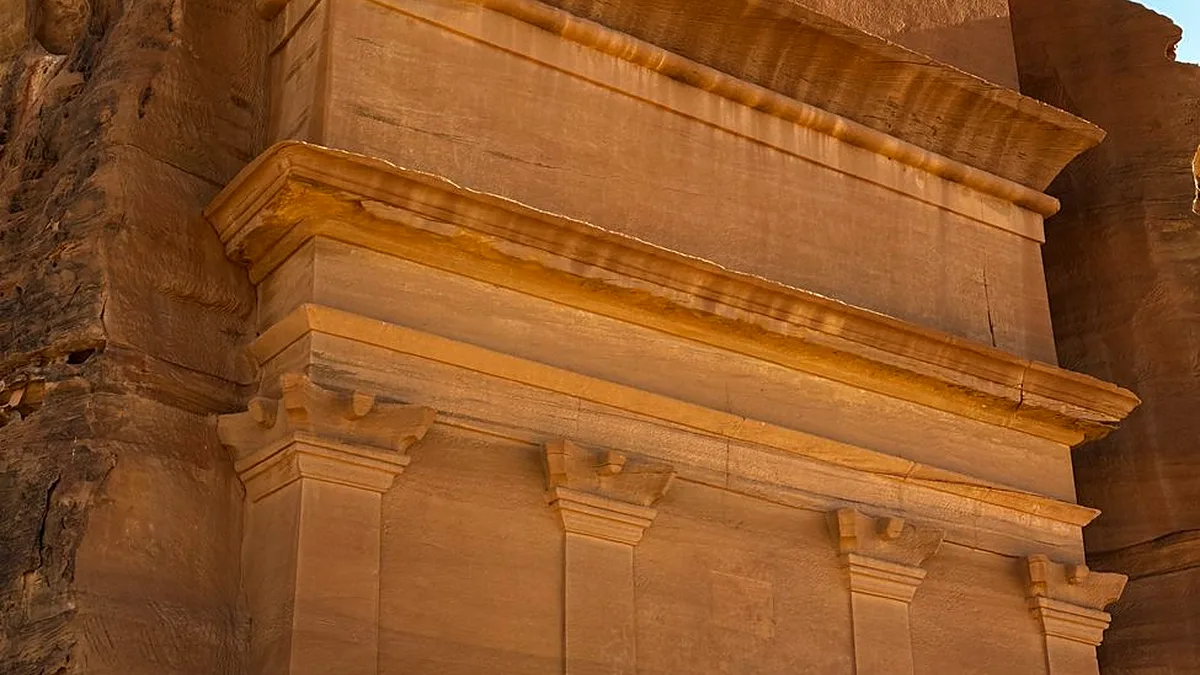

Hegra has no galleries with framed art and no clubs with velvet ropes. What it has is better and stranger: 111 tombs carved into sandstone, several of which you can actually step inside, plus rock chambers the Nabataeans used as private meeting rooms about 2,000 years ago.
The modern layer of AlUla — the region Hegra sits in — has quietly built its own version of both. A mirrored concert hall in a canyon, a desert art exhibition with no walls, a craft school inside an old girls' schoolhouse, and a short list of resort tables you need to book weeks ahead.
I've walked the tomb loop, stood inside the Diwan, and eaten at the tables that require a reservation. Here's what's worth your time, what to book first, and what to skip.

At a glance:
- Best time to visit: October to April. Daytime highs sit around 22–30°C. Book the 8am or 9am Hegra slot; summer tours get cut short by heat.
- Typical daily budget: SAR 450–900 (~$120–240) mid-range, including a rental car, one paid experience, and two proper meals. Luxury resorts start around SAR 1,500 (~$400).
- Getting around: rent a car. AlUla is a driving region — Hegra is 20 km north of Old Town and the Ashar Valley is another 20 km east. Rideshare is patchy.
- Vibe: quiet, dusty, early-to-bed. No alcohol, no nightclubs, and almost everything shuts by 11pm.
1. The Diwan at Jabal Ithlib: Hegra's Original Private Club
This is the closest thing Hegra has to a members-only room, and it's roughly 2,000 years old. Jabal Ithlib is a sacred rock outcrop in the site's northeast corner, reached through a narrow cleft called the Siq that is barely shoulder-width in places.
Inside sits the Diwan — a rectangular chamber carved into the rock with bench-like ledges running along the walls, almost certainly used for Nabataean banquets and religious meetings. Standing in there, with the door slot framing a slice of desert, is the most atmospheric five minutes at Hegra.
- Where: Jabal Ithlib, northeast sector of Hegra, about 4 km from the main tomb cluster.
- Cost: covered by the Hegra ticket (roughly SAR 95–150 / ~$25–40), but only reached on longer tours or with a private guide.
- Best time: the 8am or 9am slot, before the coach groups stack up.
- Getting there: no self-driving inside Hegra. Book through Experience AlUla and board the shuttle at the Winter Park visitor centre.
Insider tip: the standard two-hour coach loop does not stop at Ithlib. Ask specifically for the Hegra tour that includes Jabal Ithlib when booking, or you'll see the big facades and miss the best room on site.
2. Qasr al-Farid: The Tomb With No Neighbours
Qasr al-Farid — the Tomb of Lihyan son of Kuza — is the image on every brochure, and it earns the hype. It's a four-sided monolith cut free of the bedrock on all sides, roughly 21 metres tall, and it was never finished; the base is still raw, unchiselled rock.
Everyone photographs it from the same angle by the rope line. Walk 60 metres to the right instead, where the light rakes across the facade in late afternoon, and you'll get a frame nobody else on your bus has.
- Where: central Hegra, first major stop on most tours.
- Cost: included in the Hegra ticket (~SAR 95 / ~$25 for the standard tour).
- Best time: last tour of the day for the warm light; first tour for empty frames.
- Getting there: official shuttle only, no private vehicles.
Insider tip: the ticket office releases slots in blocks and peak-season mornings sell out two to three weeks out. Book the moment your dates are fixed, then plan everything else around that time.
3. The Tomb Interiors: Where the Real Galleries Are
The facades get the photographs; the interiors are the gallery. Several tombs have carved chambers behind the doorway — burial niches cut in neat rows, plus inscription panels above the lintel naming the owner and listing which families were barred from burial there.
Hinat's tomb is the one to slow down for. The facade is the most ornate at the site, and her inscription is among the longest surviving Nabataean texts. Guards generally let you step a few paces inside; touching the walls is a hard no.
- Where: scattered across the tomb clusters; your guide will point out the two or three you can enter.
- Cost: included in the standard ticket.
- Best time: late morning, when sunlight reaches the chambers without cooking you.
- Getting there: short, uneven walk from the shuttle drop-off — wear closed shoes, not sandals.
Insider tip: bring a small torch or use your phone light. The interiors are dark, and a phone flash washes out the carving detail that a low side-light picks up beautifully.
4. The Hijaz Railway Station: The Museum Almost Everyone Drives Past
The Ottoman Hijaz Railway reached this stretch of desert in 1907, and the garrison station at Mada'in Salih is one of the best-preserved on the whole line. Restored stone buildings, original rolling stock, and a small museum of the Arab Revolt era — usually with about four other people in it.
It's an easy 15-minute stop on the drive between AlUla Old Town and Hegra, and it gives you the 20th-century chapter that the tombs don't. Go if you like trains, engineering, or quiet places.
- Where: on the Hegra road, about 20 km north of AlUla Old Town.
- Cost: around SAR 25 (~$7).
- Best time: roughly 9am–5pm Saturday to Thursday, shorter hours on Fridays — confirm before you drive out.
- Getting there: by rental car; free parking on site.
Insider tip: pair it with a Hegra morning tour. You'll be back in Old Town for a late lunch, and you skip the 2pm heat entirely.
5. Desert X AlUla: An Open-Air Gallery With No Walls
Large-scale desert art, installed in canyons and wadis north of AlUla, free to walk through and completely without walls or labels you'd call a label. It runs in alternating years rather than annually, so check the calendar before you plan a trip around it.
When it's on, it's the single best argument that AlUla is more than archaeology. When it's off, the site-specific works that stay in place still make a decent half-day drive.
- Where: locations shift each edition, generally in the canyons 20–30 minutes from Old Town.
- Cost: free.
- Best time: 4–6pm, when the rock turns orange and the heat breaks.
- Getting there: you need a car; some pieces require a five-minute walk over uneven stone.
Insider tip: don't wear anything you'd mind dusting. The approach tracks are unpaved and fine sand gets into everything, including camera lenses.
6. Madrasat Addeera and the AlJadidah Art Lanes
AlJadidah, the modern quarter next to AlUla Old Town, is where the working creative scene actually lives. Big murals on plain concrete walls, a handful of small galleries and studios, and Madrasat Addeera — a mid-century girls' school turned craft hub teaching palm weaving, pottery, textiles, and stone carving.
You can browse the school for free. Workshops are the reason to come: two hours with a local instructor, materials included, and you leave with something you made rather than something imported.
- Where: AlJadidah, a 10-minute walk north-west of AlUla Old Town.
- Cost: free to wander; workshops roughly SAR 100–250 (~$27–67).
- Best time: 5–8pm, when the lanes cool down and the cafes fill up.
- Getting there: walkable from Old Town; parking is easy on the AlJadidah edge.
Insider tip: workshop places are small — often six or eight seats — and they don't always appear on the main booking site. Ask at the front desk in person the day before.
7. Maraya and the Ashar Valley Private-Table Circuit
Maraya is the mirrored hall in the Ashar Valley — 9,740 square metres of reflective panels and a Guinness record for the largest mirrored building on earth. Concerts and private events run inside; the rooftop restaurant, Maraya Social, is the reservation that matters.
To be clear about the theme: there is no licensed nightclub scene in AlUla, and no alcohol is served anywhere in the country. The 'private club' experience here means members-and-guests resort spaces — Tama at Habitas AlUla, the Banyan Tree spa — and ticketed Maraya events.
- Where: Ashar Valley, roughly 20 km east of Hegra and 20 km from Old Town.
- Cost: dinner at Maraya Social around SAR 200–350 (~$53–93) a head; Tama roughly SAR 120–220 (~$32–59); concerts vary wildly.
- Best time: arrive 45 minutes before sunset for the facade, then eat.
- Getting there: car or hotel transfer only — no public transport into the valley.
Insider tip: book Maraya Social two to three weeks ahead in December and January, and ask for a terrace table rather than the interior. The mirror wall reflecting the canyon at dusk is the whole point.
Where to Eat and Drink Nearby
Pink Camel Pastry Boutique, AlJadidah
The local sweet stop, all camel-shaped cakes, date ice cream, and proper Saudi coffee. Expect SAR 30–70 (~$8–19) for coffee and two pastries. Sit outside in the evening when the lanes light up.
Tama at Habitas AlUla, Ashar Valley
Grilled meats, mezze, and flatbreads served on a terrace facing the canyon walls. Mains run SAR 60–120, a full dinner SAR 120–220 (~$32–59). Order the lamb and the date-based dessert.
Maraya Social, Ashar Valley
Jason Atherton's rooftop room, Mediterranean-leaning, best for a splurge night. Budget SAR 200–350 (~$53–93) per person without drinks — the drinks are excellent mocktails. Reserve, always.
For cheap eating, the date-and-coffee stalls around AlUla Old Town do a decent breakfast for under SAR 20 (~$5).
Practical Logistics and Budget Tips
Getting in and around
- Fly into AlUla International (ULH), about 25 minutes from Old Town, with direct links to Riyadh, Jeddah, Dammam, and Dubai.
- Rent a car at the airport: SAR 150–250 (~$40–67) a day. Fuel is cheap, roughly SAR 2.33 a litre.
- Rideshare exists but is unreliable at night and non-existent in the Ashar Valley. Don't build an itinerary on it.
- The shuttle bus network is useful for Old Town and AlJadidah only. It does not reach Hegra or the resorts.
Money-saving moves
- Free and genuinely good: AlUla Old Town, the AlJadidah murals, the oasis walking trail, Elephant Rock at sunset, and Desert X when it's on.
- Do one paid experience properly rather than three cheaply. Hegra with Ithlib beats three rushed bus loops.
- Stay in Old Town or AlJadidah for the mid-range hotels and walkable dinners. Ashar Valley prices double for the view.
What to skip, honestly
- Elephant Rock at sunset on a weekend — the car park becomes a scrum and the on-site coffee is triple price. Go at 8am instead.
- 'Antique Nabataean' souvenirs. Almost all are imported. Buy dates, pottery, or something made at Madrasat Addeera.
- Anyone offering unofficial 'secret' Hegra access. All entry is licensed and escorted; there is no back gate, and touts are selling nothing.
- Midday tours in June through September. The heat is genuinely unsafe, not just uncomfortable.
Small things that catch people out
- Drones are banned across AlUla. Leave it at home.
- Dress modestly — shoulders and knees covered — and carry two litres of water per person.
- Ramadan shifts opening hours significantly; check Hegra tour times the week you travel.
Frequently Asked Questions
Can you visit Hegra without a tour?
No. Hegra is only accessible on licensed Experience AlUla tours, with entry via the Winter Park visitor centre and shuttle. Book online at least a week ahead, or two to three weeks in the December–February peak.
Is there a private club or nightlife scene in AlUla?
Not in the nightclub sense — there is no alcohol and venues close early. What exists is private resort dining and lounges in the Ashar Valley, plus ticketed concerts and events at Maraya.
How much does Hegra cost and how long does it take?
The standard two-hour tour runs about SAR 95 (~$25); longer tours including Jabal Ithlib and private-guide options cost considerably more. Allow half a day if you're adding the Hijaz Railway station on the drive back.
When is the best time to visit Hegra?
October to April, on the first morning slot, when temperatures are mild and the tombs are close to empty. Summer visits are possible but the tours are shortened and shade is scarce.