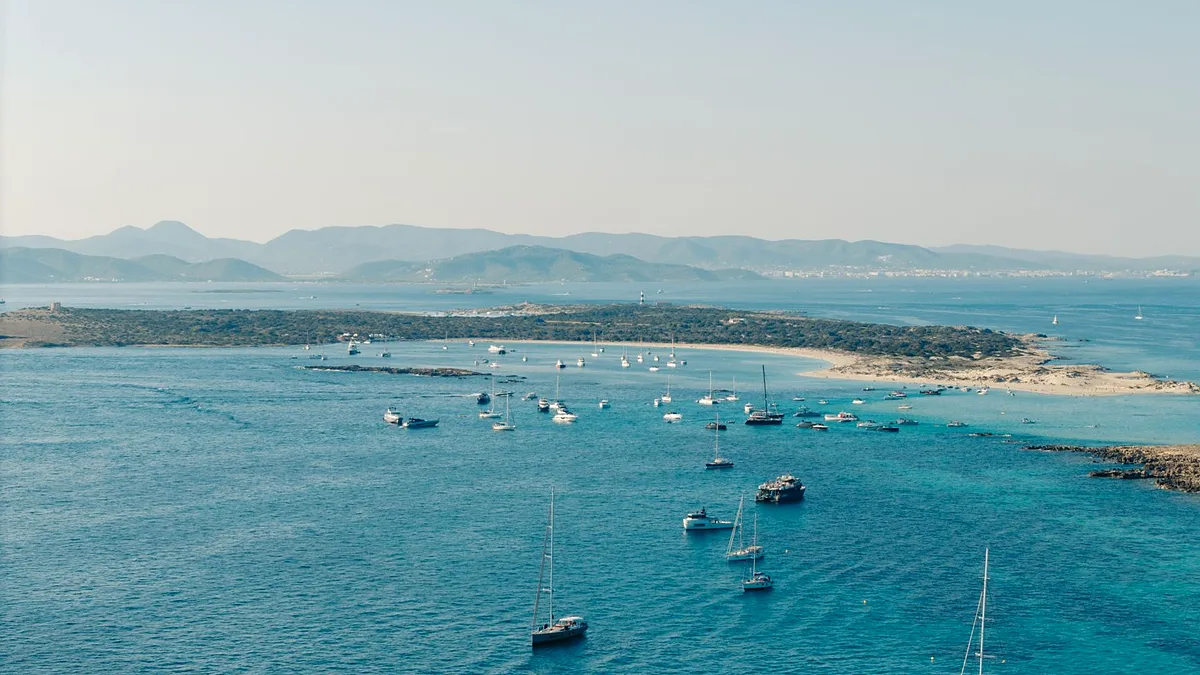

Formentera is what happens when an island decides not to bother with an airport. You fly into Ibiza, take a half-hour ferry, and land somewhere with no high-rises, almost no traffic lights, and a cultural scene that fits into a handful of whitewashed rooms.
That smallness is the point. The galleries here are the size of living rooms, the 'private clubs' are mostly beach restaurants that require a booking, and the best studios open by appointment or by handwritten sign on the door. If you want the curated, low-volume version of the island, this is the route.
Below are the actual places worth your time, plus what to skip and what things cost in 2025.

At a Glance
- Best time to visit: Mid-May to late June, or September to mid-October. August is a different, louder island.
- Daily budget: Roughly €90–160 (~$100–175) per person, covering transport, one paid sight, lunch and dinner.
- Getting around: Bus line L1 links the port, Sant Francesc, Sant Ferran and Es Pujols. Bikes and scooters fill the gaps; cars are capped in summer.
- Vibe: Barefoot-smart. Linen, no heels, no reservations after 22:00.
Centre Antoni Tur 'Gabrielet' — Sant Francesc's Free Gallery
This is the closest Formentera gets to a proper contemporary gallery, and it costs nothing. The building is an old family house in Sant Francesc with thick walls, a shaded courtyard, and two floors of exhibition space that change every few weeks through the season.
Shows lean toward artists with an island connection: photography of the salt pans, sculpture assembled from beach debris, painting that has nothing to do with sunsets. You will be in and out in half an hour, and that is exactly right.
- Neighbourhood: Sant Francesc Xavier, two minutes on foot from the church square
- Cost: Free (donations welcome)
- Best time of day: The 10:00 opening, or around 19:00 when locals drift in
- Getting there: L1 bus from La Savina port (about 10 minutes, €2 / ~$2.20) or a 15-minute walk from the village centre
Insider tip: Opening nights usually fall on a Thursday or Friday evening in July and August — free wine, no tour groups, and the only time the artists themselves turn up. Hours shift with the season, so trust the paper sign taped to the door over any online listing.
Museu de la Sal — The Salt Story at La Savina
Right where the ferry docks, a low building explains two thousand years of salt harvesting on the island. It is small, quiet and free, which makes it the smartest thing to do while you wait for a boat.
Panels cover the salt pans, the little railway that carried salt to the port, and why the whole operation is now protected. You will understand those geometric pools you keep seeing from the road, and there is a decent shaded bench outside when you are done.
- Neighbourhood: La Savina, beside the port
- Cost: Free
- Best time of day: Weekday mornings in season; check the door for seasonal closures
- Getting there: A three-minute walk from the ferry terminal, or park at the port car park
Insider tip: Save it for the end of your trip, not the start. The exhibition means far more once you have driven past the salt pans at sunset and wondered what you were looking at.
Molí Vell Ethnographic Museum — La Mola's Old Windmill
On the La Mola plateau, a restored 18th-century windmill holds a tiny museum of island life: farming tools, fishing gear, kitchen equipment, and photographs of a Formentera with no tourists in it at all.
Twenty minutes is enough, and it gives you the island's backbone. The mill still has its sails, and the view across the plateau toward the lighthouse is the real reason to drive up here.
- Neighbourhood: El Pilar de la Mola
- Cost: Around €3 (~$3.30)
- Best time of day: Mid-morning, which avoids the market crush on Wednesdays and Sundays
- Getting there: L3 bus from Sant Ferran, or a 20-minute drive from the south coast
Insider tip: Pair it with the lighthouse at Far de la Mola, ten minutes further on, and avoid the museum between 12:00 and 16:00 on market days when the crowds spill uphill.
Studio Visits in Sant Francesc — Where the Art Is Actually Made
Formentera's real creative scene is jewellery, ceramics and textiles sold out of workshops rather than galleries. The best known is Majoral, the studio of Enric Majoral, whose sand-cast silver and gold pieces have been made on the island since the 1970s.
You are not walking into a museum. You are walking into a working space with a small showroom, usually staffed by someone who can tell you which piece was cast last week. In the lanes behind the church, smaller ceramicists and textile makers open irregular hours through summer.
- Neighbourhood: Sant Francesc Xavier village centre
- Cost: Free to browse; jewellery from around €60 (~$66), ceramics from €25 (~$27)
- Best time of day: Late morning, Tuesday to Saturday, in season
- Getting there: Entirely walkable — park once and wander
Insider tip: Ask whether a piece was cast on the island or in Barcelona. Both are legitimate, but only one comes with a Formentera story. Most studios close for siesta (roughly 13:30–17:00) and shut completely from November to March.
Mercat Artesanal de la Mola — Wednesdays and Sundays
From late afternoon every Wednesday and Sunday, the plateau at El Pilar fills with stalls that trace back to the island's 1970s hippie years. It is the least minimal thing in this guide, but the back rows are where the actual makers sit.
Walk past the first forty metres of imported jewellery and incense and keep going to the far end, where you will find leatherworkers, island photographers and people selling hand-thrown ceramics out of a van. It is busy, never frantic, and the sunset up here justifies staying.
- Neighbourhood: El Pilar de la Mola
- Cost: Free entry; bring €40–60 (~$44–66) if you plan to buy
- Best time of day: Arrive around 17:30, before the 19:00 peak; the market runs roughly 17:00–21:30, later in August
- Getting there: L3 bus, or drive and use the signed field five minutes' walk away
Insider tip: Bring cash. Plenty of stalls have no card reader and the nearest ATM is back in Sant Ferran.
Església de Sant Francesc Xavier — The Fortress Church
The island's parish church was built in the 18th century with walls thick enough to hold off raiders, and it still anchors the capital. A small side room holds religious artefacts and a defensive history that explains why every old building here looks like it could take a hit.
Entry is free, it is cool at midday, and you will probably have it to yourself. Ten minutes of silence in the middle of a beach holiday is underrated.
- Neighbourhood: Sant Francesc Xavier, on the main square
- Cost: Free
- Best time of day: 12:00–15:00, when everything else has closed for lunch
- Getting there: On foot from the village square; L1 bus stop is two minutes away
Insider tip: Dress for a church, not a beach — shoulders covered. The square outside is the best coffee stop on the island and locals use it as a meeting point around 09:30.
The 'Private Club' Reality — What Actually Exists
Here is the honest version: Formentera has no members-only clubs in any formal sense. What it has is a handful of beach restaurants and bars where a booking, a minimum spend or a local phone number functions as the door policy.
Beso Beach at Ses Illetes is the loudest example — sunbeds, a minimum spend in high season, DJ sets from late afternoon. Juan y Andrea and Es Molí de Sal are the more civilised end of the same scale. Blue Bar, on the road to Cala Saona, is where the island itself goes for sunset: no list, no minimum, just arrive by 19:30 if you want a table.
- Neighbourhood: Ses Illetes and the Cala Saona road
- Cost: Beach club minimum spend €40–120 (~$44–132) per person; cocktails €12–18 (~$13–20)
- Best time of day: Lunch at 13:00, sunset drinks from 19:00
- Getting there: No useful bus to Ses Illetes — taxi, bike or car, and parking is gone after 11:00
Insider tip: Book one to three weeks ahead in July and August, and request a table away from the speakers rather than the front row. For the genuinely quiet version, watch for gallery openings and pop-up finca dinners — they are announced on Instagram a few days out, never in a listings guide.
Where to Eat & Drink Nearby
Fonda Platé, Sant Francesc. Running since 1964 and still the best value on the island. The menú del día is €16–22 (~$17–24) with grilled fish, tumbet and a slice of flaó. Arrive by 13:00 or book; it fills with locals first.
Can Rafalet, Es Caló. A clifftop room above the fishing huts serving rice dishes and whole fish, €22–30 (~$24–33) for mains. Two people with wine lands around €100–120 (~$110–132). The lobster stew is market-priced and worth asking about before you commit.
Fonda Pepe, Sant Ferran. The island's living room since the hippie era. Burgers €9–12 (~$10–13), beer €3.50, live music several nights a week, no booking culture whatsoever. Go after 21:30.
Practical Logistics & Budget Tips
Fly into Ibiza (IBZ), then take the ferry from Ibiza town's port. The fast ferry takes 30 minutes (€28–38 / ~$31–42 one way) and the slow car ferry about an hour (€18–25 / ~$20–28). Book online a week ahead between June and September; in May and October you can usually walk on.
Bus line L1 runs La Savina to Sant Francesc, Sant Ferran and Es Pujols every 30–60 minutes in summer, with single tickets at €2–3.50. L3 climbs to La Mola. There is no reliable bus to Ses Illetes or Cala Saona, so plan those days around a bike or scooter.
| Typical cost | Price |
|---|---|
| Coffee | €1.80–2.50 (~$2–2.70) |
| Menú del día | €16–22 (~$17–24) |
| Two sunbeds and an umbrella | €20–30 (~$22–33) |
| Bike rental, per day | €10–15 (~$11–16) |
| E-bike or scooter, per day | €25–55 (~$27–60) |
| Museum entry | €0–3 |
What to skip. Give Beso Beach a miss if you want to hear each other talk after 17:00. Skip the front rows of the Mola market, and skip driving to Ses Illetes between 11:00 and 15:00 in August — the road becomes a queue. Ignore boat-party tickets sold at the port kiosks; the good operators are booked direct, and anchoring on the protected posidonia meadows carries real fines.
Money notes. Cards work nearly everywhere now, but carry €50 in cash for markets and small bars. Cars are capped in summer, so reserve weeks ahead at €70–110 a day. Free water refill points exist in Sant Francesc and Es Pujols — bring a bottle and save €3 a go.
Frequently Asked Questions
Does Formentera have art galleries?
Yes, but they are small and seasonal. The Centre Antoni Tur 'Gabrielet' in Sant Francesc is the main year-round exhibition space, with the Sant Ferran cultural centre and various private studios filling the gaps in summer.
Do you need to book beach clubs in Formentera?
In July and August, yes — one to three weeks ahead for lunch or a sunbed. In May, June, September and October you can usually walk in, though sunset hours still fill up fast.
Can you get around Formentera without a car?
Mostly. Bus lines L1 and L3 cover the port, the main villages and La Mola, and bikes handle everything else on an island this flat and small. Just accept that Ses Illetes and Cala Saona need a taxi, bike or scooter.
When is the quietest time to visit Formentera?
Late May to mid-June and the second half of September, when the water is still warm and the galleries are open. August brings the crowds and the highest prices of the year.