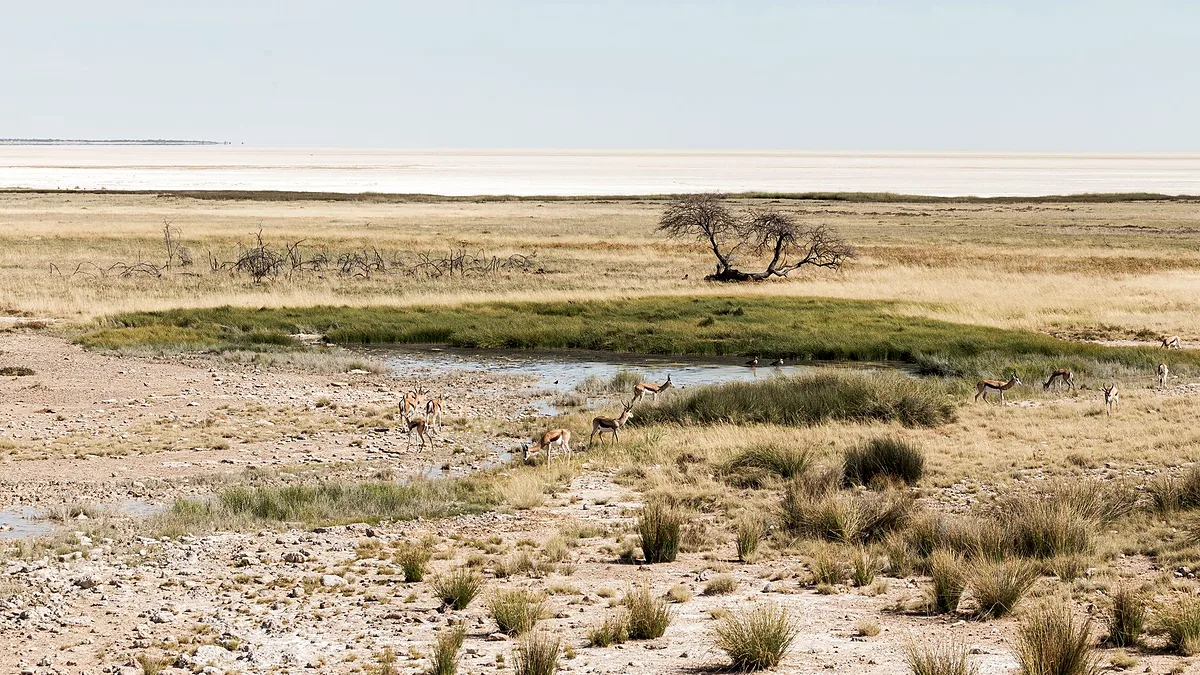

Most people picture Etosha as one thing: a white pan the size of a small country, ringed by waterholes where you queue behind six Land Cruisers waiting for a lion to lift its head. On a July afternoon, that is exactly what you get.
But the park has a second personality, and it's the one worth planning around. The western third sees a fraction of the traffic. The old German fort at Namutoni holds a small museum that most visitors walk straight past on their way to the toilets. And outside the boundary fences, private concessions run night drives and rhino tracking that day visitors never get near. Think of those as Etosha's quiet galleries and its private club rooms.
This guide covers both: the free, self-drive spots that feel like empty exhibition halls, and the paid places that feel members-only — and are worth the money.
Unlimited High-Speed International Travel eSIM
Connect in seconds across 180+ destinations. Instant QR code activation with zero roaming surcharges.

Etosha at a Glance
- Best time to visit: June to October (dry season) for animals crowding the waterholes; November to April for birds, newborns and near-empty roads.
- Daily budget: N$1,300–1,800 (~$70–100) self-drive camping; N$4,000–6,000 (~$220–330) mid-range lodge; N$9,000+ (~$500+) for the private concessions.
- Getting around: self-drive only. No buses, no shuttles. Gravel roads, 60 km/h limit, gates open at sunrise and shut at sunset.
- Vibe: 5:30am coffee, long silences, one crowded waterhole at dusk, empty tracks everywhere else.
Okaukuejo's Floodlit Waterhole: The After-Dark Gallery
Every evening, Okaukuejo's waterhole turns into the best free show in Namibia. Spotlights come on at dusk and black rhinos walk out of the dark like they're on a schedule — because they roughly are. Elephant herds arrive in silence, drink for twenty minutes, and vanish.
The camp itself is dated and busy, and the restaurant is forgettable. None of that matters once you're on the bench with a flask at 8pm, watching a rhino and her calf ignore forty people holding phones.
- Where: Okaukuejo Camp, central Etosha, 17 km north of Anderson Gate.
- Cost: free with your park permit. Waterhole-facing chalets run roughly N$2,300–3,600 (~$125–195) per night.
- Best time: 19:00–22:00, June to October, when water is scarce and animals have no choice.
- Getting there: 430 km (~5 hours) from Windhoek via Outjo on the C38. Self-drive only.
Insider tip: Request a chalet on the waterhole-facing row when you book directly with NWR — it costs about N$400 (~$22) more than a bush chalet and means you watch rhinos from your own veranda. Bring a red-light torch so you don't blind them.
The Western Pan: Dolomite Camp and the Olifantsrus Hide
The far west of Etosha is the quietest gallery in the park. Dolomite Camp sits on a ridge of dolomite koppies near Galton Gate, with about 20 rooms and a view that goes on for 40 kilometres. You can sit at the bar for an hour and see three other vehicles all afternoon.
South of there, Olifantsrus is camping only, but it has the park's best hide — a double-storey wooden tower over a waterhole, plus a small information centre about the elephant culling station that operated here in the 1980s. It's sobering, well put together, and almost always empty.
- Where: Galton Gate area, western Etosha.
- Cost: Dolomite Camp roughly N$2,400–3,000 (~$130–165) per night; Olifantsrus camping around N$400 (~$22) per person.
- Best time: first two hours after sunrise, when the light is low and the herds move.
- Getting there: enter at Galton Gate via Kamanjab on the C38; the gravel to Okaukuejo is roughly 180 km.
Insider tip: There is no fuel between Galton Gate and Okaukuejo. Fill up in Kamanjab before you enter, and don't attempt that stretch in a low-clearance sedan during the rainy season.
Namutoni Fort: The Small Museum Behind the Walls
The white fort at Namutoni is the most photographed building in Etosha and the least explored. The current structure dates from 1905–06, rebuilt after King Nehale lyaMpingana's forces destroyed the first fort in 1904. Inside, a handful of rooms hold German colonial kit, old photographs and ox-wagons.
It takes fifteen minutes. Do it anyway. Standing on the walkway above the walls, looking over the pan with nobody else up there, is the closest the park gets to a private viewing room.
- Where: Namutoni Camp, eastern Etosha, 110 km from Namutoni's own gate (Von Lindequist).
- Cost: free with your park permit.
- Best time: 11:00–15:00, when animals rest and other visitors eat lunch.
- Getting there: 540 km (~6.5 hours) from Windhoek, or a 3.5-hour drive from Okaukuejo.
Insider tip: The upper walkway looks straight down onto King Nehale waterhole. Take a cold drink up there at midday instead of paying for a game drive — the animals come to you.
Ongava Private Game Reserve: The Club Next Door
Ongava is a 30,000-hectare private reserve pressed against Etosha's southern boundary, ten minutes from Anderson Gate. It has its own rhino population, its own floodlit hide, and the right to drive after dark — something no self-drive visitor can do inside the national park.
Rhino tracking on foot here is the real draw. You go out with a guide and a tracker, follow fresh spoor, and end up standing twenty metres from a white rhino. It is not cheap, and it is the single best thing to spend money on in this part of Namibia.
- Where: immediately south of Anderson Gate, off the C38.
- Cost: roughly N$6,500–11,000 (~$350–600) per person per night, full board with activities.
- Best time: the 6am tracking slot; animals are active and the light is soft.
- Getting there: 30 km from Okaukuejo; transfers from the gate are included at most lodges.
Insider tip: You cannot visit on a day pass — you need at least one overnight. Book the rhino walk for your first morning in case weather cancels it and you can rebook.
Onguma and the Sleepout Deck: A Room With No Walls
East of Namutoni, Onguma covers about 20,000 hectares of mopane and open plain. The Fort at Onguma is a mock-colonial pile with a pool on the edge of a waterhole, and it is quietly one of the best-value splurges in the region.
Better still is the sleepout: a raised platform with a bed under a mosquito net and a bath open to the stars. You eat dinner, get driven out, and wake up with nobody around for kilometres.
- Where: eastern boundary of Etosha, adjacent to Von Lindequist Gate.
- Cost: The Fort roughly N$5,500–8,000 (~$300–430) per person full board; the sleepout is an add-on of about N$1,500–2,500 (~$80–135) per person.
- Best time: May to September for clear skies and cool nights.
- Getting there: 15 minutes from Namutoni Camp by lodge transfer.
Insider tip: The sleepout isn't on most booking websites — ask for it by name when you reserve. Pack a fleece; the temperature drops hard after midnight even in summer.
Lake Otjikoto and Tsumeb: The Underwater Gallery
About 24 km west of Tsumeb, a sinkhole lake sits beside the B1 with a car park and a few curio stalls. In June 1915, retreating German troops dumped their weapons and ammunition into it rather than surrender. Some were later recovered; many are still down there.
Pair it with the Tsumeb Museum, 25 minutes away, which holds a mineral collection that geologists fly across the world to see. Tsumeb's copper mine produced some of the rarest mineral specimens ever found. It's a proper small-town gallery, and you'll likely have it to yourself.
- Where: Lake Otjikoto on the B1 west of Tsumeb; museum in central Tsumeb.
- Cost: roughly N$50 (~$3) for the lake, N$60 (~$3.50) for the museum.
- Best time: weekday mornings, when the museum caretaker is around to explain the displays.
- Getting there: 2.5 hours from Namutoni on the B1; easy tarmac the whole way.
Insider tip: Ignore anyone selling a diving trip — permits are rarely granted. Twenty minutes at the lake is enough; give the museum the rest of your time.
Where to Eat and Drink Nearby
Outjo Bakery, Outjo
The last proper bakery before Anderson Gate, and a local institution. Load up on biltong pies, roosterkoek and koeksisters at N$30–45 (~$1.60–2.50) each. Open Monday to Saturday roughly 06:30–17:00, Sunday mornings only. Cash is quicker.
Etosha Safari Camp, 10 km south of Anderson Gate
Gondwana's camp runs a buffet dinner around N$380 (~$21) and a shebeen-style bar with live music on some evenings. The food is solid rather than special, but the bar is the best place within an hour's drive to talk to other travellers.
Okaukuejo Camp Shop and Braai
Buy a braai pack at the camp shop for N$130–190 (~$7–10), add wood for N$40, and cook at the communal braais. The restaurant buffet costs around N$350 (~$19) and is fine, but the braai is cheaper and far more fun.
Practical Logistics and Budget Tips
Getting There and Around
There is no public transport inside Etosha, so a car is non-negotiable. Windhoek to Anderson Gate is 430 km (~5 hours) and Windhoek to Namutoni is 540 km (~6.5 hours). Park roads are gravel and capped at 60 km/h, which makes Okaukuejo to Namutoni a genuine three-and-a-half-hour drive, not the ninety minutes your map suggests.
Fuel is available only at Okaukuejo, Halali and Namutoni. Fill up every chance you get, and never pass a station below half a tank. Gates close at sunset — roughly 18:00 in winter and 19:00 in the hot months — and the times are strictly enforced with fines.
Money and Park Fees
Non-resident park entry runs about N$150–250 (~$8–14) per adult per day plus a small vehicle fee; SADC and Namibian rates are lower and change periodically, so confirm when you book. Keep your permit — it can be checked at any gate.
Cards work at the main camps but not at craft stalls or small farm stalls. Carry N$1,000–2,000 (~$55–110) in cash and budget 3–4 litres of water per person per day. Self-catering cuts your food bill by more than half.
What to Skip
- Midday game drives. Animals rest between 11:00 and 15:00. Save your fuel.
- Windhoek day trips. You'll spend ten hours in a car for four hours in the park.
- Buffet dinners every night. Three in a row is N$1,000 you could spend on a rhino walk.
- Low-clearance sedans in the wet season. The western tracks turn to soup between December and March.
- Anyone offering to drive you onto the pan. You can't legally drive on it, and you'd be damaging it.
Frequently Asked Questions
Are there real galleries or clubs in Etosha?
Not in the city sense — the closest things are the Namutoni Fort museum, the Tsumeb Museum an hour east, and the private concessions outside the gates. Think of the waterholes as the galleries: each one has its own collection, and the art moves.
Do you need a 4x4 to visit Etosha?
No, for the main gravel roads between Okaukuejo, Halali and Namutoni in the dry season — a normal sedan is fine. For the western section around Galton Gate and Dolomite in the rainy months, high clearance is strongly recommended.
Can you do a night drive in Etosha?
Not in your own vehicle; park rules prohibit driving after sunset. Guided night drives run from several camps, and private reserves like Ongava and Onguma run their own — that's where you'll see aardvark, genets and hunting lions.
What is the quietest part of Etosha?
The far west, entered through Galton Gate, where you can drive for an hour without seeing another car. Inside the main circuit, the quiet hours are 11:00 to 15:00, when almost everyone is back at camp eating.