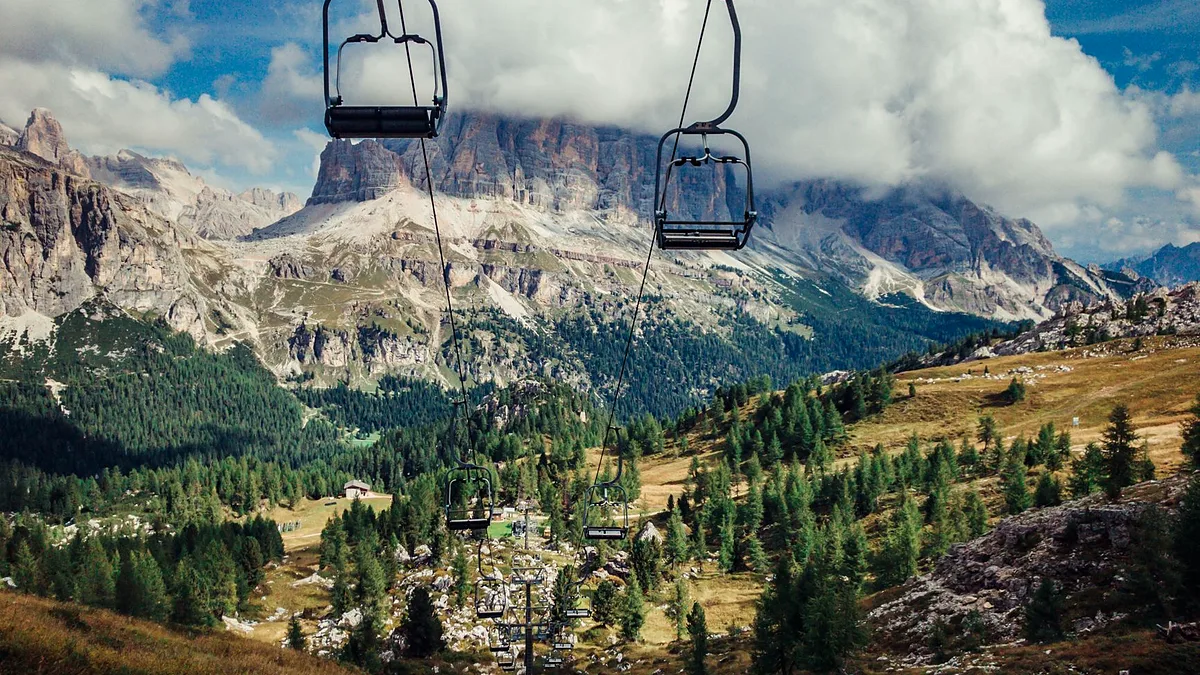

Cortina d'Ampezzo gets photographed for its jagged pink peaks, then judged by its designer shop windows. Both are real. Underneath the ski-town sheen sits a Ladin village that has been carving wood, managing common land and burying its war dead in the same valley for centuries.
This guide is for the traveller who wants that layer. It covers the small museums run by the Regole — the old land-holding families — the woodcarving benches where pieces are still cut by hand, a WWI fort that is genuinely chilling, and a railway line that vanished in 1964.
Expect modest entry fees, short walks and a lot of closed doors between noon and 3pm. Plan around the riposo and you will see more than the people queuing for lift tickets.
Unlimited High-Speed International Travel eSIM
Connect in seconds across 180+ destinations. Instant QR code activation with zero roaming surcharges.

At a Glance: Cortina d'Ampezzo
- Best time to visit: mid-June to early July, or September — museums open, trails quiet, prices lower than ski season.
- Typical daily budget: €90–150 (~$97–162) per person, including a museum ticket, two proper meals and local transport.
- Local transport style: walk the centre (15 minutes end to end); Dolomiti Bus from the Via Marangoni hub for anything up a pass.
- Vibe: Alpine, orderly, quietly expensive — but heritage sites here cost less than a plate of pasta.
1. Museo Etnografico delle Regole d'Ampezzo
The Regole are the local families who have collectively owned and managed Ampezzo's forests and pastures since the 1300s. That is a working land institution, not a folkloric re-enactment, and their ethnographic museum explains how people actually survived winters up here.
Expect carved wooden tools, cheese-making gear, hand-forged ironwork and Carnival costumes that look genuinely worn rather than staged. The woodcarving section alone justifies the ticket and sets you up for every studio you will visit afterwards.
- Neighbourhood: old centre, in the Casa de ra Regoles on Corso Italia.
- Cost: about €8 (~$9); combined ticket with the Rimoldi museum roughly €12 (~$13).
- Best time of day: 3–5pm on a weekday, once the tour groups have gone up the mountain.
- How to get there: three-minute walk from the bus station on Via Marangoni; everything in the centre is walkable.
Insider tip: Hours shift with the season — roughly Tuesday to Sunday, 10am–12:30pm and 3–7pm, closed Mondays, and often shuttered for part of November. If the door is locked, ring the bell; staff are usually inside.
2. Museo d'Arte Moderna Mario Rimoldi
Same building, different floor, completely different mood. This is a compact collection of 20th-century Italian art — De Chirico, Morandi, Sironi, Guttuso — built by a Cortina hotelier and left to the town.
It is a strange, wonderful contrast with the farming tools downstairs: two versions of the same small town, one century apart. Give it 45 minutes and save the rest of your energy for the ethnographic floor.
- Neighbourhood: Casa de ra Regoles, Corso Italia.
- Cost: €8 (~$9) alone; €12 (~$13) combined with the ethnographic museum.
- Best time of day: late morning, before the lunchtime shutdown.
- How to get there: identical to the museum above — same entrance, same staircase.
Insider tip: Buy the combined ticket and do this floor first. The ethnographic museum is the better of the two and you do not want to rush it because your parking meter is running.
3. Woodcarving Studios Along the Old Village Lanes
Cortina's carving tradition is real, but the trade has thinned. What remains are small family studios — some with a bench in the back and sawdust on the floor, others quietly reselling imported pieces at craft prices. The difference is obvious once you know what to look for.
Walk the lanes off Corso Italia — Via Cesare Battisti, Via Roma, Via XXIX Maggio — then drift towards Zuel and Alverà, where a few workshops sit in converted garages. Look for cembra pine bowls, Ladin-style benches, carved figures and wooden toys.
- Neighbourhood: old centre lanes, plus Zuel and Alverà.
- Cost: free to browse; €30–50 (~$33–54) for a small hand-carved figure, €70–120 (~$76–130) for a decent bowl, €250+ for a chair.
- Best time of day: weekday mornings, 9:30am–noon, before the afternoon shutdown.
- How to get there: on foot from Corso Italia; Zuel is a 15-minute walk east.
Insider tip: Ask, politely, “È fatto a mano qui?” — is it made by hand here? A real workshop will show you half-finished pieces and smell of fresh spruce. If the answer is vague and the shelves hold twelve identical owls, walk on. The Regole museum staff keep a list of currently working artisans, and that list beats any online map.
4. Cooperativa di Cortina
Founded in 1893, this is the shop locals actually use: a cooperative department store with groceries, hardware, knitwear and a serious local foods section. Half of Cortina's everyday economy ran through this building for a century.
It is also the most honest place in town to buy edible souvenirs. Speck, malga cheese, honey, grappa and Carnival sweets all come at normal prices rather than resort mark-up.
- Neighbourhood: Corso Italia, right in the centre.
- Cost: free to enter; speck and cheese €12–25 (~$13–27).
- Best time of day: early evening, when locals shop and the shelves are being restocked.
- How to get there: on Corso Italia, a short walk from the parish church.
Insider tip: The food hall is downstairs, not on the street level. Buy a hunk of malga cheese and a bag of fortaie if they are in season — the pine-nut Carnival fritters — then eat lunch on a bench. Restaurant prices in this town are no joke.
5. Basilica dei Santi Filippo e Giacomo and the Corso Italia Walk
The parish church was rebuilt in the late 1700s and sits directly on the main street, its bell tower visible from half the valley. Inside it is cool, plain and quiet — a good ten-minute reset in the middle of a shopping street.
Outside, the stretch between the church and the Hotel de la Poste, a coaching inn dating to the early 1800s, is the closest Cortina comes to a heritage promenade. Look up towards Zuel and you can still see the 1956 Olympic ski jump hanging over the town.
- Neighbourhood: centre, Corso Italia.
- Cost: free; donations welcome.
- Best time of day: before 10am, when the street is genuinely empty.
- How to get there: dead centre; five minutes from anywhere in town.
Insider tip: Read the WWI memorial plaques near the entrance — they explain why such a small town lost so many names. Then have one expensive coffee in the Hotel de la Poste bar for the wood panelling; standing at the bar it costs about €2 (~$2), seated at a table it roughly doubles.
6. Great War Heritage: Sacrario di Pocol and Forte Tre Sassi
WWI ran straight through these valleys, and the front line sat on the ridges directly above town. The Sacrario di Pocol, five kilometres south on the Falzarego road, is a vast stone ossuary holding thousands of Italian and Austro-Hungarian dead. It is free, quiet and sobering.
Further up, Forte Tre Sassi at Passo Valparola is an Austro-Hungarian fort built around 1900, now a small war museum with original equipment and cramped stone corridors. It is cold and bare, and far more affecting than photos suggest.
- Neighbourhood: SS48 towards Passo Falzarego for Pocol; Passo Valparola for the fort.
- Cost: Pocol free; Forte Tre Sassi about €8 (~$9).
- Best time of day: mid-morning; June to late September for the fort, which is seasonal.
- How to get there: Dolomiti Bus towards Falzarego, or 15–25 minutes by car. Falzarego parking fills by 10am in August.
Insider tip: Bring a jacket even in July — the fort sits above 2,100m and the stone walls pull the heat out of you. Check opening dates before travelling up; outside summer, the gates are simply shut.
7. The Dolomites Railway Cycle Path
The narrow-gauge line linking Dobbiaco, Cortina and Calalzo opened in 1921 and closed in 1964, killed off by cars and coach traffic. What survives is a graded gravel path along the old trackbed, plus the original Cortina station building near the bus station.
Walk it or rent a bike. The gentlest stretch heads north towards Carbonin and Dobbiaco — nearly flat, mostly in forest, and shaded enough to ride in the middle of the day.
- Neighbourhood: starts near the bus station area on Via Marangoni.
- Cost: free; bike rental €25–35 (~$27–38) per day.
- Best time of day: early morning, before the e-bike groups set off.
- How to get there: rental shops in the centre; the path is signed from town.
Insider tip: Ride north rather than south. The southern stretch towards Calalzo climbs harder and offers less shade, and the old viaducts and tunnel sections are all on the northern route. Carry water — fountains get rare once you leave town.
Where to Eat and Drink Nearby
Pasticceria Alvera (centre, Corso Italia area) — Cortina's historic pastry counter and the reason half the town leaves with a box of amaretti. A coffee at the bar is about €1.50 (~$2); a box of amaretti runs €10–14 (~$11–15). Go before 10am.
Da Beppe Sello — old-school Ampezzo cooking, wood-panelled and unhurried. Order the casunziei ampezzani, beetroot ravioli with butter and poppy seeds, then venison stew with polenta. Budget €35–55 (~$38–60) per person with wine.
San Brite (Località Alverà) — the splurge, and worth it once. A Michelin-starred kitchen cooking mountain ingredients from its own farm; tasting menus start around €130 (~$140). Book weeks ahead and walk the 20 minutes from the centre.
Practical Logistics and Budget Tips
Getting There
- Cortina Express from Venice (Mestre or Marco Polo airport) takes about 2h15 and costs €25–35 (~$27–38). Book ahead in ski season and August.
- No train reaches Cortina. Nearest stations are Calalzo di Pieve di Cadore (about 35km) and Dobbiaco (about 30km), both with onward buses.
- Once you arrive, walk. The centre is 15 minutes end to end and town parking runs €1.50–2.50 per hour.
Buses and Passes
- Dolomiti Bus runs everything, with the hub at Via Marangoni. Single rides are roughly €2–3 (~$2–3).
- If you are doing two or more rides in a day, ask for a day ticket — it beats stacking singles.
- Falzarego and Tre Croci services are seasonal. Check the timetable the night before, not on the morning.
Money
- Museum tickets sit at €8–12 (~$9–13); the Regole combined ticket saves you a few euros.
- Coffee standing at the bar is €1.50–2; seated at a table it can hit €4–6. Same drink, different price, and that is normal here.
- A supermarket lunch from the Cooperativa or the local Despar keeps a day's food under €15 (~$16).
What to Skip
- Horse-drawn carriage rides on Corso Italia — €40+ (~$43) for a slow 20-minute loop.
- “Local” woodcarving at €20 in souvenir shops. It is almost always imported, and the museum shop has better pieces for similar money.
- Driving to Passo Falzarego on an August weekend. Take the bus and save an hour of circling.
- Treating Lago di Sorapis as a casual stroll. It is a proper hike with exposed sections and a fixed cable.
Heads-Up
- Shops shut roughly 12:30–15:30. Build museum visits around that gap rather than fighting it.
- Many businesses close in the shoulder months — November especially, and briefly after Easter.
- Small heritage sites appreciate cash. Carry €20 in notes and coins.
Frequently Asked Questions
Are Cortina's museums open in winter?
The Regole museums on Corso Italia generally reopen for the ski season after a partial November closure, though daily hours shorten. Forte Tre Sassi at Passo Valparola is the exception — it is summer-only and should be treated as a June-to-September visit.
How much does it cost to visit Cortina's heritage sites?
Most sit between €8 and €12 (~$9–13), and the combined Regole ticket covers both the ethnographic and modern art museums. Several of the best stops — the parish church, the Pocol ossuary and the old railway path — are completely free.
Can you visit the 1956 Winter Olympics sites?
You can see the Stadio Olimpico del Ghiaccio and the Italia ski jump from the street and the Zuel lanes, but interior access is limited and intermittent. With the 2026 Games work underway, check locally before planning a visit around either structure.
What is Cortina d'Ampezzo known for besides skiing?
It is one of the heartlands of Ladin culture, with a living land-management system, a woodcarving tradition and a dense concentration of WWI heritage in the surrounding passes. The Regole museums are the fastest way to understand all three in a single afternoon.