
Most people treat Chefchaouen as a two-hour photo stop: a few blue alley shots, a mint tea on Plaza Uta el-Hammam, then back on the bus. That's a waste of a good mountain town. The interesting stuff sits one door deeper — in one-room galleries run by Rif painters, in dye courtyards where the blue is actually made, and on riad rooftops that work like the closest thing this town has to a private club.
Let's be straight about the "private clubs" part. Chefchaouen has no members-only lounge and no waiting list. What it has is a network of semi-private spaces — hammams, hotel terraces, artist studios, a café with a cultural calendar — that you get into by asking politely, calling ahead, or simply walking through an open door. That's the scene, and it's better than a velvet rope.
The medina is tiny. You can cross it on foot in about 20 minutes, which means everything below fits into two unhurried days.
Unlimited High-Speed International Travel eSIM
Connect in seconds across 180+ destinations. Instant QR code activation with zero roaming surcharges.

At-a-Glance Snapshot
- Best time to go: April–June and September–October. Weekdays beat weekends; mornings before 10:00 beat everything.
- Daily budget: 250–350 MAD (~$24–$33) backpacking; 500–750 MAD (~$48–$71) for a riad, sit-down meals and a hammam.
- Getting around: On foot, entirely. Petit taxis cost 15–20 MAD (~$1.50–$2) for cross-town hops; no cars enter the medina.
- Vibe: Slow, conservative, quiet after 21:00. Mountain air, mint tea, cats, and shopkeepers who genuinely want to chat.
The Kasbah Museum and Its Tower Gallery
The kasbah at the top of Plaza Uta el-Hammam dates to the 1470s and looks like a postcard from outside. Inside, it's a different place: an Andalusian garden of orange trees and jasmine, a small ethnographic collection of Rif pottery and jewellery, a row of old prison cells below ground, and a tower gallery that hosts rotating local art.
That tower is the part most visitors miss. The art changes only every few months, so don't expect a blockbuster show — expect one room of paintings or photography by Rif artists, and a rooftop view over the blue rooftops that's identical to the famous Spanish Mosque shot minus the crowd of fifty people.
- Neighbourhood: Plaza Uta el-Hammam, dead centre of the medina.
- Cost: Around 60 MAD (~$6) for adults.
- Best time: 9:00, right at opening, before the tour groups arrive around 11:00.
- Getting there: Walk. Every lane in the medina eventually funnels into the square.
Insider tip: Ask the guard at the tower which pieces are new — he usually knows the artists and will point you to their studios. Hours run roughly 9:00–18:00 with a midday lull, but they shrink in low season, so check the board at the gate.
The Indigo Dye Courtyards by Ras El Maa
Everybody photographs the blue walls and nobody asks where the blue comes from. Walk five minutes past the square to the Ras El Maa spring, then follow the stream downhill. You'll find courtyards where wool is dyed in indigo, hung in skeins to dry and sold on to the weavers.
This isn't a formal gallery and nobody will hand you a ticket. It's a working workshop, and if you stand at the edge looking interested rather than shoving a phone in someone's face, you'll usually be waved in. Watching a vat of pale wool turn deep cobalt is more memorable than any museum label.
- Neighbourhood: Ras El Maa and the lanes along the Oued El Kbir.
- Cost: Free to watch. A skein of dyed wool runs 40–80 MAD (~$4–$8) if you want to buy.
- Best time: Mornings, Tuesday and Thursday especially, when the drying racks are full.
- Getting there: 8–10 minute walk from Plaza Uta el-Hammam, following the water.
Insider tip: Ask before photographing, and never touch wet wool — indigo transfers instantly and it will not come out of a white shirt.
The Women's Weaving Cooperatives Near Bab Souk
Chefchaouen's real craft economy runs through the cooperatives, not the souvenir shops on the main drag. The ones clustered around Bab Souk sell handwoven blankets, rugs and djellabas made on-site by members who are paid directly, and you can usually watch the loom work in the back room.
Prices are higher than the machine-made scarves near the square, and worth it. A small wool rug starts around 350 MAD; a proper room-sized piece runs 1,500–3,500 MAD (~$143–$333), depending on knot count and how long it took to weave.
- Neighbourhood: Bab Souk and the lanes running off Rue Bin Souaki.
- Cost: Free entry; textiles from 150 MAD (~$14) for a small blanket.
- Best time: 10:00–16:00 on weekdays. Many shops close Friday midday.
- Getting there: 6 minutes on foot from the main square, uphill.
Insider tip: Don't open with a hard bargain. Ask how long a piece took to weave instead — you'll get a fairer price and a better story than the aggressive haggling you see in Fez.
The One-Room Painter Studios on Rue Hassan I
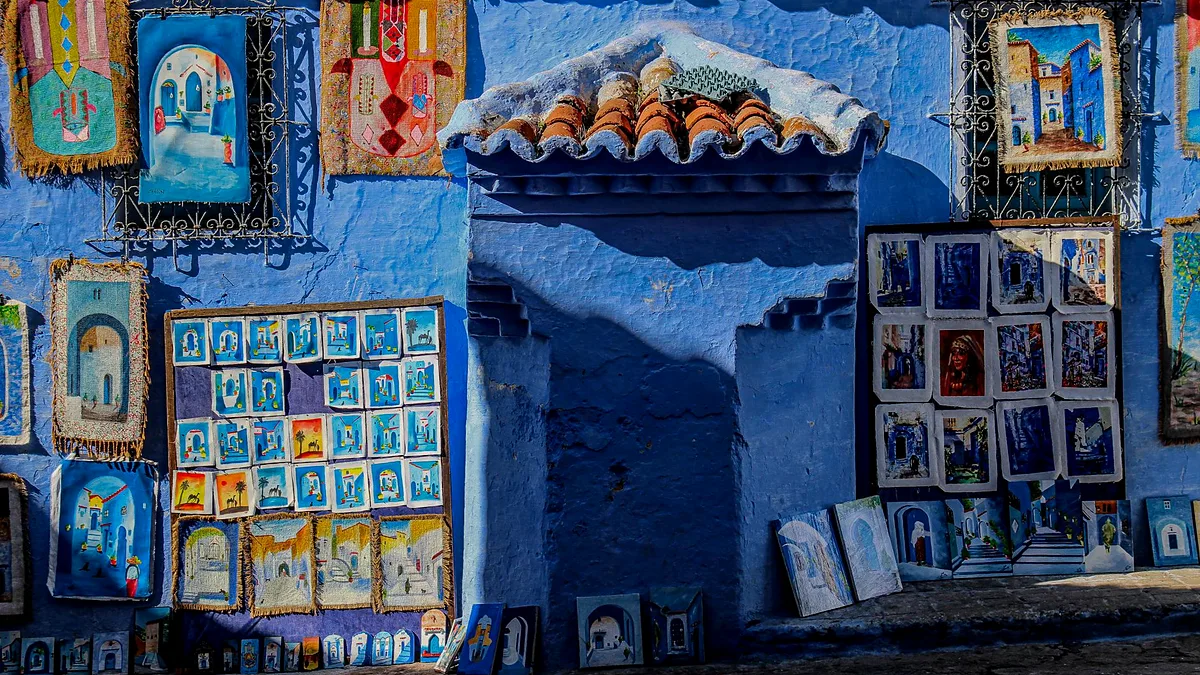
Chefchaouen has drawn painters for decades, and a handful still keep single-room studios that double as galleries. Look for signboards along Rue Hassan I and the small lanes off the main square — the doors are often wide open, and the artist is usually sitting inside with tea.
Work ranges from €20 sketches to €300 canvases of the medina, the Rif hills and the spring. Quality varies wildly, so buy what you actually like rather than what a guide pushes. If the door is shut, it's shut; don't knock hard, just come back later.
- Neighbourhood: Rue Hassan I and the alleys fanning off Plaza Uta el-Hammam.
- Cost: Free to browse; small works from 200 MAD (~$19), larger canvases 1,000–3,000 MAD (~$95–$285).
- Best time: Late afternoon, 16:00–19:00, when the light in the studios is best.
- Getting there: Walk the length of Rue Hassan I from Bab El Ain and keep your eyes on the doorways.
Insider tip: Ask if the artist ships. Most will roll a canvas into a tube for hand luggage at no charge — far safer than folding it into a suitcase.
Café Clock's Rooftop: The Closest Thing to a Club
Café Clock opened here as an offshoot of the Fez original and quickly became the town's cultural living room. The rooftop seats maybe fourteen people, the walls are covered in hand-painted Arabic script, and the calendar runs to calligraphy classes, gnawa music evenings and storytelling nights.
It's not exclusive, but it feels that way after dark, when the terrace fills up and the medina goes silent below. Tea is 20–25 MAD, mains 60–90 MAD (~$6–$9), and nobody rushes you out.
- Neighbourhood: Near Bab Souk, a short walk from the main square.
- Cost: 25 MAD (~$2.40) for mint tea; 90 MAD (~$8.50) for a full meal.
- Best time: Sunset, or whatever evening the music session is on.
- Getting there: Signposted off the main medina lanes; follow the small painted clock signs.
Insider tip: Ask to see the events board when you sit down — schedules shift with the season, and the best nights are rarely advertised online.
The Neighbourhood Hammam Off Bab El Ain
Forget the spa hammam in your riad for one afternoon. The local bathhouse near Bab El Ain is a low-ceilinged, steam-filled series of stone rooms where the scrubbing is serious, the water is hot, and nobody is selling you argan oil at the end.
Men's and women's hours alternate by day, so ask at your guesthouse before you go. Locals pay 15–20 MAD; tourists are typically charged around 50 MAD (~$5) plus 50–80 MAD for the black-soap scrub and kessa glove, which is the whole point.
- Neighbourhood: The lanes just inside Bab El Ain, north-west edge of the medina.
- Cost: 50–80 MAD (~$5–$8) total with scrub.
- Best time: Early afternoon, right when the doors open — the water is cleanest.
- Getting there: Walk; it's 5 minutes from the main square.
Insider tip: Bring your own towel, flip-flops and a plastic bag for wet clothes. Leave the phone in the locker — no photography, and people will tell you so.
Riad Rooftops and the Town's Only Real Bar
Several riads — Dar Meziana, Lina Ryad, Riad Cherifa, Casa Hassan — have terraces that function as informal private clubs. You can't just wander up, but a phone call or a request at reception usually gets non-guests a table for tea or dinner.
Mint tea runs 25–40 MAD; a three-course dinner is 180–280 MAD (~$17–$27). And if you want a beer, head for the Parador hotel: it's the most reliable licensed spot in town, which makes its terrace the de facto bar for the whole medina.
- Neighbourhood: Scattered across the medina; the Parador sits just outside Bab Souk.
- Cost: 25–40 MAD (~$2.40–$4) for tea; 180–280 MAD (~$17–$27) for dinner.
- Best time: 18:30, as the muezzin calls and the light goes gold.
- Getting there: Walking distance from anywhere in the medina.
Insider tip: Call ahead in the afternoon, not at sunset — the good corner tables go first, and a request made two hours early gets you one.
Where to Eat and Drink Nearby
Bab Ssour (near Bab Souk) is the reliable sit-down choice: chicken tagine with preserved lemon, a proper harira, and mains at 70–120 MAD (~$7–$11). Book a table on the terrace for 19:00; it fills fast and the inside room is much less pleasant.
Chez Hicham, opposite the kasbah on Plaza Uta el-Hammam, does cheap, honest tagines at 45–70 MAD (~$4–$7) plus excellent fresh orange juice and almond ice cream. It's the best value on the square, and the service doesn't mind if you linger over one tea for an hour.
Café Aladdin, also on the square, is where to get breakfast: msemen flatbread with amlou (almond and argan paste) and a coffee for around 35–45 MAD (~$3.50–$4.30). Skip the laminated photo menus on the main drag — same food, double price.
Practical Logistics and Budget Tips
- Getting there: No airport and no train. CTM or Nejme Chamal buses run from Tangier (about 3 hours, 70–90 MAD / ~$7–$9) and Fès (about 4 hours, 90–110 MAD / ~$9–$10.50). The bus station is a 15-minute walk from Bab Souk.
- Taxis: Petit taxis charge 15–20 MAD (~$1.50–$2) inside town. Agree the fare before you get in, and don't expect the driver to enter the medina — he can't.
- Cash: There are only a few ATMs, clustered on Avenue Hassan II, and they run dry on weekends. Carry enough dirhams from Tangier or Fès, and assume small shops take no cards.
- Shoes: The blue paint plus polished stone is genuinely slippery, especially after rain. Wear something with grip and leave the flip-flops for the hammam.
- Photos of people: Ask first. Many residents, particularly older women, do not want to be photographed, and a refusal is not an invitation to negotiate.
- What to skip: The unsolicited "guide" who meets you at the bus station; the overpriced scarf shops ringing the main square; the horse rides and photo-stall setups near the Spanish Mosque at sunset.
- The cannabis thing: Cultivation was legalised in 2021 for medical and industrial use, but buying or smoking as a tourist is still illegal. The friendly man offering a "hashish tour" is running a scam that ends in a police fine — sometimes with his cousin in uniform.
Frequently Asked Questions
Are there private clubs in Chefchaouen?
No — there are no members-only clubs in the formal sense. The "private" experience here comes from riad rooftops, neighbourhood hammams and artist studios that you access by asking or calling ahead.
Is the Kasbah museum worth the entry fee?
Yes, for 60 MAD (~$6) you get the garden, the ethnographic collection and the tower view, which is the best rooftop panorama in the medina. Go at 9:00 to have the courtyard almost to yourself.
How much time do I need in Chefchaouen?
Two full days is the sweet spot: one for the medina, galleries and hammam, one for the Spanish Mosque at sunrise and a hike toward Akchour. One day is enough for the blue walls, but not for anything in this guide.
Where should I buy local art and crafts?
Buy from the weaving cooperatives around Bab Souk and the working studios on Rue Hassan I. Prices are similar or slightly higher than the tourist shops, but the money goes to the maker and the quality is real.