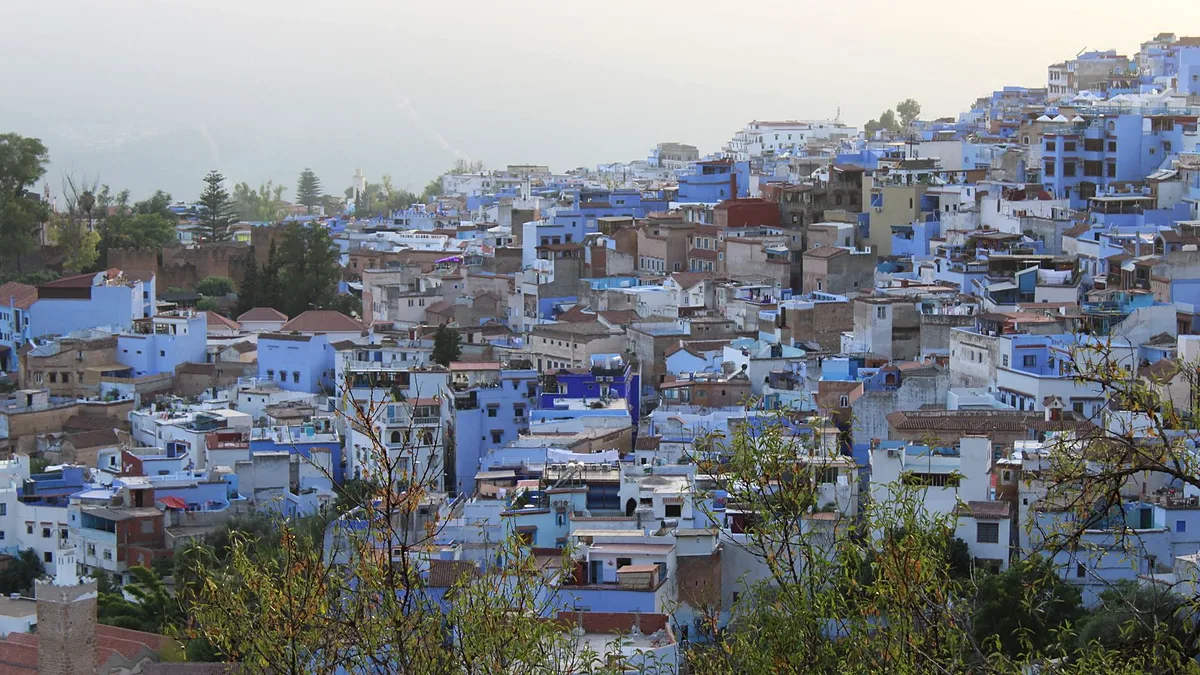

Chefchaouen gets photographed for its blue walls, then often abandoned after one afternoon of selfies. That is a waste. This is a working Rif mountain town of wool weavers, tailor shops and 15th-century gates, and most of what is worth your time here was either made by hand or built before Columbus set sail.
Below are the workshops you can genuinely walk into, the heritage sites worth paying for, and a few honest notes on what to skip.
Chefchaouen at a Glance
- Best time to visit: March to May or late September to November. July and August bring Moroccan domestic crowds and 35°C afternoons.
- Typical daily budget: 450 to 750 MAD (about $45 to $75) per person, covering a mid-range riad, three meals, one paid site and local taxis.
- Getting around: the medina is car-free and stepped. Everything in this guide sits 5 to 35 minutes on foot from Plaza Uta el-Hammam.
- Vibe: slow mornings, cats on warm stone, shopkeepers who offer tea before they offer a price.
The Kasbah of Moulay Ali Ben Rachid
Built in 1471 by the town's founder, this ochre fortress is the oldest thing in Chefchaouen and the only ticket I'd call essential. Inside you get a small garden courtyard, a modest ethnographic collection of Rif pottery, jewellery and instruments, and a set of old prison cells that is genuinely eerie.
Unlimited High-Speed International Travel eSIM
Connect in seconds across 180+ destinations. Instant QR code activation with zero roaming surcharges.

The real payoff is the tower. Climb it for a clean view over the octagonal minaret of the Grand Mosque, which is unusual for Morocco and impossible to photograph properly from street level.
- Neighborhood: west side of Plaza Uta el-Hammam
- Cost: 60 MAD (~$6) for visitors, 10 MAD for Moroccan nationals; the small art gallery is included
- Best time: 9:00 to 11:00, or after 16:00 when the tour groups thin out
- How to get there: a 5-minute walk from Bab Souk gate; open daily roughly 9:00 to 18:30, shorter hours in Ramadan
Insider tip: The courtyard garden is the coolest shaded seat in the medina at midday, and nobody guards it. Set your expectations for the museum itself low. It is three rooms, not a national collection.
Wool and Weaving Workshops Around Ras El Maa
Chefchaouen's craft identity is wool, not blue paint. Jebli sheep from the surrounding hills supply the heavy striped blankets, djellabas and scarves sold all over town, and many are still woven on wooden floor looms in family rooms between the Ras El Maa spring and Rue Sebbanin.
Walk downhill along the water channel in the morning and you will hear the looms before you see them. Doors sit open. A polite "salam" and a question about the wool usually earns you a demonstration, and there is no pressure to buy.
- Neighborhood: Ras El Maa and Rue Sebbanin, eastern medina
- Cost: free to visit; blankets 350 to 900 MAD (~$35 to $90), scarves 60 to 150 MAD (~$6 to $15)
- Best time: 10:00 to 13:00 on weekdays, when the looms are actually running
- How to get there: walk east from Plaza Uta el-Hammam for about 8 minutes, following the sound of water downhill
Insider tip: Ask before photographing the women washing wool at the spring. It is their laundry and their livelihood, not scenery, and a small purchase inside the workshop goes further than a coin handed over on the steps.
Place Mohammed V and the Monday and Thursday Souk
This small square near Bab Souk hosts Chefchaouen's weekly market on Mondays and Thursdays, when farmers come down from the Rif with honey, walnuts, dried figs, olive oil and rounds of jben, the local goat cheese wrapped in leaves. Come early and it feels like a town feeding itself rather than a town posing for cameras.
It is also the cheapest place to buy anything edible. Bring cash and a rough idea of local prices.
- Neighborhood: Place Mohammed V, between Bab Souk and Bab El-Ain
- Cost: free to wander; jben 20 to 30 MAD per 100g, honey 80 to 150 MAD a jar (~$8 to $15)
- Best time: 8:00 to 11:00 on Monday or Thursday only
- How to get there: 3 minutes on foot from Bab Souk
Insider tip: Most "Chefchaouen ceramics" you see in shop windows were fired in Fez or Safi. If a seller insists otherwise, ask which kiln. Buy the wool, the honey and the cheese instead, because those really are local.
Café Clock: A Cooking Class That Teaches You Something
The Chefchaouen outpost of the Fes-born cultural café runs half-day cooking classes that start with a market run, then move to a kitchen where you actually chop, knead and burn things. It is the best rainy-day option in town and the easiest way to talk to local cooks without awkwardness.
The same building hosts calligraphy sessions and live gnawa music a few nights a week, usually free with a drink.
- Neighborhood: medina lanes a few minutes from Bab Souk
- Cost: 350 to 450 MAD (~$35 to $45) for a 3-hour class; mains 70 to 110 MAD
- Best time: book 24 to 48 hours ahead; classes typically run mid-morning or late afternoon
- How to get there: ask your riad to point out the lane, since signage in the medina is unreliable
Insider tip: Book a class that falls on a Monday or Thursday so your market visit lands on souk day. The rooftop is also the best sunset seat that does not require a hike.
The Spanish Mosque and the Rif Skyline Walk
Built by Spanish troops in the 1920s and left unused for decades, this small mosque on the ridge above town is now the classic sunset spot. The walk up through the hillside takes 25 to 35 minutes and passes terraced gardens, grazing goats and a lot of cats.
Non-Muslims cannot enter the building, but the terrace outside is where everyone stands. The view back over the blue medina with the Rif behind it explains why the town exists at all.
- Neighborhood: hillside east of the medina, above Ras El Maa
- Cost: free
- Best time: arrive 45 minutes before sunset and bring a light layer
- How to get there: from Ras El Maa, follow the paved path uphill; uneven steps most of the way
Insider tip: Ignore anyone at the base offering to guide you up for 100 MAD. The path is obvious. Bring a phone torch for the walk down, and if you want solitude, continue past the mosque to the second ridge.
Talassemtane National Park and Akchour
Thirty kilometres north of town, the fir forests and limestone arches of Talassemtane National Park are part of Chefchaouen's heritage too. The village of Akchour is the trailhead for the Pont de Dieu arch, and the surrounding cooperatives sell walnut oil, rosemary honey and mountain herbs pressed the old way.
It is a full day out with rough trails, cold water crossings and almost no shade. Go in spring or autumn, not after heavy rain.
- Neighborhood: Akchour village, roughly 30 km north via the Fnideq road
- Cost: park access free; guided hike 300 to 400 MAD (~$30 to $40); grand taxi 150 to 200 MAD each way
- Best time: April to June and September to October, starting by 9:00
- How to get there: grand taxi from the rank on Avenue Hassan II, about 45 minutes, or a shared taxi for around 50 MAD per seat
Insider tip: The lower route to the arch is around two hours round trip and needs no guide. The upper cascades do require one. There are no working ATMs in Akchour, so carry cash.
Where to Eat and Drink Nearby
Restaurant Bab Ssour
Tucked at the edge of Plaza Uta el-Hammam, this is where locals take visiting cousins for a proper tagine. Order the chicken with preserved lemon and olives, and start with a bowl of harira. Mains run 45 to 70 MAD (~$5 to $7).
Café Clock
The camel burger is the house signature, but the vegetarian couscous and the mint tea on the terrace are the better value. Expect 70 to 110 MAD per person, and live music some evenings.
Breakfast at Place Mohammed V
Skip hotel breakfast once. Buy warm msemen for 5 MAD, a wedge of jben and a handful of olives, then eat on the square steps with a 10 MAD glass of mint tea. This is the best four-dollar meal in northern Morocco.
Practical Logistics and Budget Tips
Chefchaouen has no airport. Buses from Fes take about four hours (75 to 100 MAD) and from Tangier around three hours (60 to 80 MAD); CTM and Nejma are the reliable operators. The bus station is a 15-minute walk or a 15 MAD petit taxi from Bab Souk.
- Pack a backpack, not a wheeled suitcase. The medina is stairs, ramps and wet stone.
- Carry cash. ATMs cluster on Avenue Hassan II near the main road, but most workshops and market stalls take no cards.
- Haggle gently. Start around half the asking price for textiles, smile, and be willing to walk away. Never haggle over food.
- Budget for tips: 10% in restaurants and 20 to 50 MAD for a guide who actually taught you something.
What to skip: restaurants on the main square with photo menus and touts outside them, which serve the same tagine at triple the price. Also skip anyone offering hash or a "special view" on the street, since it is illegal and a fine for you. And unless you want deep history, a paid medina guide is optional; the old town is small enough that getting lost costs you ten minutes, not a day.
Frequently Asked Questions
Can beginners join craft workshops in Chefchaouen?
Yes. The cooking classes and weaving demonstrations are designed for people who have never kneaded dough or touched a loom, and no booking deposit is usually needed beyond a phone call the day before. Expect small groups of four to eight people.
How much does the Chefchaouen Kasbah cost and is it worth it?
Entry is 60 MAD (about $6) and takes roughly 45 minutes to explore. It is worth it for the tower view alone, though the museum collection itself is small.
How many days do you need in Chefchaouen?
Two full days covers the medina, the Kasbah, the weaving workshops and the Spanish Mosque at sunset without rushing. Add a third day if you want the Akchour hike or a cooking class.
Is Chefchaouen walkable and safe at night?
The medina is entirely pedestrian and feels calm after dark, though the lanes are uneven and poorly lit in places. Bring a torch, keep to the main routes near Plaza Uta el-Hammam, and use a petit taxi (10 to 20 MAD) if you are staying outside the walls.