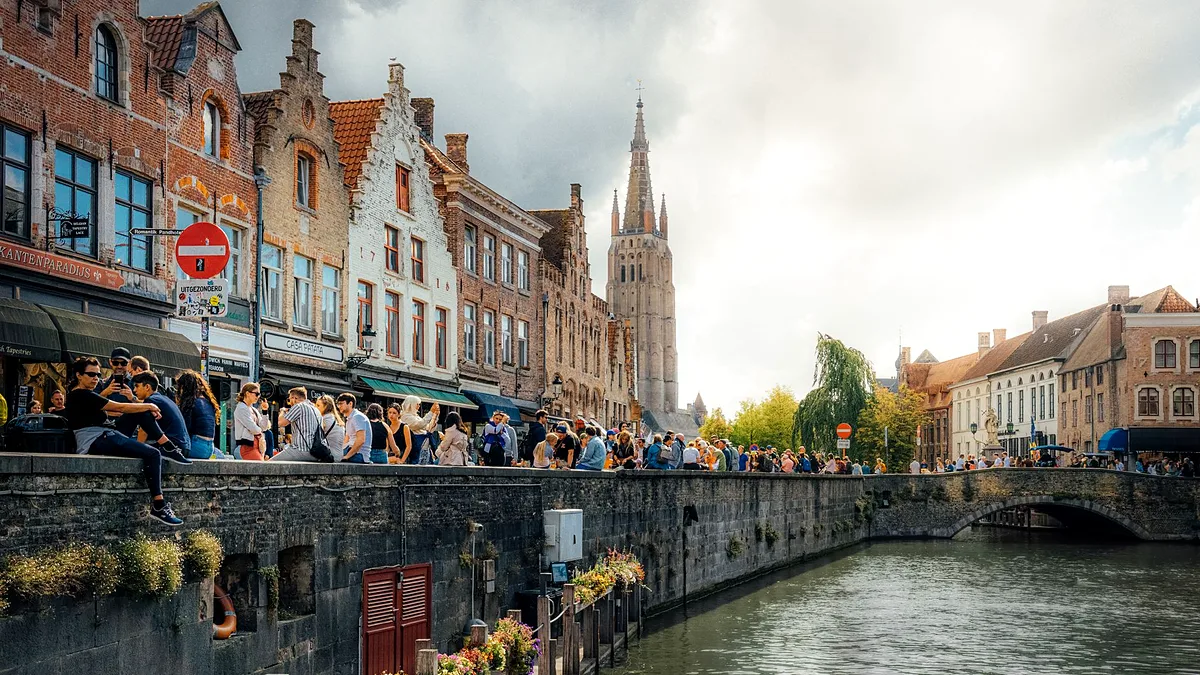

Bruges has been selling things to travellers for 600 years, and the things it sells best are the things people make with their hands. Lace, beer, chocolate, painted panels, furniture built to outlive its owner. The medieval core is a working catalogue of that craft, and it's small enough to cross on foot in 25 minutes.
That's the part most visitors miss. They ride a canal boat, photograph the Markt, buy a fridge magnet and leave. Two streets away, an 80-year-old woman is flicking 40 bobbins across a pillow while a brewer pumps beer through a pipeline under the cobbles.
Here's the version I'd give a friend: which workshops are real, which heritage sites earn the ticket price, and where to stop when your feet give out.
Unlimited High-Speed International Travel eSIM
Connect in seconds across 180+ destinations. Instant QR code activation with zero roaming surcharges.

At a Glance
- Best time to visit: late April to mid-June, or September to mid-October. Fewer queues, artisans still on schedule, softer light on the canals.
- Typical daily budget: €90–€150 / ~$98–$165 per person, covering one paid attraction, two sit-down meals, coffee and a couple of beers.
- Local transport style: walk. The historic centre is roughly 2 km across; buses only help between the station and the centre.
- Vibe: quiet, damp, brick-coloured and genuinely unhurried once you step off the Markt.
1. Kantcentrum: Lace That's Actually Made Here
Bruges lace is the city's oldest export and its most misunderstood one. Most shops near the Markt sell machine-made imports; the Kantcentrum in the Sint-Anna quarter is where you watch bobbin lace get made by hand.
The museum is small and slightly old-fashioned, which is exactly why it works. Volunteers sit at pillows of bobbins, crossing and pinning threads into flowers at roughly a centimetre an hour, and they'll happily talk you through the difference between Duchesse and Rosaline for ten minutes.
- Neighbourhood: Sint-Anna, Balstraat 14, a 10-minute walk northeast of the Markt via Potterierei.
- Cost: €6 / ~$6.50 adult, under-12s free, demonstrations included.
- Best time of day: weekday mornings, 10:00–12:00, before tour groups land.
- Getting there: walk it. The little streets here don't connect well by bus.
Insider tip: Go straight to the demonstration room upstairs before the ground-floor displays, since the artisans usually pack up around 16:00. Then cross to 't Apostelientje at Balstraat 11, where staff will show you how to tell hand work from machine copies — hand-made doilies start around €40 / ~$44.
2. Chocolate: Book a Workshop, Not a Shop Window
Bruges has around 50 chocolate shops and maybe four worth your money. Start with the hands-on side: Choco-Story on Wijnzakstraat runs a 90-minute praline workshop where you temper, pipe and box your own chocolates.
For the serious version, Dominique Persoone's The Chocolate Line on Simon Stevinplein treats chocolate like a spice rack — wasabi, tobacco, fried onion — and did it long before it became a marketing angle. If you want classic, go to Dumon at Eiermarkt 6, where the pralines are plain, fresh and better than anything on the Markt.
- Neighbourhood: all three sit within 400 m of the Markt — Wijnzakstraat 2, Simon Stevinplein 19, Eiermarkt 6.
- Cost: Choco-Story museum €14 / ~$15; workshop from about €32 / ~$35; a 250 g box at Dumon €14–€18.
- Best time of day: at 10:00 opening, or after 16:00 when day-trippers thin out.
- Getting there: five minutes on foot from the Markt in any direction.
Insider tip: Book the Choco-Story workshop online a week ahead; walk-ins almost never work in July and August. Skip any "chocolate museum" that turns out to be a shop with one display case.
3. De Halve Maan: Beer, Family and a Pipeline Under the Street
The Halve Maan has brewed on Walplein since 1856 and is still run by the same family, now the sixth generation. The 45-minute tour climbs the brewhouse, drops into the cellar and ends with a glass of Brugse Zot — the best-value hour in the city.
The detail that sticks is the beer pipeline. To stop tankers rattling through medieval streets, the brewery laid a 3.2 km underground line to its bottling plant in 2016. Beer literally flows under your feet while you drink it.
- Neighbourhood: Walplein 26, just south of the centre near Onze-Lieve-Vrouwekerk.
- Cost: €16 / ~$17 including one beer; children get a soft drink at a lower rate.
- Best time of day: the 11:00 tour or anything after 15:00; weekends sell out.
- Getting there: 7-minute walk from the Markt via Wijngaardstraat.
Insider tip: If you'd rather sit by water, Bourgogne des Flandres at Kartuizerinnenstraat 6 runs a short self-guided tour with a canal-side tasting room for about €14 / ~$15. Its terrace over the water is quieter than anything on the Rozenhoedkaai.
4. The Belfry and the Burg: Civic Craft at 366 Steps
Climbing the Belfry is the one Bruges ritual that fully earns its hype, but only if you know what you're climbing. The tower was the city's records office and lookout, and the carillon is still played by hand — a working instrument, not a recording.
Two minutes away, the Burg holds a 1376 town hall with a gilded Gothic façade and the Basilica of the Holy Blood, where a relic is displayed in near-silence most afternoons. Both are cheap, and both are far calmer than the Markt outside.
- Neighbourhood: Markt 7 (Belfry) and Burg 12 (Stadhuis), about 150 m apart.
- Cost: Belfry €15 / ~$16 timed ticket; Stadhuis €8 / ~$8.70; basilica free, upper chapel museum €5.
- Best time of day: 09:30 opening for the Belfry; 14:00–16:00 for the relic veneration.
- Getting there: every street in the centre eventually leads to the Markt.
Insider tip: There are 366 steps, no lift, and the staircase narrows to single file near the top. Buy the timed ticket online the night before, because same-day slots are gone by mid-morning in summer.
5. Sint-Janshospitaal: Medieval Nursing and Memling's Brushwork
Europe's oldest surviving hospital building, in use from the 12th century until 1976, now has a double life. Half of it explains how nuns nursed the sick for 800 years; the other half holds six Hans Memling paintings, including the Shrine of St Ursula, a wooden reliquary painted like a jewel box.
The 17th-century apothecary is stocked with original jars, and the timber roof beams alone justify the ticket. It's quieter than the Belfry and twice as interesting if you care how people actually lived.
- Neighbourhood: Mariastraat 38, directly beside the Church of Our Lady.
- Cost: €12 / ~$13 adult; covered by the Musea Brugge card.
- Best time of day: weekday afternoons; Sunday mornings fill up with local families.
- Getting there: 6-minute walk from the Markt via Simon Stevinplein.
Insider tip: The Church of Our Lady next door is free to enter, but the small museum chapel holding Michelangelo's Madonna and Child charges about €8 / ~$8.70 separately. Check the side chapel first — the sculpture is the reason to pay.
6. Kruisvest: Windmills, Ramparts and the Craft of Staying Dry
Bruges grew rich on water and spent centuries learning to control it. The ramparts along Kruisvest still carry four windmills; Sint-Janshuismolen, built in 1770, is the one you can walk inside, and the miller grinds grain whenever the wind plays along.
The walk out is the real point. From the Kruispoort gate, a 1.5 km path runs along the old moat past the mills and surviving bastions with almost nobody on it. It's the best free thing in Bruges, and it's five minutes from the centre.
- Neighbourhood: Kruisvest, on the eastern ramparts between Kruispoort and Dampoort.
- Cost: €4 / ~$4.30 to enter Sint-Janshuismolen; the walk itself is free.
- Best time of day: 16:00–18:00, when low light hits the moat.
- Getting there: 10 minutes on foot from the Markt via Langestraat.
Insider tip: The mill only opens April to September, closes Mondays and shuts in high wind. Ten minutes away, the Volkskundemuseum on Balstraat fills eight 17th-century almshouses with old trades — lace, cobbler, cooper, blacksmith — for €8, and you'll likely have the rooms to yourself.
Where to Eat and Drink Nearby
Herberg Vlissinghe (Blekersstraat 2) has poured beer since 1515 and serves carbonade flamande, beef braised in Flemish ale, for about €20 / ~$22. It's low-beamed and wood-fired, open Wednesday to Sunday, and it fills after 19:00.
Bistro Bruut (Meestraat 9) is the modern end of the scale: a short seasonal menu, three courses around €45 / ~$49, and a no-nonsense wine list. Book two weeks out for weekends; lunch is the better-value slot.
't Brugs Beertje (Kemelstraat 5) stocks around 300 Belgian beers in a room the size of a living room. No food beyond cheese and pâté, opens at 16:00, closed Mondays — arrive early for a stool.
Practical Logistics and Budget Tips
Getting there and around
Trains from Brussels run twice an hour and take about an hour; standard second class is €15.30 / ~$17. From Brugge station to the Markt is a flat 15-minute walk along Oostmeers, or bus 1 or 11 (€3 cash, cheaper through the De Lijn app).
Inside the ring, walking beats everything. Buses barely help, car parks cost €15–€25 a day, and bikes are brilliant except on the cobbles around the Markt.
Tickets and savings
- The Musea Brugge card — roughly €33 / ~$36 for 24 hours, €48 for 72 — pays for itself after two or three museums.
- Free: the Begijnhof courtyard, the Church of Our Lady nave, the ramparts walk, the Basilica of the Holy Blood.
- A canal boat is €12–€15 for 30 minutes. Do it once, at dusk rather than noon.
What to skip
- Markt terraces. €28 set menus of frozen mussels and reheated stew. Two streets away the same money buys a real meal.
- Horse-drawn carriages. Around €60 for half an hour on a fixed loop you can walk yourself.
- "Belgian lace" bargains on Breidelstraat. Under €30 means machine-made, usually imported.
- Mondays. Plenty of independent shops and workshops close Sunday and Monday — don't schedule your craft day for either.
Frequently Asked Questions
Can you do a chocolate-making workshop in Bruges?
Yes. Choco-Story on Wijnzakstraat runs hands-on praline workshops of about 90 minutes from roughly €32 / ~$35, and a few independent chocolatiers offer smaller sessions. Book online at least a week ahead in summer.
Is the Bruges lace centre worth visiting?
If you want to understand why hand-made lace costs what it does, yes — entry is €6 and you'll see live demonstrations. If you only want a souvenir, skip it and buy from a specialist lace shop instead.
How many days do you need for Bruges workshops and heritage sites?
Two full days covers a chocolate workshop, the brewery tour, the Belfry and a museum or two without rushing. Three days lets you add the windmills, the lace centre and a proper afternoon sitting by a canal.
Is Bruges walkable from the train station?
Yes. It's about 1.2 km, 15 minutes at an easy pace, and the route is flat and signposted. Take bus 1 or 11 if you're carrying luggage, or a taxi for around €10.