
Most people leave Bangkok with the same three photos: a temple, a rooftop bar, a tuk-tuk blur. That's a shame, because the city still runs on handwork — monks' alms bowls beaten out of steel strips in a Mon alley, terracotta thrown on a river island, puppets and paintings kept alive in a stilt house across the water.
This guide is for people who would rather hold the tools than photograph them. Every stop below sits within reach of the MRT, the BTS, or a public ferry that costs less than a coffee, and most of them are free or under ฿200 (~$6 USD).
Bangkok Craft and Heritage at a Glance
- Best time to go: November to February, when it's 25–32°C and dry. April afternoons hit 40°C and wreck any walking plan.
- Daily budget: ฿1,200–2,500 (~$36–76 USD), covering transit, one hands-on workshop, entry fees, and a lot of street food.
- Getting around: MRT and BTS for the backbone, the orange-flag Chao Phraya boat (฿16 flat) for the river, Grab bikes for the last two kilometres.
- Vibe: Slow and residential. These are working communities, not attractions — ask before you film, and buy something small.
1. Baan Bat: The Alms Bowl Village That Almost Disappeared
Off Boriphat Road, in a lane called Soi Ban Bat, a Mon-descended community has been hammering monks' alms bowls out of steel strips for roughly two centuries. The work runs through eight stages — cutting, shaping, firing, lacquering — and you can watch most of it from the doorway of a family workshop.
Unlimited High-Speed International Travel eSIM
Connect in seconds across 180+ destinations. Instant QR code activation with zero roaming surcharges.

This isn't a museum. Grandmothers sort bowls on the pavement, the furnace fires up when orders arrive, and someone will usually hand you a hammer if you look interested enough.
- Neighbourhood: Pom Prap Sattru Phai, between Wat Saket and the Golden Mount.
- Cost: Free to walk in; a ฿100 (~$3 USD) donation is polite, and a handmade bowl runs ฿500–1,500 (~$15–45 USD).
- Best time: Weekday mornings, 9am to noon, before the heat and the tour groups.
- Getting there: MRT Sam Yot, exit 3, then a 12-minute walk past Wat Saket.
Insider tip: Climb the Golden Mount next door (฿50 / ~$1.50 USD) first thing, then drop down into the lane. The bowls are lighter than they look, and the sound of the hammering is half the experience.
2. Ko Kret: Throw a Pot on a River Island
Ko Kret is a car-free Mon island in the Chao Phraya, technically in Nonthaburi but only a cheap ferry ride off the city's river network. It's known for terracotta: unglazed pots, tiny spirit houses, and the kind of wonky hand-thrown bowls that sell for four times as much in a design shop on Sukhumvit.
Several family studios let you sit at a wheel for 30 to 45 minutes and take home whatever survives drying. Instruction happens mostly through hand gestures, the clay gets everywhere, and it's the best ฿300 you'll spend all week.
- Neighbourhood: Pak Kret district, Nonthaburi — north of the city centre.
- Cost: Ferry ฿10 (~$0.30 USD); wheel workshop ฿250–400 (~$8–12 USD); bicycle hire ฿50–80 (~$1.50–2.50 USD).
- Best time: Saturday before 10am. Many studios and snack stalls shut on weekdays.
- Getting there: Orange-flag Chao Phraya Express boat to Nonthaburi pier (about ฿15, 45–60 minutes), then the cross-river ferry.
Insider tip: Pottery is fragile and Bangkok traffic is not. Ask the studio to wrap your piece in newspaper and bubble wrap, then carry it on your lap instead of stuffing it into checked luggage.
3. Ban Kamthieng House: The Quiet Alternative to Jim Thompson
The Siam Society moved a genuine 19th-century Lanna teak house from Chiang Mai down to Sukhumvit Soi 21 and filled it with weaving looms, fishing traps, and farming tools. Entry is ฿100, the garden is shaded, and on a weekday you may get the whole upstairs floor to yourself.
It's an academic collection rather than a show, which is exactly why it works. You actually learn how a Thai house breathes — the raised floor, the open verandah, the way the roof lifts heat out of the rooms.
- Neighbourhood: Asok, Sukhumvit Soi 21.
- Cost: ฿100 (~$3 USD) for adults.
- Best time: Tuesday to Saturday, 9am–5pm; closed Sunday, Monday, and public holidays.
- Getting there: BTS Asok exit 1 or MRT Sukhumvit exit 3, then a five-minute walk.
Insider tip: Lunch at the Pier 21 food court on the top floor of Terminal 21, five minutes away, costs ฿40–60 (~$1.50 USD) instead of the ฿300 a soi-side café will charge you.
4. Kudi Chin: The Portuguese Village That Bakes Its Own History
Portuguese traders settled on the Thonburi bank in the 1760s, built Santa Cruz Church, and left behind a dessert that never went away. In the lanes of Kudi Chin you'll find the church, the Chinese-Thai Wat Kalayanamit, a mosque, and families still baking kanom farang kudi chin — a sponge cupcake studded with raisins and candied winter melon.
It's one of the few places in Bangkok where 250 years of immigration fits into a two-block walk, and almost nobody does it.
- Neighbourhood: Klong San, Thonburi, on the west bank of the Chao Phraya.
- Cost: Cross-river ferry ฿5 (~$0.15 USD); cupcakes ฿25–45 (~$1 USD); temples free.
- Best time: Mornings, 8am–11am, while the ovens are still running.
- Getting there: Tha Tien pier beside Wat Pho, cross-river ferry, then walk five minutes inland.
Insider tip: Thanusingha Bakery House sells out of cupcakes before lunch most days. Buy two — the second one rarely survives the ferry ride back.
5. Talat Noi: Chinese Heritage Lanes and Car Parts
Talat Noi began as a Chinese trading community on the river and never fully modernised, which is why shophouses selling engine parts sit next to a 19th-century shrine, a coffee bar built around a vintage car, and murals painted on walls that flood every October.
Come for the texture, not a checklist. The best stretch is Soi Wanit 2, where you can wander from a shrine to a converted riverside warehouse in about eight minutes.
- Neighbourhood: Talat Noi, off Charoen Krung Road, next to Chinatown.
- Cost: Free to wander; coffee ฿90–140 (~$3–4 USD).
- Best time: Late afternoon, 4pm–6pm, when the light hits the river and the heat finally drops.
- Getting there: MRT Hua Lamphong, exit 1, then a 10-minute walk toward the water.
Insider tip: Some alleys are active workshops with machinery running. Step in only when someone waves you through, and never stand behind a reversing truck to get the shot.
6. Baan Silapin: Puppets in a Teak Stilt House
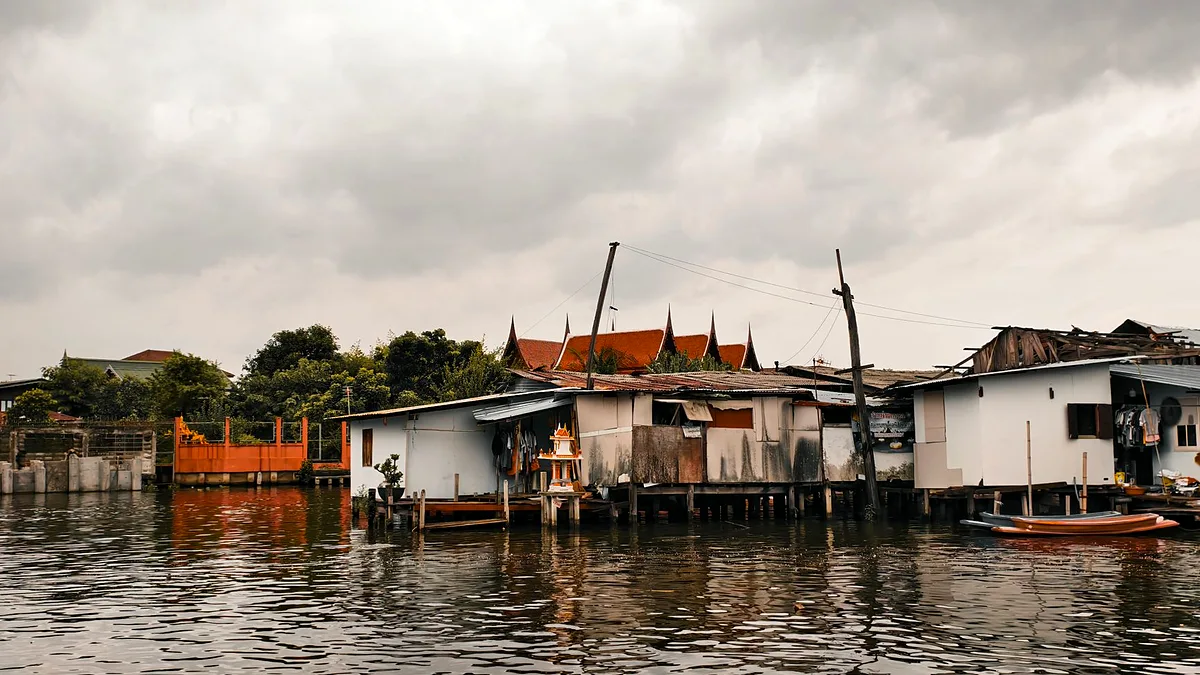
Twenty minutes west of the tourist river, on a canal called Khlong Bang Luang, a 200-year-old stilt house has become an artist's workshop and puppet theatre. Entry is free, the walls are crowded with paintings, and at 2pm a small troupe performs a traditional Thai puppet show in a courtyard the size of a living room.
It's charming without being slick, which is rare in Bangkok. Kids love it, and adults tend to leave with a painting they hadn't planned to buy.
- Neighbourhood: Khlong Bang Luang, Thonburi, down Soi Wat Kuhasawan.
- Cost: Free entry, donations welcome (฿100 / ~$3 USD); canal boat loops around ฿150 (~$4.50 USD).
- Best time: Arrive 1:30pm for the 2pm show; most days except Monday.
- Getting there: BTS Wongwian Yai, then a Grab bike or taxi for about ฿70–90 (~$2–3 USD).
Insider tip: Sit on the canal-side steps rather than the benches inside. You get the breeze, passing boats, and a clear view of the puppets' feet — which is where the skill actually shows.
Where to Eat and Drink Nearby
Nang Loeng Market
Bangkok's first paved market, opened around 1900, still trading under Art Deco shophouses on Nakhon Sawan Road. Stalls sell old-fashioned Thai sweets — khanom buang, luk chup, sticky rice in banana leaf — for ฿20–60 (~$1–2 USD) a portion. Go before 11am, because by early afternoon half the trays are empty and the shutters are down.
Nai Ek Roll Noodles, Yaowarat
A Bib-listed shophouse on Plaeng Nam Road, five minutes from Talat Noi, serving kway chap: rolled rice noodles with pork, liver, and a peppery broth. Expect ฿60–100 (~$2–3 USD) and a shared table. It runs into the night, which makes it the right finish after a Talat Noi walk.
Thanusingha Bakery House, Kudi Chin
The kanom farang here comes out of a wood-fired oven in a family house that has been baking since the Portuguese arrived. It's ฿25–45 (~$1 USD) each, cash only, and there's no seating worth mentioning — eat it on the wall by the river.
Practical Logistics and Budget Tips
Transit and passes
- Buy a Rabbit card for the BTS (฿100 deposit plus top-up) if you're in town five days or more. On a short trip, single tickets are fine.
- MRT gates now take contactless bank cards at most stations, and the one-day pass (฿120) pays for itself after four rides.
- The orange-flag Chao Phraya Express boat is ฿16 flat and the fastest link between Thonburi, Chinatown, and Banglamphu. Skip the blue-flag tourist boat: it costs more and stops less often.
- Grab bikes run ฿30–60 for short hops and beat taxis in traffic. In a metered taxi, say 'meter, please' before you get in — the ฿35 flagfall is the whole point.
Money
- Workshops and market stalls are cash only. Carry ฿1,000 in small notes, because nobody has change for a ฿1,000 bill at a ฿25 cupcake stand.
- Budget ฿300–500 (~$9–15 USD) for one hands-on session, plus ฿200 if you want to ship something home.
- Entry fees across this list run ฿50–200. The Grand Palace, at ฿500, is the outlier.
What to skip
- Damnoen Saduak floating market day tours. Two hours each way, ฿800–1,200, and largely a photo queue. Ko Kret gives you the canal experience without the coach.
- Jim Thompson House between 11am and 2pm. The house is genuinely good, but ฿200 plus a 40-person group takes the shine off. Go at 9am sharp or pick Ban Kamthieng instead.
- Chatuchak on a weekday. It's a weekend market; on a Tuesday you'll find shuttered stalls and empty lanes.
Honest heads-up
Several of these workshops are family homes with a workbench, and they close for Buddhist holidays, family funerals, and all of Songkran week in April. If you're travelling a long way for a specific class, message ahead on Facebook or Line. Don't count on English signage either — a screenshot of the Thai name solves most taxi conversations.
Frequently Asked Questions
Are Bangkok's craft workshops free to visit?
Watching is usually free — Baan Bat, Talat Noi, and Baan Silapin don't charge entry, though a ฿100 donation is expected. Hands-on sessions cost ฿250–500 (~$8–15 USD) and are almost always cash only.
Do I need to book a pottery class on Ko Kret in advance?
On weekdays you can usually walk into a studio and get a wheel within the hour. Weekend afternoons in December and January get busy, so message the studio a day ahead to hold a spot.
Is the Jim Thompson House worth visiting?
Yes, if you go early — the teak architecture and silk collection are legitimately impressive, and ฿200 (~$6 USD) is fair. Just avoid the 11am–2pm crush, and know that Ban Kamthieng covers similar ground with a fraction of the crowd.
How do I reach Thonburi's heritage sites without a tour?
Take the cross-river ferry from Tha Tien pier (฿5) for Kudi Chin, and ride the BTS to Wongwian Yai plus a short Grab for Khlong Bang Luang. Both are cheap, quick, and far more pleasant than sitting in a van on Charoen Krung Road.