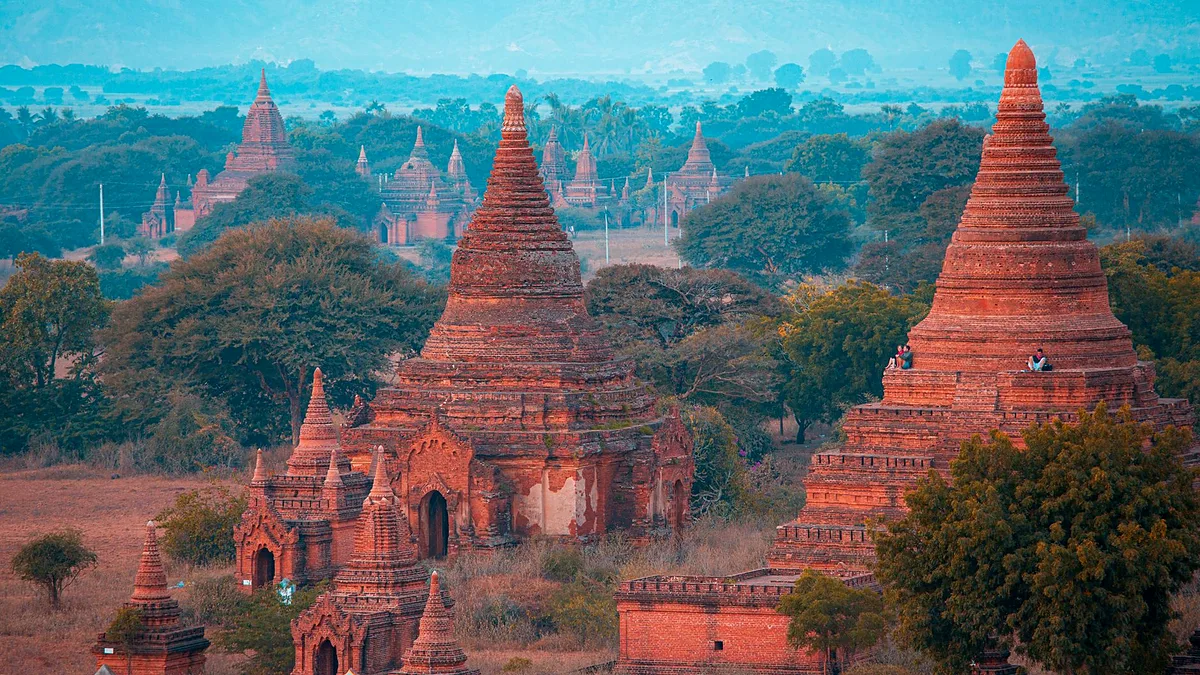

Most people give Bagan three days and spend all of them photographing the outside of brick temples. That works, but it misses the part that makes the plain legible: the workshops.
In late November the harvest trucks are stacked with sesame and peanuts, the light turns gold by four, and the villages between the temples are still doing the work they've done for centuries. In Myinkaba, lacquerware families are carving colour layers off bowls. In Minnanthu, peanut presses creak through the afternoon. Sand painters sit at the foot of the sunset mounds with jars of river grit.
Here's where to go, what it costs, and the honest bits most guides leave out.
Unlimited High-Speed International Travel eSIM
Connect in seconds across 180+ destinations. Instant QR code activation with zero roaming surcharges.

At a Glance: Bagan in Late Autumn
- Best window: mid-November to early December — 18–32°C, clear mornings, balloon season running.
- Daily budget: 45,000–90,000 MMK (~$18–35 USD) for a comfortable day, plus your one-time zone ticket.
- Getting around: electric scooter (e-bike) is the default at 10,000–15,000 MMK/day (~$4–6 USD). Horse carts if you want to skip the dust.
- Vibe: quiet, dusty, deeply rural. Workshops open by 8am and lock up by 5pm.
Myinkaba Village: Where the Lacquerware Is Actually Made
Myinkaba sits on Anawrahta Road about two kilometres south of New Bagan, and it's the reason Bagan lacquerware means anything at all. Families here make yun-de — incised lacquer — starting with a bamboo, wood or horsehair core and finishing three to six months later with a carved, coloured bowl.
At Yar Pyi and the neighbouring family workshops you pass the drying room first: dozens of pieces on racks, each coat of thitsi sap curing about a week in the dark. Then comes the carving room, where women work cross-legged with an iron stylus, scratching patterns through three or four colour layers. One good bowl can take a full day of that.
- Neighbourhood: Myinkaba village, along Anawrahta Road
- Cost: free to visit, free demos; small cup 12,000–25,000 MMK (~$5–10 USD), fine 12-step bowl 60,000–150,000 MMK (~$25–60 USD)
- Best time: 8:00–10:30am, before the workshop heats up
- Getting there: 10 minutes by e-bike from New Bagan, 25 from Nyaung U
Insider tip: Ask to see the carving room, not just the showroom. Several shops on this road are resellers with a demo table out front. Genuine thitsi lacquer has a faint, slightly sour smell and a warm, uneven surface — if it's glassy and scentless, it's resin.
Ananda Temple: The Best-Preserved Monument on the Plain
Ananda is what most first-timers picture when they imagine Bagan, and for once the hype is accurate. Built around 1091 under King Kyanzittha, it's a Mon-style cross-shaped temple with four standing Buddhas in the cardinal directions and a whitewashed exterior that still looks maintained rather than ruined.
The corridors are the point. Hundreds of glazed terracotta tiles line the walls at eye level, each one a Jataka scene, and almost nobody stops to look at them — everyone crowds the doorways. Give it 45 minutes instead of ten.
- Neighbourhood: Old Bagan, near Tharabar Gate
- Cost: covered by the 25,000 MMK (~$10–12 USD) Bagan Archaeological Zone ticket, valid for your whole stay
- Best time: 8:00–10:00am or after 4:00pm; midday is unbearable on bare feet
- Getting there: 15 minutes by e-bike north of New Bagan
Insider tip: You must remove shoes at the outer gate, not the inner one. Carry a cloth bag — leaving them on the steps is the single most common tourist mistake here, and they do go missing.
Sand Painting Studios Near the Sunset Mounds
Bagan's sand painters work with river grit sieved into five colours and glued onto canvas, usually with a sunset, an ox cart or a temple as the subject. The studios cluster near the main viewing areas and along Anawrahta Road, and the good ones will paint in front of you rather than hand you a finished piece.
Quality varies wildly. A piece done freehand with a fine brush and an artist's signature on the back is worth the money. A printed outline with sand sprinkled on top is not, and you'll see plenty of those.
- Neighbourhood: New Bagan and the roads around the designated sunset mounds
- Cost: 15,000–80,000 MMK (~$6–32 USD) depending on size; demos are free
- Best time: 3:00–5:30pm, when the studios are working and the light is good
- Getting there: e-bike; most sit within a 10-minute ride of New Bagan
Insider tip: Buy from the person actually holding the brush. Stalls run by resellers mark up 40–60% and can't tell you what's in the pigment — natural ochre and river sand versus dyed cement.
Minnanthu Village: Peanut Presses, Looms, and Empty Temples
Head four kilometres east of New Bagan and the tour buses thin out fast. Minnanthu is a working farming village where you can watch oxen walk in circles driving a wooden oil press, and households still weave cotton on floor looms under the stilt houses.
The cluster of temples here — Payathonzu, Nandamannya, Thambula — is small, dark inside, and often completely empty. Nandamannya has 13th-century wall paintings that survived because the interior stayed dry. Combine the village and the temples in one slow morning.
- Neighbourhood: Minnanthu, east of New Bagan on the dirt tracks
- Cost: free; a bottle of fresh peanut oil is 3,000–5,000 MMK (~$1–2 USD)
- Best time: 7:30–10:30am, while the presses are running
- Getting there: e-bike only — the sand tracks will stop a bicycle
Insider tip: Ask before photographing anyone working, and never stand between an ox and its route. A short nod and a gesture at your camera gets a yes almost every time.
Dhammayangyi: The Brickwork You Came For
Dhammayangyi is the largest temple on the plain and the most impressive piece of engineering, built in the 12th century with bricks fitted so tightly you can't slide a fingernail between them. The legend says the king responsible had a bricklayer executed if a needle fit in the joints.
Its inner corridors were bricked up centuries ago, so you circle the outside rather than wander the passages. That's fine — the sheer mass of it, seen from the southeast corner in low morning light, is the shot worth getting up for.
- Neighbourhood: between Old Bagan and New Bagan, just off Anawrahta Road
- Cost: included in the zone ticket
- Best time: 7:00–9:00am; zero shade after 10am
- Getting there: 10 minutes by e-bike from New Bagan
Insider tip: Vendors at the entrance will tell you the interior is open and offer to guide you in. It isn't. Walk the base counterclockwise and skip the sales pitch.
Bagan Archaeological Museum: The Air-Conditioned Crash Course
Near Gawdawpalin in Old Bagan, this slightly tired museum is the best 90 minutes you'll spend in the heat of the day. The highlight is the Myazedi inscription — the same text carved in Pyu, Mon, Old Burmese and Pali, and the key that let scholars decode Burmese script.
There are also original Buddha images removed from the temples for safekeeping, lacquerware pieces, and wall-painting fragments. Labels are basic; the point is context, not curation.
- Neighbourhood: Old Bagan, beside Gawdawpalin Temple
- Cost: 5,000 MMK (~$2 USD) on top of your zone ticket
- Best time: 12:00–2:30pm, exactly when the temples are unbearable
- Getting there: e-bike, 15 minutes north of New Bagan
Insider tip: The Myazedi stone is on the ground floor, not upstairs with the Buddha images. Most visitors miss it entirely because they head straight for the statues.
Nyaung U Market and Shwezigon Pagoda
Nyaung U market is where Bagan actually shops: thanaka bark, longyi fabric, dried fish, jade, and a lacquerware section that's cheaper but lower quality than Myinkaba. Get there early and you'll see the produce arriving before the stalls fill up.
Ten minutes away, Shwezigon is the prototype for every golden stupa in Myanmar, started in the 11th century and still gleaming. Its compound also holds the only officially sanctioned shrine to the 37 nats inside a Buddhist site — locals leave coconuts and bananas, and it's a genuine act of devotion rather than a show.
- Neighbourhood: Nyaung U town centre
- Cost: market free; Shwezigon covered by the zone ticket
- Best time: 6:30–8:30am for the market (it winds down by 2pm), 4:30pm for the stupa
- Getting there: walkable if you're staying in Nyaung U; 20 minutes by e-bike from New Bagan
Insider tip: The nat shrine sits to the left of the main stupa, not in the central courtyard. Keep your voice down — people are praying, not posing.
Where to Eat and Drink Nearby
San Thi Dar in Myinkaba is a family kitchen five minutes from the lacquerware workshops. Expect four or five Burmese curries, a soup, and tea-leaf salad for 4,000–6,000 MMK (~$1.50–2.50 USD). It's open roughly 10am to 9pm and the pumpkin curry is the order.
The Moon (also signed Be Kind to Animals The Moon) near Shwezigon in Nyaung U is vegetarian, reliable, and busy with locals at lunch. A set meal lands around 3,000–6,000 MMK (~$1–2.50 USD); the tea-leaf salad is made without fish sauce.
Weather Spoon on Thi Ri Pyitsaya 4th Street in Nyaung U is the practical pit stop — Burmese and Thai dishes, big portions, 5,000–9,000 MMK (~$2–4 USD). Air-conditioned, which matters more than you think in November.
Practical Logistics and Budget Tips
Buy the zone ticket once. The 25,000 MMK fee covers every temple on this list and stays valid for your entire stay — keep the paper, because checks happen at Shwezigon and at road checkpoints.
Rent the e-bike, but check the battery. A decent scooter does 40–50km. The sand tracks out to Minnanthu drain it faster than the paved loop. Hotels rent from 10,000 MMK; shops in Nyaung U are similar. Helmets are legally required and rarely enforced — wear one anyway.
Carry cash. No workshop takes cards. ATMs exist in Nyaung U but run dry often, so bring clean, unmarked USD notes from 2006 or later and change them at a licensed counter. Rough conversions here use about 2,500–3,000 kyat to the dollar; check the day's rate.
Walking is not realistic between temple clusters — the plain is huge and shadeless. Budget a horse cart at 25,000–30,000 MMK (~$10–12 USD) for a half day if you want to skip the dust entirely.
What to Skip
- Climbing temples for sunset. Banned since 2018. Only a handful of designated mounds and terraces allow it, and the list changes — ask your hotel on the day.
- Antique lacquerware. Bagan is flooded with resin pieces stained to look old. Real vintage is sold through dealers, not roadside stalls.
- Hotel dinner-and-puppet shows. Roughly $15–20 USD for a tame, tourist-facing hour. Spend the money on a workshop instead.
- Unofficial guides at temple gates. Licensed guides cost 40,000–60,000 MMK (~$16–25 USD) a day and are worth it for Minnanthu and the museum.
- Mt. Popa if you have two days or fewer. It's a 90-minute round trip of winding road for one crowded staircase.
Frequently Asked Questions
Do you need a guide to visit Bagan's lacquerware workshops?
No — the workshops in Myinkaba welcome walk-ins and demos are free. A guide is only worth it if you want the carving stages explained properly, in which case hire a licensed one for 40,000–60,000 MMK a day.
How much does Bagan lacquerware cost, and is it worth buying there?
Small cups start around 12,000 MMK (~$5 USD) and a fine hand-carved bowl runs 60,000–150,000 MMK (~$25–60 USD). Yes, buy it at the workshop in Myinkaba — airport and market pieces cost more for lower quality.
Can you still climb Bagan's temples for sunset?
Not on the large temples; that was banned in 2018 to protect the brickwork. A few designated mounds and terraces remain open, and an Irrawaddy boat trip is the most reliable alternative.
What is the best time of day to visit Bagan's heritage sites?
Between 7am and 10:30am, then again after 4pm. The middle of the day is genuinely dangerous on bare stone, which is why the museum and a long lunch exist.