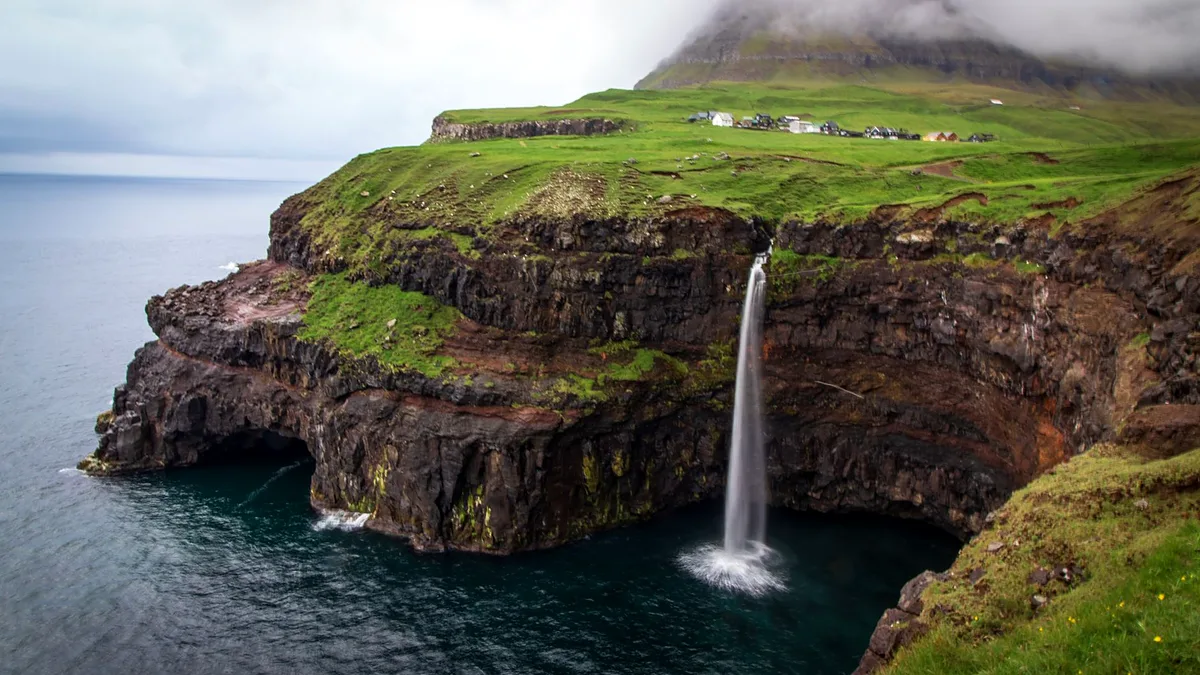

Most visitors spend three days in the Faroe Islands chasing waterfalls, photograph one turf roof, and fly home without setting foot in a gallery. That is a waste of a very good rainy-day plan. The same small population that fishes, knits and farms also runs a national art collection, a working lithography press, and a couple of tiny music rooms where the person beside you is probably related to the band.
This guide covers the indoor half of the Faroes: the turf-roofed museums, the artist workshops you can walk into, and the late-night rooms where locals actually gather. Bring a rain jacket, cash in small notes, and a schedule loose enough to change when the fog rolls in.
- Best time to visit: Mid-May to mid-September for full opening hours. June and early September are quieter than late July, when Ólavsøka fills Tórshavn.
- Typical daily budget: DKK 900–1,600 (~$130–230) per person, mid-range, with a rental car split between two.
- Local transport style: Small car for villages, SSL buses and ferries where routes exist, and your feet in Tórshavn — the centre is barely 1 km across.
- General vibe: Quiet, weather-led, refreshingly uncommercial. Galleries are small, hours are short, and you may be the only visitor.
1. Listasavn Føroya: the national collection in the city park
The national gallery sits in the Viðarlundin park in Tórshavn, in a low building that looks like a modest 1970s library and holds roughly 2,800 works. Inside, the permanent collection walks you from 19th-century landscape painting to contemporary video art: Sámal Joensen-Mikines's heavy, dark coastal scenes, Ruth Smith's portraits, Ingálvur av Reyni's colour. Give it 90 minutes and you will start seeing the same cliffs differently for the rest of the trip.
Unlimited High-Speed International Travel eSIM
Connect in seconds across 180+ destinations. Instant QR code activation with zero roaming surcharges.

The upper floor is where the rotating shows live, plus a small room of older print work that most people walk straight past. It is rarely crowded. On a wet Tuesday in October you might share the whole place with two other people and one very committed guard.
- Neighborhood: Gundadalsvegur 9, Tórshavn, next to the Nordic House and the city park.
- Cost: DKK 100 (~$14) adults; under-18s free; student discount available.
- Best time: Weekday mornings. Roughly Tue–Sun 11:00–17:00 in summer, shorter hours October–April.
- Getting there: A 10-minute uphill walk from Vaglið square in the centre.
Insider tip: Check the shop before you leave. Exhibition posters and small artist prints sell here for far less than the commercial galleries downtown, and they pack flat.
2. Steinprent: a working lithography press you can walk into
Steinprent is a proper print workshop, not a shop with a press in the window for show. Artists from across the Nordic countries come here to draw on limestone slabs and pull editions by hand, and on a weekday you can usually watch the whole slow process. The smell of ink and solvent is intense, the stones are heavy, and nobody minds a quiet visitor standing at the edge of the room.
Prints by established Faroese names hang on the walls, priced from roughly DKK 1,200 (~$175) for small editions. If your budget tops out at a postcard, that is fine too. This is the one place in the islands where you can buy original work and meet the person who made it.
- Neighborhood: Central Tórshavn, a few minutes' walk from the harbour and Tinganes.
- Cost: Free to look; cards from DKK 150 (~$22); prints from DKK 1,200 (~$175).
- Best time: Weekday late morning, when the press is running and the light is good.
- Getting there: On foot from anywhere in the centre.
Insider tip: Hours follow the artists, not a sign on the door. Message ahead a day or two, and if you buy a large print ask them to roll it in a tube rather than fold it.
3. Norðurlandahúsið: the grass-roofed Nordic House
The Nordic House is the best free hour in Tórshavn. Built in 1983 with a turf roof that blends into the hillside and a glass wall facing the harbour, it holds art exhibitions, a concert hall, a library and a café that locals use as an office. Exhibitions change every few weeks and cost nothing to enter.
Evenings are where it gets interesting. The auditorium seats around 400 and hosts everything from Faroese folk quartets to Icelandic jazz, and the audience tends to be half the local cultural scene. If you want a night out that is not a bar, this is it.
- Neighborhood: Above the city park, a 12-minute walk uphill from the Tórshavn harbour.
- Cost: Free entry to exhibitions; concerts typically DKK 150–350 (~$22–50).
- Best time: Weekday afternoons for the café, evenings for gigs.
- Getting there: Walk, or a short taxi ride from the centre.
Insider tip: Look up the Summartónar programme (June–August). It puts dozens of small concerts in village churches and community halls across the islands, many of them free or under DKK 100.
4. Kirkjubøargarður: a 900-year-old house that is still a home
Kirkjubøur, 12 km south of Tórshavn, was the islands' medieval power centre, and the farmhouse there has been continuously inhabited since the 11th century. The Patursson family has lived in it for 17 generations and still farms the land around it. You pay the farmer, walk through the dark wooden Roykstovan, and leave again while he gets back to work.
It is part museum, part family house, and that is exactly why it works. Next door, the roofless Magnus Cathedral ruins and the small St Olav's church are free to wander, and the walk between them along the shore takes 20 minutes.
- Neighborhood: Kirkjubøur, on the coast south of Tórshavn.
- Cost: Around DKK 90 (~$13) per adult; small notes are safest.
- Best time: Late morning, before any coach groups arrive.
- Getting there: Local bus from Tórshavn's Farstøðin terminal (about 25 minutes) or a 15-minute drive on the coastal road.
Insider tip: The upstairs rooms are private and off-limits, so keep the camera pointed at the ground floor. Ask about the whalebone arch outside if the family is around — it has a story.
5. Blásastova: the Eysturoy farmhouse that time forgot
Norðragøta is a village of black-tarred wooden houses, and Blásastova is the best-preserved of them: a 19th-century farmhouse museum with a turf roof, low doorways and an interior left roughly as it was. There is wool stacked in a corner, a kitchen you could still cook in, and the particular smell of old timber and peat smoke that no museum designer can fake.
It takes 30 minutes to see properly, which makes it an easy stop on the way north rather than a destination in itself. Combine it with the village church and the harbour, then drive on.
- Neighborhood: Norðragøta, Eysturoy, close to the Eysturoy tunnel exit.
- Cost: DKK 50 (~$7) per adult.
- Best time: June–August afternoons; hours are usually around 13:00–17:00 and change yearly.
- Getting there: 25–30 minutes by car from Tórshavn through the subsea tunnel, or via the older mountain road.
Insider tip: If you are here in mid-July, the G! Festival in neighbouring Syðrugøta turns these villages into a music camp for three days. Book beds six months out or plan to camp.
6. Dúvugarðar in Saksun: the turf-roof farm at the end of the road
Saksun is the postcard everyone wants: a turf-roofed farmhouse at the head of a tidal lagoon, cliffs on both sides, and a mountain road that dead-ends in the village. The farm, Dúvugarðar, is a museum now, with a small collection of farming tools and a church that looks like it was built for a film set.
The walk down to the lagoon takes about 15 minutes and is the real reason to come. Go at low tide and you get black sand, a still pool and echoes off the cliff. Go at high tide and you get a very short walk and a good view from above.
- Neighborhood: Saksun, on Streymoy's northwest coast.
- Cost: DKK 75 (~$11) for the museum; the lagoon path is free; parking is tiny.
- Best time: Early morning at low tide, before the day-trip cars arrive.
- Getting there: 45–50 minutes by car from Tórshavn. There is no useful public bus service.
Insider tip: Never walk out across the lagoon sand when the tide is coming in — the water fills behind you faster than it looks. Also check the museum is open before driving out in May or September.
7. Sirkus Bar and Reinsaríið: the after-dark rooms
Tórshavn does not do big nightlife. What it has is a handful of small rooms with low ceilings, where the lineup is announced late and the whole crowd seems to know each other. Sirkus Bar on the main street is the reliable starting point: two floors, local beer on tap, and live music on weekends that ranges from singer-songwriters to very loud rock.
Down by the harbour, Reinsaríið — an old rope factory turned venue — hosts the bigger gigs and the occasional festival night. Both are the closest thing the Faroes have to a private club: no velvet rope, no guest list, just a small town where the band drinks with the audience afterwards.
- Neighborhood: Central Tórshavn; the two are about 10 minutes apart on foot.
- Cost: Beer DKK 70–90 (~$10–13); gig tickets DKK 200–350 (~$29–50).
- Best time: Friday and Saturday from 22:00. Weeknights are usually dead.
- Getting there: Walk. Taxis exist but are scarce after midnight.
Insider tip: Alcohol is sold only at the state monopoly, Rúsdrekkasøla Landsins, which closes at 18:00 on weekdays and earlier on Saturdays. Buy your duty-free allowance at the airport on arrival — everyone does.
Where to eat and drink nearby
Kaffihúsið on Vaglið is the dependable lunch stop: open sandwiches, fish soup and good coffee, with plates around DKK 120–190 (~$17–28). It fills up at 12:30 with office workers, so go at 11:30 or after 14:00.
Áarstova, in an old wooden house a street back from the harbour, is where you eat Faroese food properly: lamb, dried fish, rhubarb. Set menus run about DKK 495–650 (~$72–94) before drinks, and the upstairs room is worth requesting.
Ræst is the splurge, built entirely around fermented and air-dried local ingredients. Tasting menus start near DKK 1,100 (~$160) per person before wine. Book weeks ahead, and go in with an open mind rather than a checklist.
Practical logistics and budget tips
- Car hire: DKK 600–900 (~$85–130) per day in summer. Book three months ahead; automatics are limited and fuel runs about DKK 13.50 per litre (~$1.95).
- Tunnels: Subsea crossings bill automatically through your rental company at roughly DKK 100–175 (~$15–25) each way. It adds up fast if you shuttle back and forth.
- Buses: SSL village routes often run only once or twice a day. A multi-day SSL travel card pays off after three or four long hops, and Tórshavn's city buses are free to ride.
- Hiking fees: Popular private-land walks charge at the gate — the Trælanípa cliff path is around DKK 200 (~$29). Bring a card and some coins.
- Food: Bónus and Miklagarður supermarkets make a DKK 60 (~$9) picnic that beats a DKK 180 café lunch. Restaurants are where budgets break.
- What to skip: The coach tours that cram six sights into one day, the 4x4 upgrade you do not need, and souvenir wool on the main shopping street — buy from the gallery shops or directly from the knitters.
- Honest heads-up: Many rural museums shut from October to May, and even in summer some galleries open for a four-hour window. Fog can wipe out an entire day of views, so keep one indoor day in reserve.
Frequently Asked Questions
Are there art galleries in the Faroe Islands?
Yes, though they are small and mostly concentrated in Tórshavn. The National Gallery, the Nordic House and the Steinprent print workshop are the three worth planning around, with farmhouse museums filling out the villages.
How much does the National Gallery of the Faroe Islands cost?
Entry is about DKK 100 (~$14) for adults, with free admission for under-18s and a student rate. It is one of the best-value indoor hours in the country, especially on a wet day.
Do I need a car to visit Faroese galleries and museums?
Not in Tórshavn, where everything is walkable or a short bus ride away. You absolutely do need a car for Saksun, Norðragøta and most village museums, since rural bus routes are infrequent.
When are museums and galleries open in the Faroe Islands?
Summer hours are typically 11:00–17:00, with many smaller sites open only June to August and only for a few afternoon hours. Outside that window, check ahead by phone or message — opening times shift with the season and the weather.