
The Quick Verdict
Sydney is the closest thing the Southern Hemisphere has to London, and in a few specific ways it is genuinely better. You trade Wren churches for convict-built Georgian sandstone, Bloomsbury squares for Victorian terraces with iron lace, and the Thames for a harbour that makes the Thames look like a service corridor. You also get a food scene built on migration waves from Vietnam, Lebanon, Greece and China that is cheaper at the mid-range and more consistent than London's.
What you lose is depth. London has 1,900 years stacked on top of itself; Sydney's surviving colonial core is roughly fifteen blocks around Macquarie Street and The Rocks, and most of the rest is glass from 1975 onward. If you are flying halfway around the world for museums, theatre and a proper dark winter, London wins and it is not close. If you want the architecture-and-food experience for roughly two-thirds of the money, with swimmable beaches folded in, Sydney is a legitimate swap.
Side-by-Side Comparison Scorecard
| Feature | London | Sydney |
|---|---|---|
| Average Daily Cost (Stay + Meals) | £210–£300 / ~$265–$380 USD | A$290–A$420 / ~$190–$275 USD |
| Atmosphere & Aesthetic | Layered medieval-to-modern city; grey, dense, ornate, walkable at every scale | Sun-bleached sandstone, harbour blue, terraces and glass; relaxed but spread out |
| Crowd Density & Seasonality | ~20m overseas visitors a year; crushing June–August, dark by 4pm in December | ~4m overseas visitors; busy December–January, mild and quiet May–September |
| Flight & Transit Accessibility | Short hops from Europe; Tube, Overground, Elizabeth line, contactless everywhere | 14–24 hours from most of the world; Metro, trains, light rail and ferries on one tap card |
| Best For | History, museums, theatre, winter atmosphere, Europe day trips | Outdoor living, coastal walks, cheap eating, harbour scenery, weather |
Scenery & Atmosphere: How Similar Are They Really?
Start on Macquarie Street and walk south. Hyde Park Barracks (1819) was designed by convict-turned-architect Francis Greenway and built by convict labour; it is now a UNESCO site and one of the best small museums in the country at A$15 (~$10 USD). Two blocks on, St James' Church (1824) is the oldest surviving church in the city, and St Mary's Cathedral is a full Gothic Revival statement in honey-coloured sandstone.
Unlimited High-Speed International Travel eSIM
Connect in seconds across 180+ destinations. Instant QR code activation with zero roaming surcharges.

The Rocks is Sydney's answer to Spitalfields: 1820s warehouses, Cadman's Cottage (1816, the oldest building still standing in the CBD), and a pub on nearly every corner. The difference is scale. Spitalfields spills into Whitechapel, Shoreditch and Bethnal Green and keeps going; The Rocks runs out after about four streets and turns into the Harbour Bridge approach.
Paddington does the Victorian terrace better than anywhere in Australia, with two-storey rows, cast-iron balconies, jacarandas and the Five Ways café cluster. It reads like Notting Hill with better weather and worse train upholstery. Newtown, Surry Hills and Potts Point add the gritty-urban texture that London's East End used to supply before the towers landed.
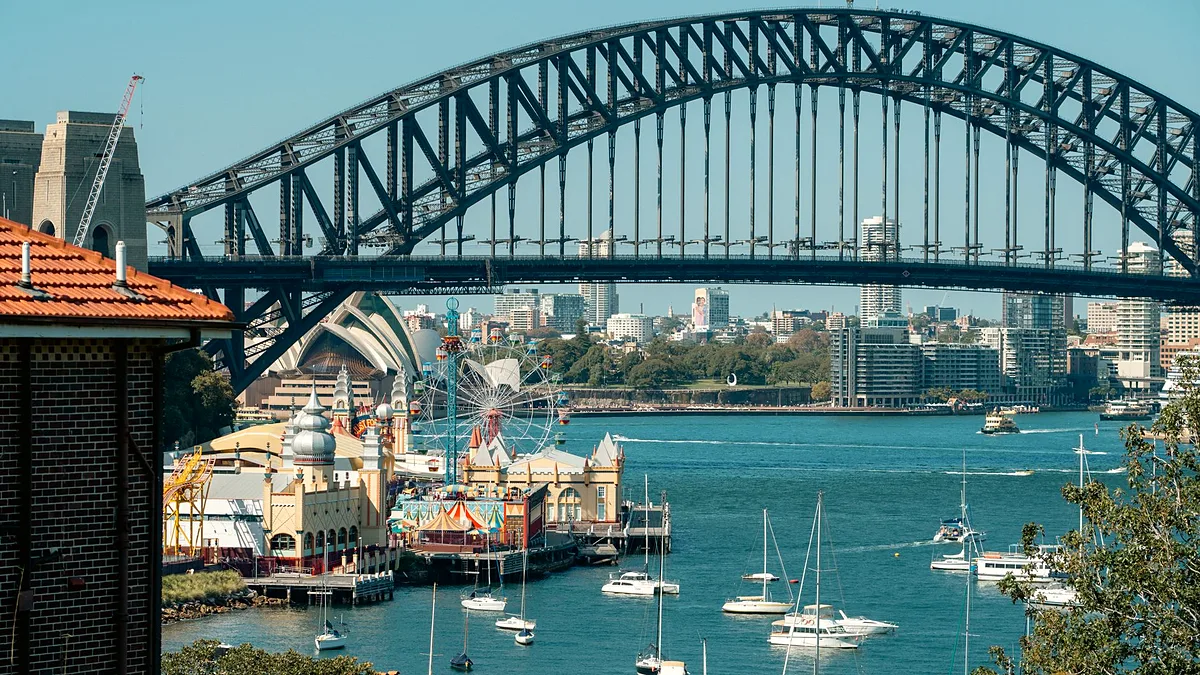
Then there is the water, which is Sydney's unfair advantage. The Manly ferry is a 30-minute commuter run across open swell for about A$8 (~$5 USD) on an Opal card — the best-value boat ride in either city. London's nearest equivalent, the Thames Clipper to Greenwich, costs more and slides under bridges rather than between headlands. Add the Opera House (Utzon, 1973) and the Harbour Bridge (1932) and you get two postcard buildings London genuinely cannot match.
The Wallet Test: Real Cost Breakdown
Sydney is not cheap. Anyone who tells you it is a budget London has not booked a hotel room lately. But the gap is real, and it is widest on accommodation and eating out.
- Mid-range double room, central: London Zone 1–2 £190–£280 (~$245–$360 USD). Sydney CBD, Surry Hills or Potts Point A$240–A$360 (~$155–$235 USD).
- Hostel dorm bed: London £35–£55 (~$45–$70). Sydney A$55–A$85 (~$36–$55).
- Pub lunch or counter meal: London £16–£22 (~$21–$28). Sydney A$26–A$34 (~$17–$22).
- Flat white: London £3.90 (~$5). Sydney A$5 (~$3.30), and better.
- Pint of beer: London £6.80–£7.80 (~$9–$10). Sydney A$10–A$13 (~$6.50–$8.50).
- Mid-range dinner, per person: London £35–£50 (~$45–$65). Sydney A$55–A$80 (~$36–$52).
- Big-ticket sight: Tower of London £34.80 (~$44). Sydney Opera House guided tour A$48 (~$31); BridgeClimb A$198–A$348 (~$130–$225) if you must.
- Public transport daily cap: London £8.90 (~$11). Sydney A$18.65 weekday (~$12), A$9.35 weekend (~$6).
Total it honestly: a mid-range day in London runs £210–£300 (~$265–$380 USD) all in, while the same standard in Sydney sits at A$290–A$420 (~$190–$275 USD). That is a saving of roughly a quarter to a third — meaningful over a week, not transformative.
Two Sydney costs catch people out. The airport train adds a station access fee of about A$17 (~$11) on top of the fare; take the 400 bus to Mascot and tap on there instead. And alcohol in licensed venues is heavily taxed, so a round for four at a CBD pub can clear A$50 (~$33) without trying.
Crowds, Authenticity, and Tourist Footprint
London absorbs around 20 million international visitors a year; Sydney takes about 4 million. On the ground that means Westminster Bridge and Borough Market are a contact sport for most of the year, while Sydney's pinch points — Circular Quay, the Opera House forecourt, Bondi — are busy but rarely suffocating outside December and January.
Bondi is the one place where Sydney's tourist footprint matches London's. It is a beautiful beach that is also a crowded one, and locals walk south to Tamarama and Bronte or drive to the northern beaches instead. If you want the postcard without the crush, arrive before 8am or come in the shoulder months.
For actual local texture, skip The Rocks on a Saturday and head to Marrickville for Vietnamese and Greek, Lakemba for Lebanese on Ramsay Street after sunset, and Cabramatta for the real thing. London's equivalents — Peckham, Walthamstow, Tooting — are just as good but cost you an hour on the Victoria line rather than twenty minutes on the Metro.
The honest downside is nightlife. Sydney's lockout laws gutted the late-night scene in 2014, and the 2020 repeal never fully brought it back. Outside Newtown, Surry Hills and a revived Kings Cross, central Sydney closes around 10pm on a weeknight. London does not.
How to Experience the Best of Sydney
Where to stay
- Surry Hills: the best eating and coffee in the city, a 15-minute walk to Central station and the CBD. Expect A$240–A$320 (~$155–$210 USD) for a good double.
- Potts Point and Kings Cross: Art Deco apartment blocks, excellent bakeries, walkable to the Botanic Garden and the Opera House.
- Newtown: King Street's bookshops, Thai food and live music, 12 minutes by train from Central and noticeably cheaper than the harbour.
- Manly: a beach suburb with a 20-minute fast ferry commute. Hotels cost less than the CBD and you get the harbour crossing twice a day.
- The Rocks: pay for the address and the view; everything is on your doorstep but the food is aimed at tourists.
Swap the London landmarks for these
- British Museum → Art Gallery of NSW and the Australian Museum, both free.
- Tower of London → Hyde Park Barracks, A$15 (~$10 USD), and Cadman's Cottage, free.
- West End → Sydney Theatre Company at The Wharf, Belvoir St Theatre in Surry Hills, or the Hayes Theatre for small-scale musicals.
- Thames sightseeing cruise → the Manly ferry, which is a real commuter service rather than a tour.
- Borough Market → Carriageworks Farmers Market on Saturday mornings in Eveleigh, plus Paddy's Markets in Haymarket for produce.
What to order
- Sydney rock oysters: smaller and creamier than Pacifics, around A$4–A$6 (~$2.70–$4) each at a fish market counter.
- Barramundi: grilled, skin on, in any pub that takes fish seriously.
- A proper meat pie: A$6–A$8 (~$4–$5.50) from a suburban bakery, not a servo.
- Yum cha in Haymarket: weekend lunch on or near Dixon Street, roughly A$35 (~$23) a head.
- Halal snack pack: the late-night benchmark, best in Lakemba or Auburn.
- A flat white: both Sydney and Auckland claim it, but Sydney's café standard is the reason the argument exists.
Who Should Still Choose London
Book London if architecture is the entire point of the trip. Sydney's historic core is a long weekend; London's is a fortnight and you would still miss things. The City churches, the Inigo Jones squares, the Barbican, the postwar estates and the medieval street plan underneath it all simply have no Sydney equivalent.
Choose London if you are travelling November to February. Sydney's winter is mild at 8–17°C and genuinely pleasant, but London's Christmas markets, theatre season and short dark afternoons deliver a specific mood that Sydney cannot fake in 22°C sunshine.
London also wins on free culture, late licences, and geography. Almost every major museum costs nothing, the Tube runs past midnight, and Paris is a two-hour train ride. Sydney gives you none of that.
Sydney wins when the trip is about water, weather, food and space — and when saving 25 to 35% on the daily spend actually changes what you can do.
Frequently Asked Questions
Is Sydney actually cheaper than London?
Yes, but by a quarter to a third rather than half. Hotels and restaurant meals are the biggest savings; beer, coffee and transport are close to parity once you convert currencies.
Can Sydney replace London for history and architecture?
Partly. Sydney has a compact but genuinely good Georgian and Victorian core around Macquarie Street, The Rocks and Paddington. It cannot match London's depth, so treat it as a substitute for a long weekend rather than a fortnight.
Do I need a car to get around Sydney?
No. The Metro, trains, light rail and ferries all run on one tap-on card or contactless card, and the CBD is walkable end to end in about 30 minutes. A car is only useful for the northern beaches and the Blue Mountains.
When should I visit Sydney to avoid crowds and heat?
March to May and September to November. You get 20–25°C days, cheaper rooms and space at Bondi. Avoid the school holidays from mid-December to late January, when prices peak and the beaches fill by 9am.