
The Quick Verdict
If your Iceland dream is standing under a waterfall with sleet hitting your face, Montreal will disappoint you. There are no geysers, no black sand beaches, and no volcano within 3,000 km. Swap the trip only if what you actually want is the mood: grey concrete, hard northern light, wool sweaters, strong coffee, and a city that manages to feel spartan and stylish at once.
Montreal runs that exact aesthetic at roughly a third of the price, and it does it with better food and far more to do after 9 pm. What you sacrifice is scale. Iceland's drama is geological and enormous. Montreal's is architectural and human-sized. What you gain is a working city where locals outnumber tourists on most streets, plus a hotel bill that won't require a second mortgage.
Side-by-Side Comparison Scorecard
| Feature | Iceland | Montreal |
|---|---|---|
| Average Daily Cost (stay + meals) | $260–$380 USD per person | $110–$170 USD per person |
| Atmosphere & Aesthetic | Volcanic, sparse, basalt-and-concrete, near-empty roads outside Reykjavík | European-flavored, dense, brick and brutalist concrete, café culture on every corner |
| Crowd Density & Seasonality | 2.2M visitors a year against 390,000 residents. Brutal June–August crush on the Golden Circle | 11M visitors against 4.3M residents. Festival peaks in summer, genuinely quiet in deep winter |
| Flight & Transit Accessibility | 5–6 hours from the US East Coast. No trains. You need a rental car to see anything | 1h25 from New York, 1h15 from Toronto. Four metro lines, walkable core, $8 airport bus |
| Best For | Landscape hunters, photographers, Ring Road road-trippers, honeymoon splurges | Budget city breaks, food and architecture, festivals, anyone who wants a nightlife |
Scenery & Atmosphere: How Similar Are They Really?
More similar than you would guess. Hallgrímskirkja, the concrete church that dominates Reykjavík's skyline, was designed by Guðjón Samúelsson to mimic Iceland's columnar basalt. Montreal has spent 60 years doing the same thing in a different key. Moshe Safdie's Habitat 67, the stacked concrete modules built for Expo 67, still looks like a rock formation that learned to be an apartment building.

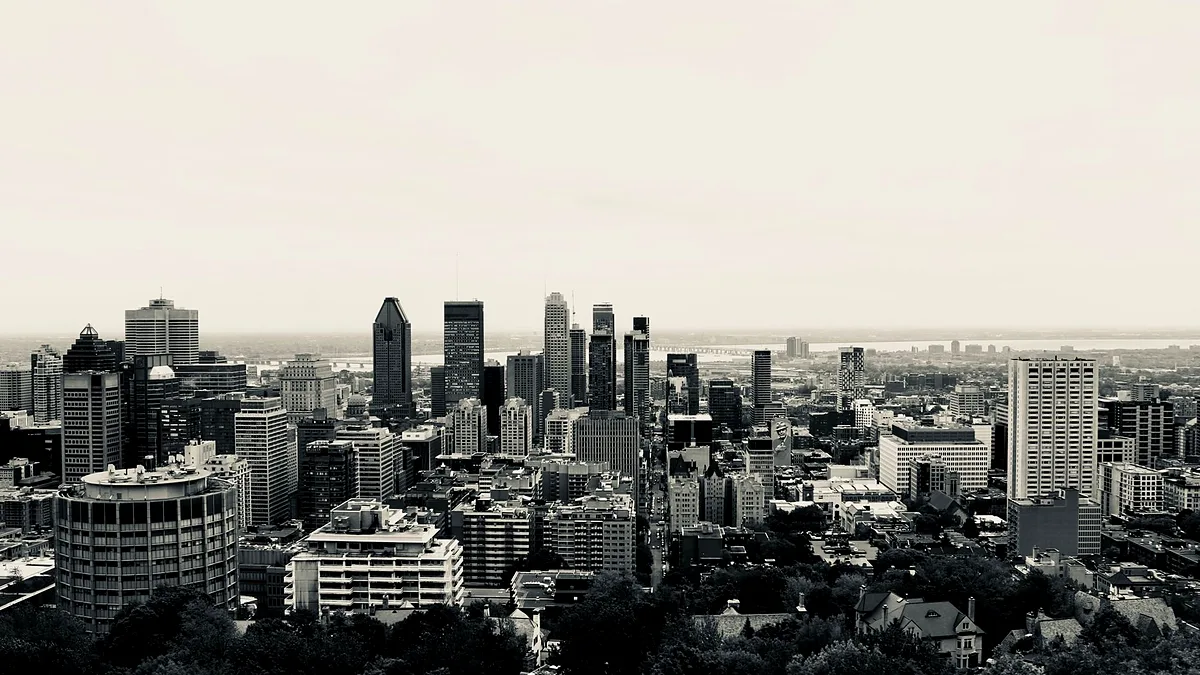
Walk the Old Port and you get the full set: Habitat 67, the Biosphere's geodesic dome on Île Sainte-Hélène, and the leaning Olympic Stadium tower across town. Add Notre-Dame Basilica's Gothic Revival interior and the Palais des congrès' glass shard facade, and you have a city that photographs with the same cold, high-contrast severity as Reykjavík.
Where Iceland wins without argument is landscape. Iceland's drama is a two-hour drive from your hotel and it is 100 meters tall and roaring. Montreal's Mont-Royal is a 233-meter hill with a nice lookout. There is no honest comparison there.
Where Montreal wins is street life. Reykjavík's downtown is walkable in about 20 minutes and empties out on a Tuesday. The Plateau's exterior spiral staircases, the murals along Saint-Laurent, the depanneur culture, the terasses spilling onto Mont-Royal Avenue in July — that is texture Iceland simply does not have at city scale.
Both cities share the light, though. Low winter sun, long shadows, and a blue hour that lasts a full hour in December. If the northern gloom is what you are chasing, Montreal delivers it convincingly.
The Wallet Test: Real Cost Breakdown
Here is what a day actually costs in each place, using mid-range choices rather than hostels or luxury. Iceland's figures are in ISK with USD approximations at roughly 140 ISK to the dollar.
| Item | Iceland (Reykjavík) | Montreal |
|---|---|---|
| Mid-range hotel, double | 28,000–40,000 ISK (~$200–$290) | CAD 190–280 (~$140–$205) |
| Guesthouse / hostel dorm | 15,000 ISK (~$110) | CAD 50–70 (~$37–$51) |
| Casual lunch | 2,500–3,500 ISK (~$18–$26) | CAD 20–28 (~$15–$20) |
| Dinner main course | 4,500–6,500 ISK (~$33–$47) | CAD 26–34 (~$19–$25) |
| Draft beer at a bar | 1,300 ISK (~$9.50) | CAD 8–10 (~$6–$7.50) |
| Coffee | 650 ISK (~$4.70) | CAD 4 (~$3) |
| Car rental per day | 12,000–20,000 ISK (~$87–$145) | Not needed in the city |
Two things quietly wreck Iceland budgets. First, you need a car, and fuel runs about 300 ISK per liter (~$8.20 per gallon). Second, every attraction outside Reykjavík is a day trip, which means 10,000–13,000 ISK (~$75–$95) for a coach tour if you skip the rental.
Montreal's secret weapon is its bring-your-own-wine culture. Bistros like Le Chien Fumant on Avenue du Mont-Royal let you carry in a $15 bottle from the depanneur instead of paying triple at the table. The metro is CAD 3.75 a ride (~$2.80), or CAD 11 (~$8) for a 24-hour pass.
One honest gotcha: Quebec expects a 15–20% tip on the pre-tax total, and it is not optional in practice. Iceland has no tipping culture at all. That difference adds roughly CAD 15–20 (~$11–$15) per person per day in Montreal.
Crowds, Authenticity, and Tourist Footprint
Iceland hosts about 2.2 million visitors a year with a population of 390,000. That ratio is why the Golden Circle in July feels like a queue with scenery attached, and why the south coast's parking lots fill by 10 am. The Westfjords and Eastfjords stay wonderfully empty, but most people never get there.
Reykjavík itself stays pleasant. Laugavegur is touristy but not unpleasant, and the city's geothermal pools — Vesturbæjarlaug especially — are still full of locals doing laps at 7 am. That is where the country still feels real.
Montreal's numbers are healthier: 11 million visitors against 4.3 million residents, and those residents use the same streets. The tourist trap is specific and easy to name — Vieux-Montréal. Restaurants on Place Jacques-Cartier charge CAD 22 (~$16) for a mediocre poutine and CAD 12 (~$9) for a beer you can find for half that two metro stops away.
Locals live in the Plateau, Mile End, Rosemont, Verdun, and Little Italy. Eat there. Also, learn one word of French. Opening with bonjour before switching to English changes the temperature of almost every interaction, and treating Montreal as an English city is the fastest way to have a flat experience.
The honest downsides of Montreal: visible homelessness around Cabot Square and parts of the Village, endless orange construction cones, and sidewalks that turn into ice rinks from January to March.
How to Experience the Best of Montreal
Where to stay
- Plateau Mont-Royal — best for first-timers. Colorful row houses, spiral staircases, easy walk to Mont-Royal lookout. Metro Mont-Royal on the Orange line.
- Mile End — best for food and coffee. Bagels, BYOB bistros, indie shops. Metro Laurier, Orange line.
- Griffintown and Old Montreal — best for architecture and river access, but add 20% to your food budget. Metro Place-d'Armes.
- Verdun — the value pick. Wellington Street's restaurant strip, waterfront walks, lower hotel rates. Metro Verdun, Green line.
Activities that scratch the Iceland itch
- Bota Bota spa on the Old Port waterfront: a floating Nordic bath circuit, CAD 70–95 (~$52–$70) for three hours. This is Montreal's answer to the Blue Lagoon at roughly the same price, minus the lava field.
- Strøm Nordic Spa on Île des Sœurs: hot baths, cold plunges, sauna, around CAD 75 (~$55).
- Sunrise on Mont-Royal: free. The Kondiaronk lookout at 6:30 am in January gives you the cold, tinted city view no tour can sell you.
- Notre-Dame Basilica's Aura light show: CAD 35 (~$26). Gothic Revival interior plus projection, and worth it in winter.
- Montreal Botanical Garden and the Biodôme: CAD 23.75 each (~$17). The greenhouse complex in February is genuinely therapeutic.
- The RÉSO underground city: 33 km of connected tunnels downtown. Free, useful, and strangely photogenic.
- Marché Jean-Talon in Little Italy: free to wander, and the best place to build a picnic.
What to order
- Smoked meat sandwich at Schwartz's (3895 Boulevard Saint-Laurent): CAD 13–16 (~$10–$12). Expect a line, bring cash.
- Wood-fired bagel at St-Viateur (263 Avenue Saint-Viateur O): CAD 1.50 (~$1.10). Get a sesame one and eat it on the sidewalk.
- Poutine at La Banquise (994 Rue Rachel E): CAD 12–16 (~$9–$12), open 24 hours.
- A cabane à sucre in spring if your timing works — the sugar shack meal is Quebec's strangest and best tradition.
Who Should Still Choose Iceland?
Go to Iceland if the landscape is the point. Waterfalls, glaciers, black sand, ice caves, northern lights, and the feeling of driving 40 minutes without seeing another car — Montreal cannot fake any of that, and it shouldn't try.
Choose Iceland if you have seven to ten days and will actually drive the Ring Road. Choose it if you are a photographer chasing light, or if this is a honeymoon where the budget is secondary. The Westfjords in September still offer a kind of solitude that no city on earth can match.
Do not choose Iceland if you want urban energy. Reykjavík is a small town with excellent coffee, not a capital city. Two nights is generous. If your ideal trip involves galleries, late dinners, live music, and a different neighborhood every evening, Montreal is the better destination regardless of price.
Frequently Asked Questions
Is Montreal really a cheaper alternative to Iceland?
Yes, by a wide margin. Expect $110–$170 per person per day in Montreal against $260–$380 in Iceland, once you factor in the rental car and day tours Iceland quietly requires. The gap is roughly 60%.
Which city is colder, Montreal or Reykjavík?
Montreal, comfortably. Reykjavík's January average sits around -0.5°C thanks to the Gulf Stream, while Montreal averages about -10°C with wind chill taking it lower. Pack accordingly — Iceland's cold is windier, Montreal's is sharper.
What is the closest thing to the Blue Lagoon in Montreal?
Bota Bota on the Old Port or Strøm Nordic Spa on Île des Sœurs. Both offer hot-cold-sauna circuits for CAD 70–95 (~$52–$70). Neither has geothermal water or a lava field, but the ritual is the same.
How many days do you need in each place?
Four full days covers Montreal well, including a Plateau wander, the Old Port, Mont-Royal, and one spa afternoon. Iceland needs at least seven to justify the flight and rental car, and ten if you want the full Ring Road.