
If you want Lisbon's stone streets, hilltop views and food-first nights without Lisbon's post-2023 prices, Lyon is the closest honest swap in Western Europe. Both are river cities with medieval cores, both make you walk uphill, and both punish anyone who waits until 9pm to think about dinner. Lyon undercuts Lisbon by roughly 20–30% on lodging, and its restaurant culture is genuinely world-class rather than merely good.
What you give up is the Atlantic. Lyon has two rivers, not an ocean, and its late-autumn weather is colder and greyer — think 5–12°C with morning fog, not 15°C and soft Tejo light. What you gain: shorter queues, cheaper hotel rooms, Roman ruins on a hill above town, and bouchon lunches that cost less than a mediocre seafood dinner in Alfama.
The Scorecard at a Glance
| Feature | Lisbon | Lyon |
|---|---|---|
| Average Daily Cost (stay + meals) | €150–210 (~$165–230) | €120–170 (~$130–185) |
| Atmosphere & Aesthetic | White limestone, azulejo tile facades, seven hills, estuary light, faded grandeur | Ochre and pink Renaissance fronts, two rivers, hidden traboule passages, slate roofs, hilltop basilica |
| Crowd Density & Seasonality | Heavy year-round. Cruise ships at Cais do Sodré, tram 28 queues, peak May–September, still busy in November | Moderate. Business city midweek; spikes for Beaujolais Nouveau (third Thursday of Nov) and Fête des Lumières (5–8 Dec) |
| Flight & Transit Accessibility | LIS has direct long-haul from the US, UK and Brazil; metro Red line to the centre in ~20 min for €1.85 | LYS covers Europe well but most long-haul routes need a Paris connection; Rhônexpress tram to Part-Dieu in 29 min, ~€18. Or a 2-hour TGV from Paris |
| Best For | Mild winter sun, viewpoints, ocean day trips, easy long weekends from North America | Serious eating, Roman and Renaissance history, budget-led city breaks, pairing with Paris or the Alps |
Scenery & Atmosphere: How Similar Are They Really?
Both cities force you upward. Lisbon has its miradouros; Lyon has Fourvière, the basilica-topped hill you reach on the little F2 funicular from Vieux Lyon. Climb it at dusk and you get the same reward Lisbon hands out from Senhora do Monte — rooftops, river, a city laid out below you — except you'll be sharing the terrace with thirty people, not three hundred.
Unlimited High-Speed International Travel eSIM
Connect in seconds across 180+ destinations. Instant QR code activation with zero roaming surcharges.

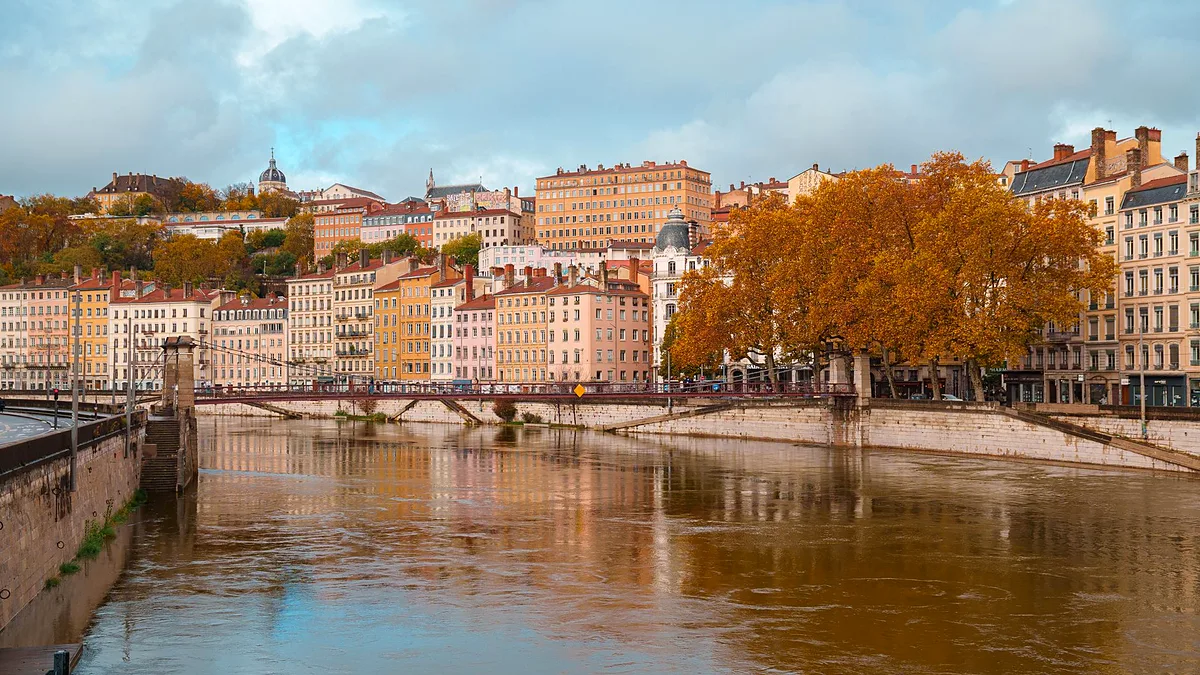
The architecture is where they part ways. Lisbon is bright and tiled, all cream limestone and blue azulejo, with buildings that look beautiful and slightly crumbling at the same time. Lyon is warmer in tone and more solid: ochre, rose and butter-yellow facades along the Presqu'île, slate roofs instead of terracotta, and Renaissance courtyards in Vieux Lyon that you enter through unmarked doors off rue du Bœuf or rue Saint-Jean.
Lyon is also far more compact. You can walk from the cathedral in Vieux Lyon to Place des Terreaux in about 20 minutes across the Presqu'île, and the whole historic centre sits between two rivers you can cross on foot. Lisbon's hills are steeper and its sights spread wider — Belém alone is a 25-minute tram ride from Alfama. If you have knee trouble or a stroller, Lyon's flat central spine is the friendlier of the two.
One honest caveat: late autumn in Lyon means fog. The brouillard lyonnais is real, and on a grey Tuesday in November the Saône quays look more melancholy than photogenic. Lisbon in the same week is usually dry and 16°C. If your trip is about light and photographs, that gap matters.
The Wallet Test: Real Cost Breakdown
Lisbon's accommodation has become its biggest problem. A mid-range double in Alfama or Chiado now runs €140–200 (~$155–220) in shoulder season, and cheaper rooms under €110 often have no window and a shared stairwell. Lyon's three-star hotels on the Presqu'île land at €110–150 (~$120–165), and a well-equipped Croix-Rousse apartment is €90–130 a night. That's the single biggest saving in this comparison.
Food is where the maths flips. Lisbon is still cheap at the bottom: a bifana is €3.50, a tasca lunch with wine is €10–12, a ginjinha at a hole-in-the-wall bar is €1.50. Lyon's bouchon lunch menus start around €22–28 and dinners run €32–45 (~$35–49) before wine. Order quenelle de brochet, salade lyonnaise and a pot of Beaujolais and you'll spend what a decent Lisbon dinner costs — sometimes more.
- Espresso: Lisbon €1–1.50 | Lyon €2.50–3.50
- Beer: Lisbon €1.50–2.50 local bar, €6 on a tourist square | Lyon €5–6.50 for a demi
- Museum entry: Lisbon free Sunday mornings at many state museums | Lyon's Musée des Beaux-Arts permanent collection is free; Musée des Confluences €12
- Transit: Lisbon metro €1.85 single, 24-hour pass €6.80 | Lyon €2 single, 24-hour TCL pass €6.60
- Day trip: Lisbon–Sintra train €2.30 each way | Lyon–Beaujolais villages by train from €8
Run the numbers on four nights and Lyon typically saves €150–250 (~$165–275) once lodging and incidentals are counted. Spend two of those dinners in bouchons and the gap narrows to almost nothing. The dupe wins on where you sleep, not on what you eat.
Crowds, Authenticity, and Tourist Footprint
Lisbon's overtourism is not exaggerated. Alfama has lost a chunk of its resident population to short-term rentals, the 28 tram is a pickpocket's office, and on a Tuesday in October you'll still queue for pastéis de nata in Belém. Local life has shifted outward to Graça, Campo de Ourique, Alvalade and Marvila — go there and the city still works, but you're commuting to the postcard.
Lyon carries a fraction of that weight. Tourism concentrates in Vieux Lyon and on Fourvière, and the rest of the city is a working place of 520,000 people with universities, hospitals and a biotech sector. The Saturday market on Boulevard de la Croix-Rousse is genuinely local; you'll hear more Lyonnais accents than English.
The downside is that Lyon has its own tourist traps, mostly in Vieux Lyon. Rue Saint-Jean is lined with laminated photo menus and staff waving you in — the food is fine and forgettable. Skip those, and skip the chain restaurants on rue Mercière. Book a proper bouchon instead, or eat lunch at Les Halles Paul Bocuse, which is expensive but honest.
One more warning: Lyon's calm has two loud exceptions. Beaujolais Nouveau lands on the third Thursday of November, and the Fête des Lumières takes over the city around 5–8 December with millions of visitors. Book those weeks months ahead or avoid them entirely.
How to Experience the Best of Lyon
Where to Stay
For a first visit, base yourself on the Presqu'île around Cordeliers or Ampère — flat, central, walkable to both rivers and every metro line. Vieux Lyon (Saint-Jean) is prettier but noisier and pricier. Croix-Rousse gives the best value and a village feel, though you'll walk up a hill every evening. Only pick Part-Dieu if you're chasing the cheapest chain hotel; it's concrete and lifeless after dark.
What to Do Instead of Miradouros
Ride the F2 funicular to Fourvière for the view, then walk down past the Roman theatres of Lugdunum, which are free and often empty. Do a self-guided traboule walk through Vieux Lyon's hidden corridors, find the Mur des Canuts fresco in Croix-Rousse, and spend a slow afternoon in Parc de la Tête d'Or. Evenings belong to the Saône quays, where locals sit on the stone steps with a bottle of wine.
What to Order
Start with salade lyonnaise — frisée, lardons, a poached egg and mustard dressing. Then quenelle de brochet in a crawfish sauce, or tablier de sapeur if you want the deep end. Finish with tarte aux pralines, the bright pink tart that tastes like almonds and burnt sugar. Drink Beaujolais by the pot, not the bottle, and ask what's on the ardoise rather than the printed menu.
Who Should Still Choose Lisbon?
Choose Lisbon if weather is the priority. Between November and February, Lisbon gives you 15–18°C and dry afternoons while Lyon gives you fog and 6°C. Choose it too if you're flying long-haul: direct flights from New York, Boston, Toronto and São Paulo beat a Paris connection with a suitcase.
Lisbon also wins if you want the ocean in your trip — Cascais, the Sintra coast, a ferry to Cacilhas for grilled fish. Lyon can't offer a sea, only rivers. And if you want fado, Portuguese wine lists and a language you can half-guess at, the original still beats the substitute.
Finally, choose Lisbon if you want a shorter, softer trip. Three nights in Baixa and Chiado with one day in Belém is a complete city break. Lyon rewards a fourth day, because its best experiences — the markets, the bouchons, the traboules — are slow ones.
Frequently Asked Questions
Is Lyon actually cheaper than Lisbon?
Yes on lodging, transit and coffee — roughly 20–30% less on hotel rooms. But Lyon's sit-down restaurants cost more than Lisbon's tascas, so a food-heavy trip can close the gap fast. Budget travellers save in Lyon; restaurant obsessives break even.
Does Lyon feel as historic as Lisbon?
It feels older, in a different way. Lyon has Roman ruins on Fourvière and a Renaissance quarter that predates most of Lisbon's post-1755 rebuild. Lisbon's charm is tiled facades and layered decay; Lyon's is hidden courtyards and two-thousand-year-old stone.
Do I need to speak French in Lyon?
No, but it helps. Most younger staff in hotels, bars and bouchons speak English. Opening with "bonjour" before any question goes a long way, and smaller neighbourhood spots in Croix-Rousse may have no English menu at all.
When is the best time to visit Lyon instead of Lisbon?
Late September to early November and mid-January to March. You get lower prices, short queues and real local life. Avoid the Beaujolais Nouveau weekend in late November and the Fête des Lumières in early December unless you've booked well in advance.