
The Quick Verdict
Lofoten hands you Iceland's core drama — black water, knife-edge peaks, wind that rearranges your hair — for roughly 20–30% less per day once you're on the ground. What you pay instead is time: from North America it's an extra hop through Oslo, adding five or six hours each way.
The honest call: with ten days and a tolerance for a longer haul, Lofoten is the better buy and the quieter experience. With a week, kids in tow, or a wishlist that includes geysers and glaciers, Iceland earns its price.
Side-by-Side Comparison Scorecard
Figures below assume two people sharing a mid-range room and a rental car, with one restaurant meal and two self-catered meals a day.
Unlimited High-Speed International Travel eSIM
Connect in seconds across 180+ destinations. Instant QR code activation with zero roaming surcharges.

| Feature | Iceland | Lofoten Islands |
|---|---|---|
| Average Daily Cost (Stay + Meals) | $230–320 per person | $170–240 per person |
| Atmosphere & Aesthetic | Horizontal and volcanic: ice caps, geysers, waterfalls dropping off a flat edge | Vertical and granite: 1,000 m peaks rising straight from the sea, red rorbuer on stilts |
| Crowd Density & Seasonality | ~2.3 million visitors a year; July Golden Circle is a convoy | ~1 million overnight stays; July busy at Reinebringen, near-empty in September |
| Flight & Transit Accessibility | 5.5 h nonstop from the US East Coast; Ring Road self-drive, no trains | 12–16 h via Oslo to Leknes or Evenes; car essential, buses thin |
| Best For | Geothermal pools, glaciers, ice caves, first-timers, short trips | Hiking, photography, midnight sun, slower pace, tighter budget |
Scenery & Atmosphere: How Similar Are They Really?
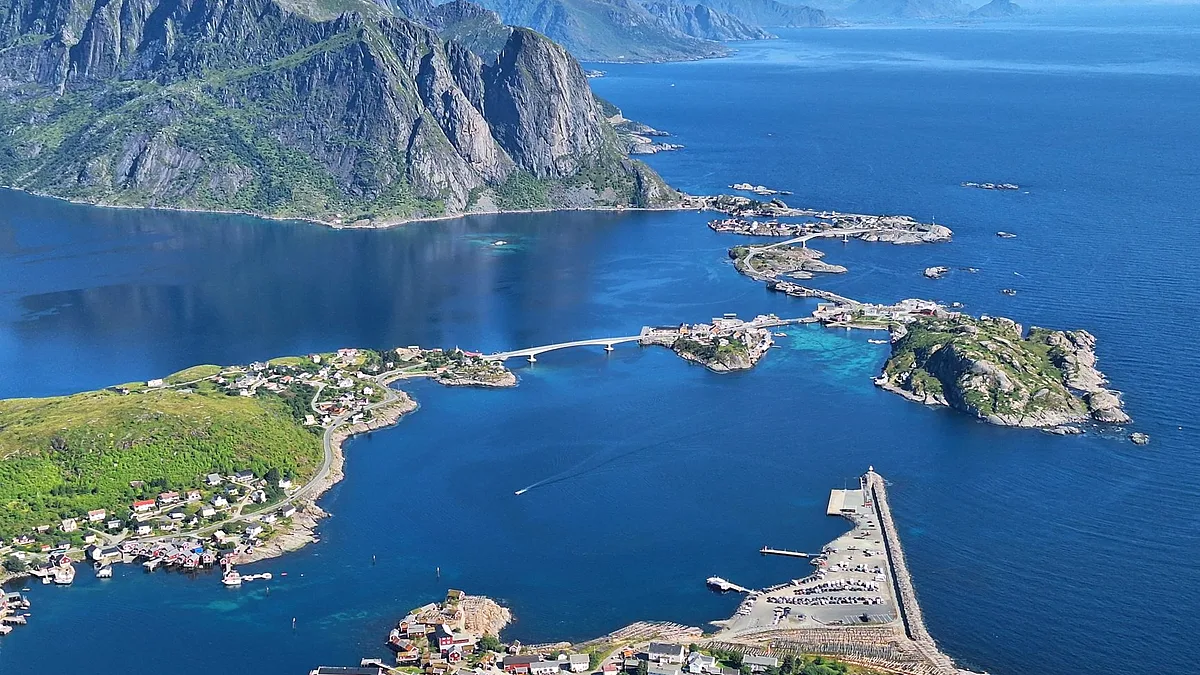
Strip the marketing and the two places share a lot: treeless coastlines, black sand, sheep, turf roofs, weather that changes its mind every 40 minutes. The difference is geometry. Iceland is horizontal — plateaus, ice caps, waterfalls falling off a flat edge. Lofoten is vertical — granite going from sea level to 1,000 metres with almost no foothills.
In practice, Iceland's south coast gives you Skógafoss, Seljalandsfoss and Reynisfjara's black sand in one day's drive. Lofoten gives you Reine, Hamnøy and the hamlet of Å in one afternoon, each viewpoint wearing that same drowned-mountain look. Keep well back from Reynisfjara's water — the sneaker waves there have killed people.
Architecture splits them further. Iceland's built landscape is corrugated iron in Reykjavík and turf churches like Víðimýrarkirkja in the north. Lofoten's is the rorbu, a red or ochre fisherman's cabin on stilts over the water, plus wooden hjell racks hung with drying cod from February to May. They smell exactly as you'd expect and are worth seeing anyway.
Street life is where Iceland runs away with it. Reykjavík is a real capital of 140,000 people, with bars on Laugavegur and live music on a Tuesday. Svolvær, Lofoten's biggest town, has about 4,700 residents and closes its restaurant kitchens at 21:00.
The Wallet Test: Real Cost Breakdown
Both destinations are expensive. The gap is real but narrower than the headlines suggest — and airfare can erase it entirely.
Flights first, because this is the honest catch. Nonstop New York to Keflavík is 5.5 hours and $450–700 return in shoulder season. Reaching Lofoten means Oslo, then Widerøe to Leknes (LKN), or SAS or Norwegian to Evenes (EVE) plus a 2 h 45 m drive; budget $900–1,300 return from the US.
| Cost Item | Iceland | Lofoten Islands |
|---|---|---|
| Mid-range double room, summer | ISK 35,000–45,000 / ~$255–330 | NOK 1,700–2,600 / ~$160–245 |
| Hostel dorm bed | ISK 8,000–11,000 / ~$58–80 | NOK 450–650 / ~$42–61 |
| Rorbu cabin sleeping four | — | NOK 2,200–3,500 / ~$205–330 |
| Casual lunch (soup and bread) | ISK 2,200–2,800 / ~$16–20 | NOK 150–220 / ~$14–21 |
| Restaurant main course | ISK 3,500–4,800 / ~$25–35 | NOK 260–380 / ~$24–36 |
| Bar beer, 0.4–0.5 L | ISK 1,400–1,800 / ~$10–13 | NOK 95–120 / ~$9–11 |
| Coffee | ISK 600–750 / ~$4.50–5.50 | NOK 45–60 / ~$4–5.60 |
| Rental car, per day | ISK 12,000–18,000 / ~$88–130 | NOK 650–1,000 / ~$61–94 |
| Petrol, per litre | ~ISK 300 / ~$2.15 | ~NOK 22 / ~$2.05 |
| Guided glacier walk / fjord RIB tour | ISK 17,000–20,000 / ~$125–145 | NOK 1,100–1,400 / ~$103–132 |
The pattern holds: Lofoten is cheaper on beds, tours and fuel, roughly level on restaurant food, and slightly pricier on alcohol. Book a rorbu with a kitchen and cook two meals a day, and a couple saves $70–110 daily against an equivalent Icelandic guesthouse.
Two more numbers matter. Lofoten rental cars run NOK 650–1,000 (~$61–94) a day in July and need booking by March. Iceland's are ISK 12,000–18,000 (~$88–130), plus roughly ISK 1,800 (~$13) for the Hvalfjörður tunnel if you take the shortcut north.
Crowds, Authenticity, and Tourist Footprint
Iceland welcomed about 2.3 million international visitors in 2024 against a population of 390,000. The Golden Circle in July is nose-to-tail traffic, the Blue Lagoon needs booking weeks ahead, and Laugavegur is souvenir shops end to end. Drive 40 minutes off the main road, though, and the country empties out fast.
Lofoten takes roughly a million overnight stays a year with about 24,000 residents. That sounds gentler, and mostly is — but July at the Reinebringen trailhead is a line of tripods, and Trollfjord often has three tour boats in it at once. Nusfjord now charges admission to walk through its preserved village, which tells you plenty.
Go in the first half of June or in September and the gap widens dramatically. September brings aurora, half the traffic and prices 25–35% below peak. What you give up is the midnight sun, which runs roughly 25 May to 20 July in Lofoten.
Authenticity still leans Lofoten's way. Cod fishing is a working industry there, not a museum exhibit — the stockfish on those racks is bound for Italy and Nigeria, and the boats in Ballstad go out in February regardless of the forecast.
How to Experience the Best of Lofoten Islands
Give it five to seven days and split your stay between two bases. The archipelago is only about 160 km end to end along the E10, so nothing is far, but backtracking wastes the good light.
Where to Stay
- Svolvær: the largest town, with the Hurtigruten pier, the widest restaurant choice and a 2-hour drive from Evenes. Good for the first and last night.
- Henningsvær: art galleries and that football pitch, 25 minutes from Svolvær. Parking is tight and dinner needs booking.
- Reine, Hamnøy or Å: the postcard shots and the Reinebringen trailhead. Book a rorbu six months ahead for July.
- Ballstad or Leknes: cheaper, central and practical. Skip Leknes as a base if scenery is the whole point — it's a service town.
Signature Activities That Rival Iceland
- Reinebringen: 1,978 Sherpa-built steps, 1–1.5 hours up, free. No guardrails — don't attempt it wet.
- Kvalvika Beach and Ryten: a 4–5 hour round trip from the Fredvang parking area, with the best beach-and-peak photo in Norway.
- Trollfjord by RIB or silent electric boat from Svolvær, NOK 1,100–1,400 (~$103–132).
- Sea eagle safari out of Svolvær, NOK 950–1,150 (~$89–108), best in the afternoon light.
- Sea fishing from a rented boat in Reine or Ballstad — no licence needed, but the export limit is 20 kg of fillets per person.
What to Order
Eat skrei, Arctic cod, if you're there February to April, with butter and boiled potatoes. Bacalao shows up on every menu — the Norwegian take on the Portuguese classic, with tomato and olives — and it's the best value main in town.
Look for fiskekaker fish cakes at a harbour kiosk, Lofoten lamb fattened on seaweed, and brunost melted over a waffle with cloudberry cream. Eating out is the budget killer, though: one Coop Extra or Rema 1000 run in Svolvær covers breakfast and lunch for a family at about NOK 400 (~$38).
Who Should Still Choose Iceland?
Be honest with yourself about what you actually want to see. Iceland does things Lofoten simply cannot match, and the extra spend buys real experiences.
- You want variety in one trip. Geysers, ice caves, hot springs, glaciers, lava fields and whale watching — Lofoten has none of that at scale.
- You have five or six days. Connection time and jet lag eat the cost savings before you've seen a single fjord.
- You fly from the US East Coast. A 5.5-hour nonstop versus 13-plus hours each way is worth a lot on a short holiday.
- You want geothermal pools. Lofoten has saunas and cold plunges, not the Blue Lagoon.
- You want a city night. Reykjavík delivers; Svolvær is a small town with an early bedtime.
- You need easy, low-mobility sightseeing. Iceland's accessible viewpoints and coach tours are far more developed.
Frequently Asked Questions
Is Lofoten cheaper than Iceland?
On the ground, yes — roughly 20–30% less per day on accommodation, tours and fuel. Your flights will cost around $400–600 more from North America, so the savings only hold on trips of eight days or longer.
Can you see the northern lights in Lofoten?
Yes, from September to late March. Both sit north of 63°, so the two compare well. Lofoten's coastal cloud cover is the trade-off; Iceland's highlands are clearer but colder and harder to reach in winter.
Do you need a car in Lofoten?
Yes. Boreal route 300 links Svolvær, Leknes and Å, but service is sparse and Sundays are close to useless. Rental is NOK 650–1,000 (~$61–94) per day and July stock sells out months in advance.
How many days do you need in Lofoten versus Iceland?
Five to seven days covers Lofoten comfortably, travel days included, because the islands are compact. Iceland's Ring Road wants eight to ten days minimum, or five if you stay on the south coast and skip the north entirely.