
The Quick Verdict
If you want to watch a lioness walk past your jeep, Kanazawa cannot help you. Nobody should book a flight to Ishikawa expecting wildebeest, and anyone claiming a Japanese castle town is a direct swap for a Tanzanian safari is selling something. But if what you actually want from Serengeti is the feeling of standing somewhere old, crafted, and far from your ordinary life, Kanazawa delivers a version of that for roughly a quarter of the money.
That is the honest trade. Serengeti is a once-a-decade spend; Kanazawa is a long-weekend spend you could repeat every year. You give up wildlife, horizon-scale drama, and the particular silence of the plains. You gain 400-year-old teahouses, samurai lanes, one of Japan's three great gardens, and seafood that hits your plate hours after it leaves the Sea of Japan — plus no malaria tablets, no yellow fever certificate, and a train you can board without a tour operator.
Side-by-Side Comparison Scorecard
| Feature | Serengeti | Kanazawa |
|---|---|---|
| Average Daily Cost (Stay + Meals) | $450–$1,200+ per person, mid-range lodge on full board, before park fees | $110–$220 per person, business hotel or simple ryokan, three real meals |
| Atmosphere & Aesthetic | Open grassland, granite kopjes, dust, enormous skies, wildlife-driven days | Edo-era wooden facades, stone lanes, moss gardens, gold-leaf workshops |
| Crowd Density & Seasonality | Peak July–October; Seronera can stack 20–30 vehicles at one leopard | Peak late March–April and mid-November; Kenrokuen is busy but never gridlocked |
| Flight & Transit Accessibility | Fly to Kilimanjaro (JRO), then a 1–2 hour bush flight ($350–$500 return) or a 7-hour drive | Hokuriku Shinkansen from Tokyo in 2.5 hours (around ¥14,000 / ~$93); Komatsu Airport is 40 minutes by bus |
| Best For | Wildlife photographers, bucket-list safaris, big-anniversary spending | Food travellers, craft lovers, garden people, repeat Japan visitors |
Scenery & Atmosphere: How Similar Are They Really?
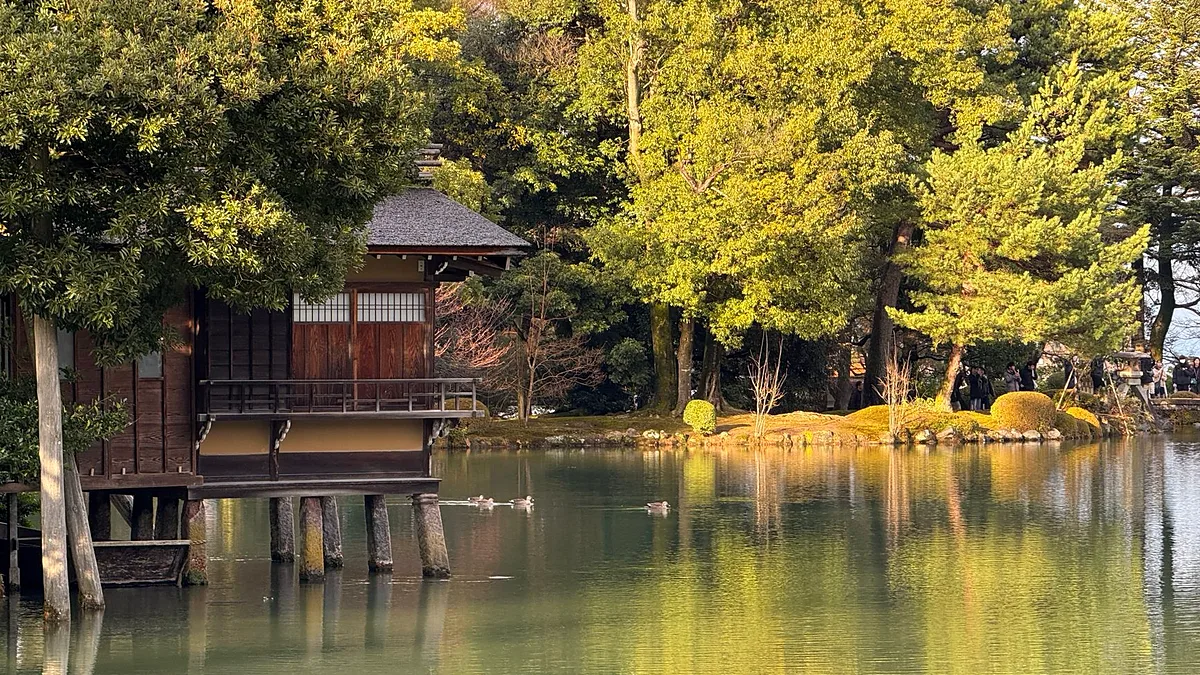
Not similar visually, and it is worth saying that plainly. Serengeti is 14,750 square kilometres of short-grass plains, granite kopjes and acacia, and the sky fills most of your photographs. Kanazawa is a compact city of about 460,000 people where the drama is close and vertical: moss, dark timber, wet stone, and the sound of water moving through a garden channel.
Unlimited High-Speed International Travel eSIM
Connect in seconds across 180+ destinations. Instant QR code activation with zero roaming surcharges.

Where they genuinely overlap is age and craft. Serengeti's ecosystem is measured in millions of years. Kanazawa's identity was built on purpose — the Maeda clan poured money into art and tea culture from the 1580s onward, and that wealth still shows in the joinery of a teahouse or the way a stone lantern sits above a pond.
What Kanazawa looks like on the ground
Kenrokuen covers 11.7 hectares and opened to the public in 1871, and it is the reason many people come. Go at the 7:00am opening (8:00am from mid-October to February) and you get mist, empty gravel, and the Kotoji-toro lantern balanced on its two stone legs by the pond. Entry is ¥320 (~$2), which is the best two dollars in Japan.
Ten minutes east, Higashi Chaya was laid out in 1820 and still has its wooden lattice fronts and second-floor teahouse rooms. Kazuemachi, along the Asano River, is quieter and arguably prettier; Nishi Chaya is smaller again and mostly locals. Nagamachi, the old samurai district, keeps its earthen walls and water channels running with carp.
Serengeti's equivalent of a walking tour is a 6:00am game drive through the Seronera valley, where the river draws everything in the dry season. The northern Serengeti near Kogatende is a different landscape entirely — hills, riverine forest, and the Mara crossings from roughly July to October.
The honest comparison: Serengeti gives you scale and wildness. Kanazawa gives you detail and human history. They are both excellent, and they are not the same product.
The Wallet Test: Real Cost Breakdown
Serengeti pricing is unforgiving because the fees come first. Non-resident travellers should budget roughly $170–$220 per person per day just in conservation, park entry, vehicle and camping fees, before a bed or a meal. On top of that, mid-range lodges run $400–$700 per person per night on full board, and luxury camps run $900–$1,800.
Kanazawa is a different universe. A clean business hotel double costs ¥9,000–14,000 (~$60–$93), a hostel dorm bed ¥3,500–5,000 (~$23–$33), and a ryokan with dinner and breakfast ¥22,000–50,000 per person (~$145–$330) if you want the full experience.
| Line Item | Serengeti (per person) | Kanazawa (per person) |
|---|---|---|
| Bed for one night | $400–$700 (lodge, full board) | $60–$95 (business hotel) |
| Sit-down dinner | Included, or $40–$80 at camp | $25–$40 (izakaya with a drink) |
| Beer or glass of wine | $6–$10 | $5–$7 |
| Signature paid activity | $550–$650 hot-air balloon | ¥1,500–3,000 (~$10–$20) gold-leaf workshop |
| Realistic daily all-in | $600–$1,000 | $120–$200 |
Run the numbers on a week and the gap is stark. Seven days in the Serengeti, including the bush flight and tip kitty, lands somewhere between $5,000 and $9,000 per person. Seven days in Kanazawa, shinkansen included, lands between $1,000 and $1,600.
Two Kanazawa costs worth flagging: the 21st Century Museum general admission is ¥450 (~$3) but special exhibitions add ¥1,200+, and the Kanazawa Loop Bus day pass is ¥600 (~$4) rather than paying ¥200 per ride. Skip the ¥900 gold-leaf soft-serve if you are watching pennies — it photographs better than it tastes.
Crowds, Authenticity, and Tourist Footprint
Serengeti receives a few hundred thousand visitors a year across a park larger than Connecticut, so solitude is easy to find away from Seronera. The exception is July and August, when a leopard sighting can attract 25 vehicles and the Mara River crossings turn into a car park. Pick a conservancy bordering the park, or travel in the green season, and the crowding problem mostly disappears.
Kanazawa is not Kyoto. It gets a fraction of the visitors, largely because it took a 2.5-hour shinkansen ride to reach before 2015 and still sits off most first-timer itineraries. The pinch points are narrow and predictable: Kenrokuen between 10:00am and 3:00pm in cherry season, and the main Higashi Chaya street from mid-morning.
The craft economy is real rather than staged. Kanazawa produces around 99% of Japan's gold leaf, and you can watch it being beaten at workshops in the backstreets rather than on the main drag. Omicho Market is still where locals buy fish at 8am. The downside is that a handful of teahouses have become ice-cream counters, so walk two blocks off the main lane and the tourist veneer drops away.
How to Experience the Best of Kanazawa
Where to stay
Korinbo and Katamachi put you within a 15-minute walk of Kenrokuen, Omicho and the samurai district, with the best restaurant density in the city. The station area is cheaper and unbeatable for transit but feels like a shopping mall at night. A night or two in a Higashi Chaya machiya conversion is worth the splurge, though options are few.
What to do that rivals a game drive
- Kenrokuen at opening time — 7:00am most of the year, ¥320 (~$2). Then walk straight into Kanazawa Castle Park, which is free, and climb the restored Gojikken Nagaya storehouse.
- Gold-leaf workshop at Sakuda or Hakuza, ¥1,500–3,000 (~$10–$20). You leave with a small box you decorated yourself.
- 21st Century Museum of Contemporary Art — Leandro Erlich's Swimming Pool alone justifies the trip. Closed Mondays.
- D.T. Suzuki Museum, ¥310 (~$2), a small concrete meditation pavilion that is the calmest room in the city.
- Omicho Market breakfast from 9:00am, closed most Wednesdays.
- Day trip to Shirakawa-go, a 75-minute bus from Kanazawa Station, if you want mountain scenery to balance the urban days.
What to order
Jibuni — duck simmered in a thick wheat-flour sauce — is the dish that defines the city, and kaburazushi (turnip pressed with yellowtail) is the local winter sushi. Nodoguro, the blackthroat seaperch, is expensive and worth it once at ¥3,000–5,000. A kaisendon at Omicho runs ¥2,200–3,800 (~$15–$26), and Kanazawa curry is the cheap, thick, satisfying fallback at ¥1,000.
Drink local sake: Tedorigawa, Kikuhime and Kagatobi are all Ishikawa labels and cost ¥700–1,200 a glass.
Who Should Still Choose Serengeti?
Choose Serengeti if animals are the point. Kanazawa has gardens and old streets; it does not have predators, migration, or the sound of a herd moving in the dark. If your trip is a honeymoon, a milestone birthday, or a photography expedition, spending the money on the real thing beats saving it on a substitute you did not want.
Serengeti also wins if you want a trip with no decisions. A good safari operator handles vehicles, permits, meals and routing. Kanazawa rewards planning — you will walk more, navigate buses, and choose restaurants. Some people find that relaxing; others find it work.
One practical note: the southern Serengeti calving season from January to March is meaningfully cheaper than the July–October peak, and the predator viewing around Ndutu is excellent. If cost is the blocker, that is your lever rather than a swap.
Frequently Asked Questions
Is Kanazawa really cheaper than a Serengeti safari?
Substantially. A realistic Kanazawa day costs $120–$200 per person including a hotel and three meals. A Serengeti day starts around $600 and climbs quickly. A week in Kanazawa typically costs a fifth of a week in the Serengeti.
Can Kanazawa replace Serengeti for a cultural trip?
Yes, if your priority is history, food and craft. No, if you want wildlife. Kanazawa covers 400 years of samurai and merchant culture with a genuine working craft scene, which is a fair substitute for the cultural weight of a safari — but not for the animals.
When is the best time to visit each?
Serengeti peaks from July to October for the northern migration, with a strong January–March window for calving. Kanazawa is best in late March to April for cherry blossom and mid-November for autumn colour, with early morning visits in peak season to dodge the day-trippers.
Could I do both in one trip?
Not sensibly. Tokyo to Kilimanjaro is 20+ hours of flying, and the ideal seasons barely overlap. If you have the budget, do them as separate trips and give each one proper time.