
The Quick Verdict
Hwange is not Maui with elephants. It's closer to the version of Maui you'd get if someone quietly removed the resorts, the traffic, and 95 percent of the visitors, then filled the gap with 40,000 elephants and a pumped waterhole you can watch from a folding chair with a cold drink in your hand. If the thing you actually want is space and silence rather than beach clubs, Hwange wins on both price and atmosphere.
Here's the honest trade-off. Getting to Zimbabwe from the US costs more than flying to Kahului, so your savings show up on the ground, not at the departure gate. You also give up swimmable ocean, painless self-driving, and same-day hospital access. The rest of this guide is the math behind that claim.
Side-by-Side Comparison Scorecard
| Feature | Maui | Hwange |
|---|---|---|
| Average Daily Cost (Stay + Meals) | About $520–$900 for two, mid-range in Kihei; $1,000+ in Wailea | About $150–$260 for two self-catering; $900–$1,400 for two at an all-inclusive tented camp |
| Atmosphere & Aesthetic | Open-air lanais, koa wood, infinity pools, Pacific sunsets, resort uniforms | Thatch and canvas, paraffin lamps, teak woodland, red dust, no TV, no lobby |
| Crowd Density & Seasonality | ~3 million visitors a year on 1,884 km²; peak Dec–Mar and Jun–Aug | Under 50,000 visitors a year across 14,651 km²; peak Jul–Oct, quiet and green Nov–Mar |
| Flight & Transit Accessibility | Nonstop from most US West Coast hubs to OGG; rental car essential | Fly to Victoria Falls (VFA), then two hours by road; high-clearance 4x4 essential for self-drive |
| Best For | Beach days, honeymoons, easy family trips, snorkelling | Dry-season wildlife, photographers, walkers, people who hate queues |
Scenery & Atmosphere: How Similar Are They Really?
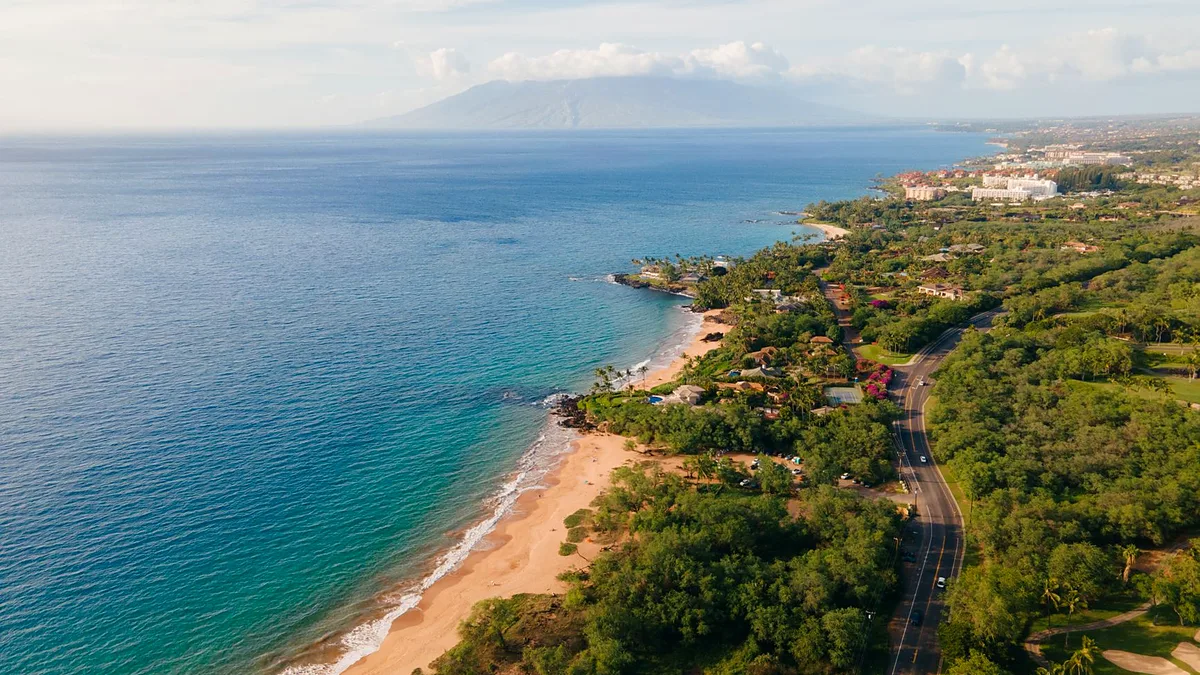
Maui's beauty is vertical and wet. You drive 38 miles of switchbacks on the Road to Hana past black lava cliffs and waterfalls, or stand above Haleakalā's crater at 3,000 metres in a down jacket while the sun comes up. It's genuinely dramatic, but it's drama you share with a few thousand other rental cars.
Unlimited High-Speed International Travel eSIM
Connect in seconds across 180+ destinations. Instant QR code activation with zero roaming surcharges.

Hwange's beauty is horizontal and dry. The park sits on deep Kalahari sand covered in mopane scrub and Zimbabwe teak, with fossil pans and palm islands that flood into shallow lakes in the wet season. At dawn you hear Cape turtle doves, francolin, and, if you're lucky, the low rumble of elephants negotiating who drinks first.
Both places do quiet luxury, but the materials are different. Maui builds with koa wood, travertine, and infinity edges pointing at the Pacific. Hwange builds with thatch, canvas, and hardwood decks looking at a waterhole. Neither has a lobby television. Only one has a leopard walking past the pool at midnight.
One thing worth knowing: Hwange's wildlife concentrations exist because the park pumps groundwater into waterholes, a system started in the 1930s by its first warden, Ted Davison. In the dry months those pumps are the whole show. It's managed, not accidental, and it works.
The Wallet Test: Real Cost Breakdown
Numbers below reflect the 2024–2025 season. Maui adds roughly 14.75 percent in state and county taxes plus resort fees that can hit $45 a night, so always ask for the all-in rate before you compare.
| What You'll Pay | Maui | Hwange |
|---|---|---|
| Nightly room, mid-range | $280–$420 + tax + resort fee (Kihei/Wailuku) | $50–$80 rondavel at Main Camp; $130–$190 B&B at Hwange Safari Lodge |
| Nightly room, luxury | $700–$1,100 + fees (Wailea) | $1,000–$1,500 per person, all-inclusive (Somalisa, Linkwasha) |
| Breakfast | $12–$18 | Included at camps; $4–$6 at a Hwange town cafe |
| Lunch | $16–$19 plate lunch | $5–$8 for sadza and chicken |
| Dinner for two | $90–$140 with tax and tip | $25–$40 self-catered; included at camps |
| Beer | $8–$11, up to $16–$20 at a resort bar | $1.50–$2.50 Zambezi Lager |
| Signature excursion | Molokini snorkel $140–$190 per person | Guided game drive $15–$30 per person; walking safari $40–$60 |
| Park fees | Haleakalā $30 per vehicle | About $20 per person per day + a small vehicle fee |
| Vehicle | $55–$85 per day + fuel | 4x4 hire $60–$110 per day + fuel |
On the ground, Hwange is genuinely cheaper, sometimes by 60 to 70 percent. A two-bed rondavel at Main Camp with a kitchen runs about $50–$80 a night (roughly €46–€74), and you self-cater from the supermarket in Hwange town. The closest Maui equivalent is a $300 motel room in Kihei with a mini-fridge.
What flips the equation is airfare. A return from Los Angeles to Kahului is often $250–$450; Los Angeles to Victoria Falls runs $1,300–$1,900 with two connections. For seven nights for two people, Maui lands around $5,200–$6,500 mid-range. Hwange, self-catering plus two nights at Victoria Falls, lands around $5,500–$7,000. From the US you are not saving money. You're trading a beach trip for a wildlife trip at a similar total.
Where the swap genuinely saves thousands is if you were pricing Wailea. A week at a $900-a-night resort, with fees, valet, and $18 cocktails, is an $11,000 trip for two. The same money buys two people a week at a top-tier Hwange camp, all meals, two activities a day, and park fees included. That's the fair comparison: luxury against luxury, not motel against safari.
Two practical warnings. Zimbabwe runs on US dollars, so bring clean post-2009 notes, because ATMs are unreliable outside Victoria Falls and Bulawayo. And park fees change often, so confirm the current tariff before you budget.
Crowds, Authenticity, and Tourist Footprint
Maui receives around 3 million visitors a year across 1,884 square kilometres. Hwange is nearly eight times larger and sees fewer than 50,000. That ratio is the entire pitch: at a sighting in Hwange you're usually one of two or three vehicles, and in the quieter camps you're alone.
Maui's crowding has consequences. Haleakalā sunrise needs a reservation booked 60 days out, Hana Highway pullouts fill by 9am, and Lahaina is still rebuilding after the August 2023 fires, so a large part of West Maui's restaurant and shop scene simply isn't there right now. Go anyway, but go informed.
Hwange has its own honesty problem: you spend a lot of time in a vehicle. Roads are rough, signage is patchy, and self-drive visitors without high clearance can lose half a day to a bad track. Green season (November to March) is lush and cheap, but the wildlife scatters and tall grass hides almost everything.
Authenticity cuts both ways as well. A fenced luxury camp in a private concession is no more real Zimbabwe than a Wailea resort is real Hawaii. If you want the local layer, add a day in Hwange town or Dete and eat where the drivers eat.
How to Experience the Best of Hwange
Where to base yourself
Main Camp is the practical choice: self-catering rondavels, a fuel run into Hwange town, and the Nyamandhlovu platform ten minutes away, which is one of the best elephant-watching spots in southern Africa. Sinamatella in the north gives you cliff-top views over the river and far fewer people. Robins Camp in the west, recently rebuilt, sits closest to the Botswana border pans.
For quiet luxury specifically, book a private concession in the east or southeast: Somalisa in the Ngamo area, Linkwasha on the Ngamo plains, or The Hide near Main Camp. These are the camps that match a Wailea suite dollar for dollar, and guiding, meals, and park fees are included.
What to actually do
- Sit at a waterhole for two hours. Nyamandhlovu at Main Camp or Mandavu Dam. No schedule, no queue, no reservation. This is the sunset you came for.
- Take a walking safari. Around $40–$60 (€37–€55) per person with a licensed guide. You'll notice what a vehicle hides: spoor, dung beetles, and why your guide keeps checking the wind.
- Book a night drive in a private concession. National park rules don't allow self-drive night driving, but concessions do, and that's when genets, bushbabies, and hunting lions show up.
- Day-trip to Victoria Falls. Two hours by road, and the KAZA Univisa (about $50 / €46) covers Zimbabwe and Zambia in one sticker if you want to walk the bridge.
- Visit Dete or Hwange town. $20–$30 for a community tour. Buy a cold drink, watch the football, skip the souvenir stalls.
What to order
Sadza (thick maize meal) with muriwo greens and a piece of roadrunner chicken is the national plate, and it costs $5–$8 (€4.60–€7.40) in Hwange town. Game stew, usually kudu or impala, turns up on camp menus. Macimbi, dried mopane worms, are a real delicacy if you're there in season; try one before you decide.
Beer is where Hwange quietly embarrasses Maui. A Zambezi Lager is $1.50–$2.50 (€1.40–€2.30) against $16–$20 for a resort mai tai in Wailea. Add biltong, Tanganda tea, and a proper braai and you've eaten well.
Practical note: malaria prophylaxis, a high-clearance vehicle, cash in USD, and pre-booked accommodation. Hwange is not a place to wing it after dark, and the nearest reliable hospital is in Victoria Falls or Bulawayo.
Who Should Still Choose Maui?
Plenty of people should, and the swap isn't always the smarter move. Be honest with yourself about these conditions.
- You have five days, not twelve. Hwange needs two travel days at each end from the US. Maui is a five-hour flight from California.
- You're travelling with toddlers or a grandparent with mobility issues. Malaria pills, long transfers, and rough tracks are a bad combination.
- You want water. There's no ocean at Hwange, and the camp pool is for looking at, not swimming laps.
- You want to self-drive without drama. Maui's roads are excellent and every beach has parking. Hwange's are not, and fuel stops need planning.
- You need predictable medical care or a specific diet. Maui has hospitals, pharmacies, and gluten-free menus within ten minutes.
Choose Maui if the trip is about the ocean, a wedding, or a first big family holiday. Choose Hwange if it's about animals, silence, and spending your money on guides rather than valet parking.
Frequently Asked Questions
Is Hwange actually cheaper than Maui?
Per day, yes, often by 50 to 70 percent once you're on the ground. For a full US-origin trip, airfare to Victoria Falls usually wipes out the difference, so Hwange is a true dupe only if you're already in Africa or you're comparing it against a Wailea resort rather than a Kihei motel.
Is Hwange safe for tourists?
Yes, within normal safari rules. Zimbabwe's park areas are calm and crime against visitors is rare. Your real risks are road accidents, malaria, dehydration in October heat, and getting too close to wildlife. Travel with a licensed operator and don't drive park tracks after dark.
When is the best time to visit Hwange versus Maui?
Hwange peaks July to October, when dry-season conditions pull elephants to the pumped waterholes. October is brutally hot (40°C) but outstanding for sightings. Maui's sweet spots are April to May and September to November, with whale season running December to April.
Can I combine a beach with a Hwange safari?
Yes, but not a Hawaiian one. Pair Hwange with two nights at Victoria Falls, or fly to Vilanculos in Mozambique for Indian Ocean beaches. Safari plus warm water is the honest version of what most people imagine when they book Maui.