
The Quick Verdict
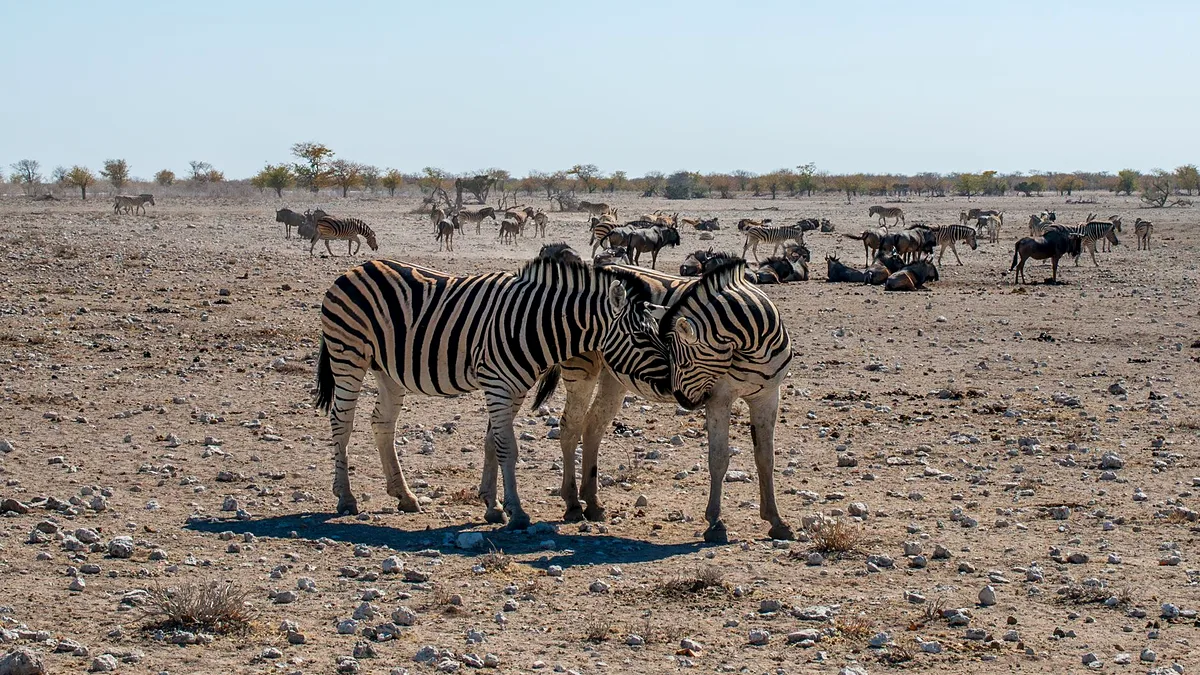
Etosha is not a Miami substitute in any literal sense. There is no Art Deco, no ocean, no cocktail bar with a DJ, and no brunch queue. What you get instead is 22,270 square kilometres of salt pan and mopane scrub where the busiest waterhole on a Tuesday might hold four other cars.
If what you actually want from Miami is space, quiet, and the feeling of buying exclusivity, Etosha delivers it for roughly a third of the daily cost. What you sacrifice is convenience and scene: flights to Namibia cost more than flights to Florida, you drive yourself on gravel, and dinner is a game steak at a camp restaurant rather than a tasting menu.
Side-by-Side Comparison Scorecard
| Feature | Miami | Etosha |
|---|---|---|
| Average Daily Cost (Stay + Meals) | $300–450 per person, mid-range South Beach hotel split two ways, two meals, one drink | $120–190 per person self-drive in park camps; $400–600+ in a private lodge on the boundary |
| Atmosphere & Aesthetic | Pastel Art Deco facades, neon, palm-lined promenade, constant background music | White salt pan, red dust, thatched roofs, silence broken by doves and francolins |
| Crowd Density & Seasonality | ~26 million visitors a year; peak December–April plus spring break | ~250,000 visitors a year; peak July–October, genuinely empty November–April |
| Flight & Transit Accessibility | MIA is a major hub, direct from 100+ cities, then rideshare or free Metromover | Fly to Windhoek (WDH), then a 4.5-hour drive or a 90-minute charter; self-drive is essential |
| Best For | Beach days, nightlife, design shopping, a serious restaurant scene | Wildlife, photography, empty horizons, slow mornings, black rhino at a floodlit waterhole |
Scenery & Atmosphere: How Similar Are They Really?
Not very, and that is the entire point of the swap. Miami's visual signature is man-made: the pastel curves of Ocean Drive, the neon of Collins Avenue, the murals in Wynwood, the coral stone of Vizcaya. It is a city you look at, and it looks back — there is always a photo being taken and always a queue outside a door.
Unlimited High-Speed International Travel eSIM
Connect in seconds across 180+ destinations. Instant QR code activation with zero roaming surcharges.

Etosha's signature is geological. The Etosha Pan is a 4,760 sq km sheet of white clay and salt so flat and so bright it registers clearly from orbit. Around it sits dry woodland, dolomite ridges in the west, and a chain of waterholes that pull animals in like a magnet through the dry months.
The daily rhythm differs more than the scenery does. Miami mornings mean brunch reservations and traffic on the MacArthur Causeway. Etosha mornings mean a gate that opens at sunrise, 8°C in July, and a black-backed jackal trotting past your wing mirror before you have finished your coffee.
If you want the closest thing to architecture here, it is history rather than design: the whitewashed German fort at Namutoni, first built in 1903 and reconstructed after the siege of 1904, and Okaukuejo's stone tower overlooking the floodlit waterhole. Charming, not stylish.
The Wallet Test: Real Cost Breakdown
Miami pricing swings hard with the calendar, and December to April is not your friend. Ocean Drive cocktails run $18–22, a decent dinner for two lands at $120–160 before tip, and resort fees of $35–45 a night are routinely added on top of the room rate you thought you booked.
Etosha runs on Namibian dollars, roughly N$18 to $1 USD. Costs are stable year-round apart from peak-season lodge rates, and the biggest line item is usually the car, not the bed.
| Item | Miami | Etosha |
|---|---|---|
| Mid-range double room, peak season | $280–420 plus resort fee | N$1,400–2,200 / $78–122 (NWR camp bungalow) |
| Casual lunch | $14–20 (Cuban sandwich, Little Havana) | N$150–220 / $8–12 (camp restaurant or picnic) |
| Dinner for two with drinks | $120–160 | N$700–1,000 / $39–55 |
| Beer or house wine | $9–22 | N$30–70 / $2–4 |
| Signature paid experience | $90 for 30 minutes on a jet ski; $25 Vizcaya entry | N$700 / $39 per person for a guided game drive |
| Park or access fees | Free beaches; museums $12–25 | ~N$150 per person + N$50 per vehicle per day / ~$11 total |
| Getting around | Free Metromover, $2.25 Metrorail, $15–30 rideshare | Own rental, N$900–1,600 per day / $50–90 |
A realistic self-drive day for two in Etosha — camp bungalow, fuel, three meals, one guided drive — comes to about $230, or $115 each. The same day in South Beach is closer to $600 for two. The catch: a return flight from the US to Windhoek often runs $1,200–1,800, against $250–450 to Miami.
Crowds, Authenticity, and Tourist Footprint
Miami hosts roughly 26 million visitors a year. Etosha hosts around 250,000. That single statistic explains most of the difference in how the two places feel: one is a global destination operating at capacity, the other is a park where you can drive 40 minutes without passing another vehicle.
Miami's trade-off is that very little feels untouched. Ocean Drive is a photo set, Lincoln Road is a shopping mall outdoors, and the best-value food has migrated to neighborhoods tourists rarely reach — Hialeah for roast pork, Sweetwater for Venezuelan arepas, North Beach for a quieter stretch of sand.
Etosha has its own crowd problem, just compressed into fewer months. July to October, the NWR camps at Okaukuejo and Halali fill up and the waterholes at midday look like car parks. Go in February, and you will have the place largely to yourself alongside green grass, newborn antelope, and 340-plus bird species.
The honest caveat: the state-run camps inside the park are dated, the service is slow, and the bungalows have the charm of a 1980s holiday flat. The genuine quiet-luxury experience sits on the park boundary in private reserves like Ongava, Onguma, and Mushara, where you pay more but get guided drives, off-road access, and a pool that looks over nothing at all.
How to Experience the Best of Etosha
Where to Stay
- Okaukuejo (inside the park): central location and the famous floodlit waterhole, your best shot at black rhino after dark. Book six to nine months ahead for July–October.
- Halali (inside the park): mid-park and noticeably quieter, with a short walk to the Moringa waterhole.
- Namutoni (inside the park): eastern side, closest to the Andoni Plains and the fort. Good for a first or last night.
- Ongava or Onguma (private reserves): on the southern and eastern boundaries, with night drives, walking safaris, and far better food. Expect N$4,000–9,000 per person per night (~$220–500), often all-inclusive.
- Dolomite Camp (far west): remote, built into a dolomite ridge, reached via Galton Gate. Fewer animals, fewer people.
What to Do
Self-drive is the budget option and the best way to control your own day. Gates open at sunrise and close at sunset, the speed limit is 60 km/h, and leaving the marked tracks is forbidden. Fuel is available at Okaukuejo, Halali, and Namutoni.
Build your day around waterholes rather than mileage: Gemsbokvlakte, Chudob, Klein Namutoni, and Rietfontein all deliver. Book one guided sunset drive (N$700 / ~$39) for the interpretation and the chance to go out after dark.
What to Eat
Order oryx (gemsbok) steak, kudu biltong, and potjiekos, the slow-cooked cast-iron stew you will find on most lodge menus. Wash it down with a Windhoek Lager or a Tafel, both around N$35 (~$2). Skip the buffet unless you are genuinely hungry — it rarely justifies the price.
Who Should Still Choose Miami?
Choose Miami if you want to swim in warm water, eat three great meals in a day, and never need a car. Etosha has no beach, no nightlife, no art museums, and no restaurant worth planning a trip around. It is also a poor fit for anyone with limited mobility, very young children, or a schedule under four nights.
Pick Miami too if your priority is a short flight and a cheap one. From most of the US, Namibia is a 20-to-30-hour journey via Europe or Johannesburg, and that cost and time is real. Miami also wins on spontaneity: you can decide on Thursday and be on the sand by Friday.
Where Etosha genuinely beats it is on the thing Miami sells hardest — exclusivity. A private reserve dinner under the Milky Way, with no music and no other tables, costs less than a middling South Beach dinner for two.
Frequently Asked Questions
Is Etosha actually cheaper than Miami?
On the ground, yes — often 60–70% cheaper per day. Once you factor in long-haul flights and a rental car, a 10-day Etosha trip usually costs about the same as or slightly less than 10 days in Miami in high season.
Can Etosha replace a beach holiday?
No. There is no swimming and no coast. The closest equivalent is the pool at your lodge. Treat it as a landscape-and-wildlife trip, not a sunbathing one.
When is the best time to visit each?
Etosha peaks June to October, when dry conditions push animals to waterholes. November to April is green, quiet, and cheaper but hot. Miami is best January to April; June to November brings hurricane season and, in summer, sargassum seaweed on some beaches.
Do I need a 4x4 in Etosha?
No. The main gravel roads are fine in a normal sedan in the dry season. A 4x4 helps in the wet months and if you plan to explore the western Dolomite Camp section, but it is not essential.