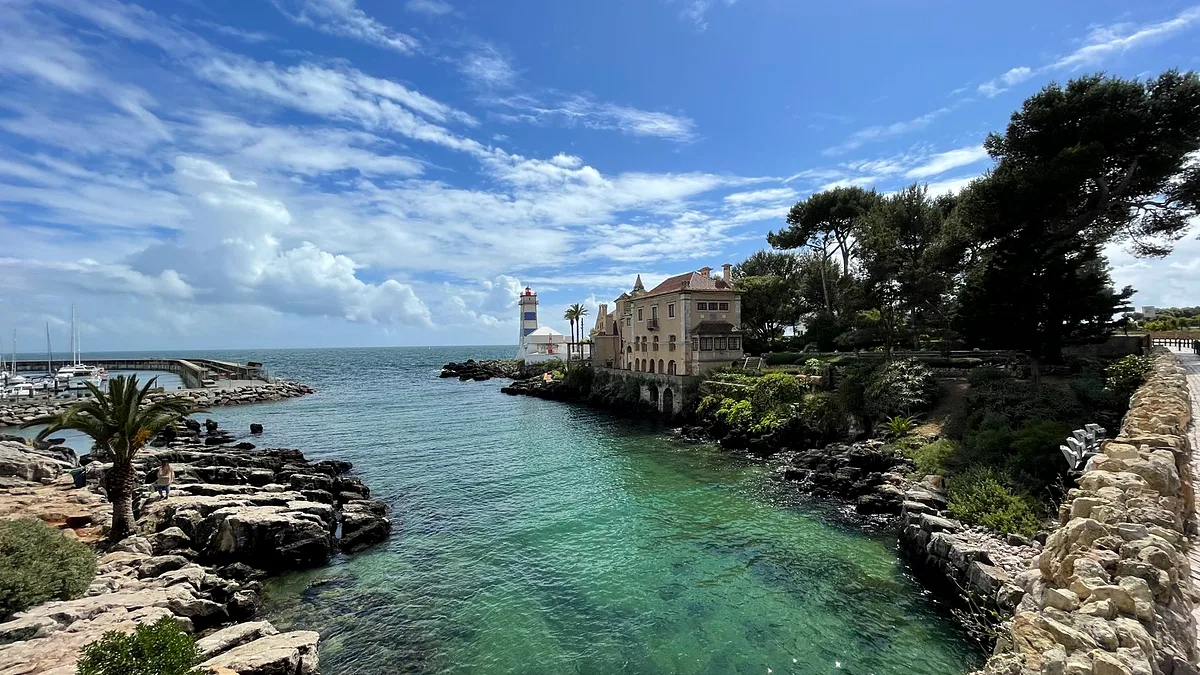

Cascais is the closest thing Europe has to a Rio de Janeiro you can do in a long weekend without wrecking your budget. The two places share the same genetic code: black-and-white wave mosaics underfoot, pastel façades with wrought-iron balconies, palms leaning over tiled sidewalks, and a beach at the end of nearly every street. Swap Rio for Cascais and you keep the look, cut the flight in half, and stop planning your evenings around which phone you're willing to lose.
What you sacrifice is scale and heat. Cascais is a town of roughly 30,000 people, not a 6.7-million-person city with 400-metre granite peaks, samba spilling out of corner bars, and Carnival. If you want Sugarloaf at sunset or 24°C (75°F) water in February, Cascais will disappoint. If you want the architecture, the Atlantic light, the seafood, and a €2.35 train from Lisbon, it delivers hard.
The Quick Verdict: Who Wins This Swap?
Cascais wins on cost of getting there, cost of getting around, safety, and stress. A return flight from most of Europe to Lisbon runs €80–150; to Rio it's €700–1,100. Once you land, Cascais is walkable end to end and the train back to Lisbon costs less than a coffee in Ipanema. You also skip the 11-hour flight, the jet lag, and the visa paperwork.
Unlimited High-Speed International Travel eSIM
Connect in seconds across 180+ destinations. Instant QR code activation with zero roaming surcharges.

Rio wins on sheer spectacle and on the things that make a trip memorable rather than pleasant. The mountains-to-ocean geography has no European equivalent at this scale, the beach culture is a genuine way of life rather than a summer hobby, and the music scene is unmatched. Cascais is the better value. Rio is the better story.
The Scorecard: Cascais vs Rio de Janeiro at a Glance
| Feature | Rio de Janeiro | Cascais |
|---|---|---|
| Average Daily Cost (Stay + Meals) | R$780–1,250 / ~$140–230 mid-range; doubles or triples during Carnival and New Year | €110–180 / ~$120–195 mid-range; €200+ in August, €90–120 from November to March |
| Atmosphere & Aesthetic | Portuguese colonial bones under a tropical modernist skin — Burle Marx mosaics, granite domes, botecos, constant noise | Village-scale belle époque: azulejo façades, a royal summer palace, Atlantic cliffs, quiet tiled streets after 11pm |
| Crowd Density & Seasonality | Heavy year-round in Copacabana and Ipanema; brutal December–March peak | Peaks July–August with Lisbon day-trippers; May–June and September–October are genuinely calm |
| Flight & Transit Accessibility | 10–12 hours from Europe, 9–10 from the US East Coast; Galeão (GIG) is 40–70 minutes from the Zona Sul | 40 minutes from Lisbon airport (LIS) by car; €2.35 train from Cais do Sodré; the old town is entirely walkable |
| Best For | Carnival, big-city energy, warm-water beaches, live music, mountain hikes | Architecture, coastal walks, seafood, surfing, low-stress weekend breaks |
Scenery & Atmosphere: How Similar Are They Really?
More similar than you'd expect, because Rio's most photographed surfaces were laid by Portuguese hands. The Copacabana promenade that Roberto Burle Marx designed in 1970 is calçada portuguesa — the same black basalt and white limestone wave pattern you'll walk on outside Cascais's Câmara Municipal. The azulejo tilework on Rio's colonial churches and Cascais's Santa Marta lighthouse come from the same tradition, roughly two centuries apart.
The difference is what sits behind the buildings. Rio throws 842-metre Pedra da Gávea and the Sugarloaf straight out of the Atlantic, with Tijuca rainforest filling the gaps. Cascais has the Serra de Sintra rising a few kilometres inland, pine and scrub instead of rainforest, and cliffs at Boca do Inferno that drop into churning green water rather than warm turquoise.
Street life is where the two diverge hardest. Rio's sidewalks function as living rooms — plastic chairs, beers at 3pm, vendors working the sand. Cascais is orderly and quiet. On a Tuesday in October you can walk the marina and hear your own footsteps. That's either the whole point or a dealbreaker, depending on what you came for.
The Wallet Test: Real Cost Breakdown
Here's what a mid-range traveller actually spends. All figures are typical 2025 prices, converted at roughly €1 = $1.08 and R$1 = $0.18.
| Expense | Rio de Janeiro | Cascais |
|---|---|---|
| 3–4★ double, high season | R$650–1,100 / ~$120–200 (Ipanema, Leblon) | €130–200 / ~$140–215 (Centro Histórico) |
| Same room, low season | R$450–700 / ~$80–130 | €85–120 / ~$90–130 |
| Hostel dorm bed | R$120–180 / ~$22–33 | €30–45 / ~$32–49 |
| Lunch (prato do dia / por quilo) | R$45–70 / ~$8–13 | €11–15 / ~$12–16 |
| Dinner for two with wine or beer | R$220–320 / ~$40–58 | €55–80 / ~$60–87 |
| Local drink | Caipirinha R$28–38 / ~$5–7 | Glass of vinho verde €3.50–5 / ~$4–5.50 |
| Signature excursion | Sugarloaf cable car ~R$130 / ~$24; Corcovado train ~R$110 / ~$20 | Boca do Inferno free; Sintra bus €2.60 / ~$2.80; surf lesson €45–65 / ~$49–70 |
Hotels land in a similar band, which surprises people. Cascais is not a cheap destination in July and August — it's a Lisbon commuter town with a royal history and a marina. The real savings show up in transit, excursions, and airfare, and they get dramatic in winter, when Cascais rooms drop 35–45% and Rio's stay stubbornly high.
Budget tip: sleep one train stop out. A double in Parede or São Pedro do Estoril runs €75–110 (~$81–119) and puts you 12 minutes from Cascais on the same €2.35 line. In Rio the equivalent move — staying in Botafogo or Flamengo instead of Ipanema — saves 30% and gets you better food.
Crowds, Authenticity, and Tourist Footprint
Cascais has a tourist problem in miniature. The old town is 400 metres across, so when two trainloads of Lisbon day-trippers arrive at 11am, the gelato queue swallows the square. August is the worst of it: packed beaches, standing-room trains, and restaurant prices that assume you won't check. Go in June or September and it's a different town.
Rio's tourist footprint is concentrated rather than spread. Copacabana, Ipanema, Lapa and the Corcovado run on visitor money; the rest of the city barely notices you. The tradeoff is petty crime — phone snatching on the beach and in Lapa after dark is real, common, and worth planning around. Cascais, by contrast, is one of the safest places in Portugal; walking home at midnight is a non-event.
Neither place is untouched. Cascais has been a resort since King Luís I started summering there in the 1870s. It just wears its tourism more quietly.
How to Experience the Best of Cascais
Where to Stay
- Centro Histórico — walk to everything, pay for it. Best for a two-night stay.
- Estoril — calmer, bigger hotels, the casino, and a 25-minute walk along the coast into Cascais.
- Monte Estoril — leafy streets, villas, the best-value boutique stays, still walkable.
- Parede or Carcavelos — the budget play. Surf, supermarkets, 10–15 minutes by train.
What to Do That Rivals Rio
Walk the Paredão. The coastal path from Cascais to Estoril is about 3 km and takes 40 minutes. It's the closest Cascais gets to the Ipanema promenade, minus the volleyball and the caipirinha carts.
Bike to Guincho. The coastal cycle path runs roughly 8 km from Cascais to Praia do Guincho, past Boca do Inferno and Cabo Raso. Guincho is serious surf, not swimming — think cold, windy, and dramatic rather than tropical.
Day-trip to Sintra and Cabo da Roca. Bus 403 from Cascais station reaches Sintra in about 40 minutes (€2.60) and Cabo da Roca — mainland Europe's westernmost point — in about 20. Do both in one day, leave before 9am.
Taste Colares wine. The Ramisco vines grow in sand dunes just north of Cascais and survived phylloxera. A tasting at a local adega runs €15–25 (~$16–27) and it's a genuinely unique bottle you won't find in Rio.
What to Order
Start with peixinhos da horta — battered green beans that Portuguese sailors carried to Japan and which became tempura. Follow with grilled sardines, caldeirada fish stew, or bacalhau à Brás. Finish with a pastél de nata (€1.30 / ~$1.40) and, if you make it to Sintra, a travesseiro from Piriquita. Drink vinho verde by the glass and ginjinha if someone offers it.
Who Should Still Choose Rio de Janeiro?
Choose Rio if Carnival is the reason you're travelling. Nothing in Portugal comes close, and no amount of coastal architecture compensates for missing it. Choose Rio if you want warm water, tropical heat in February, and a beach that runs for 4 km.
Choose Rio if you're already in South America, or if you want a city that stays up until 4am. Choose it if hiking Pedra Bonita or watching a football match at Maracanã matters more to you than a quiet tiled street and a €4 glass of wine.
And choose Rio if you can afford the flight without flinching. Cascais's advantage evaporates the moment you're paying €900 for a long-haul fare and then discovering August hotel rates match Ipanema's.
Frequently Asked Questions
Is Cascais actually cheaper than Rio de Janeiro?
On the whole, yes — but the savings come from flights, transit, and excursions rather than hotels. A mid-range day in Cascais costs roughly €110–180 (~$120–195) versus R$780–1,250 (~$140–230) in Rio's Zona Sul, and the gap widens sharply from November to March. In peak August they're nearly level.
Does Cascais really look like Rio?
The Portuguese layer does. You'll find the same calçada portuguesa wave mosaics, azulejo tiles, wrought-iron balconies and pastel render. What's missing is Rio's tropical backdrop and scale — no granite domes rising from the sea, no rainforest, no city-sized street life.
How many days do you need in Cascais?
Two nights covers the old town, the marina, Boca do Inferno and the Estoril walk. Give it four or five if you're adding Sintra, Cabo da Roca, a surf lesson and a Colares wine tasting. Beyond that, most people start commuting into Lisbon — the train takes 40 minutes.
When is the best time to visit Cascais?
Late May to June and September to mid-October. The water is still cold (17–19°C / 63–66°F), but the light is good, hotels run 25–35% cheaper than August, and the old town isn't shoulder-to-shoulder. Avoid the first two weeks of August if crowds bother you.