
Let's be straight with each other: Cartagena is not Vienna. There is no Ringstrasse, no Klimt in a gilded hall, no opera house selling standing-room tickets for €13. What Cartagena does have is a walled colonial city of comparable scale and swagger, where a four-night break costs roughly 40 to 60 percent less than the same trip in Austria — and where your evening stroll happens at 29°C instead of 4°C.
So treat this as a dupe with a big caveat. You get UNESCO-listed streets, monster stone fortifications, cathedral domes, horse carriages rattling over cobbles, and a café culture that runs from 7 a.m. espresso to midnight cocktails. You give up Habsburg scale, world-class museums, transit that runs like a watch, and the freedom to walk anywhere without sweating through your shirt. If your Vienna dream is about art and grandeur, book Vienna. If it is about wandering beautiful old streets and eating very well for cheap, Cartagena wins on the math.
Side-by-Side Comparison Scorecard
| Feature | Vienna | Cartagena |
|---|---|---|
| Average Daily Cost (Stay + Meals) | €140–185 per person (~$150–200), double occupancy, mid-range hotel | $70–110 per person (COP 290,000–460,000), double occupancy, boutique guesthouse |
| Atmosphere & Aesthetic | Imperial, orderly, grey-gold stone, Baroque and Ringstrasse grandeur, café houses with marble tops | Caribbean colonial, saturated colour, wooden balconies, bougainvillea, heat, salsa after dark |
| Crowd Density & Seasonality | Peaks July–August and the December markets; the city absorbs crowds well across 23 districts | Peaks 20 Dec–10 Jan and Semana Santa; cruise-ship surges hit the old town 10 a.m.–4 p.m. |
| Flight & Transit Accessibility | Vienna Airport (VIE), direct from most of Europe, 16 minutes to centre on the S-Bahn (€4.60) | Cartagena (CTG), direct from Miami, Fort Lauderdale, New York and Panama; from Europe you connect via Bogotá or Panama City |
| Best For | Museum lovers, opera, Christmas markets, solo walkers, cold-weather city breaks | Warm-weather escapes, food, photography, couples, budget-conscious long weekends |
Scenery & Atmosphere: How Similar Are They Really?
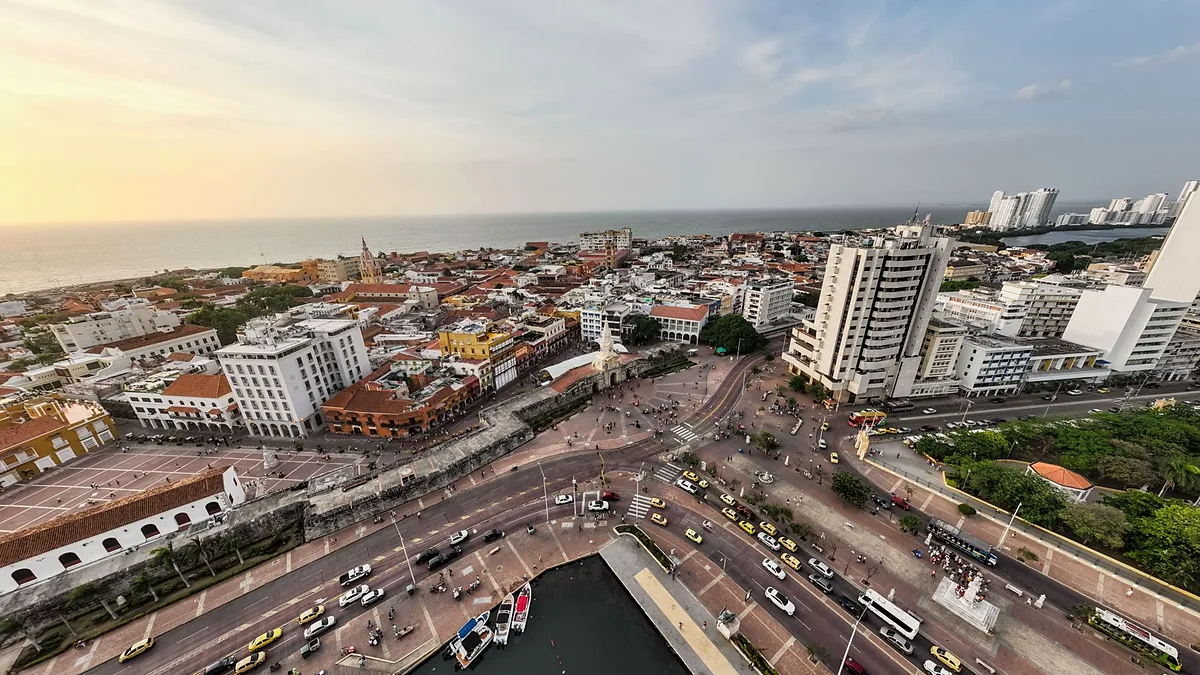
The comparison holds best at the level of urban bones. Both cities grew up around a defensive wall, and both still show it off. Vienna has the Ringstrasse, a 19th-century boulevard built where the old ramparts stood. Cartagena has Las Murallas, the actual 16th-century coral-stone wall, still walkable for 11 kilometres and still the best sunset seat in town.
Unlimited High-Speed International Travel eSIM
Connect in seconds across 180+ destinations. Instant QR code activation with zero roaming surcharges.

Both put a cathedral at the centre and both still run horse-drawn carriages for tourists. Both have a deep café habit — Vienna's Kaffeehaus culture has a direct cousin in Cartagena's plaza-side tables, where a tinto costs COP 3,000 (~$0.75) and nobody rushes you out.
That is where the resemblance stops. Vienna is monumental: five- and six-storey stone facades, wide boulevards, geometry, clean sightlines. Cartagena is intimate and low-rise, two or three storeys with overhanging balconies that almost touch across the street. Vienna's beauty is cool and structured. Cartagena's is hot, peeling, and loud.
The other difference is sensory. Vienna has the Danube Canal and grey skies; Cartagena has the Caribbean 200 metres from the clock tower. You will not confuse the two when you step outside. Honestly, by 2 p.m. in Cartagena's old town, the streets half-empty and shimmering with heat — Vienna at 2 p.m. is at its best.
The Wallet Test: Real Cost Breakdown
Hotels
In Vienna, a decent mid-range double in Neubau or Mariahilf runs €120–170 a night (~$130–185). Design hotels push €200+, and dorms sit at €30–45. The 7th district is the sweet spot: central, quiet, and cheaper than the 1st.
In Cartagena, a boutique double inside the walls in San Diego or El Centro runs $75–130 (COP 310,000–540,000). Getsemaní guesthouses are $40–70, and Bocagrande high-rises $60–100. Watch the calendar: rates roughly double from 20 December to 10 January and during Semana Santa.
Food and Drink
- Vienna: breakfast of pastry and coffee €8–12; a Würstelstand sausage €5–7; sit-down dinner €20–30 with a drink; a melange €4.50; half-litre of beer €4.50–5.50. Tip 5–10%.
- Cartagena: menu del día lunch COP 25,000–40,000 (~$6–10); dinner inside the walls COP 70,000–140,000 (~$18–35); local beer COP 5,000–8,000 (~$1.30–2); cocktail COP 30,000–45,000 (~$7–11); street arepa de huevo COP 4,000–6,000.
- Honest note: restaurants inside the old town charge tourist prices. Walk 15 minutes to Manga or grab lunch in El Bosque and the same plate costs half.
Sights and Transit
Vienna's set pieces add up: Schönbrunn Grand Tour €32 (~$35), Belvedere €17.50, Kunsthistorisches €21, St. Stephen's south tower €6.50, opera standing room €13–18. Transit is a single ticket at €2.60, a 24-hour pass at €8, and a weekly pass at €17.10.
Cartagena is cheaper at the gate. Castillo San Felipe costs COP 30,000 (~$7.50), the Museo del Oro Zenú is free, tip-based walking tours run three hours, and a Rosario Islands boat day is COP 130,000–220,000 (~$33–55). There is no metro; taxis from the airport to the old town run COP 25,000–35,000 (~$6–9), and you will take more of them than you planned because of the heat.
The bottom line: four nights, flights excluded, lands around €700–850 per person in Vienna and $350–500 in Cartagena. From Europe, though, the flight gap ($400–600 extra, plus a connection) can wipe out most of that saving.
Crowds, Authenticity, and Tourist Footprint
Vienna gets crowded, but it is a working city of two million people and it spreads visitors out. Even at Schönbrunn in August you can walk ten minutes and find a quiet street. Cruise ships do not land here.
Cartagena's old town is a different story. It is roughly 1.5 kilometres across, and it fills up fast. When ships are in port — heaviest Tuesday to Thursday — the stretch between the Torre del Reloj and Plaza de los Coches becomes a hawker gauntlet for six hours. Once the ships leave, it resets to something pleasant.
The harder truth is that inside the walls, nearly every ground-floor space is now a hotel, restaurant or souvenir shop. It is a gorgeous stage set, and it knows it. For the real thing, head to Manga, take a local bus to El Bosque, or eat where the menu is printed on a laminated sheet and priced for Colombians.
Vienna has its own honesty problems. Service can be brusque, January is dark by 4:30 p.m., and a lot of the postcard streets are bank offices. Neither city is a secret. Both reward you for walking two blocks off the main drag.
How to Experience the Best of Cartagena
Where to stay
- San Diego (north end inside the walls): quietest, best-preserved streets, boutique hotels $90–150.
- El Centro around Parque Bolívar: most central, noisiest, most expensive.
- Getsemaní: $40–80, street art, nightlife, eight-minute walk to the walls — though some blocks get rough after midnight.
- Bocagrande: beach strip and high-rises, less charm, better value for families.
- Manga: residential, almost no tourists, the best-value longer stays.
Signature activities that rival Vienna's set pieces
- Castillo San Felipe de Barajas at 8 a.m. opening, before the heat and the tour groups. COP 30,000.
- Walking Las Murallas at 5:30 p.m. — the closest thing to a Ringstrasse stroll, with the sun dropping into the Caribbean.
- A tip-based Getsemaní walking tour for the history the pretty walls leave out.
- Iglesia de San Pedro Claver and Convento de la Popa for baroque interiors that hold their own against anything in Austria.
- Split a private boat to Barú's quieter beaches four ways, roughly $40 each.
- Skip: the chiva party bus, the volcano mud bath (long drive, tight crowds), and the Playa Blanca day tour if you dislike queues and upselling.
What to order
Start with posta negra cartagenera, slow-braised beef in a dark sweet-savoury sauce, COP 45,000–70,000 (~$11–17). Add ceviche at El Boliche Cebichería in Getsemaní or La Cevichería in the centre, and a street-side arepa de huevo for breakfast at COP 4,000–6,000.
Buy fruit at the Portal de los Dulces on Plaza de los Coches — mangostino, zapote, and a coconut sweet you will think about later. Coffee is improving fast: a flat white now runs COP 8,000–12,000 (~$2–3), versus €4.50 in Vienna.
Who Should Still Choose Vienna?
Skip the dupe and pay for the original in a few clear cases.
- You want great art. The Kunsthistorisches, the Belvedere's Klimt, the Albertina. Cartagena has nothing in this league.
- You want to walk all day. Cartagena's heat forces three-hour windows and afternoon siestas. Vienna in June is a walking city.
- You want infrastructure. U-Bahn every three minutes, drinkable tap water, safe streets at 2 a.m., English spoken everywhere.
- You want the classical music or Christmas market experience. Nothing in Colombia replicates it.
- You are flying from Europe. Cartagena means a Bogotá or Panama City connection, 8 to 12 extra hours and $300–500.
- You are a solo traveller who wants zero friction. Cartagena is manageable but demands awareness that Vienna simply does not.
Frequently Asked Questions
Is Cartagena really cheaper than Vienna?
Yes, by roughly 40–60 percent on the ground. A mid-range day in Vienna runs €140–185 (~$150–200); in Cartagena, $70–110 (COP 290,000–460,000). Flights can erase the gap entirely if you are coming from Europe.
Does Cartagena actually look like Vienna?
Only in skeleton. Both have a walled historic core, a cathedral, grand plazas, horse carriages and café culture. Vienna is Habsburg stone and boulevards; Cartagena is Spanish colonial colour and tropical heat. Same plot, different film.
When should I visit Cartagena to avoid crowds?
April to May and September to November. Avoid 20 December to 10 January, Semana Santa and Colombian public holidays, when domestic tourism doubles room rates. Cruise-ship days are heaviest Tuesday to Thursday.
Can I do Cartagena on a backpacker budget?
Easily. Getsemaní dorms run $12–18 a night, menu del día lunches are COP 25,000 (~$6), and walking the walls is free. A lean day lands at $40–50.
How many nights do I need in each?
Four nights covers Cartagena's old town, Getsemaní, the castle and one island day. Vienna deserves five if you want museums without sprinting.