
The Quick Verdict
Cape Town is the closest thing to Interlaken's mountain-town thrill that won't gut your savings account. Both sit in a valley ringed by steep peaks, both run a cable car or funicular up to a viewpoint above town, and both make you feel pleasantly small. Cape Town charges roughly a third of the price for the same emotional payoff.
What you give up: reliable snow, carved wooden chalets with geranium balconies, and trains timed to the second. What you gain: a coastline, a serious food and wine scene, and the freedom to eat out twice a day without checking your balance. Choose Interlaken for the postcard village. Choose Cape Town for mountain drama plus a real, working city.
Side-by-Side Comparison Scorecard
| Feature | Interlaken | Cape Town |
|---|---|---|
| Average Daily Cost (Stay + Meals) | CHF 300–420 / ~$345–480 for a mid-range double plus three meals | R2,400–3,600 / ~$130–195 for the same standard |
| Atmosphere & Aesthetic | Alpine chalet town between two glacial lakes. Wooden balconies, watch boutiques, a green meadow in the middle of town. | Mountain amphitheatre above a working port city. Cape Dutch gables, Bo-Kaap colour, Atlantic seaboard, vineyards 45 minutes out. |
| Crowd Density & Seasonality | July–August and December–March are shoulder-to-shoulder. Roughly 5,600 locals hosting millions of overnight stays a year. | Peak December–January and February–March. City Bowl and Camps Bay get busy; June–August is quiet, wet and cheap. |
| Flight & Transit Accessibility | 2h15 by train from Zurich, direct from Basel and Geneva. No car needed anywhere. | 11–12 hours nonstop from Europe, 2 hours from Johannesburg. You want a car or Bolt for the Winelands. |
| Best For | Hiking purists, Jungfraujoch bucket-listers, families who want zero friction. | Budget travellers, food and wine people, anyone staying five nights or more. |
Scenery & Atmosphere: How Similar Are They Really?
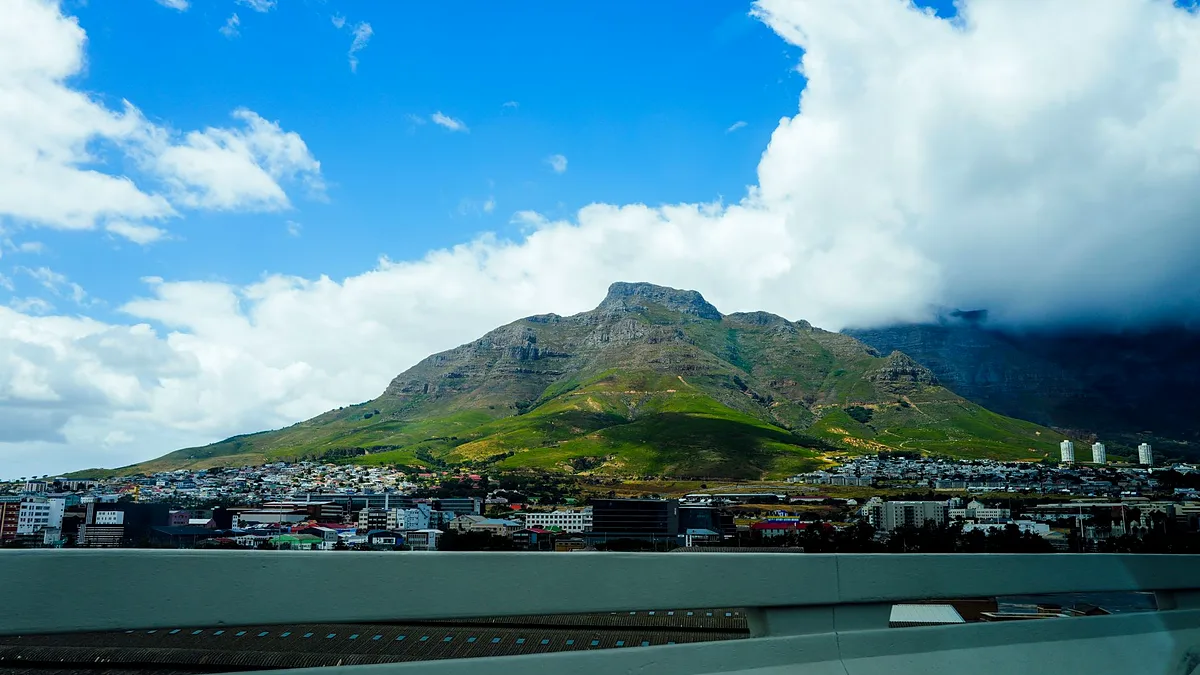
Stand on the Höhematte meadow in Interlaken and the comparison makes itself. You get a flat green centre, a low town spread out around it, and the Jungfrau massif stacking up behind the rooftops. Cape Town does something similar from the Company's Garden or the Signal Hill viewpoint: flat foreground, city in the middle, Table Mountain filling the whole back wall of the picture.
Unlimited High-Speed International Travel eSIM
Connect in seconds across 180+ destinations. Instant QR code activation with zero roaming surcharges.

The vertical transport matches up too, and this is where the twin logic really holds. Interlaken has the Harder Kulm funicular climbing to a clifftop terrace in about ten minutes. Cape Town has the cableway spinning visitors up Table Mountain in roughly five, with rotating floors so everyone gets the view.
Both towns also sell the same airborne thrill. Tandem paragliding over Interlaken's lakes is a rite of passage; the same thing from Signal Hill or Lion's Head drops you over the Atlantic Seaboard instead of green water and villages. It is the same adrenaline, different backdrop.
Where the comparison breaks down
The buildings are not actually twins, so set that expectation correctly. Interlaken is uniformly alpine: dark timber, wide eaves, carved balconies, a 1950s concrete hotel tower that locals still complain about. Cape Town is a layered mix of Cape Dutch, Georgian, Victorian corrugated iron and Bo-Kaap's bright Malay quarter, which looks nothing like Switzerland.
You also get no snow on the town in winter, no glacier on your doorstep, and no chocolate-box village stroll that feels like a film set. Cape Town's mountains are fynbos and sandstone, not pine forest and snowfield. If your mental image involves a chalet with snow on the roof, this swap will not satisfy it.
The Wallet Test: Real Cost Breakdown
This is the whole reason to consider the swap. Swiss prices are not a rumour — a basic plate of rösti and a beer will set you back close to $50 before you have done anything interesting. Cape Town lets you eat genuine restaurant food twice a day and still have money for excursions.
| Cost Item | Interlaken (CHF / USD) | Cape Town (ZAR / USD) |
|---|---|---|
| Mid-range double room, per night | CHF 220–320 / ~$255–370 | R1,900–2,900 / ~$105–155 |
| Hostel dorm bed | CHF 50–70 / ~$58–80 | R380–550 / ~$21–30 |
| Flat white / cappuccino | CHF 5.50 / ~$6.30 | R38 / ~$2 |
| Sit-down main course | CHF 28–34 / ~$32–39 | R180–240 / ~$10–13 |
| Half-litre beer | CHF 8 / ~$9 | R60 / ~$3.25 |
| Mountain cable car or funicular | Harder Kulm CHF 40 / ~$46 | Table Mountain R480 return / ~$26 |
| Big-ticket day out | Jungfraujoch CHF 210–260 / ~$240–300 | Cape Point plus Boulders self-drive R900–1,200 / ~$50–65 |
| Tandem paragliding | CHF 180–200 / ~$205–230 | R1,600–2,200 / ~$87–120 |
| One-week total, mid-range | CHF 2,100–2,900 / ~$2,400–3,300 | R16,000–22,000 / ~$865–1,190 |
Two honest caveats. First, the Jungfraujoch trip is the single biggest line item in any Interlaken budget, and plenty of repeat visitors skip it entirely in favour of the free-or-cheap walks around Lauterbrunnen and Grindelwald. Second, Cape Town's number creeps up fast if you add a Winelands tasting day, a rental car, and a splurge dinner in Constantia.
Practical tip: buy the Table Mountain cable car ticket online for a specific morning slot. The queue without a booking can eat two hours, and the cableway shuts down in high wind with no refund drama beyond a rebooking.
Crowds, Authenticity, and Tourist Footprint
Interlaken has become a case study in over-tourism, and locals know it. The Höheweg promenade is essentially a shopping strip of watch boutiques, souvenir shops and tour-bus drop-offs, and the town centre empties of residents after 7pm. Neighbouring Lauterbrunnen introduced bus fees and visitor management measures in 2024 after years of congestion complaints, and Interlaken itself has debated a tourist levy.
The upside is that everything works. Trains connect, trails are signed, taps are drinkable, and you can walk anywhere at 11pm without a second thought. The trade is that you rarely feel like you have discovered anything — you feel like you have joined a very well-organised queue.
Cape Town is the opposite flavour of crowded. The city has around 4.7 million people in the metro, so tourists vanish into it. Only the V&A Waterfront, Camps Bay beach in late December, and the Boulders Beach penguin boardwalk ever feel genuinely jammed.
The honest downside is safety. Petty crime is real, particularly in the CBD after dark and around the station. Use Bolt or Uber instead of walking at night, keep your phone out of sight on the street, and skip the obvious scams. It is manageable, but it is not Switzerland, and pretending otherwise would be dishonest.
How to Experience the Best of Cape Town
Where to stay
- Oranjezicht and Gardens: walkable to Kloof Street's restaurants and cafes, guesthouses around R2,000 / ~$108 a night. Best all-round base.
- De Waterkant and Green Point: cobbled streets, closest thing to a resort feel, five minutes from the Waterfront.
- Sea Point: the promenade replaces the lakeside stroll, cheaper than Camps Bay, good bus links on the MyCiTi routes.
- Stellenbosch or Franschhoek: pick these for two nights if wine is the point of the trip. Forty-five minutes from the airport.
Activities that rival Interlaken's
Lion's Head at sunrise is the free equivalent of a Harder Kulm climb, roughly 90 minutes up and down, and you will share it with maybe thirty people instead of a cable car full. Kirstenbosch Botanical Gardens, Chapman's Peak Drive and Cape Point fill a full day by car.
Add sea kayaking from the Waterfront, whale watching out of Hermanus between June and November, and a Stellenbosch tasting room afternoon. It is a very different menu from alpine hiking, but it is just as dense.
What to order
Start with a Cape Malay curry in Bo-Kaap, then work through bobotie, snoek with sweet potato, and a proper braai. Biltong and koeksisters cover the snack gaps, and a Stellenbosch chenin blanc costs a fraction of any Swiss wine list.
Who Should Still Choose Interlaken?
Book Interlaken if snow is non-negotiable. Ski season, sledging runs, frozen lakes and a genuine white Christmas are things Cape Town simply cannot deliver. Winter sports families should not attempt the swap.
Choose it too if you have three or four days and want zero planning friction. Swiss trains, English signage and total walkability make it the easier trip with kids or older parents. And if you are chasing the Jungfraujoch, the Trümmelbach falls or a glacier hike, go to the original — the imitation does not exist.
Frequently Asked Questions
Is Cape Town really cheaper than Interlaken?
By a wide margin. Accommodation and food run roughly 60 to 70 percent less for the same standard, and entry fees for mountain access are a fraction of Swiss cable car prices. A one-week mid-range trip in Cape Town costs about what four days costs in Interlaken.
Is Cape Town a good substitute for the Swiss Alps?
For scenery, hiking and cable-car views, yes. For snow, glaciers and traditional chalet villages, no. Treat it as a mountain-and-coast city break rather than an alpine replacement.
How many days do you need in each?
Interlaken works in two to three days if you stick to the valleys and one peak. Cape Town needs five to seven days minimum once you add the Winelands and Cape Peninsula.
When is the best time to visit Cape Town?
November to March for dry, warm weather, with February and March the sweet spot before the December crowds. Expect strong southeaster winds in January that can shut the Table Mountain cableway.