
The Quick Verdict
Bath is not a copy of Bali, and anyone who says otherwise hasn't been to both. But peel back the marketing and you find a similar core offer: a thermal bathing culture, sculpted green hills, ceremonial stone architecture, and mornings built around a long soak instead of a schedule.
What you gain by swapping: no 17-hour flight, no visa-on-arrival queue, no scooter. Bath's historic core runs about 20 minutes end to end on foot, and a comfortable day on the ground costs roughly half a Bali villa-and-brunch day once you've landed.
What you give up: heat, sea, and scale. Bath hands you two solid days of headline sights. Bali hands you three weeks of territory. If your holiday depends on swimming in warm ocean or learning to surf, stay with the original and pay the villa tax.

Side-by-Side Comparison Scorecard
| Feature | Bali | Bath |
|---|---|---|
| Average Daily Cost (Stay + Meals) | $55–85 / £43–67 (guesthouse + warungs); $150–220 with a private pool villa | £120–160 / ~$150–200 (budget); £200–260 / ~$250–330 (boutique hotel + pub dinners) |
| Atmosphere & Aesthetic | Rice terraces, volcanic peaks, carved tuff temples, constant scooter hum | Honey limestone crescents, a river weir, seven green hills, near-total walkability |
| Crowd Density & Seasonality | July–August and late December peak hard; wet season (Nov–Mar) is quieter and cheaper | July–August and Christmas Market weekends are jammed; January–March and November are calmest |
| Flight & Transit Accessibility | 17–19 hours from London with one stop; scooter or private driver needed to get around | 80 minutes by train from London Paddington; ~2 hours from Heathrow; core is fully walkable |
| Best For | Beaches, diving, month-long stays, cheap weekly massages | Architecture, spa weekends, food-led city breaks, no visa or jabs needed |
Scenery & Atmosphere: How Similar Are They Really?
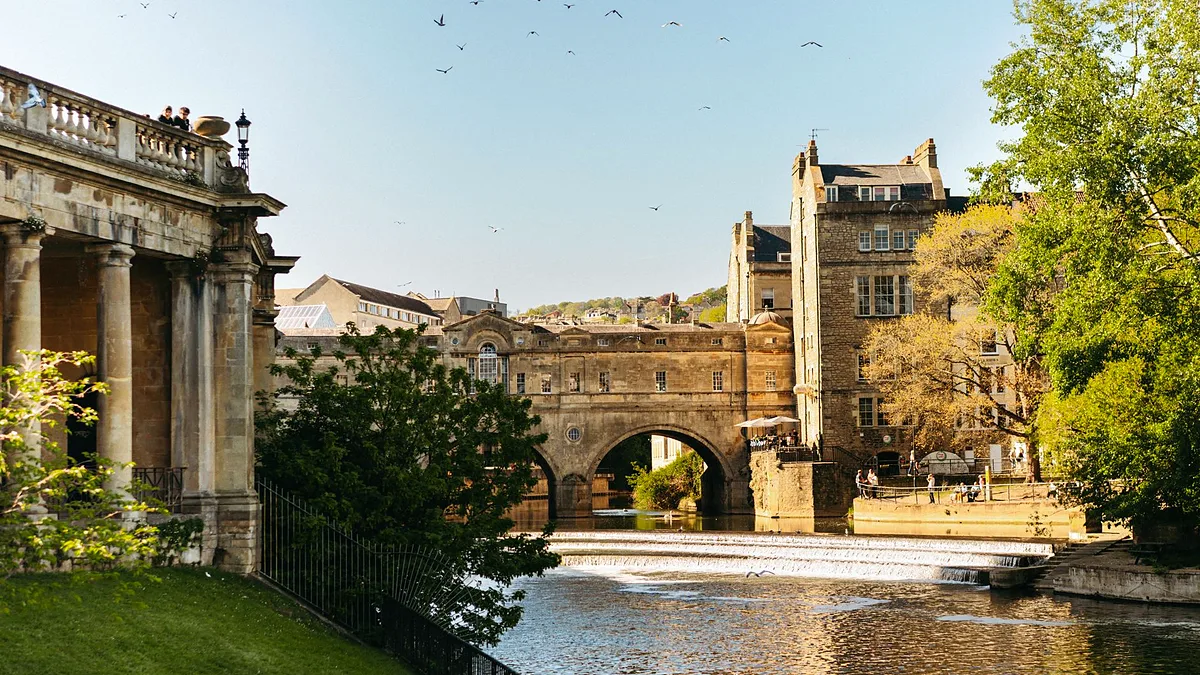
Bath's signature material is Bath stone, an oolitic limestone the colour of weak honey, quarried from Combe Down and Bathampton Down since Roman times. Because almost everything was built from the same seam within an 80-year window, the city reads as one continuous object rather than a jumble of eras. That single-tone effect is the closest thing England has to Bali's visual consistency, where nearly every shrine, gate and wall is cut from grey volcanic tuff.
The Royal Crescent is the set piece: 30 terraced houses sweeping 150 metres around a private lawn, finished in 1775 by John Wood the Younger. Five minutes uphill, the Circus does the same trick in a full circle, with Doric, Ionic and Corinthian columns stacked up its three tiers. Bali's equivalent showpieces are the water temples at Tampaksiring and the cliff-top shrine at Uluwatu, where the drama comes from landscape rather than geometry.
And that's the honest difference. Bath is a look-up city: cornices, fanlights, carved keystones. Bali is a look-out island: volcanic ridgelines, terrace steps, a horizon that keeps moving. Pulteney Bridge, one of only four bridges on earth with shops built across both sides, is about as close as Bath gets to a postcard panorama. It's a 40-second walk across.
What genuinely rhymes is the green. Bath sits in a bowl of the River Avon with the Cotswolds to the north and the Mendips to the south, and the National Trust's six-mile Skyline Walk threads through grazed hills that feel surprisingly Tegallalang. You just won't be sweating through your shirt doing it.
The Wallet Test: Real Cost Breakdown
Here's what things actually cost on the ground in each place, checked against 2025 prices. Treat these as ranges, not promises — Bath hotel rates swing wildly on rugby weekends and during the Christmas Market.
| What you'll pay for | Bali | Bath |
|---|---|---|
| Mid-range double room | $35–70 / £28–55 | £110–170 / ~$140–215 |
| Private pool villa (peak season) | $130–300 / £105–235 | £280–450 / ~$355–570 (Gainsborough spa suite) |
| Cheapest filling lunch | 30,000–45,000 IDR / ~$2–3 | £7–9 / ~$9–11 (Chai Walla wrap) |
| Coffee | 25,000–35,000 IDR / ~$1.60–2.20 | £3.60–4.20 / ~$4.60–5.30 |
| Dinner for two, mid-range | 350,000–600,000 IDR / ~$22–38 | £65–90 / ~$82–114 (with a bottle of wine) |
| Local beer | 40,000 IDR / ~$2.50 | £5.50 / ~$7 |
| Signature paid sight | 50,000 IDR temple entry / ~$3 | £27–33 Roman Baths / ~$34–42 |
| 60-minute massage | 120,000–200,000 IDR / ~$7.50–12.50 | £55–75 / ~$70–95 |
| Getting around | 80,000 IDR scooter day / ~$5 | Free — the centre is walkable |
Now the part most comparison posts skip: the flight gap doesn't save Bali as much as you'd think. A return London–Denpasar fare runs £600–1,100 (~$760–1,400) depending on season, plus a 500,000 IDR visa on arrival (~$31) and the 150,000 IDR tourist levy (~$9.40). Bath costs £50–90 return by train, plus a £16 UK ETA if you're from the US, EU, Canada or Australia.
Run a seven-night trip and Bath usually wins outright. Mid-range Bath: roughly £1,450–1,550 all in (~$1,840–1,970) including train, food and entries. Comparable Bali: around $1,900–2,100 once you add flights, a decent villa and daily warungs. The island only pulls ahead at the two-week mark, when Bath's nightly hotel cost compounds faster than Bali's.
Two other things worth knowing. Bath prices include 20% VAT, so the menu price is the price — no surprise tax line. And you cannot swim in the Roman Baths; they're a museum. Thermae Bath Spa is the only place to actually bathe in the mineral water, at £40–48 (~$50–60) for a two-hour session. Check it's open before you book — it has had extended maintenance closures.
Crowds, Authenticity, and Tourist Footprint
Bath takes roughly six million visitors a year into a city of about 90,000 people, and the historic core is outnumbered by tourists most weekends. That's the trade-off for a place compact enough to see on foot. The upside is that 200 metres off the main drag — Walcot Street, St James's, Widcombe — the crowd thins to almost nothing and you get proper locals' pubs.
Bali's saturation is a different shape. Roughly five to six million foreign arrivals land each year, and the pressure is concentrated: Canggu gridlock, Seminyak's built-up beachfront, Ubud's central market at 10am. Traffic between Canggu and Ubud can eat two hours for 40 kilometres. Neither place has solved overtourism, but Bath's version is confined to about 800 square metres around the Abbey.
On authenticity, Bath is a curated city and knows it. Jane Austen lived here and hated it, which tells you something. Bali still has genuine ceremony — odalan temple anniversaries, Ngaben cremations, Nyepi's silent day when the airport shuts for 24 hours — but you'll be one of many watching. If witnessing living culture matters more than architecture, Bali wins that round without argument.
How to Experience the Best of Bath
Where to Stay
- Kingsmead / city centre: two minutes from Bath Spa station, everything walkable. Premier Inn and Z Hotel sit at £80–120 a night; No.15 Great Pulteney is the splurge at £180–260.
- Upper Town / Royal Crescent: the pretty option, ten minutes downhill from the centre. Quieter nights, better views, slightly higher rates.
- Widcombe: south of the river, five minutes from the station, two good pubs (The White Hart, The Ring O'Bells) and rooms £20–40 cheaper.
- Bear Flat / Oldfield Park: residential, unfussy, 15–20 minutes on foot, and the cheapest beds in town apart from YHA Bath's Italianate mansion on Bathwick Hill (£30–45 a dorm).
Signature Experiences That Rival Bali
Book the Roman Baths (£27–33) for the 9am opening slot and you'll have the Great Bath almost to yourself for 20 minutes. Then walk the six-mile Skyline Walk — free, waymarked, and the closest thing to a rice-terrace ramble Somerset offers. Alexandra Park gives you the classic sunset city view for nothing.
For the spa fix, Thermae's rooftop pool at dusk is the whole point of the trip: warm mineral water, steam rising, Bath Abbey towers in silhouette. Add Prior Park Landscape Garden (£11) for the Palladian bridge, and the Bath Abbey tower tour (~£12, 212 steps) if your legs survive.
Day trips are where Bath quietly outperforms. Bradford-on-Avon is 12 minutes by train (~£4.50 return) with a medieval tithe barn and a Saxon church. Castle Combe is 30 minutes by car, or a two-leg bus hop via Chippenham if you're without wheels.
What to Order
- A Sally Lunn bun at Sally Lunn's, the oldest house in the city (c. 1482) — cinnamon butter, £4.50, or a full cream tea for £13.
- A Bath Bun elsewhere in town; locals argue fiercely about which version is authentic, and both are correct.
- A Chai Walla wrap — Bath's answer to a warung. £7–9, queue out the door, no bookings.
- A pie and a pint at The Raven on Queen Street, or squeeze into The Old Green Tree on Green Street, which holds about six tables.
- Fish and chips at The Scallop Shell (£14–16), coffee at Colonna & Small's, sourdough from Landrace in Walcot.
- Afternoon tea at the Pump Room, £32–40 a head, ideally not on the same day as the bun.
Who Should Still Choose Bali?
Choose Bali if you want warm sea, surf, diving, or heat in February. Choose it if you're travelling for three weeks or more, working remotely, or splitting a villa with six friends — that's when the economics flip decisively in Bali's favour. Choose it if you're flying from Perth, Singapore or Tokyo, where the island is a cheap short hop rather than a long-haul commitment.
Choose it too if you want a daily massage at £8 and a bowl of nasi campur for £2.50. Bath's cheapest equivalent is a £9 wrap, and its spa treatments cost ten times Bali's. If your ideal holiday involves being barefoot for a week, no amount of Georgian architecture will fix that.
Be honest with yourself about the season, as well. Bath in late January is dark by 4.45pm, wet, and the riverside walks are muddy. It is not a winter sun substitute, and it isn't trying to be.
Frequently Asked Questions
Is Bath actually cheaper than Bali?
On the ground, yes — roughly half the daily spend for a mid-range trip, and you skip a long-haul fare entirely. On a seven-night trip, Bath usually comes out £150–250 cheaper all in. Past two weeks, Bali's low nightly rates overtake it.
Can you swim in Bath's thermal water like in Bali's springs?
Not in the Roman Baths — that's a museum and the water is untreated. Thermae Bath Spa is the only place to bathe in the mineral spring, from £40 for two hours. It's a closer match to Bali's Tirta Empul in spirit, minus the ritual and the sarong.
When is the cheapest time to visit Bath versus Bali?
Bath is cheapest in January, February and early November, outside school holidays and the Christmas Market (late November to mid-December). Bali is cheapest in the wet season, roughly November to March, when villa rates drop 30–40% — you just trade sunshine for afternoon downpours.
How many days do you need in Bath compared with Bali?
Two full days covers Bath's Roman Baths, Abbey, Crescent and a spa session, with a third for the Skyline Walk or a Cotswolds day trip. Bali rewards a minimum of ten days if you want more than one region. That ratio — three days versus ten — is the real cost of the swap.