
Quick Route Overview
This plan is for travelers who would rather sit at one waterhole for three hours than tick off five in twenty minutes. The pace is two outings a day — sunrise and late afternoon — with a proper lunch, a real nap, and no two consecutive 5 a.m. starts. It suits couples, solo travelers comfortable with their own company, and anyone who has already done the "big five in three days" trip and wants something calmer.
Geographically, the route only moves once. You start in the east at Main Camp, work the pans around Nyamandhlovu and Guvalala, then drive northwest to Sinamatella for the Masuma Dam hide. That is one transfer, roughly 120 km of sandy park road. Repacking once is what makes five days feel like eight.
- Duration: 5 days / 4 nights
- Best season: Late July to early October for dry-season game viewing; November to March for green scenery, birds, and 30–40% lower rates
- Recommended base: 2 nights at Hwange Main Camp, 2 nights at Sinamatella Camp
- Getting there: Fly to Victoria Falls (VFA), then a 2.5–3 hour road transfer; or self-drive a 4x4 from Bulawayo (about 4.5 hours to the Main Camp turnoff)
- Transit inside the park: Your own 4x4 or a camp vehicle — no public transport exists inside Hwange
Day 1: Arrival, the Painted Dog Centre, and Nyamandhlovu Pan
Morning
Land at Victoria Falls before 11 a.m. if you can — it keeps the day from feeling like a relay race. Pick up your vehicle or meet your transfer driver, then stop in Hwange town for fuel and a supermarket run. Nothing is sold inside the park, so this is your only chance.
Unlimited High-Speed International Travel eSIM
Connect in seconds across 180+ destinations. Instant QR code activation with zero roaming surcharges.

Fill the tank completely. Diesel runs about $1.65/litre, and a 4x4 doing park loops will drink 60–80 litres over five days.
Afternoon
Take the Dete road to the Painted Dog Conservation centre, a working rehabilitation facility with a small visitor centre. Entry is by donation, around $10 / ~$10 USD, and 45 minutes is enough. Wild dogs are Hwange's rarest sighting, so seeing them here first makes the drive more interesting.
Carry on to Main Camp and check in. A late lunch at the camp restaurant costs $12–18 / ~$12–18 USD for a simple burger or chicken and rice.
Evening
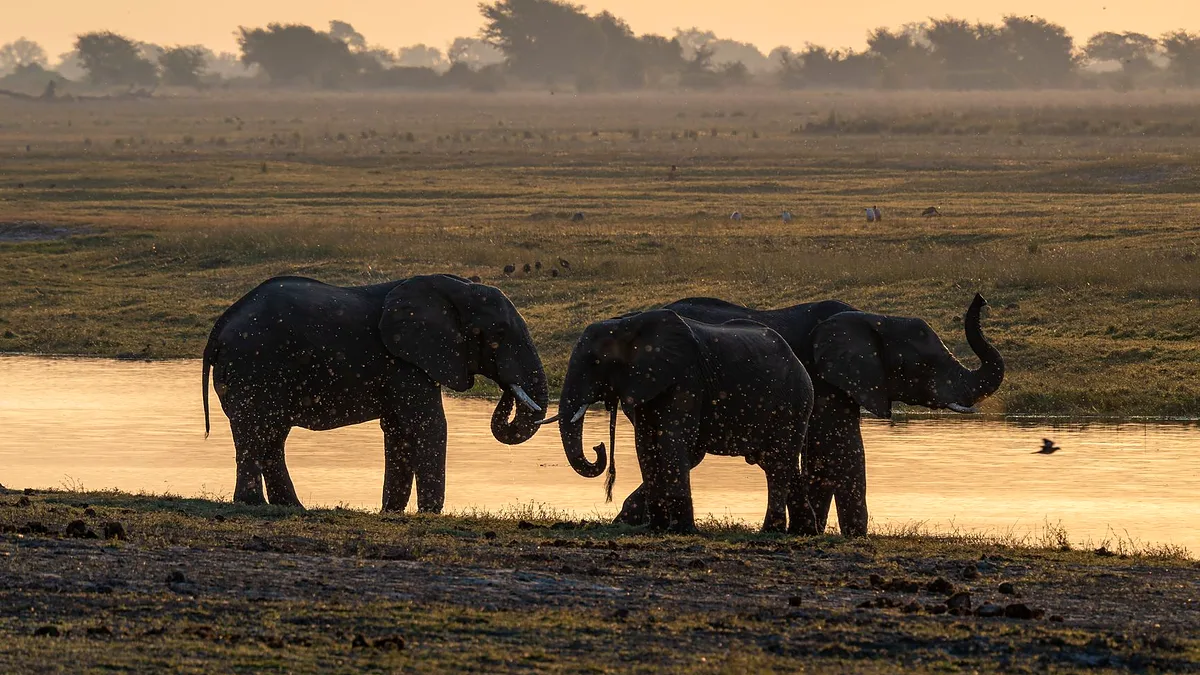
Drive the 12 km to the Nyamandhlovu Pan platform for 5 p.m. It is an elevated wooden deck over a pumped waterhole, and in the dry months it delivers elephant herds within twenty minutes. Bring a sundowner in a flask — glass bottles are not allowed outside your vehicle.
Back at camp, dinner is either the restaurant ($20–25) or a braai on your cottage's outdoor stand. Turn in early; tomorrow starts before dawn.
Route Efficiency Tip: Do the Painted Dog Centre and the supermarket on the way in, not as a separate outing. It sits outside the park gate, so a mid-trip detour would cost you two hours of driving for nothing.
Day 2: The Eastern Pans Circuit
Morning
Out of the gate at 5:45 a.m. for sunrise at Nyamandhlovu, then back for breakfast at 9. The light between 6 and 8 is when lions are still moving and the elephants come in to drink before the heat.
After breakfast, drive east to the Guvalala platform, about 12 km on sandy two-track. Coffee from a flask on the deck is the whole point of this itinerary.
Afternoon
Return to camp for lunch and a genuine nap — the middle of the day belongs to the animals, not to you. At 3 p.m. head out again toward Shapi Pan and Dom Pan, both within 25 km of camp.
Dom Pan has a small viewing platform and a reputation for sable antelope in the late afternoon. Give it the last ninety minutes of light.
Evening
Stay at Dom Pan for sunset with a cold drink from the cooler box. Drive back before the light goes — park rules require you in camp by gate closing, and the roads are sand, not tarmac.
Eat at camp and take a chair onto the veranda. The night noise at Main Camp is surprisingly good: hyena, pearl-spotted owlet, the occasional lion far off.
Route Efficiency Tip: Loop clockwise — Nyamandhlovu, Guvalala, Shapi, Dom — rather than doubling back. It is about 70 km total and never puts you on the same road twice in one day.
Day 3: North to Sinamatella and Mandavu Dam
Morning
One last sunrise loop around Nyamandhlovu, then breakfast and pack. Leave camp by 8 a.m. — the drive to Sinamatella is 120 km and takes three to four hours on park roads.
Take the northern route via Sinamatella Road rather than retracing your steps to the tar. The middle section is quiet, with very few vehicles and good odds of elephant bulls in the mopane.
Afternoon
Stop at Mandavu Dam for a packed lunch around 12:30. It is a concrete wall with a picnic shelter, and the birdlife along the shoreline is excellent — fish eagles, herons, and if you are lucky, a finfoot.
Reach Sinamatella by mid-afternoon and check into a self-catering cottage. These are older than Main Camp's and cheaper, roughly $60–90 / ~$60–90 USD per cottage per night, and the views are far better.
Evening
Walk to the terrace above the cliff for sunset. The whole valley drops away and you can usually pick out elephant moving along the base.
Cook in the cottage or eat at the small camp restaurant. There is no shop here, so whatever you bought in Hwange town is dinner.
Route Efficiency Tip: Do not attempt the Main Camp to Sinamatella drive in the late afternoon. The road is slow and the sand can be deep; arriving in the dark is how people get stuck.
Day 4: The Masuma Dam Hide
Morning
Leave at 6 a.m. for Masuma Dam, 25 km from Sinamatella. The hide is a double-storey thatched structure right on the water, and it is the single best wildlife seat in the park.
Sit there until 11 a.m. Do not talk loudly, do not stand up when elephants arrive. A flask of coffee and a bag of rusks will cover you.
Afternoon
Back to camp for a late lunch and a long siesta. At 3:30 p.m. drive to Deteema Dam, another 20 km on, for the second half of the day.
Both dams are pumped through the dry season, which is why the concentrations of game here are so high from August onward.
Evening
Return to the Sinamatella cliff terrace for sunset. It is a two-minute walk from the cottages, which makes it the easiest sundowner of the trip.
Dinner at the cottage, then sit outside for an hour. Sinamatella is quieter than Main Camp and the stars are worth staying up for.
Route Efficiency Tip: Masuma and Deteema sit on the same northbound road. Save fuel by doing them as one long day rather than two separate outings.
Day 5: Sunrise Loop and the Road Out
Morning
Take one last short drive on the Sinamatella loop road at sunrise, then breakfast and pack. Aim to be at the gate by 9:30 a.m.
The exit road runs about 40 km to the tar highway, then 100 km north to Victoria Falls. Budget two and a half hours total.
Afternoon
Stop in Hwange town for lunch, around $8–12 / ~$8–12 USD for a plate of sadza, beef and greens. It is not fancy and that is fine.
If your flight is late, detour to the Painted Dog Conservation centre again on the way past Dete — it takes under an hour and the staff remember returning visitors.
Evening
Arrive in Victoria Falls for sunset at the rainforest walk, or head straight to the airport. A final dinner at one of the Indaba-area restaurants will run $20–35 / ~$20–35 USD per person.
Route Efficiency Tip: Refuel in Hwange town before the airport run — the last stretch has no reliable station and you do not want to be bargaining for jerry cans.
Getting Around Hwange
There is no public transport inside the park, full stop. You either self-drive a high-clearance 4x4 or you book a camp vehicle with a guide. Self-drive is cheaper and gives you control over the pace, which is the whole point of this trip.
Roads are graded sand. They are fine in a 4x4 in the dry season and genuinely difficult in a sedan after rain. Keep to 40 km/h, never drive off the marked tracks, and carry two spare tyres plus a compressor.
Gate hours run roughly 6 a.m. to 6 p.m. and you must be inside camp by closing. Night driving is not permitted. Park fees for international visitors are around $30 per adult per day plus a vehicle fee of about $10 — keep the receipt, it covers re-entry on the same day.
If you fly in, road transfers from Victoria Falls run $180–250 per vehicle one way. Light-aircraft charters land at the Main Camp airstrip and at private concession strips.
Estimated Daily Budget Breakdown
Figures are per person per day, assuming two people sharing. Park fees, fuel and guided drives are the biggest variables.
| Travel Style | Accommodation | Food & Drink | Transit & Sights | Total / Day |
|---|---|---|---|---|
| Budget Backpacker | $15–25 (campsite) | $20–30 (self-catering) | $55–75 (park fees, fuel share) | $100–125 |
| Comfortable Mid-Range | $50–70 (park cottage, shared) | $40–55 | $80–110 (incl. one guided drive) | $180–235 |
| Boutique Splurge | $650–900 (private concession, all-inclusive) | Included | Included + $40–60 tips | $700–950 |
A note on cash: Zimbabwe runs on US dollars in practice. Bring clean notes printed 2009 or later, no tears, no tape. Local ZiG currency is accepted in towns but rarely inside the park.
Frequently Asked Questions
Do I need to book Hwange accommodation in advance?
Yes, and earlier than you think. Private concession camps for July to October are often full 9–12 months ahead. ZimParks cottages at Main Camp and Sinamatella are bookable directly and usually have space 2–3 months out, but the good cliff-side units at Sinamatella go first.
Can I self-drive inside the park?
Yes, and it is a genuinely good way to travel slowly. You need a high-clearance vehicle, a full tank, and a realistic sense of distance — 60 km here takes two hours. Off-road driving is banned, and rangers do enforce it.
What is the best season for a slow-paced trip?
Late July to early October gives you pumped waterholes, bare bush, and the highest game concentrations. If you want fewer people and lower rates, the green season from December to March is beautiful for birds and newborn animals — but check road conditions first and expect some tracks to be closed.
What should I not skip preparing?
Malaria prophylaxis, for a start — Hwange is a malaria area, especially November to May. Also pack binoculars per person, a head torch, and more water than you think. Mobile signal is patchy at best, so download offline maps before you leave Victoria Falls or Bulawayo.