
Quick Route Overview
This five-day route is built for travelers who would rather spend an afternoon with a papier-mâché artisan than tick off five beaches. The pace is moderate: two changes of base, one travel-heavy morning, and afternoons left deliberately loose so a long lunch doesn't wreck the plan.
It suits couples and solo travelers who are comfortable on regional trains, plus anyone visiting in low season who wants empty piazzas, working olive presses and seafood at half the summer price. If you need a car under your window every single day, you'll find it annoying. If you like trains, walking and the occasional short taxi, it fits well.
- Duration: 5 days / 4 nights
- Best season: late January to mid-March — mills still pressing in January, almond blossom from late February, almost no crowds
- Base plan: 1 night Bari (Vecchia Bari), 1 night Polignano a Mare, 2 nights Lecce (centro storico)
- Transit: Trenitalia regional trains on the Bari–Lecce line, FSE trains in Salento, plus a 48-hour car rental or a booked driver for the inland olive-grove day
- Winter reality check: beach clubs are shut, many masserie close midweek, and a few restaurants take January off entirely — always call ahead
Day 1: Bari Old Town — Focaccia, Fish and First Impressions
Morning
Land at Bari Karol Wojtyla (BRI) and take the FM2 train from the airport station straight to Bari Centrale — about 20 minutes and €5 (~$5.40). Drop bags at your B&B in Vecchia Bari or use the paid luggage lockers at the station (€4–6 per bag for the day).
Unlimited High-Speed International Travel eSIM
Connect in seconds across 180+ destinations. Instant QR code activation with zero roaming surcharges.

Start walking at Strada del Carmine, where women still roll orecchiette on wooden boards outside their doorways. Buy a slab of focaccia barese from Panificio Fiore — get there before 13:00 — and eat it standing up like everyone else. It costs about €2.50 (~$2.70) and it is the correct first meal.
Afternoon
Walk five minutes to the Basilica di San Nicola, open roughly 7:00–13:00 and 16:00–19:30, free entry. Then loop down to the Castello Svevo (€6 / ~$6.50) and the Teatro Margherita on the water.
Lunch is orecchiette alle cime di rapa in one of the small trattorias off Piazza Mercantile — expect €12–15 (~$13–16) with a glass of house wine. Follow it with a slow coffee and a walk along the Lungomare Nazario Sauro.
Evening
Sunset from the lungomare is the best free show in the city; in winter it lands around 17:00. For dinner, stay in the old town for raw seafood and grilled fish at Molo San Nicola — budget €30–40 (~$32–43) per person with wine.
Finish with a nightcap in Piazza Mercantile. It's quiet in winter, which is exactly the point.
Route Efficiency Tip: Everything on Day 1 sits inside a 600-metre radius of Piazza Mercantile. Don't bother with buses after the airport train — you'll walk more slowly than you'd expect on the polished limestone.
Day 2: Polignano a Mare and Monopoli — Cliff Towns by Train
Morning
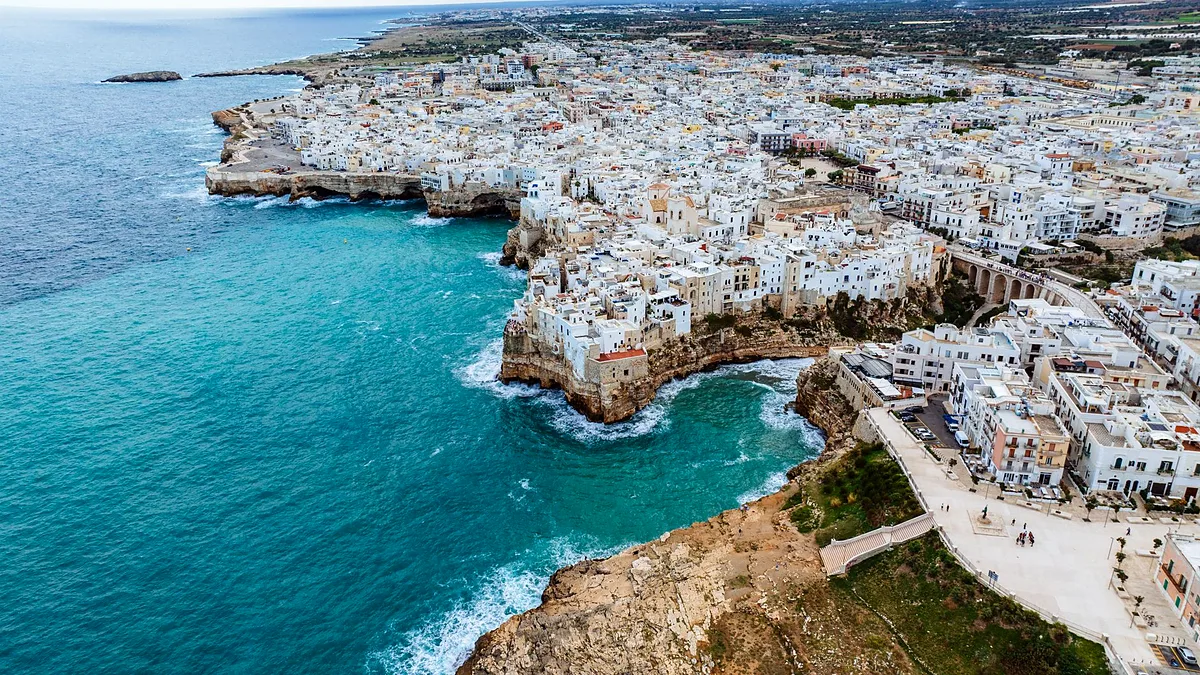
Catch a regional train from Bari Centrale to Polignano a Mare: 25 minutes, roughly €3.50 (~$3.80), trains every 30–60 minutes on weekdays. Drop your bag at the hotel and walk ten minutes to Lama Monachile, the gorge beach under the bridge.
Coffee and a panzerotto at Il Mago del Gelo in the old town, about €3 (~$3.25). Then find the Domenico Modugno statue on the seafront — the town's most famous son, mid-song, arms wide.
Afternoon
Lunch on a terrace above the water: €18–25 (~$19–27) for a seafood pasta. In winter the terraces are half-empty, so you can actually get the table you came for.
Take the 8-minute train to Monopoli (€1.50 / ~$1.60) and walk the old port, the Cathedral of Maria Santissima della Madia, and the palm-lined lungomare. It's a working harbor town, not a stage set, and it feels noticeably less polished than Polignano.
Evening
Come back to Polignano for sunset from the Balconata sul Mare. Dinner is simple: a plate of sea urchin or crudo with a bottle of Locorotondo white, €30–35 (~$32–38).
Sleep in Polignano tonight — it makes tomorrow's inland run shorter.
Route Efficiency Tip: Polignano and Monopoli are 8 minutes apart on the same line, so do them in one direction and don't backtrack. Both stations sit within a 10-minute walk of the historic centre.
Day 3: Olive Country — Frantoio Visit and Ostuni's White Lanes
Morning
This is the day that genuinely needs wheels. Pick up a small rental car in Polignano or Monopoli the night before (€30–45 / ~$32–48 per day in winter, plus ~€30 one-way drop fee if you leave it in Lecce).
Drive 30 minutes to a working frantoio outside Ostuni. January is still pressing season, so you can watch the harvest go in and taste the new oil straight from the tap — grassy, peppery, and nothing like the supermarket bottle. Book a tour a week ahead; most charge €15–25 (~$16–27) including tastings.
Afternoon
Drive into Ostuni and park outside the walls (blue-line parking, about €1.50/hour). Walk up to the Cattedrale di Santa Maria Assunta and get lost in the whitewashed lanes below it.
Lunch at Osteria del Tempo Perso, tucked into a cave-like room near the cathedral — €30–35 (~$32–38) for antipasti, a primo and wine. If you'd rather splurge, Masseria Il Frantoio outside town does a set lunch built around its own oil, roughly €55 (~$59), booking essential.
Evening
Drive or train down to Lecce (about 50 minutes by car, or 50 minutes by train from Ostuni station plus a 3 km bus into town — a hassle with bags, which is why the car earns its money).
First walk: Piazza del Duomo at dusk, then dinner in the centro storico for €25–35 (~$27–38).
Route Efficiency Tip: Ostuni's train station sits 3 km below the town — the shuttle bus is infrequent on winter Sundays. If you're car-free, take the train to Ostuni, then a taxi up (€10 / ~$11) and pre-book the return.
Day 4: Lecce — Papier-Mâché Masters and Baroque Stone
Morning
Start at the Basilica di Santa Croce, open from about 9:00, where the facade is so densely carved it looks frosted. Then walk ten minutes to the Roman amphitheatre in Piazza Sant'Oronzo.
Coffee and a pasticciotto at Caffè Alvino on the piazza — the almond custard tart is €1.20 (~$1.30) and the espresso is a ritual.
Afternoon
This is the artist day. Lecce's cartapesta (papier-mâché) workshops cluster on Via Palmieri and Via degli Ammirati, mostly open 9:30–13:00 and 16:00–19:30, Monday to Saturday. Walk in, watch a Nativity figure being built from wire, glue and newspaper, and buy a small piece for €20–60 (~$22–65).
For context, visit the Museo della Cartapesta inside the Castello di Carlo V (€5 / ~$5.40). Lunch is a rustico leccese — puff pastry, tomato, béchamel and mozzarella — for €2 (~$2.20) from any bakery counter.
Evening
Sunset from the city walls near Porta Napoli, then an olive oil and Negroamaro tasting at one of the small enoteche around Vico dei Bolognesi (€15–20 / ~$16–22 for a guided flight).
Dinner at a Salento osteria for ciceri e tria (pasta and chickpeas) or a seafood crudo, €30–40 (~$32–43) with wine. The passeggiata along Via Vittorio Emanuele II runs late even in February.
Route Efficiency Tip: Santa Croce, Sant'Oronzo, the amphitheatre and the cartapesta streets form a single 15-minute loop. Do not cross town twice — park once and walk.
Day 5: Otranto and the Adriatic Edge
Morning
Take the FSE train from Lecce to Otranto — about 1 hour 5 minutes, €3.50 (~$3.80), a handful of departures daily, so check the timetable the night before. Go straight to the Cathedral of Santa Maria Annunziata to see the 12th-century mosaic floor of the Tree of Life; it's open mornings and late afternoons and entry is free.
Climb the Castello Aragonese walls (€5 / ~$5.40) for the view over the harbor.
Afternoon
Lunch on the harbor front: grilled fish by the kilo or a plate of fave e cicoria, €25–30 (~$27–32). Then walk the Lungomare and, if you have a car, drive 20 minutes to Punta Palascìa, the easternmost point of Italy, where the lighthouse looks across to Albania.
In winter the sea here is grey-green and completely empty — the whole reason to come in this season.
Evening
Return to Lecce by train, or head straight to Brindisi: the station is 15 minutes from the airport by local bus (€1.50 / ~$1.60). If your flight is next morning, spend a fifth night in Otranto and catch the early bus.
Final nightcap: a glass of Primitivo di Manduria in Lecce's centro storico, €5–7 (~$5.40–7.60).
Route Efficiency Tip: Otranto and Brindisi sit on different lines. If you're flying out the same day, go Otranto → Lecce → Brindisi rather than trying a coastal shortcut that doesn't exist by rail.
Getting Around Puglia
Regional trains are cheap and reliable on the coast but thin inland. Trenitalia covers Bari–Polignano–Monopoli–Ostuni–Brindisi–Lecce; FSE handles Lecce–Otranto, Lecce–Gallipoli and most of Salento. Buy tickets from machines or a tabaccheria, and validate the paper ones on the platform.
A car earns its keep only for the inland olive-grove and masseria day. Rental rates drop to €30–45 (~$32–48) per day in winter; fuel is around €1.80/litre. Watch for ZTL cameras in Lecce and Bari old towns — they will ticket you weeks after you get home.
Walking is the main mode everywhere else. Sidewalks in the historic centres are uneven limestone, so bring shoes with grip, and carry a small umbrella between November and March.
Skip if you're short on time: Gallipoli in winter is largely boarded up, and Alberobello's trulli are pretty but deeply commercial — pick one, not both.
Estimated Daily Budget Breakdown
| Travel Style | Accommodation | Food & Drink | Transit & Sights | Total / Day |
|---|---|---|---|---|
| Budget Backpacker | €40 (~$43) | €30 (~$32) | €15 (~$16) | €85 (~$92) |
| Comfortable Mid-Range | €95 (~$103) | €55 (~$59) | €30 (~$32) | €180 (~$194) |
| Boutique Splurge | €220 (~$238) | €110 (~$119) | €70 (~$76) | €400 (~$432) |
Winter pricing is the quiet advantage here: the same masseria suite that runs €280 in July sits near €140 in February, and restaurant bills drop by roughly a third.
Frequently Asked Questions
Do I need to book restaurants and masserie in advance in winter?
Yes, but only a little. Popular Lecce and Ostuni dining rooms fill on Friday and Saturday nights, and masserie that stay open in January usually require 24–48 hours' notice. Weekday lunches you can usually walk into.
Can I do this route without a car?
Almost. Days 1, 2, 4 and 5 work entirely on trains. Day 3's olive mills need either a rental car for 48 hours or a pre-booked driver (€120–150 / ~$130–162 for a half day). The trains themselves are the more relaxing option overall.
What's the weather actually like?
Expect 8–14°C (46–57°F), bright spells mixed with rain, and a cold wind off the Adriatic. Pack a waterproof jacket, layers and grippy shoes; the limestone gets slick. Snow is rare on the coast but does dust the inland hills.
Where do I leave luggage on changeover days?
Bari Centrale and Lecce station both have paid lockers (€4–6 / ~$4.30–6.50 per bag), and most B&Bs will hold bags after checkout at no charge. Ostuni has no station lockers, which is another argument for driving that day.