
Pokhara rewards travelers who slow down. Most people treat it as a pit stop before a trek, spend one night on Lakeside, and leave without ever seeing the old bazaar where the town's real working life happens. This five-day route flips that: mornings for mountains and museums, afternoons in craft lanes and Newari courtyards, evenings back at the water for sunset and dinner.
The pace is deliberately gentle — two or three stops a day, no early buses except one sunrise run to Sarangkot. You'll walk a lot, eat well, and spend maybe $40–60 per person on transport and entry tickets across the whole trip if you use taxis sensibly.
Quick Route Overview
This itinerary suits slow travelers, couples, solo walkers and anyone who'd rather spend an hour in a brass shop than sprint through a checklist. You need average fitness — the only real climb is the stair path up to the World Peace Pagoda — and no gear beyond broken-in shoes.
Unlimited High-Speed International Travel eSIM
Connect in seconds across 180+ destinations. Instant QR code activation with zero roaming surcharges.

Do bear in mind Pokhara is a valley town, not a mountain village. Dust, honking and patchy footpaths are part of the deal, and the lakefront is more commercial than the postcards suggest. The old bazaar and the southern museum belt are where the texture is.
- Duration: 5 days, 4 nights
- Best season: October–November for clear Annapurna views; March–April for warmer days and rhododendrons
- Recommended base: North Lakeside (Baidam/Khahare) for quiet nights and walkable dinners — or Old Pokhara if you want culture on your doorstep
- Transit method: Taxis and walking by day, local buses for Begnas, one shared jeep for sunrise
Day 1: Lake Orientation and the Island Temple
Morning
Start flat and easy on the Lakeside promenade. Grab an espresso and a set breakfast at one of the Baidam Road cafés (around 500 NPR / ~$3.75) and walk north toward Khahare — roughly 2 km, 25 minutes at a stroll. This is the flattest, best-lit stretch in Pokhara, so use it to shake off the bus.
Afternoon
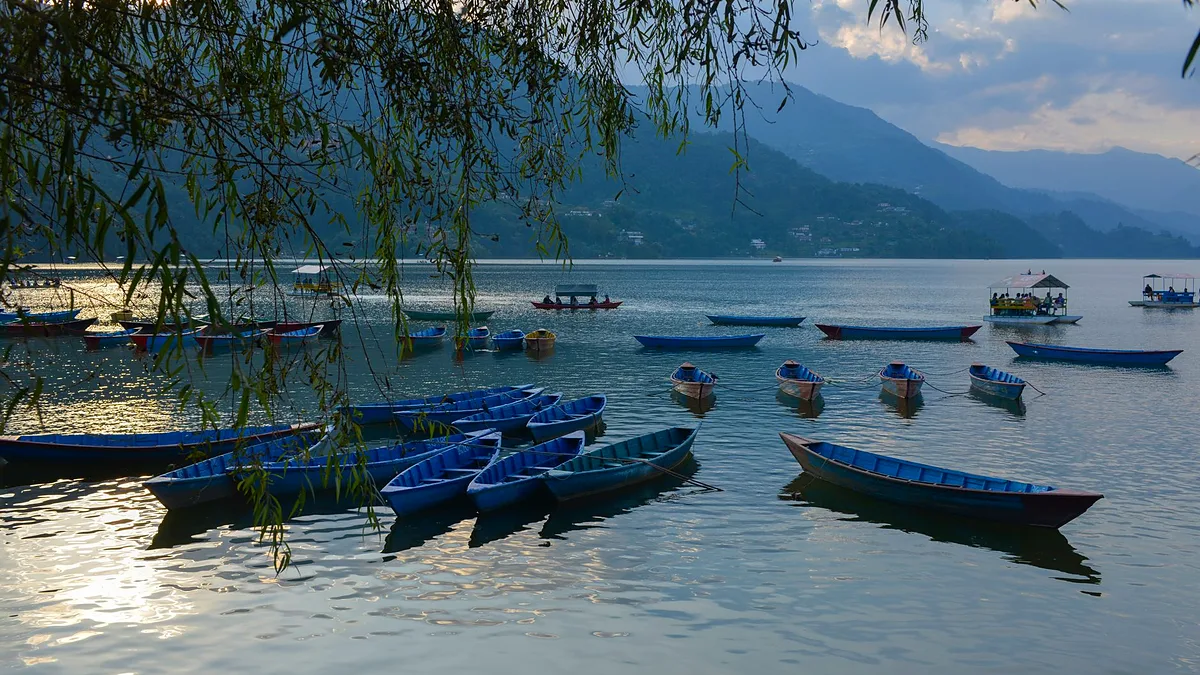
Head to the Baidam boat station opposite the lake. A rowed boat to Tal Barahi Temple and back costs about 1,000 NPR (~$7.50) for the boat, not per person; self-paddle boats run roughly 600 NPR an hour. The two-tiered pagoda on the island is free to enter and takes fifteen minutes. Lunch afterwards at Moondance Restaurant on Baidam Road — expect 700–900 NPR (~$5–7) for a proper sit-down meal.
Evening
Sunset is best from the northern end of the lake near Khahare, where the Annapurna reflections show up on clear evenings. Then eat where the locals do: a plain dal bhat bhojanalaya one street back from the water costs 350–450 NPR (~$2.60–3.40) with refills. Walk the promenade back to your guesthouse — it stays lit and busy until about 10pm.
Route Efficiency Tip: Everything on Day 1 sits within 2.5 km of the lake's eastern shore. Don't take a taxi at all; save your fare for Sarangkot later in the week.
Day 2: Old Pokhara Bazaar and the Craft Lanes
Morning
Take a taxi to Old Pokhara Bazaar (400–600 NPR / ~$3–4.50, 15 minutes from Lakeside) and arrive by 9am, before the shops get busy. Start with a chiya at a bazaar tea stall (50 NPR) and walk Bhimsen Tol, where the 18th-century Bhimsen Temple anchors a lane of brassworkers, goldsmiths, dhaka-topi tailors and khukuri knife shops. Ask before photographing anyone's workshop.
Afternoon
Walk ten minutes uphill to Bindhyabasini Temple, open roughly 5am–8pm, free entry, with a stone courtyard and good valley views. Lunch on a Newari set — bara, chhoyla and beaten rice — for around 450 NPR (~$3.40) at one of the small bazaar eateries. Then cool off in the Pokhara Regional Museum or the small Annapurna Butterfly Museum at Prithvi Narayan Campus (about 100 NPR each; both usually closed Saturdays).
Evening
Walk to the K.I. Singh Bridge over the Seti River Gorge, where the river disappears into a slot barely three metres wide — free, and genuinely startling. Sunset from the bridge is short but dramatic. Dinner back at Lakeside: a Thakali set with black lentils, gundruk and timur-spiked pickle runs 600–800 NPR (~$4.50–6).
Route Efficiency Tip: The bazaar, Bindhyabasini and the Seti gorge all sit inside a 1.5 km triangle. Do them on foot in that order and only use one taxi for the return leg.
Day 3: Mountain Stories and the Tibetan Settlement
Morning
Taxi 20 minutes south to the International Mountain Museum (open 9am–5pm, 500 NPR / ~$3.75). Give it two hours — the climbing history rooms and the Sherpa exhibit are the highlight, and the scale model of the Annapurna range helps you read the skyline for the rest of the trip. Coffee at the museum café, 250 NPR.
Afternoon
Continue to the Gurkha Memorial Museum near the airport road (about 300 NPR; closed Saturdays), which tells the regimental story through medals, uniforms and letters — quieter and more moving than it sounds. Lunch nearby for 400–600 NPR, then head to the Tashi Ling Tibetan settlement at Chhorepatan. The carpet workshops and incense stalls are open to visitors, and the momos are the best value in town at 200 NPR a plate.
Evening
Fit in Davis Falls (100 NPR) and the Gupteshwor Mahadev cave beneath it (100 NPR) before 5pm, then return to Damside for sunset over the lake's southern end. Dinner at a rooftop place on Baidam Road — OR2K or Fresh Elements both do good vegetarian plates for 600–900 NPR.
Route Efficiency Tip: The mountain museum, Gurkha museum, Tashi Ling, Davis Falls and the cave all fall along one 4 km southern loop. Book one taxi for the afternoon (roughly 2,000 NPR / ~$15) instead of hailing four separate ones.
Day 4: Sarangkot Sunrise and the Peace Pagoda
Morning
Leave at 4:45am by pre-booked taxi (1,800–2,200 NPR / ~$13–16 round trip) or a shared jeep from Lakeside (about 300 NPR per seat). Sunrise over the Annapurna wall lands between 5:30 and 6:15 depending on season; the viewing platform charges 100 NPR. Breakfast of boiled eggs and milk tea at a ridge shack costs 250 NPR. Fit travelers can walk down to Kaskikot in about 2.5 hours.
Afternoon
From Sarangkot, take the same taxi to the World Peace Pagoda road head, or hike across if you're feeling strong. The stupa is free, open 5am–6pm, and the ridge behind it has the best free view of the whole lake. Lunch at one of the ridge cafés for 500 NPR, then walk down the stone steps to Damside — 45 minutes, steep and slippery after rain.
Evening
Watch the light drop behind the hills from the lake's western shore, then take a boat back across (about 800 NPR / ~$6). Splurge dinner on grilled fish or a proper Thakali spread for 900–1,200 NPR, and finish with a nightcap on a Baidam rooftop bar where the music stays low until about 11pm.
Route Efficiency Tip: Sarangkot and the Peace Pagoda sit on the same ridge line. Taxi up, walk down, and you'll never backtrack through town.
Day 5: Begnas Lake and Last-Minute Craft Shopping
Morning
Take a local bus from Prithvi Chowk to Begnas Lake — about 60 NPR (~$0.45), 40 minutes — or a taxi for 1,500 NPR return. Walk the eastern embankment and the ridge path above the water for an hour; it's quieter, greener and far less built-up than Phewa. Coffee at a lakeside shack, 150 NPR.
Afternoon
Begnas is fish country. A whole fried fish with rice and greens at a lakeside hut costs 600–800 NPR and beats most Lakeside restaurants. If you have energy left, hire a kayak for an hour (500 NPR). Head back to Pokhara by 3pm to leave time for shopping.
Evening
Do your final buying at a handicraft cooperative rather than the promenade souvenir shops: lokta paper notebooks (300–500 NPR), dhaka fabric by the metre (700 NPR) and pashmina shawls from 2,500 NPR. If you'd rather cook than shop, a momo-making class runs 2,000–3,000 NPR and includes dinner. End with one last Thakali meal and a slow walk along the lake.
Route Efficiency Tip: Buses to Begnas leave from Prithvi Chowk, which is also the closest transport hub to Old Pokhara — combine the lake trip with any last bazaar errands on the way back.
Getting Around Pokhara
There's no metro or ride-share network worth relying on; inDrive and Pathao work intermittently, so most people use street taxis. Fares are negotiated, not metered — agree the price before you get in. Lakeside to Old Pokhara is 400–600 NPR, Lakeside to the airport 500–700 NPR.
Local buses and tempos are cheap (30–60 NPR) but slow and crowded at peak hours. Scooter rentals run 900–1,300 NPR a day and require an international driving permit plus a helmet; police checkpoints on Lakeside Road are common. Bicycles cost 300–500 NPR a day and are ideal for the flat lakeside strip. Walking after dark is fine on the promenade, but carry a torch for old-town lanes where the paving breaks up.
Estimated Daily Budget Breakdown
| Travel Style | Accommodation | Food & Drink | Transit & Sights | Total / Day |
|---|---|---|---|---|
| Budget Backpacker | 1,200–1,800 NPR ($9–14) | 1,000–1,400 NPR ($8–11) | 600–900 NPR ($5–7) | 2,800–4,100 NPR ($21–31) |
| Comfortable Mid-Range | 4,500–6,500 NPR ($34–49) | 2,200–3,000 NPR ($16–22) | 1,200–1,800 NPR ($9–13) | 7,900–11,300 NPR ($59–84) |
| Boutique Splurge | 12,000–20,000 NPR ($90–150) | 4,000–6,000 NPR ($30–45) | 2,500–4,000 NPR ($19–30) | 18,500–30,000 NPR ($139–224) |
Frequently Asked Questions
Do I need to book boats, taxis or paragliding in advance?
Boats and taxis are turn-up-and-go; no booking needed. Paragliding from Sarangkot (8,000–12,000 NPR) should be booked a day ahead in peak October–November, and only through a company registered with the Nepal Air Sports Association.
Can I store luggage in Pokhara?
Yes. Almost every Lakeside guesthouse holds bags free or for 100–200 NPR a day while you trek, and there are paid lockers at several trekking gear shops on Baidam Road. Bring a padlock and photograph your bag tag.
When is the best time to visit?
October and November give the crispest mountain views and stable weather. March and April are warmer but hazier. Avoid June to September unless you like leeches and landslide delays; December to February is cold in the mornings but wonderfully clear and quiet.
Do I need permits for this itinerary?
No. Everything here sits inside Pokhara city and the surrounding valley, so no ACAP or TIMS permit is required. You only need those if you extend into the Annapurna Conservation Area for a trek.