
Quick Route Overview
This four-day Milos route is built for the quiet season: short bus hops, long coastal walks, and no sprinting to catch a boat that is not sailing anyway. It suits independent travelers who would rather see three places properly than eight badly, and who do not mind eating dinner at 7 p.m. because the kitchen shuts at nine.
Every day is grouped by geography, so you never pay twice for the same stretch of road. All buses leave from one hub, Adamas, which is exactly why you should sleep there instead of in prettier Plaka. Each day ends with a short summer swap, so the plan still works if you come back in June.
- Duration: 4 days, 3 nights
- Best season: Late November to March for empty landscapes and half-price rooms; late May to June and September for the same route with swimming
- Recommended base: Adamas (Adamantas) — the port, the bus hub and the only district with year-round open kitchens
- Transit method: KTEL Milos buses plus walking, with one or two short taxi hops
Day 1: Adamas, Papikinou Bay and the Lay of the Land
Morning
Arrive by ferry into Adamas, or by plane into Milos National Airport, four kilometres south. The airport bus meets most flights and drops you at the port in about ten minutes for €2 (~$2.20); a taxi is €15–20 (~$17–22).
Unlimited High-Speed International Travel eSIM
Connect in seconds across 180+ destinations. Instant QR code activation with zero roaming surcharges.

Leave your bags at the guesthouse — message ahead and most winter hosts will let you check in early — then walk the harbour front. Your first coffee costs €3–4 (~$4) anywhere on the waterfront, and the ferry office window is the place to photograph the bus timetable before you forget.
Afternoon
Walk fifteen minutes west to Papikinou beach, the sandy bay locals actually use in winter. It is free and unorganised at this time of year, and it gives you a first look at the island's volcanic geology without spending a cent on transport.
Lunch back in Adamas: grilled sardines, a Greek salad and bread comes to about €15–18 (~$17–20) with water. Ask what the day's fish is before you sit down — winter menus run on whatever the boats brought in.
Evening
Sunset over the water from the quay, then a slow loop past the fishing caiques and the back lanes behind the church. For dinner, ask your host which kitchens are open that week; winter openings rotate and review sites are out of date by November. Budget €20–25 (~$22–28) a head with house wine, and expect most cafés to close by midnight.
Route Efficiency Tip: Do not save Adamas for later. Days 3 and 4 both start and end at this port, and the bus departure point sits directly opposite the ferry quay. Summer swap: take the evening Sarakiniko bus for sunset instead of the harbour walk.
Day 2: Plaka, Trypiti and the Walk Down to Klima
Morning
Take the Adamas–Plaka bus (€2, about fifteen minutes, roughly hourly in winter and half-hourly in summer) up to the island capital. Plaka is a whitewashed village on a hill with a Venetian castle on top, and forty minutes is enough to walk the whole thing slowly.
Coffee on the platia, €3.50 (~$4), then climb to the Kastro for the view across the whole west coast. It is free, always open, and best before the day-trip crowds arrive in summer.
Afternoon
Drop into the Archaeological Museum of Milos in Plaka (about €3; closed one weekday, usually Tuesday, with short winter hours). It holds the plaster cast of the Venus de Milo — the original is in the Louvre — plus the island's obsidian story, which explains why people have lived here for 11,000 years.
Walk fifteen minutes downhill to Trypiti for the Catacombs of Milos (€5) and the Ancient Theatre, which is free and always accessible. Winter hours at the catacombs are genuinely unreliable, so check the sign in Plaka first. Lunch is a gyros or souvlaki in Plaka for €5–8 (~$6–9).
Evening
Twenty minutes before sunset, walk down the paved path from Trypiti to Klima, the strip of painted boat garages with balconies over the water. Sit on the rocks with a drink from Astakas taverna if it is open, or bring your own — the sunset is the point, not the service.
Walk back up in daylight or with a phone torch; the path is unlit and the last stretch is steep. A taxi from Plaka back to Adamas is €10–12 (~$11–13).
Route Efficiency Tip: Plaka, Trypiti and Klima sit on one downhill line. Do them in that order and you never climb twice — going the other way in the dark is miserable.
Day 3: Sarakiniko, Mandrakia and Firopotamos on Foot
Morning
Walk the road north-east to Sarakiniko, about fifty minutes from Adamas, or take a taxi for €10 (~$11). In winter the Pollonia bus sometimes drops at the Sarakiniko junction — ask the driver — but do not build a plan around it.
Give the white rock formations two hours. There is no shade, no shop and no tap, so carry water. The smooth limestone and shipwreck-shaped inlets look best in low morning light, and you will have them almost to yourself.
Afternoon
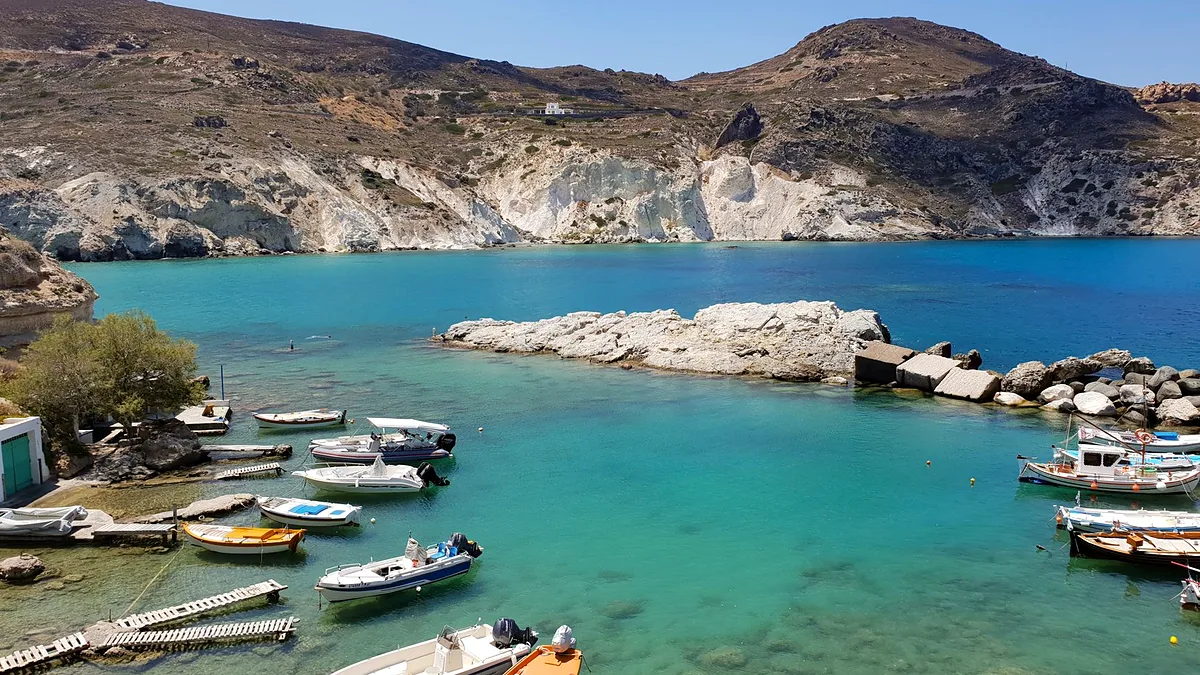
Continue on foot about two kilometres east to Mandrakia, a tiny syrmata harbour where the boat garages have coloured doors and the swimming is straight off the concrete. The fish taverna there is seasonal and usually shut between November and April — pack a bakery lunch from Adamas (€6–8) just in case.
Then follow the coast road roughly three kilometres to Firopotamos, another syrmata hamlet built around a small sandy cove. It is the quietest of the three and the one most people skip.
Evening
Walk back to Adamas (about forty-five minutes) or call a taxi for €12–15 (~$13–17). Dinner at a year-round taverna in Adamas costs €18–25 (~$20–28), followed by an early night if you are catching a morning boat.
Route Efficiency Tip: Sarakiniko, Mandrakia and Firopotamos sit on a single arc north-east of the port, so walk one direction only. Summer swap: swim at Firopotamos and take the afternoon Pollonia bus back rather than retracing the road.
Day 4: Pollonia and the Kimolos Hop
Morning
The Adamas–Pollonia bus takes twenty to twenty-five minutes and costs about €2.50 (~$2.75); winter runs are timed around school and ferry arrivals, so confirm return times on the KTEL Milos site before you leave. Pollonia is a fishing village with a working harbour and a strip of cafés behind it.
Coffee at the port, then take the small Pollonia–Kimolos ferry if the weather allows — roughly twenty to thirty minutes, €3–5 (~$3–6), a few sailings a day year-round. Kimolos is even quieter than Milos: Chorio, the hill village, and Psathi, the harbour, are a two-hour wander.
Afternoon
Back in Pollonia for a late seafood lunch, €20–30 (~$22–33) with a glass of something local. The tavernas on the water are pricier than Adamas, so check the day's price per kilo before ordering fish.
If the Kimolos boat is cancelled — winter wind does that — walk the headland path north of the village instead and come back for lunch. There is a small beach on either side of the port.
Evening
Take the 16:00 or 17:00 bus back to Adamas with time to collect bags before a ferry or flight. If you are staying a fourth night, the sunset from the Pollonia breakwater is worth the wait, and dinner back in Adamas will be cheaper.
Route Efficiency Tip: Pollonia is a dead-end spur off the main road, so it is a there-and-back by design. Save it for departure day — it is only twenty minutes from the port.
Getting Around Milos
KTEL Milos runs the island's buses from a stand opposite the Adamas ferry quay. Single fares are €1.70–2.50 (~$2–2.75), paid in cash to the driver, and printed timetables go up at the port kiosk each season. Winter services follow school schedules, which means the 8 a.m. and 2 p.m. departures are the reliable ones.
Taxis are few. The rank is by the port, local hops run €10–20, and you should book anything before 8 a.m. the night before. Outside Adamas there are no pavements, so walk facing traffic, wear something visible and carry a light.
A rental car only makes sense if you want Thiorichia (the old sulphur mine, rough 4x4 track) or the southern beaches at Firiplaka and Tsigrado. Winter rates start around €25–35 (~$28–39) a day including basic insurance.
Book ferries from Piraeus two to three weeks ahead in winter. Conventional boats take about five hours and cost €40–45 (~$44–50); fast ferries cut it to under three hours for €60–75 (~$66–83). Flights from Athens take 45 minutes.
Estimated Daily Budget Breakdown
Figures are per person, per day, in low season, assuming two people sharing a room.
| Travel Style | Accommodation | Food & Drink | Transit & Sights | Total / Day |
|---|---|---|---|---|
| Budget Backpacker | €40–55 (~$44–60) | €20–30 (~$22–33) | €8–15 (~$9–17) | €70–100 (~$77–110) |
| Comfortable Mid-Range | €80–130 (~$88–143) | €40–60 (~$44–66) | €15–30 (~$17–33) | €135–220 (~$150–242) |
| Boutique Splurge | €180–280 (~$198–308) | €70–110 (~$77–121) | €40–80 (~$44–88) | €290–470 (~$320–517) |
Frequently Asked Questions
Do I need to book anything in advance?
Ferries and flights, yes — winter sailings are limited and the cheap seats go first. Rooms can wait until a week out in low season, though the handful of year-round hotels in Adamas fill on holiday weekends. The Kleftiko boat trips run roughly May to October and are worth booking two or three days ahead in summer.
Can I store luggage on my last day?
Almost every guesthouse in Adamas will hold bags after checkout at no charge; ask the night before. If you are sailing with the same company, the ticket offices near the quay will often keep them for a couple of hours. There are no public lockers at the port.
When is the best time to do this route?
Late May to mid-June and September give you warm sea, running boats and quiet roads at the same time. July and August bring meltemi wind, packed buses and doubled prices. Winter is the cheapest and emptiest option, but expect shut tavernas and no beach buses.
Is Milos doable without a car?
Yes, if you stick to the bus corridors — Adamas, Plaka, Trypiti, Pollonia and, in summer, Paleochori and Provatas. You need wheels for Thiorichia, the far south beaches and the west coast at Agios Konstantinos, or a lot of patience with taxis.