
Quick Route Overview
This three-day Kanazawa plan is for travelers who want a calm, culture-first pace: two or three big sights a day, long lunches, and enough slack to duck into a tea house when it rains. It suits couples, solo walkers, and friends who don't mind 15,000–20,000 steps but hate feeling rushed. If you want clubs open until 2am, Kanazawa will feel quiet; if you want gardens, crafts, and serious seafood, it fits.
Base yourself in Korinbo or Katamachi. You'll be walkable to Kenrokuen, the castle, and dozens of dinner spots, and buses to Higashi Chaya and Nagamachi run often. Stay near Kanazawa Station only if you have an early train; it's handy but less atmospheric at night.
- Duration: 3 full days; 4 nights gives you a buffer for rain.
- Best season: Late March to early April for cherry blossoms; November for autumn leaves and crab. Skip Golden Week (late April to early May) if crowds bother you.
- Recommended base: Korinbo or Katamachi; Kanazawa Station for early departures.
- Transit: Walk plus Hokutetsu buses; a Loop Bus day pass costs ¥600 (~$4). No car needed.
Day 1: Gardens, Castle Walls, and Contemporary Art (Kenrokuen & Korinbo)
Morning
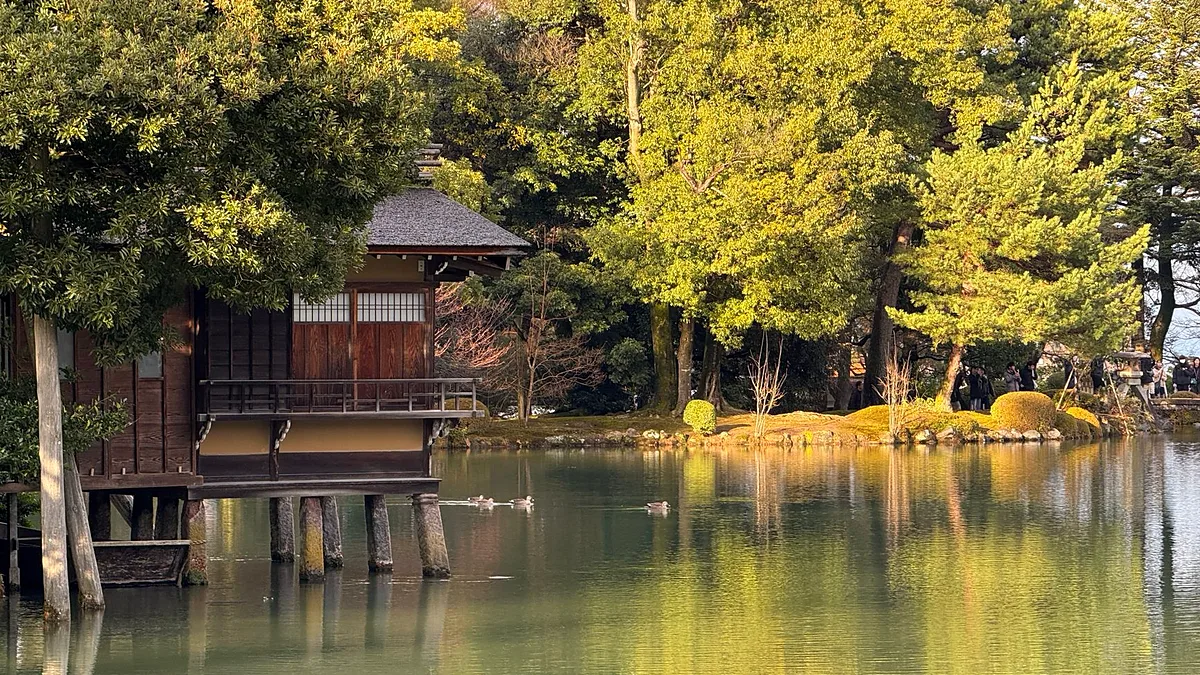
Start at Kenrokuen when the gates open—7:00am from March to October, 8:00am from November to February. Entry is ¥320 (~$2), and the first hour is worth the alarm: tour groups arrive around 9:30am, and the pine-lined paths feel completely different before then. Walk 10 minutes to Kanazawa Castle Park next door; the grounds are free, and the restored Hishi Yagura and Gojukken Nagaya storehouses cost ¥320 (~$2) if you want the interior tour.
Unlimited High-Speed International Travel eSIM
Connect in seconds across 180+ destinations. Instant QR code activation with zero roaming surcharges.

Grab coffee after the garden at one of the old-school kissaten near Korinbo crossing; expect ¥450–600 (~$3–4) for a drip coffee and toast set. Walk downhill toward Korinbo—it's about 15 minutes on flat streets.
Afternoon
Spend the middle of the day at the 21st Century Museum of Contemporary Art. It's open 10:00am–6:00pm, closed Mondays (if Monday is a holiday, it opens and closes the next day); permanent collection entry is ¥450 (~$3), special shows cost extra. The famous swimming-pool installation is free to see from above, but the paid galleries are worth it if you like modern art. For lunch, walk 5 minutes to Champion Curry in Korinbo for a Kanazawa-style curry plate at ¥800–1,100 (~$5–7).
After lunch, choose one nearby culture stop: the D.T. Suzuki Museum (9:30am–5:00pm, closed Mondays, ¥310/~$2) for quiet water-mirror architecture, or Seisonkaku Villa (9:00am–5:00pm, ¥700/~$5) for a look at a samurai family's formal rooms. Both are within a 10-minute walk of the 21st Century Museum.
Evening
For sunset, walk back toward Kanazawa Castle's stone walls or cross the Sai River bridge near Katamachi. The light hits the castle's white storehouses nicely, and you avoid the evening queue at Kenrokuen. Dinner in Katamachi's izakaya lanes: expect ¥3,000–4,500 (~$20–30) per person with a drink or two. Try local oden, jibuni (duck stew), or grilled fish.
Finish with a short walk along the Sai River. It's a low-key nightcap area, not a party street, so you'll be back at your hotel by 10pm without feeling like you missed anything.
Route Efficiency Tip: Keep Day 1 inside the Kenrokuen–Korinbo–Katamachi triangle. Everything is a 5–15 minute walk, so you won't need a bus until Day 2. If it rains, swap the castle interior for the 21st Century Museum and save the garden for the next morning.
Day 2: Tea Houses, Market Breakfasts, and Gold Leaf (Higashi Chaya & Omicho)
Morning
Get to Omicho Market by 9:00am, when most stalls are fully open (a few close on Wednesdays, and nearly all shut by 5:00pm). From Kanazawa Station it's a 15-minute walk or a 5-minute bus ride; from Korinbo, walk 10 minutes. Breakfast is a sushi bowl at a market counter—¥2,000–3,500 (~$13–23)—or a grilled scallop for ¥500 (~$3) if you want to keep it light. Go early: by 11:00am the aisles get tight.
Walk off breakfast with a 25-minute stroll north along the Asano River to Higashi Chaya. If it's raining, take the Hokutetsu bus from Omicho to Hashiba-cho (about 8 minutes, ¥210/~$1.40).
Afternoon
Tour the Shima Teahouse (9:00am–6:00pm, ¥500/~$3), a preserved geisha house with thin tatami rooms and a tiny garden. Then book a gold leaf workshop at Hakuichi or Sakuda—30–45 minutes, ¥1,000–1,500 (~$7–10), and you leave with a small box or plate you decorated yourself. Lunch in Higashi Chaya: a jibuni set costs ¥1,800–2,500 (~$12–17), or grab a gold leaf soft-serve for ¥500–700 (~$3–5) if you're still full from the market.
Take a scenic pause on the Asano River bank near Kazuemachi. The tea-house lanes are residential, so keep your voice down and skip photos inside private alleys—signs ask you not to block doorways.
Evening
Sunset from the Kazuemachi side of the Asano River is the best free view in town: wooden facades, willow trees, and no ticket booth. Stay for dinner at a small izakaya in Kazuemachi or walk 15 minutes back to Katamachi. Budget ¥2,500–4,000 (~$17–27) for oden, sashimi, and a beer.
End with a slow loop through the Higashi Chaya backstreets after dark. Most shops close by 6:00pm, but the streets are safe and quiet, and the lack of crowds is the point.
Route Efficiency Tip: Do Omicho first, then Higashi Chaya, then Kazuemachi—this follows the Asano River downhill and avoids backtracking to the station. Save your souvenir shopping for Day 3 at Kanazawa Station so you're not carrying bags all day.
Day 3: Samurai Lanes, Ninja Tricks, and Craft Streets (Nagamachi & Nishi Chaya)
Morning
Start in Nagamachi, the old samurai district, around 9:00am. The Nomura-ke garden and house open at 8:30am and close at 5:30pm (last entry 5:00pm); entry is ¥550 (~$4). The mud walls, narrow canals, and low gates are the main draw, so give yourself 45 minutes to wander. Coffee at Curio Espresso and Vintage Design in Nagamachi is a solid pit stop—¥500–700 (~$3–5) for a flat white.
From Nagamachi, take a Hokutetsu bus to Nishi Chaya (15–20 minutes, ¥210/~$1.40) or walk 25 minutes if the weather is good. Nishi Chaya is smaller and quieter than Higashi Chaya, with two preserved tea houses and fewer tour groups.
Afternoon
Book the Myoryuji Ninja Temple before you arrive—phone reservation is required, tours are timed, entry is ¥1,000 (~$7), and you cannot just walk in. It's a 15-minute walk from Nishi Chaya, and the trick corridors and hidden stairs are genuinely fun. Lunch nearby: a Kanazawa oden set in Nishi Chaya costs ¥1,200–1,800 (~$8–12), or grab a rice ball and tea for ¥600 (~$4).
If you have energy left, visit the Ohi Pottery Museum (9:30am–5:00pm, closed Mondays, ¥300/~$2) or browse the craft shops along Teramachi. This is the day to buy gold leaf cosmetics, Kutani ware, or a small lacquer box—just check shop hours, since many close at 6:00pm.
Evening
For your last sunset, walk the Saigawa River bank near Nishi Chaya or take the bus back to Korinbo for the castle park view. Then head to Kanazawa Station's Rinto dining floor for an easy final dinner—¥2,500–4,000 (~$17–27) for a set meal or sushi. It's not the most romantic choice, but it's reliable, close to luggage, and open later than many neighborhood spots.
Finish with a walk through the station's Motenashi Dome and buy your train snacks at the souvenir hall. If you have an early departure, pack tonight and leave the shopping for the platform kiosk.
Route Efficiency Tip: Nagamachi, Nishi Chaya, and Myoryuji sit in a line south of the center. Do them in that order, then finish at Kanazawa Station—no need to cross back through Korinbo. If Myoryuji is sold out, swap in the Ohi Pottery Museum and give yourself a slower lunch.
Getting Around Kanazawa
Kanazawa is flat and easy to walk, but the sights are spread out enough that you'll want buses for Higashi Chaya, Nishi Chaya, and Myoryuji. The Kanazawa Loop Bus runs every 15–20 minutes and costs ¥200 (~$1.40) per ride or ¥600 (~$4) for a day pass. Hokutetsu city buses charge a flat ¥210 (~$1.40) in the central zone; pay with cash or an IC card on board.
The Machi-nori bike-share network is handy for short hops—¥200 (~$1.40) per 30 minutes or ¥1,000 (~$7) per day—but you'll need the app and a credit card, so set it up before you arrive. Taxis start around ¥730 (~$5) and are best for late nights or rain. Walking is safe, sidewalks are wide, and drivers are courteous; just look both ways at the small intersections near Omicho, where bikes come fast.
Estimated Daily Budget Breakdown
Prices assume one person, double-room rates split between two where relevant, and a mix of market meals and one sit-down dinner. Exchange rate used: ¥150 to $1.
| Travel Style | Accommodation | Food & Drink | Transit & Sights | Total / Day |
|---|---|---|---|---|
| Budget Backpacker | ¥3,500–5,000 (~$23–33) | ¥2,500–4,000 (~$17–27) | ¥1,500–2,500 (~$10–17) | ¥7,500–11,500 (~$50–77) |
| Comfortable Mid-Range | ¥9,000–14,000 (~$60–93) | ¥6,000–9,000 (~$40–60) | ¥3,000–4,500 (~$20–30) | ¥18,000–27,500 (~$120–183) |
| Boutique Splurge | ¥25,000–45,000 (~$167–300) | ¥15,000–25,000 (~$100–167) | ¥6,000–10,000 (~$40–67) | ¥46,000–80,000 (~$307–533) |
Frequently Asked Questions
Do I need to reserve Myoryuji (Ninja Temple) in advance?
Yes. Myoryuji runs timed tours only, and walk-ins are usually turned away. Call ahead (076-241-0888) or ask your hotel to book; entry is ¥1,000 (~$7), and tours last about 30–40 minutes.
Where can I store luggage in Kanazawa?
Kanazawa Station has coin lockers from ¥400–800 (~$3–5) and a staffed baggage counter. Most hotels will hold bags before check-in and after checkout, so drop them there if you're staying central.
What is the best season for this itinerary?
Late March to early April for cherry blossoms, or November for autumn leaves and crab season. Both are crowded but manageable; June and September are quieter and cheaper, though you may get rain.
Is Kanazawa easy without a car?
Yes. The central sights are walkable, and buses cover Higashi Chaya, Nishi Chaya, and Myoryuji. A rental car is more hassle than it's worth for a short city trip, especially with limited parking near Kenrokuen.